• Contact
  • Elaborations
    • A Policeman’s View
    • Driving School Diary
    • Great Danes
    • IVA charged on Tassa Rifiuti
    • Nana
    • Old trains and Old weekends
    • The peasant, the virgin, the spring and the ikon
    • Will Someone Please, Please Take Me to Scotland??
  • Recipes
    • ‘Mbriulata
    • *Baked Barley and Mushroom Casserole*
    • *Captain’s Boston Baked Beans*
    • *Cherry Tart*
    • *Crimson Pie*
    • *Louise’s Birthday Cake*
    • *Melanzane alla Parmigiana* – Eggplant Parmesan
    • *Penne with Cabbage and Cream
    • *Pizzoccheri della Valtellina*
    • *Pumpkin Ice Cream*
    • *Risotto alla Bolognese*
    • *Rolled Stuffed Pork Roast* on the rotisserie
    • *Shrimp and Crayfish Tail Soup*
    • *Spezzatino di Vitello*
    • *Stuffed Grape Leaves*
    • *Swordfish with Salsa Cruda*
    • *Tagliarini with Porcini Mushrooms*
    • *Tagliatelli al Frutti di Mare*
    • *Tzatziki*
    • 10th Tee Apricot Bars
    • Adriana’s Fruit Torta
    • Artichoke Parmigiano Dip
    • Best Brownies in the World
    • Clafoutis
    • Cod the Way Sniven Likes It
    • Cold Cucumber Soup
    • Crispy Tortillas with Pork and Beans
    • Easy spring or summer pasta
    • Fagioli all’ucelleto
    • Fish in the Ligurian Style
    • Hilary’s Spicy Rain Forest Chop
    • Insalata Caprese
    • Kumquat and Cherry Upside Down Cake
    • Lasagna Al Forno con Sugo Rosato e Formaggi
    • Lemon Meringue Pie
    • Leo’s Bagna Cauda
    • Leo’s Mother’s Stuffed Eggs
    • Louis’s Apricot Chutney
    • Mom’s Sicilian Bruschetta
    • No-Knead Bread (almost)
    • Nonna Salamone’s Famous Christmas Cookies
    • Pan-fried Noodles, with Duck, Ginger, Garlic and Scallions
    • Pesto
    • Pesto
    • Pickle Relish
    • Poached Pears
    • Polenta Cuncia
    • Pumpkin Sformato with Fonduta and Frisee
    • Rustic Hearth Bread
    • Sicilian Salad
    • Soused Hog’s Face
    • Spotted Dick
    • Swedish Tea Wreaths
    • The Captain’s Salsa Cruda
    • Tomato Aspic
    • Vongerichten’s Spice-Rubbed Chicken with Kumquat-Lemongrass Dressing
    • Winter Squash or Pumpkin Gratin
    • Zucchini Raita

An Ex-Expatriate

~ and what she saw

An Ex-Expatriate

Category Archives: Uncategorized

La Cervara

13 Monday Aug 2012

Posted by farfalle1 in American recipes, Italian Churches, Italian gardens, Italy, Uncategorized

≈ 6 Comments

Tags

Monasteries in Italy

Photo from helicopter courtesy of http://www.parks.it

Monasteries in Italy have had a tough time of it.  La Cervara, a monastery constructed in 1361 which sits above the road between Santa Margherita and Portofino, is no exception. When France invaded at the end of the 18th century the monastic orders here were suppressed and the resident Benedictines had to abandon La Cervara.
The monastery has been in a state of loving rehabilitation since 1990; the present owners report that the work is 50% complete.  It’s hard to believe there’s as much to do as has already been done.  It looks perfect to the casual visitor.  In fact, when a friend and I recently took the tour I was reminded of nothing so much as the exquisitet restorations that one sees all through Tuscany, and which are not as common here in Liguria.

The first building was erected by Ottone Lanfranco, a Genovese priest, on land owned by the Carthusians.  Around 1420 ownership was transferred to the Benedictine order, who stayed until the above mentioned troubles.

As was the case for Montallegro, bad weather played a role in La Cervara’s history.  Pope Gregory XI was returning the papacy from Avignon to Rome in 1377 when a tempest arose, and his ship took shelter in the harbor near La Cervara.  The Pope rested with the monks there for a while, and got to know and respect them.  Upon his return to Rome he showed favor to the monastery, eventually elevating it to the status of Abbey.

The monks at La Cervara were not uneducated simple men; rather they were cosmopolitan, well-traveled and worldly wise.  La Cervara was a prestigious abbey and its inhabitants, usually about twenty in number, were frequently looked to for counsel in the great houses of Genova and throughout Europe.

The 15th and 16th centuries were the high points of La Cervara’s history. More buildings were added to the complex, including, in the 16th century, a tower from which to watch for the raiding pirates from Africa, those pesky Saracens.

In 1525 poor  King Francis I of France was defeated by the Holy Roman Emperor Charles V at nearby Pavia.  He was brought to La Cervara where he was imprisoned in a different tower, one with a lovely view looking out to sea.

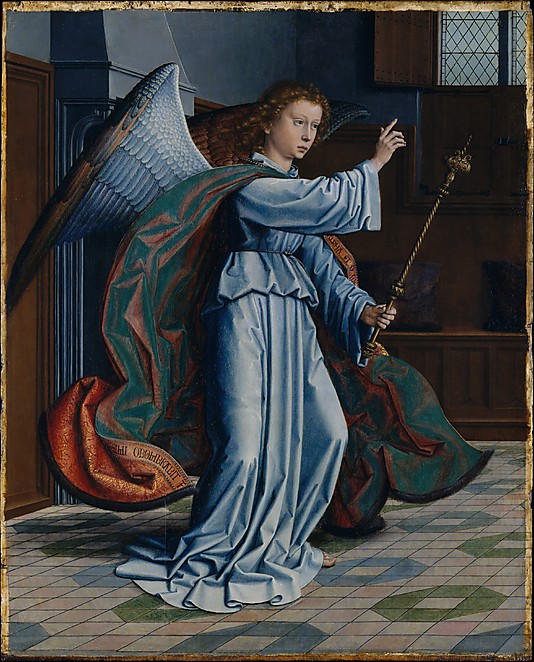
During the suppression, most of La Cervara’s beautiful artifacts and art works were removed.  The Polyptych, painted by Gerard David was separated.  Four panels are now in Palazzo Bianco in Genova, and the other three are in the Metropolitan Museum in New York and the Louvre in Paris.

Image courtesy of the Metropolitan Museum of Art

In the beginning of the 19th century La Cervara again became a religious house, passing through the hands of several orders (Trappists, Somaschi, Carthusians) and eventually it was placed under the Diocese of Chiavari.  Finally in 1937 it passed into private hands.  The first private owner added a long hall and built a grand double stairway and a very large room.  More interested in sport and socializing, he did little to preserve or augment the chapel (but neither did he do any damage).

The present owners have been painstaking in their restoration of La Cervara.  The work has been under the direction of architect Mide Osculati and the art restoration has been overseen by Pinin Brambilla Barcilon, who restored the famous painting of The Last Supper in Milano. A private home, La Cervara is also available to rent for conferences, weddings, parties and the like.  A fortunate friend has been to several evening events there and describes how  the soft candlelight inside echoes the twinkling lights on the coast across the bay.  No electric lights – only candles; it is, she says, ‘magical.’  Her favorite place, she says,  “is the cloister at night with only one single shiny jet of water ….not a big splashy fountain, one single jet is all it takes to create beauty.”  You can see the fountain, elegant and eloquent in its simplicity in two of the photos above. Thank you for sharing that lovely image, fortunate friend!

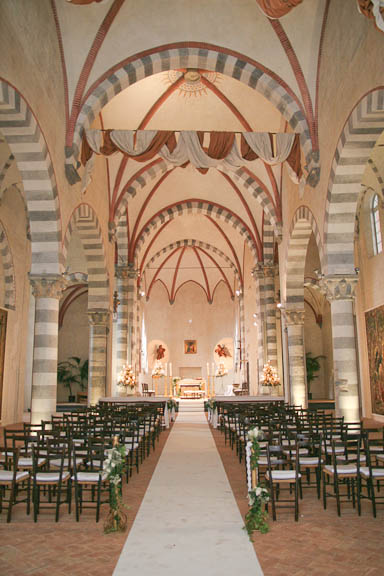
An example of the care taken in the restoration:  it was thought the original floor of the chapel was ardesia, the dark slate indigenous to this area, because that’s what was there, albeit in deplorable condition.  The architect was reluctant to use that material again because it is so dark.  Further digging  revealed, though, that before the ardesia was put down, the floor had been brick.  Unable to find hand-made bricks that matched the light original color, the architect procured the new bricks from Spain.  They look just right, too.

Photo by Roberto Bozzo, courtesy of http://www.fotografi-matrimonio.com

Instead of trying to recreate the missing sacred art in the chapel the owners have installed four enormous tapestries – not religious in theme, but somehow absolutely appropriate for the setting.  You can see just a wee bit of one in the photo above.

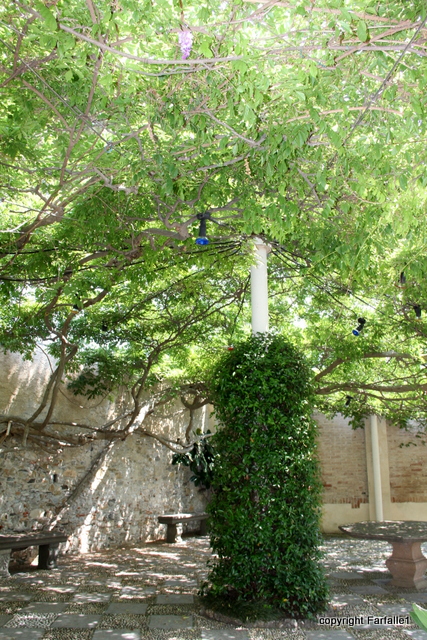
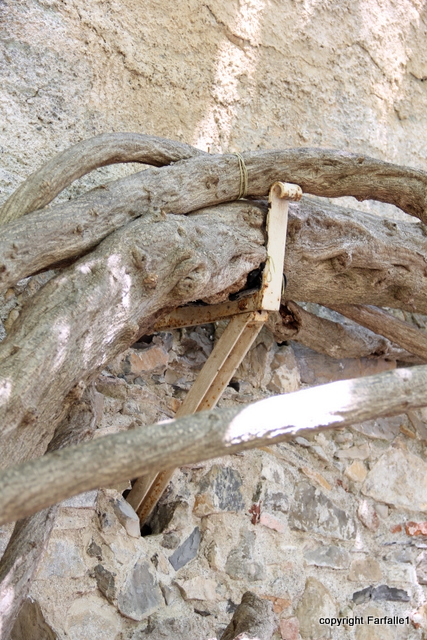
In an extraordinary and successful attempt to save a 150-year old wisteria, the owners used a crane to life the ancient branches from where they had fallen on the ground, one or two inches every week.  It took over a year to get the vine into position, but the wisteria survived and is splendid.

Center pole supports some of the branches, which also grow along the wall on the left.

Ancient branch, now well supported

Unfortunately one is not allowed to take photographs inside the buildings, but the gardens (formerly the monks’ orchard) are fair game.


La Cervara is open to the public on the first and third Sunday of each month  from March through October; guided tours are run at 10, 11 and 12 o’clock.

Pizzo Tombolo

30 Monday Jul 2012

Posted by farfalle1 in Arts and crafts, Italian arts and crafts, Liguria, Rapallo, Uncategorized

≈ 14 Comments

Tags

Lace-making

Photo courtesy of piazzacavour.it

Ah, the old ladies of Italy.  They are in a class of their own.  Once one reaches ‘a certain age,’ it seems, one can go to the front of any line.

We were in a very crowded ice cream shop a while back in Santa Margherita, and a lady of just that age came through and scusami-ed her way to the very front.  Two seconds another lady appeared and announced to one and all, ‘that’s my friend,’ which of course entitled her to move up to the front.  Then came another, then another and another – all with the same excuse – ‘those are my friends.’  Finally Speedy asked, in very good humor, ‘how many of you sisters are there?’  Everyone got a chuckle, the ladies (there were six finally) got their ice-creams and the line began a more organized movement.

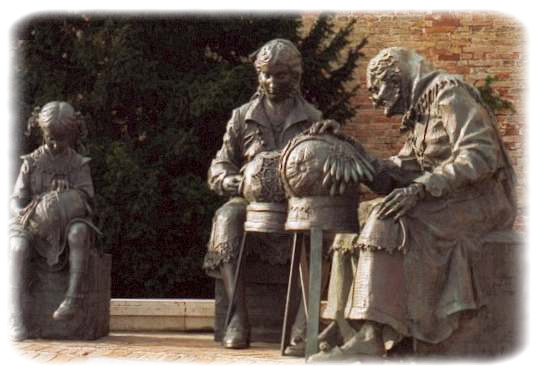
When we went outside we were so happy we had not been grumpy.  All the ice-cream ladies were demonstrating Pizzo Tombolo, an incomprehensible cross between crochet, embroidery and knot-tying.  If you’re like me a bobbin always makes you laugh (that and banana peels on the side walk, sorry, I just can’t help it, they are hilarious).  So I was chuckling away when I approached the group and asked about their work.

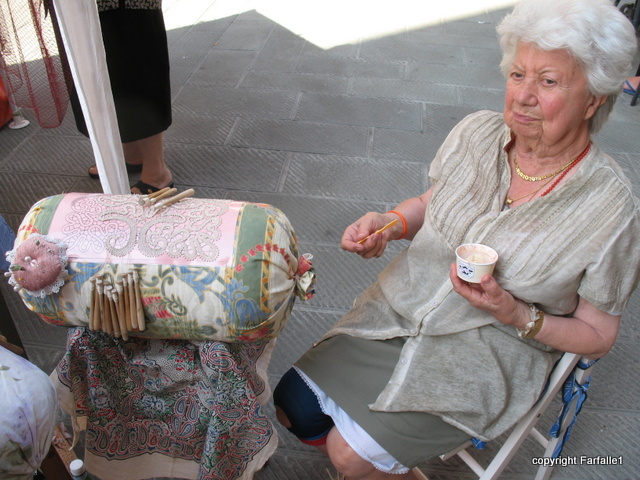
Meet Giuseppina (note the ice cream).  Why she is not blind I can’t imagine.  She doesn’t even seem to need glasses. She is working on a pizzo, also known as ‘merletto.’ The Tombolo is the pillow on which the work is done.

The ancient art of making a delicate and lacy adornment for clothing and furnishings has existed in Rapallo for centuries.   Archaeologists have discovered bits and pieces from as early as the 13th century.  A shop inventory from Genoa in 1600 mentions articles made from ‘filo di Rapallo’ (thread of Rapallo), suggesting that the ornate handwork was well known and appreciated outside the town.

There is a lovely story about how one of the styles of lace-making in Rapallo, known as Bella Nina, got its name.  In the 1500’s the dreaded pirate Dragut made a raid on Rapallo.  All the townspeople fled in terror.  But upon entering the home of a fisherman, one of the pirates who had stayed behind found two women poorly hidden behind a pile of nets.  One was very old and couldn’t move; one was young and beautiful, and was working lace on a pillow.

‘Why didn’t you leave with the others?’ he asked.  The young woman replied that her grandmother was paralyzed and she did not wish to abandon her. When asked their names, the young woman replied they were both called Nina, as women’s names were handed down from mother to daughter.

The pirate asked what the young woman was doing, and she showed him her delicate handwork.  When asked what it was called, Nina said that it had no name, it was just the work that women of Rapallo did.  The pirate was so impressed with Nina’s beauty and fidelity that he said he would not harm either of the women and that henceforth the work she was doing should be known as ‘Bella Nina.’

How is the work done?  I can’t begin to tell you!

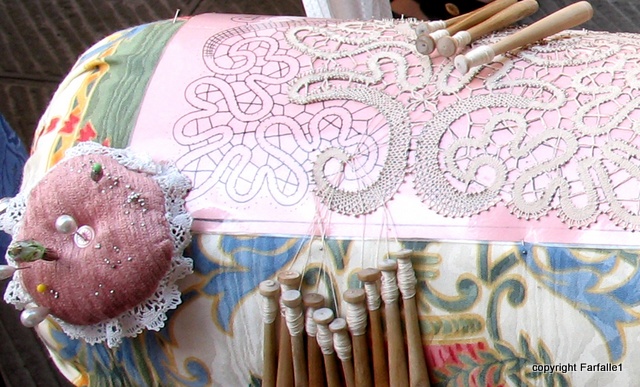
As you can see in the enlarged photo above, Giuseppina attaches a pattern to her tombolo, then uses a million straight pins as anchors for her weaving and knotting.  Now you know as much as I do, which isn’t nearly enough to undertake the craft.  However, if you do want to learn how to do this, you can sign up at the Scuola di Tombolo “Le amiche del ‘Merletto’ in Santa, or, come winter, at the Accademia Culturale in Rapallo.

If you’d like to know more about Pizzo Tombolo, there is a lot of information here and here.

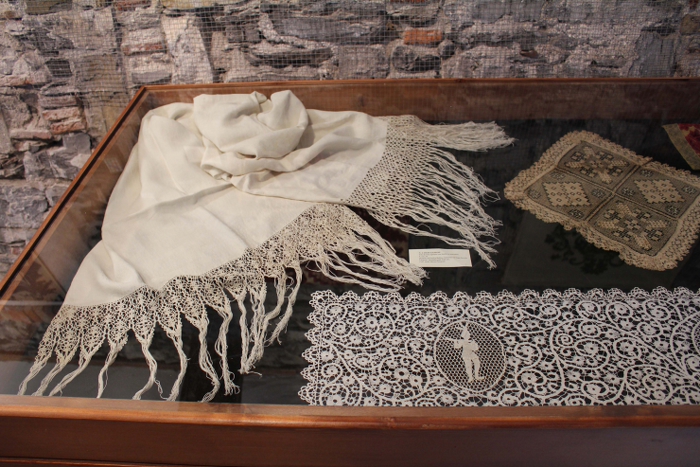
And if you’re in Rapallo and you’d like to see a panoply of examples of Pizzo Tombolo, you can visit the Museo del Merletto.  I’m embarrassed to say I haven’t been there yet, but writing this has aroused my curiosity and I think a visit is order.  I wonder… am I old enough now to go to the front of the line?

Italian at Bronze statue of woman doing Pizzo Tombolo courtesy of merlettoitaliano.it


A(nagrafe) to Zed

19 Thursday Jul 2012

Posted by farfalle1 in Italian bureaucracy, Italian habits and customs, Italy, Law and order, Uncategorized

≈ 12 Comments

Tags

Anagrafe, Gathering social data, Italian bureaucracy, Italian social data

Anagrafe (an-ah-gra-fey) is the office in each comune that keeps track of who’s who and the status of each inhabitant: births, deaths, marriages, divorces, that sort of thing.  This is true, it seems, for both Italians and resident expatriates  (Anagrafe issues our Carte d’Identite).  I’m sure they do other things of which we’re completely unaware.

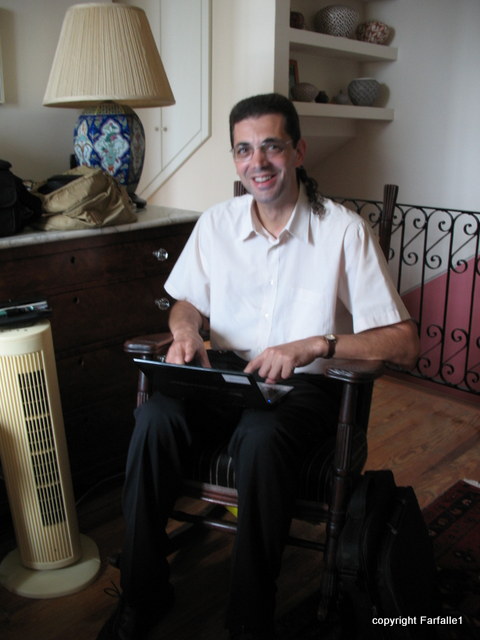
One such thing was brought to our attention last week when we received a visit from the very affable Piermanlio (a roman name, he told us) who spent two and a half hours grilling  interviewing us.  He works for the Statistics Department of Anagrafe (who knew?) and spends a good part of his life traveling from one expatriate domicile to the next interviewing people.  Then he spends some more time transmitting his data to the main office in Rome (without identity information attached) where it is all, presumably, crunched up and turned into important reports of some sort, which in turn lead to enlightened social policies, new laws and more bureaucracy.

Here are two things you might not be able to tell about Manlio from the above photo:  he is probably one of the most patient and kindest guys in the world; it is hard for him to find shoes because his feet are large.  For this reason he takes exceptionally good care of the shoes he wears. ( I guess that’s three things, but since the last two are so closely related I’m counting them as one.)

The last time the U.S. took the census we won the long-form lottery, and spent about thirty or forty minutes filling in the form with information about our race, gender, education, income and what kind of house we lived in.  Well.  Italy could certainly teach the U.S. something about long forms.

At first we thought Speedy would be the only one interviewed, which was fine by me, as it took ages.  To the surprise of all three of us Manlio was instructed by his computer to interview me when Speedy was done.  What response triggered that, I wonder?  Most of the questions were the same, but there were some amusing differences.    They were all multiple choice questions and all answers were entered immediately into Manlio’s laptop.  If an answer was wildly out of the norm the computer might give Manlio a query sign.  If it was totally ridiculous the system was blocked til a realistic answer was put in.  How do we know?  Speedy answered 8 years old when asked at what age he began working (happens to be true).  Turns out the question meant when he stopped being a student and began to work as an adult.  ‘8 years old’ caused a delicious block.

Here are some of the topics Manlio covered with us during our time together, other than the obvious of age, heritage, race, religion and education.

Do we have relatives living in Italy?  Do we have relatives living outside the US but not in Italy?

In our family, who makes the decisions?  Who does the housework, do we share the burden? Who does the marketing?  Who cooks?  Is it up to the husband to choose who the wife’s friends will be?

Do we like Italian food?  Do we eat it often? Do we eat food of other cuisines?

Are we healthy?  Smoke? Weight? Height? Do we take medicines? (polite Manlio: ‘oh yes?  They’re prescribed, I would assume.’  Us: ‘Of course!’)

Curious omission noted here: no questions about drinking and/or wine!

Do we have a car?  How many TV’s? Motorini?  A video camera? (why a video camera?)  When we watch TV, do we watch in English or Italian or ? Do we have a satellite dish?  More than one?

Do we have a telephone  land line?

Why did we move to Italy?  Who decided that we would move to Italy?  How did mother feel about it (Really!  This was a question for me, the only one of us with an extant mother when we came.)

What language do we use when speaking to each other?

Do we read newspapers, if yes in hard or virtual form? Magazines? Books?  In what language(s)?

Do we follow Italian politics?  Do we talk about politics with friends? Do we feel knowledgable about Italian Politics?  How often do we discuss politics?  Same questions again vis-a-vis the U.S.

What do we do for entertainment: movies? sports? concerts?

I guess one can catch the drift of the kinds of questions being asked and the kind of information they are trying to gather.  There are so many people from all over the world living in Italy now, there’s perhaps not unreasonable concern that the ‘national identity’ might erode.  At the very least there is also interest in knowing if the basic ‘rights’ generally recognized here are being observed by one and all.

I guess my favorite question, one directed to both of us, was: Has anyone in Italy made you feel uncomfortable because you are a foreigner?  How lucky I felt at that moment.  Italians like Americans; they do not necessarily like all the other nationalities represented in the immigrant population.  No.  No one has ever made us feel uncomfortable, I’m happy to say, though I’m certain others have not been so fortunate.

My favorite unasked question: Does your husband still beat you?

I guess it’s not just a cold, hard, statistical office after all.  They care about us, they really care.

Damn Pigs

10 Tuesday Jul 2012

Posted by farfalle1 in Animals in Italy, Liguria, Uncategorized

≈ 26 Comments

Tags

Cinghiale, Wild boar, Wild pigs

Photo courtesy of /www.atripaldanews.it

Oh sure, they look kind of cute and fuzzy when you see a photo like the one above.

You want to know how they look even better? Like THIS:

Photo of Cinghiale alle Cacciatore courtesy of maremmaguide.com

I’m as soft as the next person, and if I had to kill my own meat I’d definitely be a vegetarian. But what we really need around here is a ‘cacciatore’ – a hunter. After ten years with nary a sign we’ve been invaded by the wild boars, known here as ‘cinghiale’ (pronounced ching-ghee-ah’-lay).  They have visited and torn up each of our six fascie though, through some miracle, they have so far left the vegetable garden untouched.

Wikipedia has a great deal of information about this widely-dispersed ungulate.  Some of the more interesting data are: height, averages 22-43″ (that last is almost 4′ tall at shoulder – yikes!); weight, 110-210 pounds, though in Tuscany and Liguria they tend to be larger, perhaps 180-220 pounds.  They have four tusks which they keep sharp for defense and for rooting around.

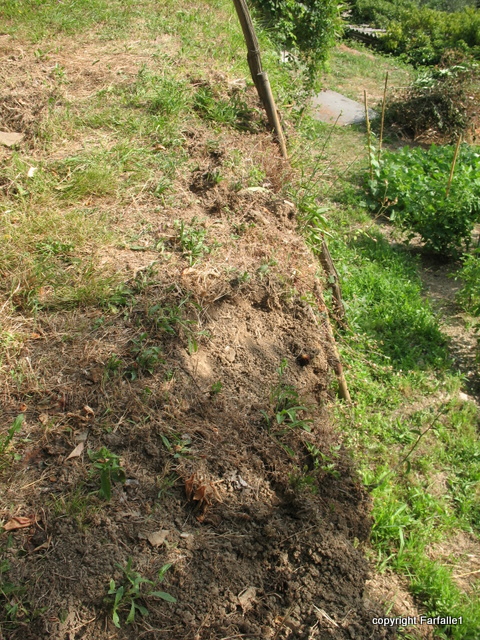
And that’s the crux of our problem with the pigs – they root around like crazy, and do an amazing amount of damage to ground and crops in a short period of time.

Looks like a roto-tiller went through, doesn’t it?

They tend to be crepuscular or nocturnal, so we don’t see them that often.  But we know when they’ve been here.  Plants are uprooted, there are big dirt holes where there used to be none, and there is a wild and pungent smell that is unmistakable (and not very pleasant).

They are more nimble than you’d imagine.  The photo above shows the chewed up edge of a wall where the pigs have scrabbled up from the fascia below.

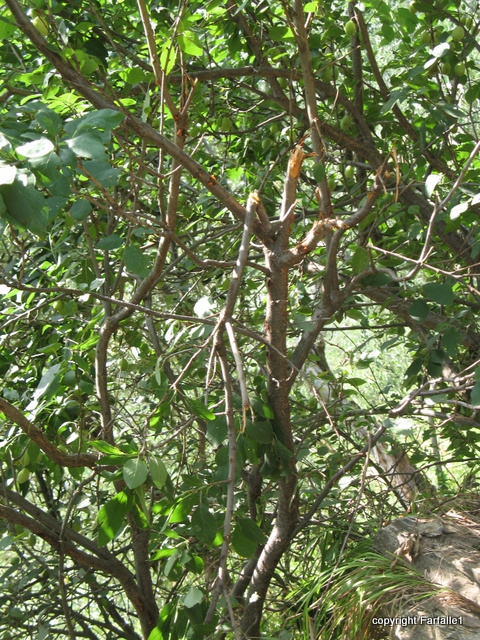
As far as I know they don’t actually climb trees, but they will certainly stand up tall and break branches if there is something there they want (in the case above, it was some plums – see previous post).

This year brought us a banner crop of apricots, most of which we harvested.  A lot of spoiled ones fell on the ground, and there were a lot left at the top of the tree which we couldn’t reach.  We were surprised that the cinghiale didn’t eat the groundfalls on the their early visits, choosing instead to dig trenches around other trees.  Then one day last week Speedy went out to the apricot tree to get some fruit for lunch.  There was no sign of an apricot anywhere.  Everything on the ground had been vacuumed up, and the tree, which had been madly speckled yellow with fruit the night before showed nothing but green leaves, not a fruit to be seen.  Turns out these rascals know how to butt the trees to get the very ripe fruit to fall.  And they’re smart enough to wait until the fruit is very ripe to do it.  Speedy couldn’t believe his eyes; he just stood there staring, wondering if he was looking at the wrong tree.  But no.  The thieves had come and taken everything.
We asked a lot of people what could be done.  The obvious solution is to fence the property.  But this is Italy!  In order to put up a permanent fence, we are told, we would have to do a ‘project’, complete with geometra, plans, town approval and so forth.  It seems a daunting prospect, in addition to sounding very expensive.  Introducing natural predators might be a solution, but somehow I think the town fathers would take a dim view if we imported tigers, wolves and, for the piglets, pythons.

Simone, who keeps our motorini running smoothly, said he had heard that the pigs don’t like shade cloth and olive nets, and that if we were to build a not terribly high fence of one or the other of these, the pigs would not come in.  Worth a try, we thought.

We did this on the two points where we surmised the pigs were gaining access, and for three nights we had no visitors.  Then they came back and tore up two upper fascie.  My theory is they simply walked down the steps from the street above our house to get there, but we don’t really know.
There is a hunting season in the fall, and we hear a lot of gunshots, but I don’t think there’s any way the hunters can keep up with the exploding population of cinghiale.  They are well adapted to suburban and country life, and the sows produce two litters a year of from anywhere between three and fourteen piglets.  They are, in short, a nuisance.

I’m sure there is a solution to our problem (see ‘fence’ above) and no doubt we’ll resign ourselves to it one of these days.  In the meantime our property is beginning to look like a Christo exhibition.  And I just know that those damn pigs are watching the garden and waiting for the tomatoes to ripen.

Happy 4th of July!

04 Wednesday Jul 2012

Posted by farfalle1 in Holidays, Italian Churches, Italian festas, Italian habits and customs, Italian holidays, Rapallo, Uncategorized

≈ 4 Comments

Tags

Festa della Madonna di Montallegro, fireworks

(Click on any photo for a slightly sharper image.)

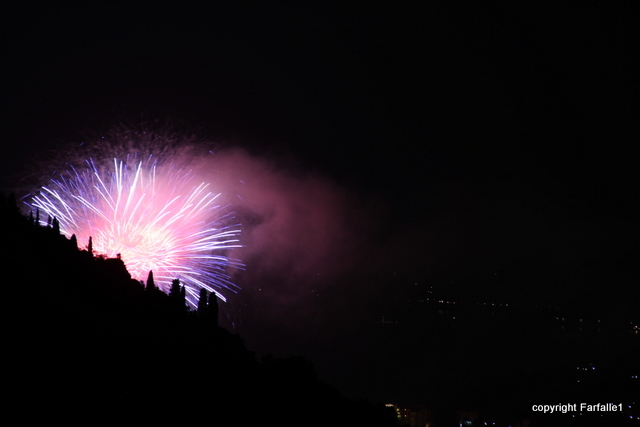
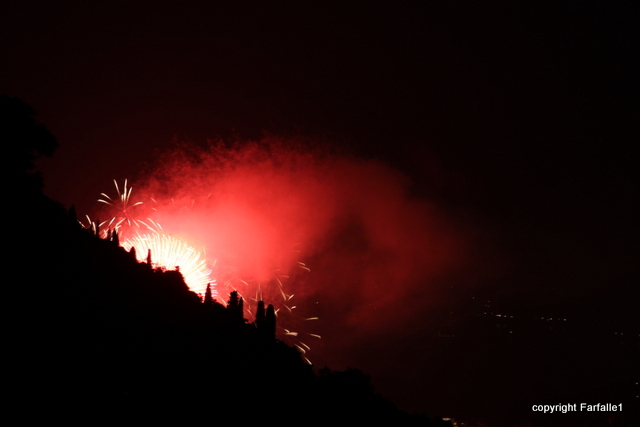
July 3rd, a quiet night in Rapallo:

Then suddenly all hell broke loose!

July 1, 2 and 3 are the special days Rapallo has set aside to honor the Madonna of Montallegro. It’s crazy in town – huge crowds; lots of noise; a wonderful procession with crosses, bishops and mayors, and children; all culminating in the tradional ‘attack and burning’ of the ancient castello. To give you an idea of the scope and the noise, over the course of the day on Monday, the middle day of the Festa, some 6,000 mortars were fired off.  These are the bright flashes accompanied by an ear-splitting and echoing BOOM that can be heard all through the area.

This year we did not go down into the hub-bub. Instead we stayed ‘quietly’ home and enjoyed a partial show of fireworks. (‘Quiet’ does not exist here on July 1, 2 or 3.)  I love that this happens right before our own traditional Fireworks Day, the 4th of July.  If you’d like to see some photos and read more about the doings in town, read this post from last year.  And if you’re interested in knowing why Rapallo has chosen the Madonna as her patron saint you can read about it here (spoiler: The Blessed Virgin was an early tourist).

Happy Independence Day to one and all!

Il Marinaio

28 Thursday Jun 2012

Posted by farfalle1 in Arts and crafts, Italian men, Rapallo, Uncategorized

≈ 4 Comments

Tags

Il Marinaio, Sea Cairns, Sea sculpture

Well, it just drove me crazy not to know who was responsible for the sea cairns shown in the last post.  My source had told me that the artist was probably one of the members of the Associazione which has its headquarters next to the castello. So I went back there and hung around the club grounds for a while until someone turned up I could speak to.  I asked a few questions and was lucky enough to be invited in.

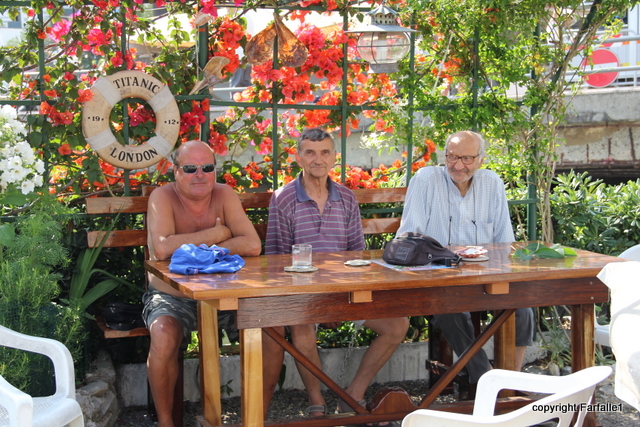
This Friends of the Castello group is a gang of men (I think all men, though I’m not sure, and they didn’t ask me to join), mostly retired, who enjoy boating and fishing.  And, as it turned out, making cairns in the sea.

I asked if the life-saving ring really was from the Titanic, but no one knew for sure.  It is very old, they said, and was given to them by an English friend a long, long time ago.  Nice to think, in this centenary year of the tragedy, that a relic of the great ship resides in Rapallo.  Being a sceptic, I doubt it… but it could be.

Now I know you’re just eaten up with curiosity, so without further chat, allow me to introduce Il Marinaio, creator of the ever-changing exhibit of sculptures in the sea:

His name is Michele (no last name offered and I didn’t like to ask).  He ‘fessed up to being the artist, and admitted that some of his work gets washed away by the tide every day.  When I asked him if he had a special reason for making these lovely sculptures he replied, “Beh! Passa tempo.”   But a friend tells me he likes to walk in the water to improve the circulation in his feet.  They both sound like good reasons to me.

Where it comes from…

10 Sunday Jun 2012

Posted by farfalle1 in American habits and customs, Italian food, Uncategorized

≈ 12 Comments

Tags

Catch of the day, Eating locally, Fresh fish, Italian fishing fleet, Locavore, Santa Margherita Ligure

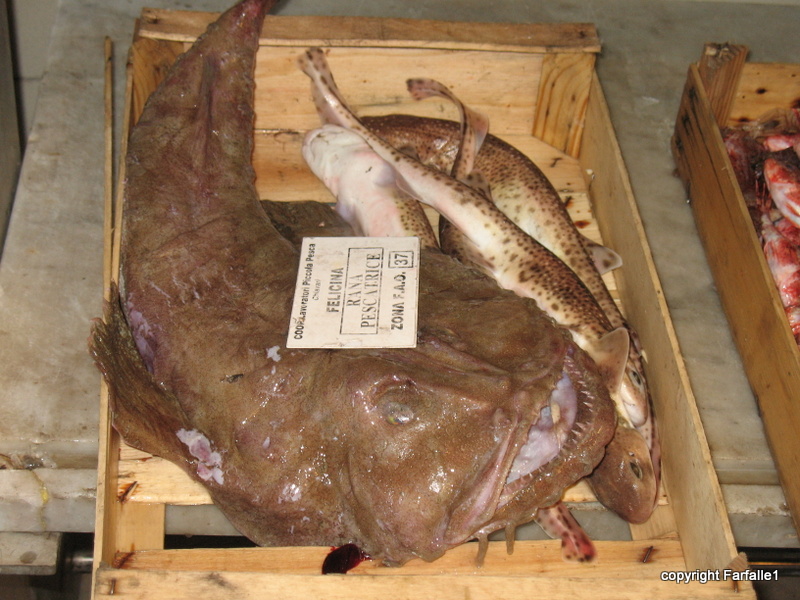
Possibly the world’s ugliest fish?

‘Locavore’ is a word I abhor.  Oh I know, it’s a perfectly good word and absolutely descriptive.  But, to me, it carries moral overtones that I don’t like – the idea that if I eat food that is all grown/produced within, let us say, fifty miles of where I live, I am somehow a better person than the poor sod who has to eat out-of-season apples from Argentina and whose beef comes from the mid-west and which enjoyed a last supper of who knows what.

We lived in New England when I first heard the term.  I thought it was laughable. What would we, in Connecticut, eat in January if all our food had to be grown nearby?  Frozen food?  But think of the energy costs associated with that.  Food that was grown in our own gardens that we lovingly canned.   While it’s true that canned fruits and veggies seem to retain most of their nutritional value, they likely give up a great deal in texture and crispness.  Wouldn’t you rather eat a fresh green bean than a canned one?

Then I thought about the long arc of the history of what we eat.  In the Middle Ages people were restricted to a diet of food produced nearby because the means to move it any great distance simply did not exist.   Their teeth turned black and fell out.  They had diseases associated with vitamin deficiencies: rickets, scurvy and beriberi.   How wonderful it was when  trade began to bring spices and food from the East, the Caribbean  and South America, and eating changed forever.  Sugar!  Coffee and tea!  Sublime.  Lemons and limes.  Pineapple!  Poi. No, forget about poi. Chocolate!! (never forget chocolate…)  Empires grew and food moved ever more freely from point A to point B, and it was all good (and from more than just a culinary point-of-view, but that’s another subject altogether).

Then, about a decade or so ago, the specter of eating locally reared its head.  Farm markets (of which I am a huge fan, incidentally) sprouted on every village green.  Calves seen cavorting in a neighbor’s pasture one day were in his freezer the next day.  Everyone had a chicken. And that was good too.  But the idea that that’s all we should eat seems to me to be nonsense.

So, having said all that, let me recant just a bit.  I think it’s really important to know where our food comes from, and to make intelligent choices about what we eat using that information as one criterion.  I have a personal preference against eating a fish from China – God only knows what that fish ate, so I don’t want to eat him.  I also think it’s really important for everyone, especially children, to know that food doesn’t ‘come’ from supermarkets.  Milk comes from cows and goats, and cheese comes from milk – these are really good things to know.  Jellies and jams are not born that way, and spaghetti doesn’t grow on trees, despite what you see about Switzerland on Youtube.

People in Italy take food very seriously.  The fresh fods  we buy here are marked with a quality grade and geographical source.  There are plenty of Italians who won’t eat food not grown in Italy (or, maybe, France and Switzerland) – but there are plenty who will.  The important thing is that the information is available and one can make a choice.

Fish is a topic of often spirited discussion: wild caught or farm raised?  As ocean stocks grow ever smaller, there’s much to be said for farm-raised fish, as long as the farmer is responsible about the fish food he uses (I suppose the same thing could be said for chickens – but when was the last time you ate a wild-caught chicken?  I digress.)  There is a large fish-farm off the coast in nearby Chiavari; you can see the pens as you drive down the hill into the city.  But in neighboring Santa Margherita Ligure you can do one better – you can go to the port at about 3:30 or 4:00 p.m. and watch the day’s catch as it is delivered to the fish stalls in the arcade across the street.  Then, if you’ve seen something that whets your appetite, you can go over and buy it immediately, sometimes still squirming.

Many of the small Rivieras communities no longer have fishing fleets, but Santa and several others still do.  The boats are all business, as you can see above.  They usually moor  a short distance from the port, and the catch is ferried in by skiff.

The fish are all neatly sorted and put in flats.  The person taking the box will trot through a gauntlet of curious onlookers, cross the street, and deliver the goods to the vendors.    Sometimes the fellow who transports the fish is the vendor.  Who goes to see the fish come in?  Some are tourists who have just happened by, some are buyers for the local restaurants, and some are consumers looking for a good fish for dinner.

Yum!  Someone’s having octopus tonight.

This guy was so pleased with his fishies he had to share the good news with his friends.

This is the kind of ‘locavore’ I adore.  It’s just people doing what they’ve done their whole lives, and what’s been done in their town for centuries.  It has nothing to do with a Philosophy, or a Point of View, and there’s certainly no sense that if you go buy your fish from Supermercato Billa you’re less of a person than if you go to the port to buy it.  It’s just the way things are. As a matter of fact, with the whole sea at their door,   one of the great winter treats for Ligurians is, surprisingly, stoccafisso, dried cod.  I think it is odious, but people here love it cooked with tomatoes, potatoes, carrots, onions and garlic. That’s the Ligurian style.  In Milan it is cooked with cream, which is even worse. Why would you eat that when you can have fresh fish?  I don’t know, but it is highly regarded here, and eaten with great gusto. Cod, by the way, doesn’t live in the warm Tigullio Sea – it comes from New England or Scandinavia.

So yes, please grow your own veggies in your garden, or buy them from your local farm market or CSA, but please, oh please, don’t make me feel guilty when I buy a peach from Israel.  Don’t turn eating fresh local food into a Cause or a Movement.  Good food is good food no matter where it comes from.  I understand the arguments about the cost of transport, but transporting goods is something that has gone on for centuries.  Let’s not go back to the Middle Ages.

Taxing Times

05 Tuesday Jun 2012

Posted by farfalle1 in Italian bureaucracy, Taxes in Italy, Uncategorized

≈ 15 Comments

Tags

Ici, IMU, Italian taxes, IVIE

Just when we think we’re finally getting a handle on the ins-and-outs of Italian bureaucracy, Italian bureaucracy throws us a curve ball. This year it is the in the form of two new taxes.

Well, actually one re-instated tax and one new tax.

The reinstated tax used to be call l’ICI, and it was a modest tax on one’s real estate holdings in Italy. Several years ago then Prime Minister Silvio Berlusconi abolished the tax in an effort to appease voters and gain re-election, in which endeavor he succeeded. If you have been following events in Italy, you know she is in deep financial crisis, and that the new Prime Minister, Mario Monti, is a technocrat.  ” Technically (no pun intended), a technocratic government is one in which the ministers are not career politicians; in fact, in some cases they may not even be members of political parties at all. They are instead supposed to be “experts” in the fields of their respective ministries.” (For a more in-depth explanation of a technocracy, read this article by Joshua A. Tucker, writing for ‘Aljazeera,’ from which the preceding quote is taken.)  Monti has been given the unenviable task of ‘fixing’ the Italian economy, and one of his steps has been to reinstate the ICI, now known as the IMU  (Imposta Municipale Unificata).  It is pronounced exactly as below.

Photo courtesy of http://www.mdahlem.net

Figuring out what one owes for the IMU is not terribly difficult, fortunately. There is a handy-dandy website (Google IMU *your town’s name* to find it) that will tell you just what you owe, and will even print out the F24 form to use when paying it. The first payment is due June 18. The second payment is due in September if you are paying in three installments, or in December if you are paying in two. The tricky part is that part of the tax goes  to the federal government and part goes to municipalities. Rates for the later have not yet been set, and probably won’t be until August; so while you can figure out what you owe and need to pay for June, the second and third installments are still a bit of a mystery. The tax is only slightly higher than the old ICI for first homes. It is a good bit higher for second homes.

Speedy and I have no problem with this tax being stout-hearted believers in paying for civic services, even curtailed as they have become through the austerity measures.  We DO have a big problem with the second tax.

Ivy courtesy of sparkle-and-fadeaway.blogspot.it

The IVIE (Imposta sul valore degli immobili situati all’estero) is a tax on any real property owned in another country.  Designed to catch out the big fish who hide large assets overseas, this tax is sadly also netting all us little minnows.  It is not a particularly small tax either, as it is equal to 0.76% of the value of your property.  The tricky part here (aside from actually paying the damn thing) is knowing what the correct value of the overseas property is.  Fortunately in the U.S. we all have assessed values placed on our homes for tax purposes, so I suppose we could use them.  And one does get a limited amount of credit for real estate taxes paid to the locality of the property in question.

There is yet another tax which is sort of bundled in with the dreaded IVIE (dubbed ‘Poison IVIE’ by The Informer website which, by the way, I highly recommend to anyone living in Italy).  Strictly speaking it is not IVIE, but it feels like it – it is a tax on the value of any money, funds, pensions and so forth that you might have in another country.  For 2011 and 2012 it’s 0.10% of the value of said investments; in 2013 that goes up to 0.15%.  Probably by then no one will have any money left anyway, so never mind.

We understand the reasoning behind these IVIE taxes but they seem hideously unfair to an expatriate.  They are, once again, meant to catch big fish: the wealthy who have secreted their resources in foreign countries or off-shore safe havens, something rich Italians are famous for doing.  The penalties for not reporting/paying are extortionate – 10%-50% the value of the unreported assets.  Many of us “victims” of this tax wish the government huge success so as to alleviate the burden on us in the future.

It is ‘Poison IVIE’ indeed to those of us who are just trying to enjoy a quiet  expatriate life.  At some point Italy will ask just one thing too much of us; our backs will break.  We understand that we all have to do our bit to save the country, but taxing assets in our home country just isn’t right.  And don’t get any ideas, U.S.A. – don’t think you can start taxing our property here in Italy!

Tragedies Natural and Man-Made

29 Tuesday May 2012

Posted by farfalle1 in Italy, Uncategorized

≈ 10 Comments

Tags

Brindisi bombing, Earthquake Italy May 2012, Earthquakes in Italy, Italian earthquakes, Melissa Bassi, Murder in Brindisi

I was sitting on our bed this morning about 9 a.m., finishing the chapter in the book I was reading, when I heard the tinkle, tinkle, tinkle of small objects moving, and a millisecond later felt the bed swaying beneath me.  Uh oh, I thought, that sure sounds and feels like an earthquake.  I shouted down to Speedy who was working out on the terrace, but he had felt nothing, so I went back to my book.

Later in town, the friend with whom I was having a cuppa in her apartment near the top of a seven-story building asked me if I had felt the earthquake.  Oh yes.  And no sooner did we start discussing it than we felt an aftershock, much gentler.  This was certainly alarming, as an apartment building is no place to be for an earthquake.  Fortunately for us, that was the end of it.

But the north/central part of the country was not nearly so fortunate.  The 5.8 quake was centered near Modena, right near where the last one occurred, and more buildings, many already weakened by the previous quake, came tumbling down.  Early reports indicate ten people have died, and more are trapped under rubble.

A week ago Sunday morning a 6.0 earthquake centered between Bologna and Mantova killed seven people and did untold damage to buildings.  Italy is no stranger to earthquake; a rocky country covered with ancient buildings made of stone, the effects are often catastrophic.

#1 is Rapallo, #2 is where the 2nd quake hit, and #3 is where the first quake was centered (roughly)

Meanwhile in Brindisi, just a day before the first quake, a bomb went off  outside a girls’ vocational school, killing 16-year-old Melissa Bassi. An only child, she was at the top of her class. I think of her as she might have been earlier in the morning, getting up, getting dressed for school, fixing her hair, putting on make-up, making plans, maybe day-dreaming a little.  And then bam, gone before her life was truly under way.

Italy is in mourning.  These tragedies, perhaps small in the Grand Scheme of Things, are large in the national psyche.  Both instill a sense of fear: on the one hand for the Big One, like the quake that destroyed Aquila in 2009 which killed over three hundred people; and on the other for the return of the ‘years of lead’ in the 1970’s and ’80’s when the Red Brigades terrorized the country.

What these events all have in common is their utter randomness, meaninglessness and ultimate uselessness.  Is that what makes them tragedies?

Already beset by a worsening economic crisis, the recent tragedies have only added to the sense of unease abroad in this beautiful country.

I Didn’t Know: Ancient Tower in Chiavari

28 Monday May 2012

Posted by farfalle1 in Italian history, Uncategorized

≈ 2 Comments

Tags

Castle in Chiavari, Chiavari

Photo courtesy of vengomatto on Flikr

On the same walk that brought Passion Fruit to my attention, Angela and I discovered the ancient walls and Tower above Chiavari.  I had no idea they were there!

Chiavari, two towns down the coast from Rapallo, is an ancient city.  A necropolis discovered near the city center suggests that there was habitation as early as the 8th – 7th century B.C.E.  and it was an important way station during Roman times.  In 1146 construction was begun on the castle which was, at that time, a military fort.   In 1178 Chiavari was appropriated by Genova, by which time it seems the castle was finished.

And this is where my paltry research breaks down.   Rapallo has a wonderful library, and I was able to find a good history of Chiavari (“La Citta’ della Liguria: Chiavari” by Franco Ragazzi and Carla Carallo, 1981), but it didn’t tell me nearly enough about the castle.  Who lived there?  Why was it pretty much dismantled in the Sixteenth century, leaving only the tower seen above and some wall segments?  More research required!  I took a picture of a lovely aquarelle illustration of the castello complex made in the first half of the Seventeenth century which is in the above mentioned book:


You can see why the location had military significance. From its hilltop perch the castle offers a splendid view of the whole bay and the Portofino peninsula.

Here is one of the sections of once extensive walls that is still standing… barely?

One of the beautiful things about Italy is the way old and new live so happily together.

Another beautiful aspect of life here is that every town offers a surprise, an “I didn’t know that” moment. Sometimes it’s as small as a special painting (about which more in a later post); other times it’s as large and obvious as a ruined castle. You simply have to look around here, and you will discover something special.

← Older posts
Newer posts →

Enter your email address to follow this blog and receive notifications of new posts by email.

Join 112 other subscribers

rss

Subscribe in a reader

Search the Blog

A. Useful Links

  • bab.la language dictionary
  • Bus schedules for Tigullio
  • Conversions
  • English-Italian, Italian-English Dictionary
  • Expats Moving and Relocation Guide
  • Ferry Schedule Rapallo, Santa Margherita, Portofino, San Frutuoso
  • Italian Verbs Conjugated
  • Piazza Cavour
  • Rapallo's Home Page – With Link to the Month's Events
  • Slow Travel
  • The Informer – The Online Guide to Living in Italy
  • Transportation Planner for Liguria
  • Trenitalia – trains! Still the most fun way to travel.

C. Elaborations

  • A Policeman’s View
  • Driving School Diary
  • IVA refunds due for past Rifiuti tax payements
  • Nana
  • Old trains and old weekends
  • The peasant, the Virgin, the spring and the ikon
  • Will Someone Please, Please Take Me to Scotland?

D. Good Recipes - Best of the Week winners are starred

  • 'Mbriulata
  • *Baked Barley and Mushroom Casserole*
  • *Captain’s Boston Baked Beans*
  • *Crimson Pie*
  • *Louise’s Birthday Cake*
  • *Melanzane alla Parmigiana*
  • *Penne with Cabbage and Cream
  • *Pizzoccheri della Valtellina*
  • *Pumpkin Ice Cream*
  • *Risotto alla Bolognese*
  • *Rolled Stuffed Pork Roast*
  • *Spezzatini di Vitello*
  • *Stuffed Grape Leaves*
  • *Stuffed Peaches (Pesche Ripiene)*
  • *Swordfish with Salsa Cruda*
  • *Tagliarini with Porcini Mushrooms*
  • *Tagliatelli al Frutti di Mare*
  • *Three P's Pasta*
  • *Tzatziki*
  • 10th Tee Oatmeal Apricot Bars
  • Adriana’s Fruit Torta
  • Aspic
  • Bagna-calda
  • Best Brownies in the World
  • Clafoutis
  • Cold cucumber soup
  • Crispy Tortillas with Pork and Beans
  • Easy spring or summer pasta
  • Fish in the Ligurian Style
  • Hilary's Spicy Rain Forest Chop
  • Insalata Caprese
  • Lasagna al forno
  • Lasagna al Forno con Sugo Rosato e Formaggi
  • Lemon Meringue Pie
  • Leo’s Bagna Cauda
  • Leo’s Mother’s Stuffed Eggs
  • Louis’s apricot chutney
  • Mom's Sicilian Bruschetta
  • No-Knead (almost) Bread
  • Nonna Salamone's Christmas Cookies
  • Pan Fried Noodles with Duck, Ginger, Garlic and Scallions
  • Pesto, the classic and original method
  • Pesto, the modern, less authentic method
  • Pickle Relish
  • Poached pears
  • Poached Pears
  • Polenta Cuncia
  • Recipes from Paradise by Fred Plotkin
  • Rustic Hearth Bread
  • Shrimp and Crayfish Tail Soup
  • Sicilian salad
  • Slow Food Liguria
  • Slow Food Piemonte and Val d'Aosta
  • Spinach with Garlic, Pine Nuts and Raisins
  • Stuffed Eggs, Piemontese Style
  • The Captain’s Salsa Cruda
  • Tomato Aspic
  • Zucchini Raita

E. Blogroll

  • 2 Baci in a Pinon Tree
  • Aglio, Olio & Peperoncino
  • An American in Rome
  • Bella Baita View
  • Debra & Liz's Bagni di Lucca Blog
  • Expat Blog
  • Food Lovers Odyssey
  • Italian Food Forever
  • L’Orto Orgolioso
  • La Avventura – La Mia Vita Sarda
  • La Cucina
  • La Tavola Marche
  • Rubber Slippers in Italy
  • Southern Fried French
  • Status Viatoris
  • Tour del Gelato
  • Weeds and Wisdom

Photographs

  • A Day on the Phoenix Light Rail Metro
  • Apache Trail in the Snow
  • Aquileia and Croatia
  • Birds on the Golf Course
  • Bridge Art
  • Canadair Fire Fighters
  • Cats of Italy
  • Cloudy day walk from Nozarego to Portofino
  • Fiera del Bestiame e Agricultura
  • Football Finds a Home in San Maurizio
  • Hiking Dogs
  • Mercatino dei Sapori – Food Fair!
  • Moto Models
  • Olive pressing
  • Rapallo Gardens
  • Rapallo's Festa Patronale
  • Ricaldone and the Rinaldi Winery
  • Rice Fields
  • Sardegna ~ Arbatax and Tortoli
  • Sardegna ~ San Pietro above Baunei
  • Sardegna ~ The Festa in Baunei
  • Scotland, including Isle of Skye
  • Slow Food 2008 Salone del Gusto
  • The Cat Show and the Light Rail Fair
  • The desert in bloom
  • Trip to Bavaria

Pages

  • Fagioli all’ucelleto

Archives

Recent Posts

  • The World’s Most Expensive Tomatoes
  • It all depends on how you look at it…
  • A Superior Visit
  • Fun at the Ranch Market
  • The MAC
June 2026
M T W T F S S
1234567
891011121314
15161718192021
22232425262728
2930  
« May    

Member of The Internet Defense League

Blog at WordPress.com.

  • Subscribe Subscribed
    • An Ex-Expatriate
    • Join 112 other subscribers
    • Already have a WordPress.com account? Log in now.
    • An Ex-Expatriate
    • Subscribe Subscribed
    • Sign up
    • Log in
    • Report this content
    • View site in Reader
    • Manage subscriptions
    • Collapse this bar

Loading Comments...