• Contact
  • Elaborations
    • A Policeman’s View
    • Driving School Diary
    • Great Danes
    • IVA charged on Tassa Rifiuti
    • Nana
    • Old trains and Old weekends
    • The peasant, the virgin, the spring and the ikon
    • Will Someone Please, Please Take Me to Scotland??
  • Recipes
    • ‘Mbriulata
    • *Baked Barley and Mushroom Casserole*
    • *Captain’s Boston Baked Beans*
    • *Cherry Tart*
    • *Crimson Pie*
    • *Louise’s Birthday Cake*
    • *Melanzane alla Parmigiana* – Eggplant Parmesan
    • *Penne with Cabbage and Cream
    • *Pizzoccheri della Valtellina*
    • *Pumpkin Ice Cream*
    • *Risotto alla Bolognese*
    • *Rolled Stuffed Pork Roast* on the rotisserie
    • *Shrimp and Crayfish Tail Soup*
    • *Spezzatino di Vitello*
    • *Stuffed Grape Leaves*
    • *Swordfish with Salsa Cruda*
    • *Tagliarini with Porcini Mushrooms*
    • *Tagliatelli al Frutti di Mare*
    • *Tzatziki*
    • 10th Tee Apricot Bars
    • Adriana’s Fruit Torta
    • Artichoke Parmigiano Dip
    • Best Brownies in the World
    • Clafoutis
    • Cod the Way Sniven Likes It
    • Cold Cucumber Soup
    • Crispy Tortillas with Pork and Beans
    • Easy spring or summer pasta
    • Fagioli all’ucelleto
    • Fish in the Ligurian Style
    • Hilary’s Spicy Rain Forest Chop
    • Insalata Caprese
    • Kumquat and Cherry Upside Down Cake
    • Lasagna Al Forno con Sugo Rosato e Formaggi
    • Lemon Meringue Pie
    • Leo’s Bagna Cauda
    • Leo’s Mother’s Stuffed Eggs
    • Louis’s Apricot Chutney
    • Mom’s Sicilian Bruschetta
    • No-Knead Bread (almost)
    • Nonna Salamone’s Famous Christmas Cookies
    • Pan-fried Noodles, with Duck, Ginger, Garlic and Scallions
    • Pesto
    • Pesto
    • Pickle Relish
    • Poached Pears
    • Polenta Cuncia
    • Pumpkin Sformato with Fonduta and Frisee
    • Rustic Hearth Bread
    • Sicilian Salad
    • Soused Hog’s Face
    • Spotted Dick
    • Swedish Tea Wreaths
    • The Captain’s Salsa Cruda
    • Tomato Aspic
    • Vongerichten’s Spice-Rubbed Chicken with Kumquat-Lemongrass Dressing
    • Winter Squash or Pumpkin Gratin
    • Zucchini Raita

An Ex-Expatriate

~ and what she saw

An Ex-Expatriate

Category Archives: Uncategorized

Badia di Tiglieto

17 Friday Jun 2011

Posted by farfalle1 in Italian Churches, Uncategorized

≈ 2 Comments

Tags

Abby of Tiglieto, Badia di Tiglieto, Cistercian Order, Santa Maria e Santa Croce

Not long ago our friends Elena and Michela took me to see the Badia di Tiglieto, also known as the Abbazia Santa Maria e Santa Croce, located in the town of Tiglieto  in the hills to the northwest of Genova.  Founded in 1120, Santa Maria was the first Italian monastery of the Cistercian Order; in fact it was the first monastery founded outside of Burgundy, France where Saint Robert founded the order in 1098.
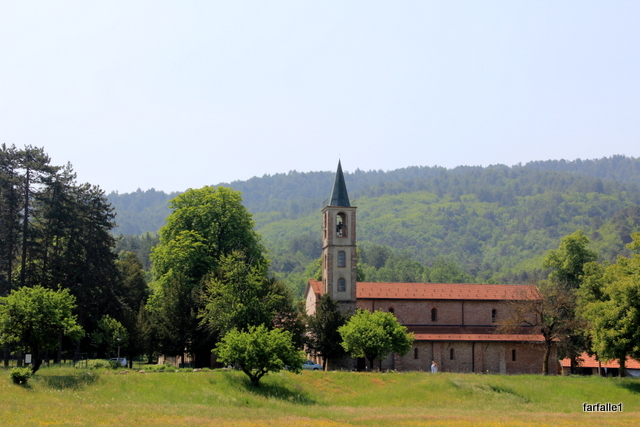
Nestled against the hills it lies on the plain of the Orba River and is surrounded by the Beigua Regional Park.  It’s a full day’s outing to visit the monastery and take the ring hike in the adjacent park.

The Abby has had its ups and downs over the centuries.  For the first century or two of its existence it grew and prospered.  Farming and agriculture are hallmarks of the Cistercian Order, and the monks at Santa Maria were no exception.  Their holdings grew to be quite large over the years, and because of excellent relations with both the nobility and the ordinary people of the region they were able to get seasonal help for their agricultural pursuits.  They raised corn, wheat, rye, hay and veggies, made flour from chestnuts, and harvested the plentiful wood from the surrounding forests.  They reclaimed boggy areas in the lowlands, turning them into productive fields.

In addition to their physical pursuits the monks had a lively spiritual life.  They were renowned for their even-handedness, neutrality and their attentiveness to local problems.  Frequently they were called upon to adjudicate disputes among the region’s inhabitants.  An indication of their value and importance in this area is that they helped negotiate the peace between Genova and Pisa.

The booklet available in the monastery store presents an image of an idyllic country existence, a life well balanced between hard physical labor and intense spiritual meditation and practice.  It was not always perfect, however; the records indicate numerous cases of disagreements about boundaries, water usage and the like between the brothers and others.

The decline of Santa Maria began somewhere along the middle of the 1200’s.  Unlike the mendicant orders based in cities, the agrarian Cistercians had a hard time finding novices to join the order; there simply was not an ample enough population to provide the needed monks.  As their numbers lessened they were less able to look after their holdings and had either to sell or to lease them.  As their holdings and prosperity declined, so did their prestige, and by the middle of the 14th century they were in a total economic, moral and spiritual decline.

Pope Eugenio IV delivered the death blow when, in 1442, he gave the abby to Cardinal Giorgio Fieschi as Commendatory Abbot.  (A commendatory abbot is one who draws the revenues of the Abby but has no jurisdiction over its spiritual life and practice; he is not obliged to live at the Abby.)  Cardinal Fieschi was not frequently at Santa Maria.  What happened to the remaining monks is unknown.  Perhaps attrition finished them off, or perhaps they moved to other orders; in any event, they were no longer at Santa Maria.

The local populace was not happy about this state of affairs, and did not accept it willingly, being obstructive and even destructive to Fieschi and successive  commendatory abbots whenever possible.  This was the case until 1635 when Pope Innocent X gave the title to Cardinal Lorenzo Raggi who immediately began to improve the premises.  In 1648 Cardinal Raggi recieved the Abby for his family in perpetuity.  He moved to Santa Maria, which has been in the Raggi (now Salvago-Raggi) family ever since.

The Abby underwent major restorations in 1953, 1977, and 1999, with efforts made to restore the structures to their medieval forms.  Unfortunately the cloisters are irretrievably lost, but several rooms have been beautifully restored, notably the chapel and the chapter room.
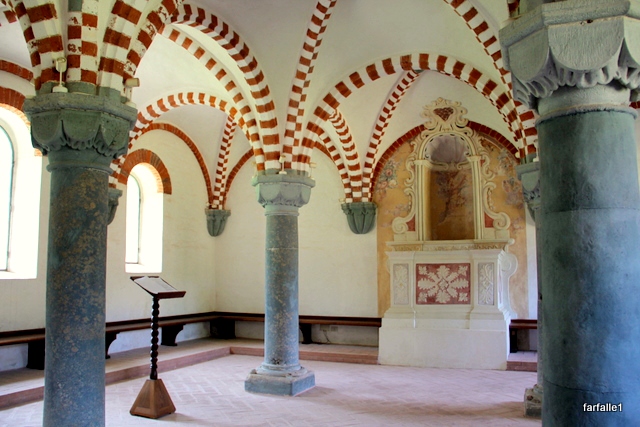
This is the Chapter Room, the Sala Capitolare. The lovely white and red stripes are not medieval; probably they date from the 16th century.

The Chapel is beautiful in both its proportions and its simplicity.
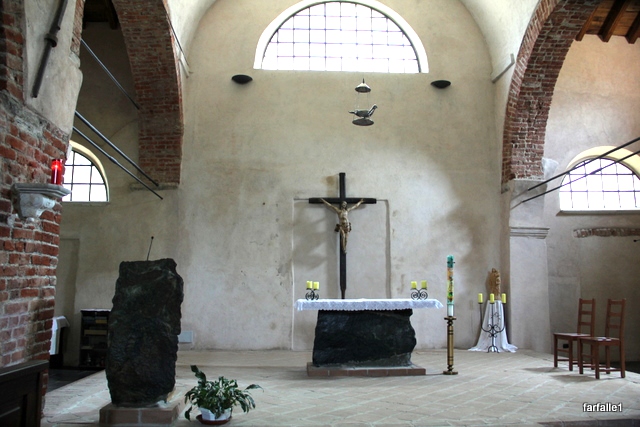
Above the altar there is a silver dove with a golden feather in its wing. The silver represents Christ’s humanity, the golden feather his divinity.

In 2001 the Cistercian monks returned to Santa Maria, through the cooperation of marchesa Camilla Salvago Raggi, the owner of the property, and the Cistercian Congregation of San Bernardo in Italy.  There are now four monks in residence; three are in rather poor health, but one, Brother Walter, is still able to work and, with help from a local family, tends an enormous garden, makes honey and soap, and minds the monastery shop.
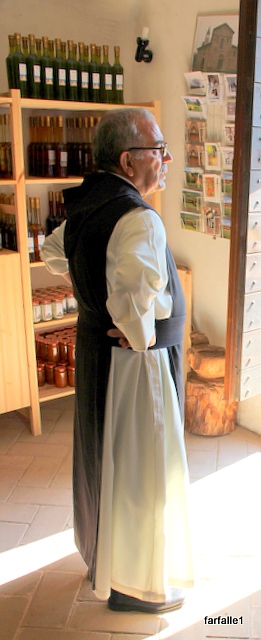
I was amused in the shop to see this display:
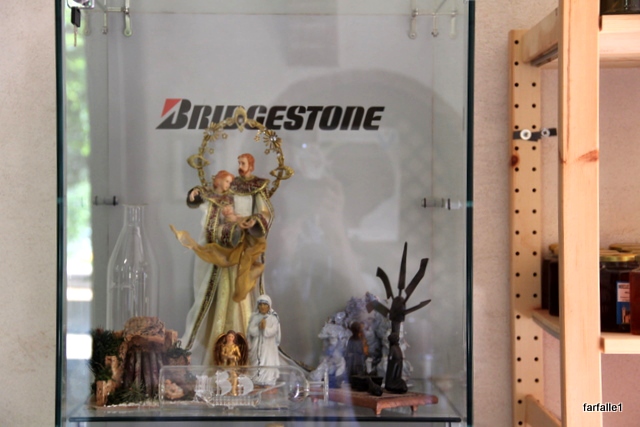

Apparently someone amongst the brothers has an interest in things automotive.

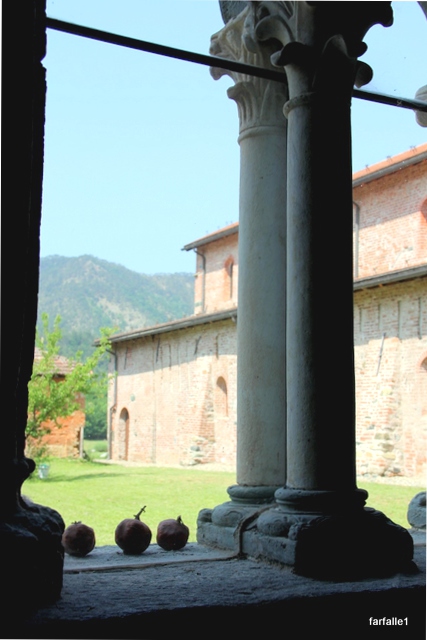
Three pomegranates, symbols of hope and transformation, were drying on the window ledge – one for each of us.  Of course we left the fruit there, but we took the hope with us when we left the peaceful Badia di Tiglieto.

Election Day

14 Tuesday Jun 2011

Posted by farfalle1 in Italian bureaucracy, Italian habits and customs, Italy, Rapallo, San Maurizio di Monti, Uncategorized

≈ 4 Comments

Tags

Italian Elections, Referendums in Italy, Voting in Italy

Faithful readers will remember that the Captain became an Italian citizen about a month ago.  As luck would have it, there was an election yesterday, and he is now eligible to vote.  It wasn’t an election for political office, it was referenda on four questions: 1) should the law allowing privatization of the water company stay on the books?  2) should the cost of water be increased?  3) should the law exempting politicians currently in office from being tried in court stay on the books? and 4) should the plans to re-institute nuclear power plants in Italy go forward?

Will it surprise you to hear it was not a simple matter to get into the voting booth?  The Captain started two weeks ago, when he went to the Comune to request his voting card, without which he could not vote.  They were too busy to take care of him that day, and in fact tried very hard to discourage him from voting this time. But as a citizen it is his right to vote, and they were more or less obliged to take care of him, although not at that exact moment.  They grumblingly instructed him to come back a week later, which he did. They were even busier and once again they tried to put him off.  He wouldn’t give up, so they promised they would do the necessary work and then call him to let him know when he could pick up his card.

The polls were open on Sunday and Monday.  Late Sunday afternoon the long-awaited call came, and first thing Monday morning the Captain went back to the Comune where he found… that his card was not ready.  But there was a document that would allow him to vote and it was lacking only one signature.  Fortunately the hand that had to affix the signature was actually in the building, so without too much more delay the Captain received a handsome paper on Comune letterhead, signed by the man in charge of elections, and officially stamped, attesting to his right to vote.

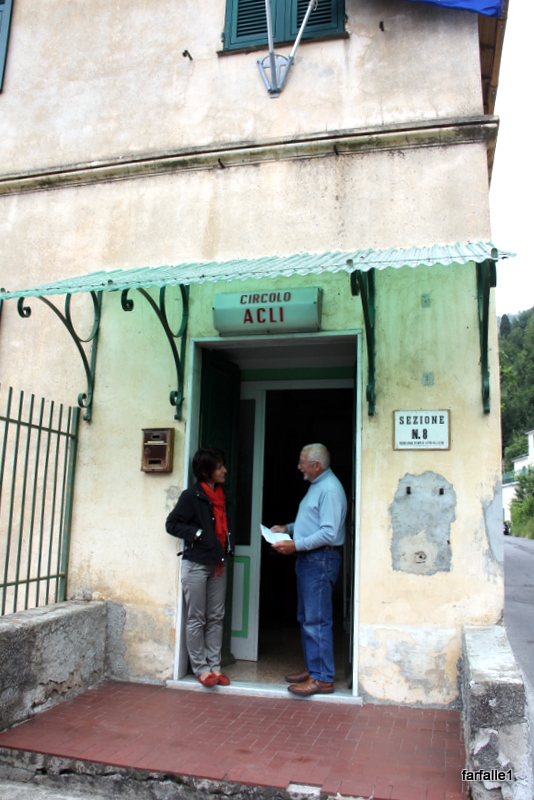
Going to the polls turned out to be one the pleasantest experiences we’ve had in quite a while.  It began outside the former elementary school (now a Catholic social club) where we were warmly welcomed by the secretary of the polling section, Enrica Pedrasi, to whom the Captain explained his mission.

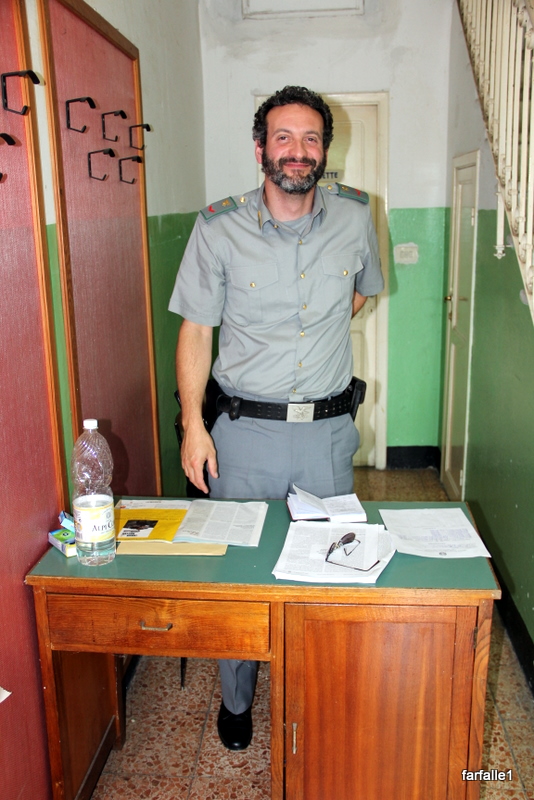
Inside we encountered the genial Gianluca from the Forestiere service. He was one of the people taxed with guarding the ballots from the time they arrived on Saturday until the polling was over on Monday afternoon. There is an armed guard on site at all times to make sure no one monkeys with the ballots.

There was a bit of confusion over the Captain’s document, because it was not the usual voting card, but the President of the polling section, Alberto Tumiati, made a quick phone call to the Comune, and all was well.


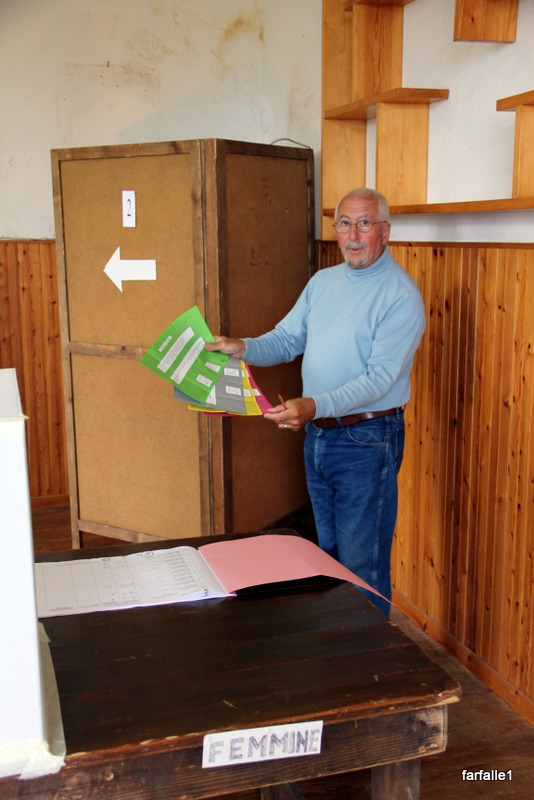
Renata Castagneto, one of the scritore normale of the polling section, entered the Captain’s name in the ledger of eligible voters.  Please note, he has been entered on the ‘maschi’ side.  Women’s names are entered in a different book kept at the other end of the table.  We’re accustomed to seeing alphabetical groupings in the States – it was a surprise to see the gender separation.

Then the Captain was given his ballots.  There was a separate color-coded ballot for each question.  The referendum question was on a strip of paper glued on the top of the paper, instructions were glued below, and two large boxes, one for Si and one for Non were glued at the bottom.

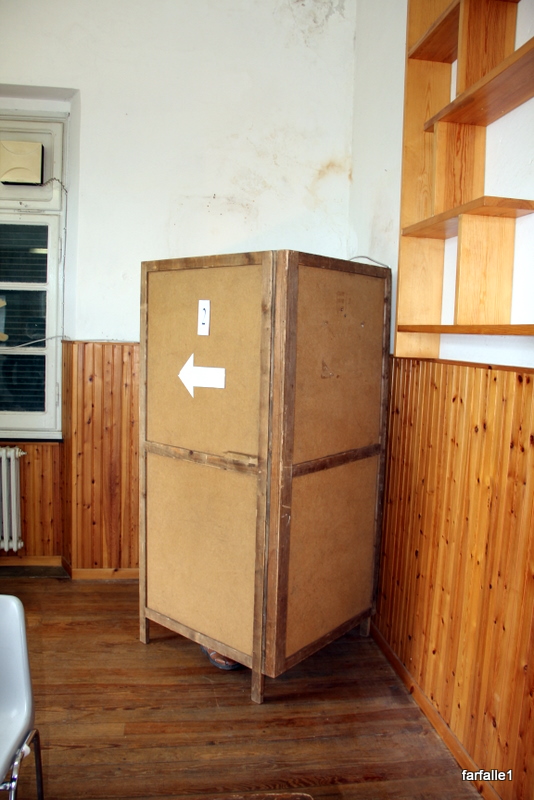
Into the booth he went, and, for the first time, voted as an Italian Citizen.  You can see his shoe in the picture below, peeking out from beneath the voting booth.


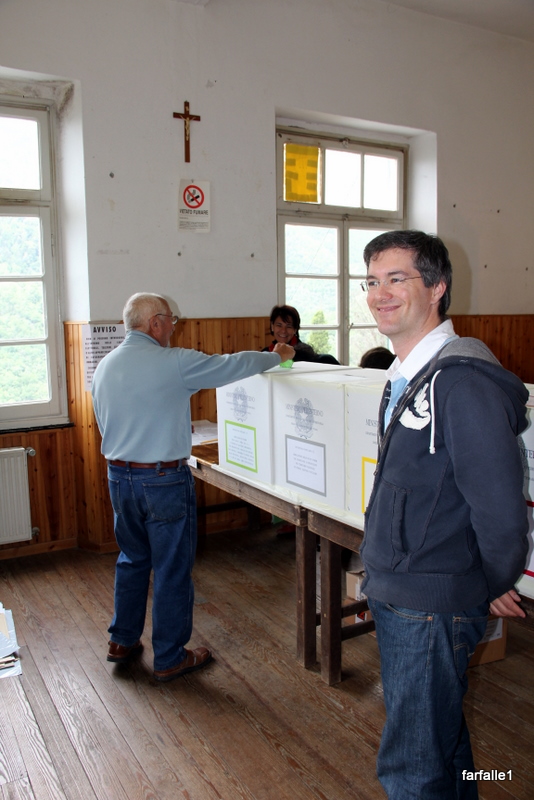
Moments later he emerged with his marked and folded ballots, and deposited each ballot in the appropriately colored box (he reports that it was complicated to fold the ballot correctly – many folds, and one section had to face out).


You can see from the expressions on the faces above that we received a very warm welcome.  In fact a cheer went up when we first walked into the room.  We were told that with the Captain’s appearance the percentage of people voting of those eligible at this voting station now stood at 51% (Rapallo, with its population of 30,000+ has 30 polling districts, each with about 1,000 voters.  Voters must vote at their own polling stations).  Well, that’s nice, we thought.  Then we learned that for the referenda to be effective more than 50% of the eligible voters in the nation must vote.  Little San Maurizio did its part.  There are about 330 eligible voters in the village, and at least 165 turned out.

As I write this the final results are not yet in.  But the evening news indicated that it seems all four referenda were passed – that is, that the laws already in place allowing for nuclear power plants, privatization of the water companies and immunity from prosecution for politicians in office, have all been overturned by popular vote.

Hurray for democracy!

Addendum:  It is the first time in fifteen years that enough voters have turned out to make a referendum valid.  All four popular initiatives passed convincingly (90%), which some see as the beginning of the end for Mr. Berlusconi.  See what the Italian press is saying here (in English).

Renata, Enrica, Alberto… if I have details wrong, please correct me in the comments or in an e-mail, okay?

Hi Pidge!


What the…..???

07 Tuesday Jun 2011

Posted by farfalle1 in Italian bureaucracy, Italy, Uncategorized

≈ 8 Comments

Tags

Italian Postage, Italian Postage Increase, Italian Postal Rates, Italian stamps, Mail in Italy, Mailing a Letter in Italy, Posta Priorita, Stamps in Italy

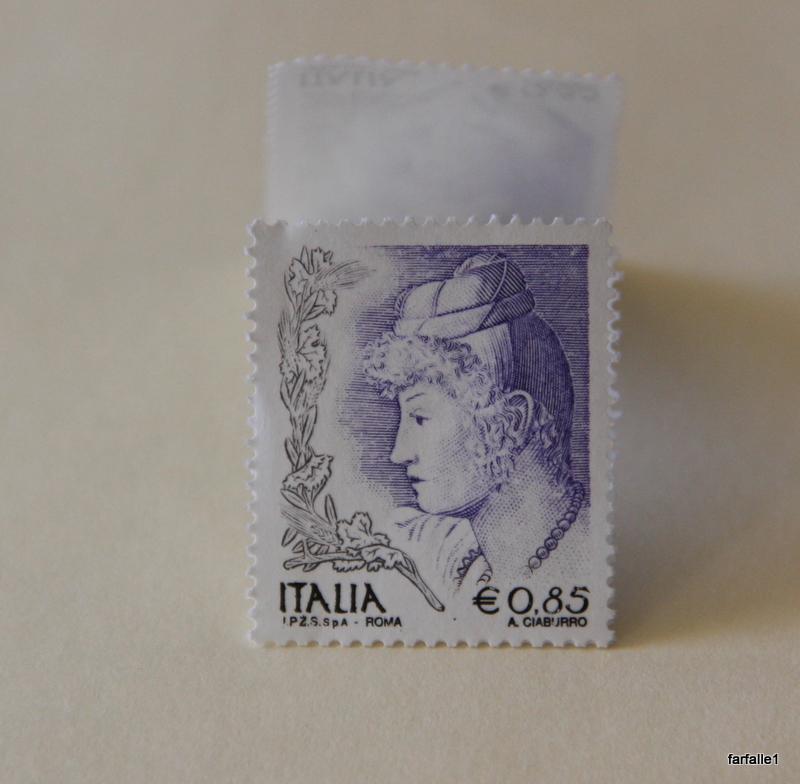
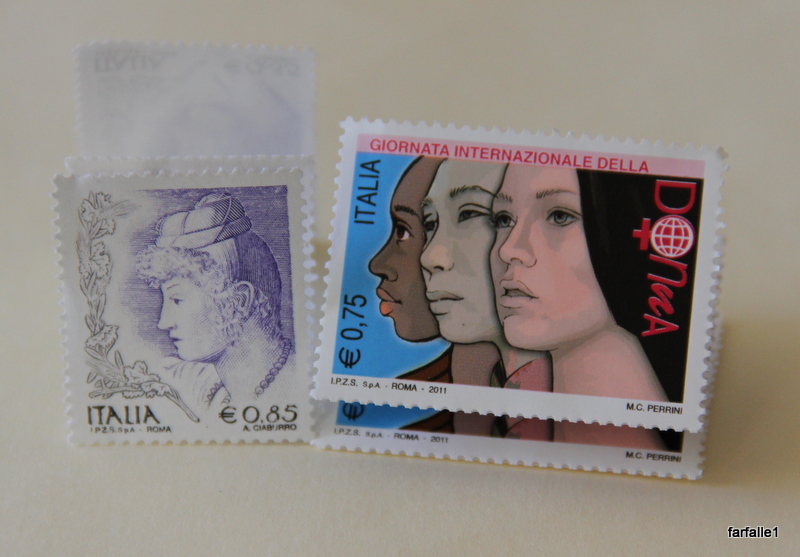
Last November when we left Italy it was possible to put one of these on an envelope and know that sometime in the next five to ten days the letter would arrive in the U.S. of A.

Last week the nice tabaccaio (the man in the cigarette, salt and stamp store) told me I would have to put this on a similar letter to the same destination:

That’s right.  Postage to zone 2, which includes the United States, increased from .85 to 1.60 in December (the patient tabaccaio had to show me the official notice before I was able to believe him).  Factor in the exchange rate and that’s about $2.25.  Can you imagine what would happen if the U.S. Postal Service almost doubled rates from one day to the next?  There would be Congressional hearings at the very least, and quite possibly the streets would be filled with rioting junk-mailers.

So to all dear friends and family who are accustomed to receiving snail mail from me, you’ll be getting only half as much in the future.  Which will still be pretty much the ‘none’ you’re already used to.
Hi, Jay!

Tri-Colore

03 Friday Jun 2011

Posted by farfalle1 in Italian festas, Italian holidays, Uncategorized

≈ 4 Comments

Tags

Fly-overs, Italian Air Force, precision flying, stunt flying, Tri-Colore

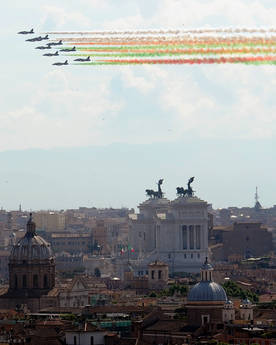
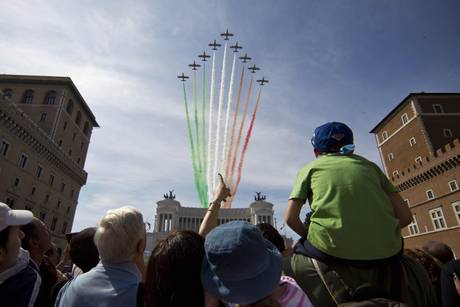
Today’s photo essay from ANSA (the Italian online news service which has an English edition) showed a spectacular fly-over of the tri-colore above the Roman crowds celebrating the Festa della Repubblica.  To see the other 13 photos, click here.

What a sight!

Jammin’ in the Kitchen

29 Sunday May 2011

Posted by farfalle1 in American recipes, Uncategorized

≈ 19 Comments

Tags

Cherries, Cherry Jam, Jam Making, Pectin

When we restructured our house ten years ago we planted many fruit trees, among them a sweet cherry tree.  It grew and grew but gave us no fruit.  Then four years ago we had five cherries – great excitement!  The next year we had fifteen.  The year after that there were more than we could count, but we were able to eat them all in one sitting.   And this year – ta dah!


More than we could count AND more than we could eat.

Clearly it was cherry jam time.

Jam is much easier to make than jelly – none of that time-consuming drip, drip, drip to get a clear jelly.  For anyone who likes instant gratification in their preserves, jam is the way to go.

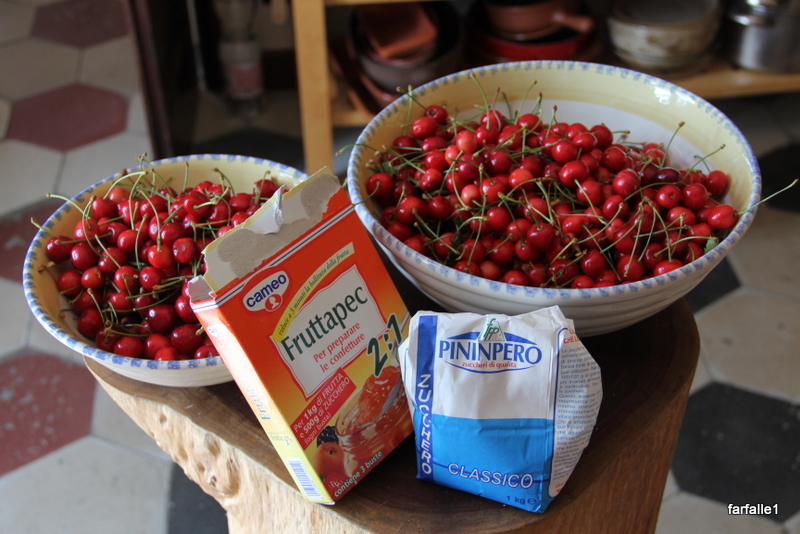
Here are the ingredients: the cherries, sugar, and a pectin product made from apples, among other things.  Apples, guavas, quince, plums, gooseberries, oranges and other citrus fruits, contain large amounts of pectin, while soft fruits like cherries, grapes and strawberries contain small amounts of pectin, according to Wikipedia.  Pectin is what puts the ‘jel’ in jams and jellies, so if you’re working with a low-pectin fruit you want to add some to make a good jam. I once made cherry ‘jam’ without adding pectin, and ended up with a lovely cherry sauce.  In the good old days people simply boiled their fruit and sugar mixture until it was reduced to a jelly or jam.  I’ve tried this and have ended up with a sort of sticky goo.  For me adding pectin produces a better result. Sure-Jell, Ball and Certo are some of the name-brands of Pectin in the U.S., and many grocery chains sell it under their own label.  I’ve read complaints about liquid pectin; some people have trouble getting it to set.
The Fruttapec above is called 2:1 because the recipe calls for only 1/2 kilo of sugar to a kilo of fruit.  Many jam recipes call for equal weights.  I know!  It’s a great way to take something healthy like a cherry and turn it into something a lot less healthy.  So, even though 2:1 jam is still full of sugar, you can feel very virtuous because you’ve reduced your intake by half.

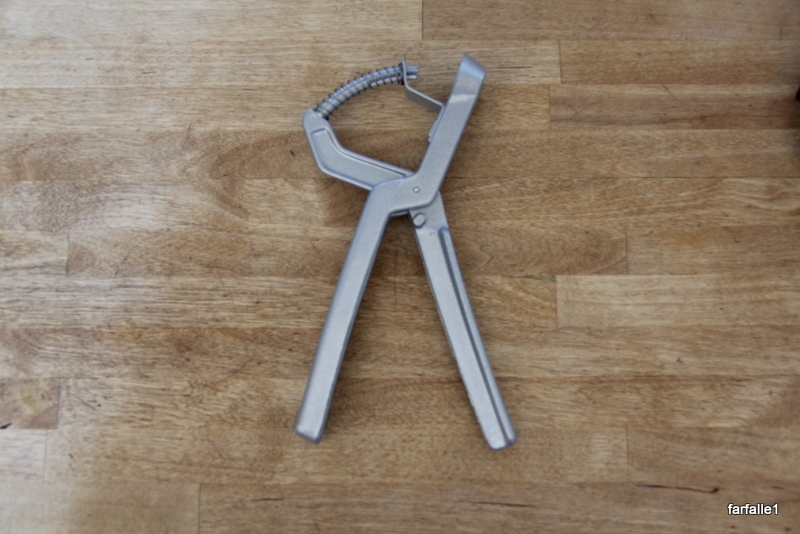
All you have to do is mix the pectin with the sugar, then add the room-temperature prepared fruit (cleaned, and in the case of cherries, pitted).  On that subject, here is the best purchase of the year:


Made by a German company, it is marketed as an olive-pitter, but it works just fine for cherries.  You put the cherry in, squeeze the handle and the pit (and only the pit!) pops out the bottom.  It’s fun, and a great time saver.  The first day I made jam it took me an hour and a half to pit the fruit with a manicure tool, a wee spatula-like thing.  With the new tool the next day it took less than half an hour.


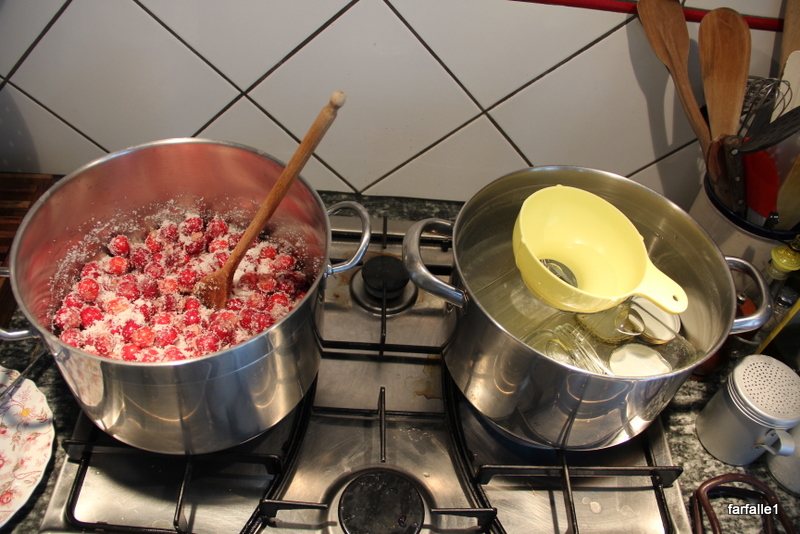
You put the mixture on high heat, and at the same time boil up a pot of jam jars, lids and any other tools you will use.  In addition to the pitter I use a jar-lifter, barely visible on the bottom right of the photo, and a wide-bottomed funnel for getting hot jam into the jars.

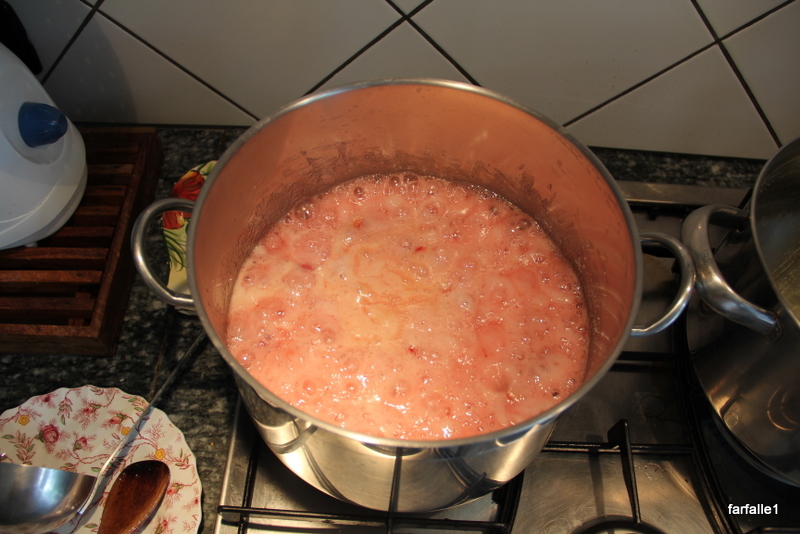
You bring the jam mix to a full roiling boil stirring all the while:


Once you’ve achieved boil, set a timer for three minutes.  Then remove the pan from the heat and stir for a minute; then get as much of the foamy scum off the top as you can – it’s easier for some fruits than others (for cherries it’s difficult).  Add three TBL of lemon juice, put back on the high fire, and boil for one more minute.  Then it’s jar time.


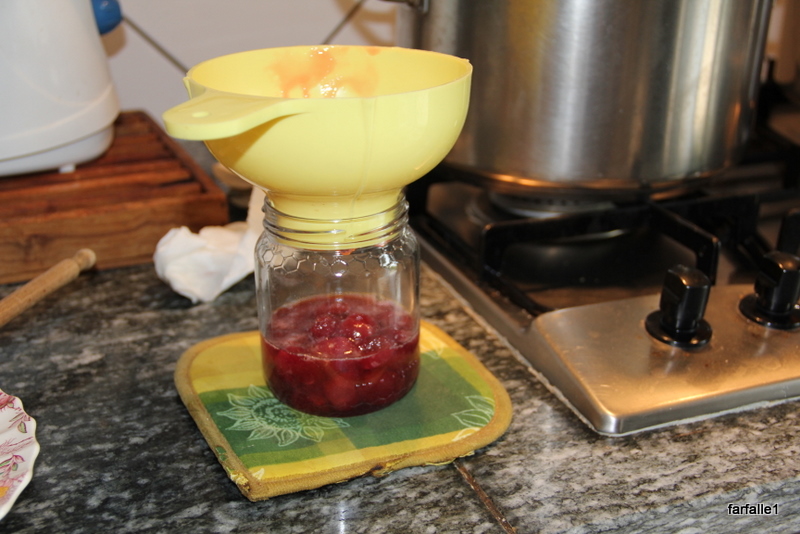
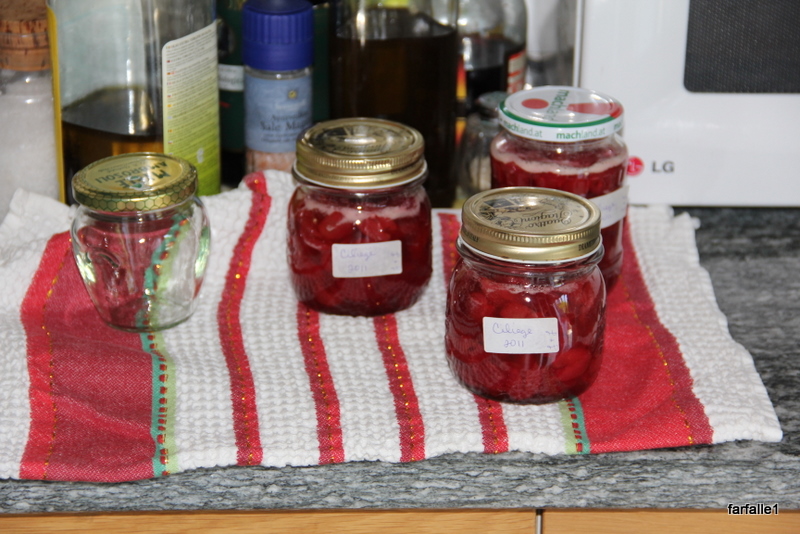
Remove a jar from the pot of boiling water, fill it with hot fruit mix, remove a lid from the boiling water and screw it on, not too tightly.  Then set the jar on a folded tea towel to cool.  You’ve made jam!

Make sure your vacuum jars have sealed. If they haven’t, either re-do the process, or simply eat the jam right away.

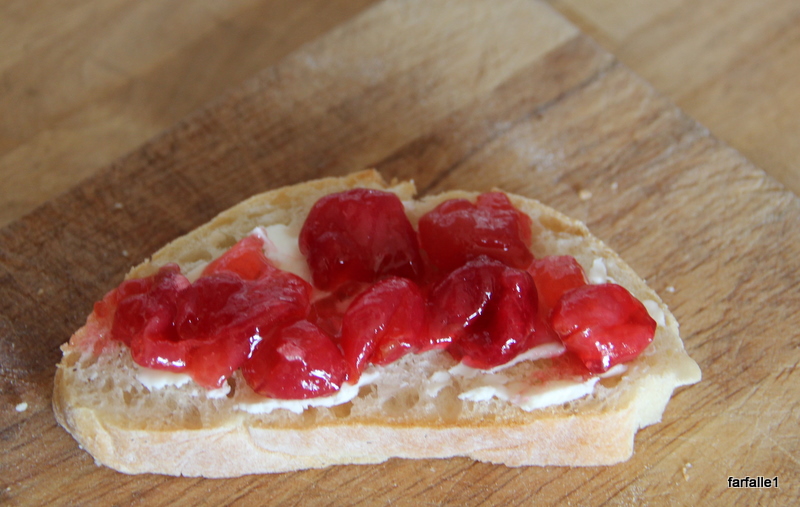
Here’s your reward:

Yum!

Oddly enough, cherry jam does not seem to be prevalent in Italy.  The jars I’ve given Italian friends have produced more curiosity than delighted recognition.  One taste has been sufficient to turn them into believers, so maybe one day soon the grocery shelves will be groaning under jars of cherry jam.  But I’m not going to hold my breath; instead I’m going to hope for another banner crop next year.

Spring Wildflower Walk

21 Saturday May 2011

Posted by farfalle1 in Flowers, Hiking in Italy, Italian flowers, Photographs, Rapallo, Uncategorized

≈ 13 Comments

Tags

La Crocetta, Montallegro

It was a beautiful spring day, not too hot, not too cool, when four of us set out to have a walk and a picnic.  We left from La Crocetta, the apex of the pass over the mountain on which the Captain and I live, and walked to Montallegro, the pilgrim church about which I’ve written in the past.  We didn’t set out to have a wildflower walk, but that’s what we ended up having.

For some of the flowers we were too early:


and for some we were too late:


but for oh so many we were there at just the right moment.

Here’s something I learned from this expedition: I am hopeless at identifying wildflowers.  I have two books on the subject, both related to flowers in this area, and I still find it almost impossible.

How I wish this blog had ‘smellovision’ so you could smell the sweet acacia:


These, by the way, are a culinary treat when fried up in a batter.  Yum.

And I wish I could attach sound to this so you would hear the wind sighing through the trees.  It sounded exactly like a Fellini movie (I’m thinking Amarcord, I guess, which I recommend you see if you haven’t already).

Here is a web album of the gorgeous flowers we found along the path.  I identified the ones I was able to, but most of them remain a mystery.  If you’d care to help identify, please, feel free!  I’d be grateful.

If you’d like a quick video of the trail from La Crocetta to MontAllegro, you can ride along here  on a February outing with mountain biker ‘guru63byric.’

Web album of wildflower walk:

Wildflower Walk from La Crocetta to Montallegro

Lizards Here and There

16 Monday May 2011

Posted by farfalle1 in Animals in Italy, Animals in the U.S., Arizona, Uncategorized

≈ 6 Comments

Tags

chuckwalla, lucertola, lucertole

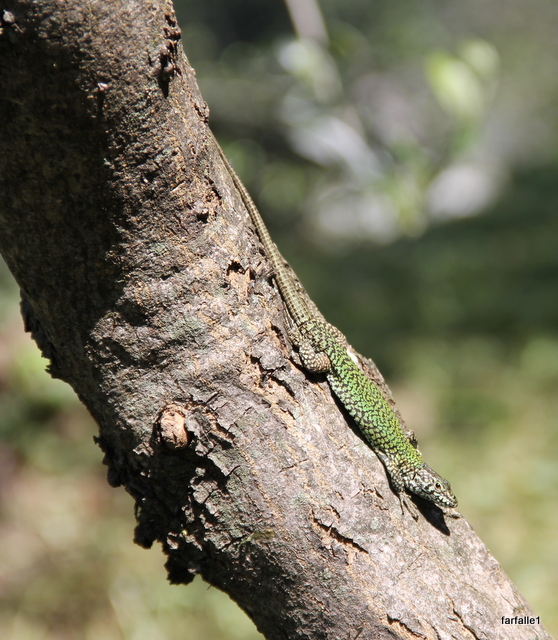
Here in Italy we live with the sweetest and shyest little lizards, called ‘lucertole‘ (prounounced loo-chair’-toe-lay).  In fact, I just took one from our interior stairs and released him outside.  They look like this:


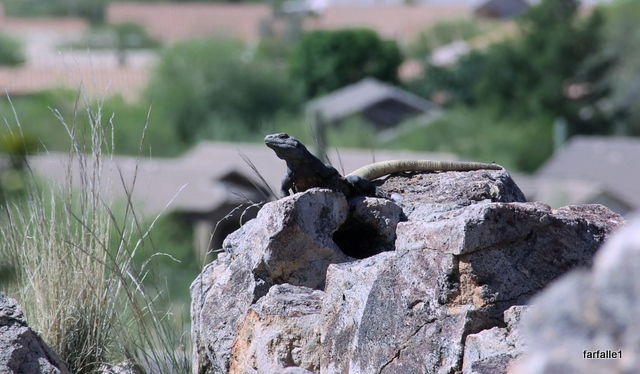
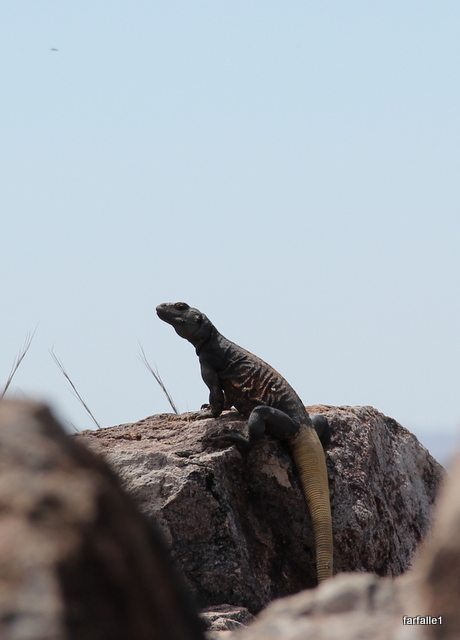
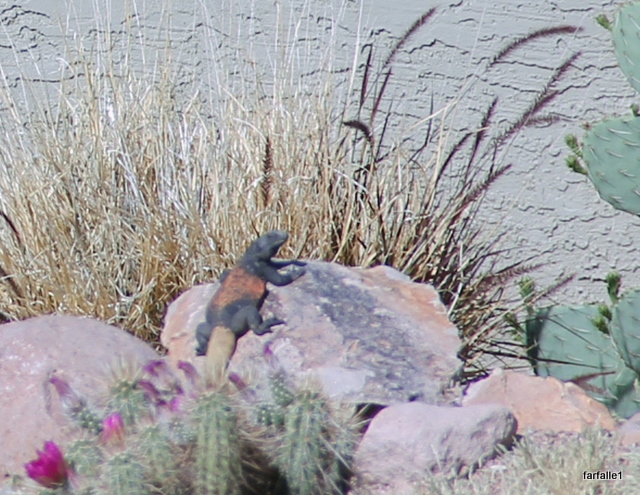
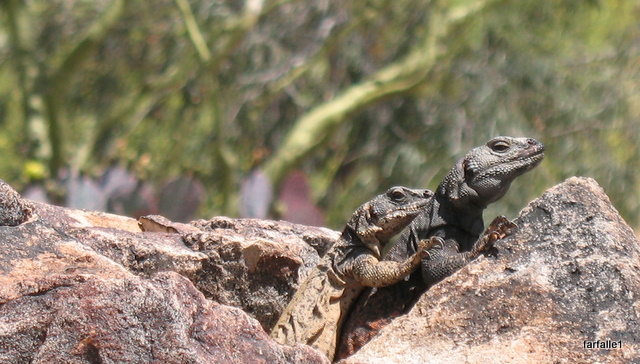
Of course in America everything must be Bigger – including the lizards.  These fellows, called chuckwallas, live in the rock pile outside our house in Arizona. They are absent in the winter, sleeping in their stony nests, but in the spring they come out to bask in the sun and engage in other typical spring behavior.


A poor photo, but the only one that shows rusty back patch


In all fairness, we see plenty of smaller lizards in Arizona, as well, most of them a dull brown and moving so fast it is impossible to get a photograph.  And, according to Wikipedia, most of the lizards are cousins to one another and share many traits. Like the lucertole, the chuckwallas are very shy and don’t let us get close with a camera.

The chuckwalla’s tail looks like we should be able to count the rings on it to determine his age, but I don’t think that’s true.  It also looks like it should unscrew and come off; it probably does come off, though we’ve never seen that.  The little lucertole frequently do lose their tails  It’s part of a defense mechanism when they are attacked by predators.  They can sharply contract a muscle which detaches the tail without loss of blood.  The predator thinks the still twitching tail is the animal; the lucertola stays very still until the predator has left with the tail.  The tail stops twitching after a time, but by then the rest of the lucertola has run away.  Every summer we have a whole sub-family of lucertole living around the house that are nick-named Stumpy.  Their tails do grow back, but never completely, which tends to leave them with an unfinished look.

There’s something about seeing a lizard, so prehistoric, timeless and ancient in appearance, that makes us feel humble, and maybe even a little smaller than the animals we are watching.

Giro d’Italia – What’s all the Fuss?

09 Monday May 2011

Posted by farfalle1 in Italian festas, Rapallo, Uncategorized

≈ 14 Comments

Tags

Bicycle races, Giro d'Italia, UCI World Tour

What we’ve been regarding as an A-#1 headache this week turns out to be a bicycle race with an impressive pedigree.   As Wikipedia succinctly puts it:

The origins of the Giro are similar to those of the Tour de France, a competition between two newspapers: La Gazzetta dello Sport and Corriere della Sera. La Gazzetta wished to boost its circulation by holding a professional road race based upon the Tour de France and similar to the Corriere della Sera-organized car rally. On August 7th, 1908 the newspaper’s founder Eugenio Camillo Costamagna, director Armando Cougnet and its editor Tullio Morgagni announced the inaugural Giro d’Italia to be held in 1909. 

On May 13th, 1909 at 02:53 am 127 riders started the first Giro d’Italia from Loreto Place in Milan. The race was split into eight stages covering 2448 kilometres, 49 riders finished with Italian Luigi Ganna winning the inaugural event having won three individual stages and the General Classification. Ganna received 5325 Lira as a winner’s prize with all riders in the classification receiving 300 lira (at the time the Giro’s director received 150 lira a month salary).

Luigi Ganna

The race has continued, with interruptions for wars, ever since and has, like so many sporting events, become ever bigger and more commercialized. Wikipedia gives an exhaustive account of the race, its various elements and many of its winners here.  Two of the three cyclists with the most wins (5) are Italians Alfredo Bindi and Fausto Coppi.

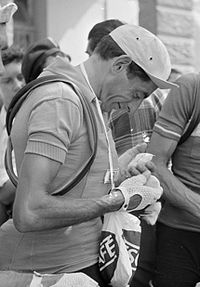
Alfredo Bindi

Fausto Coppi


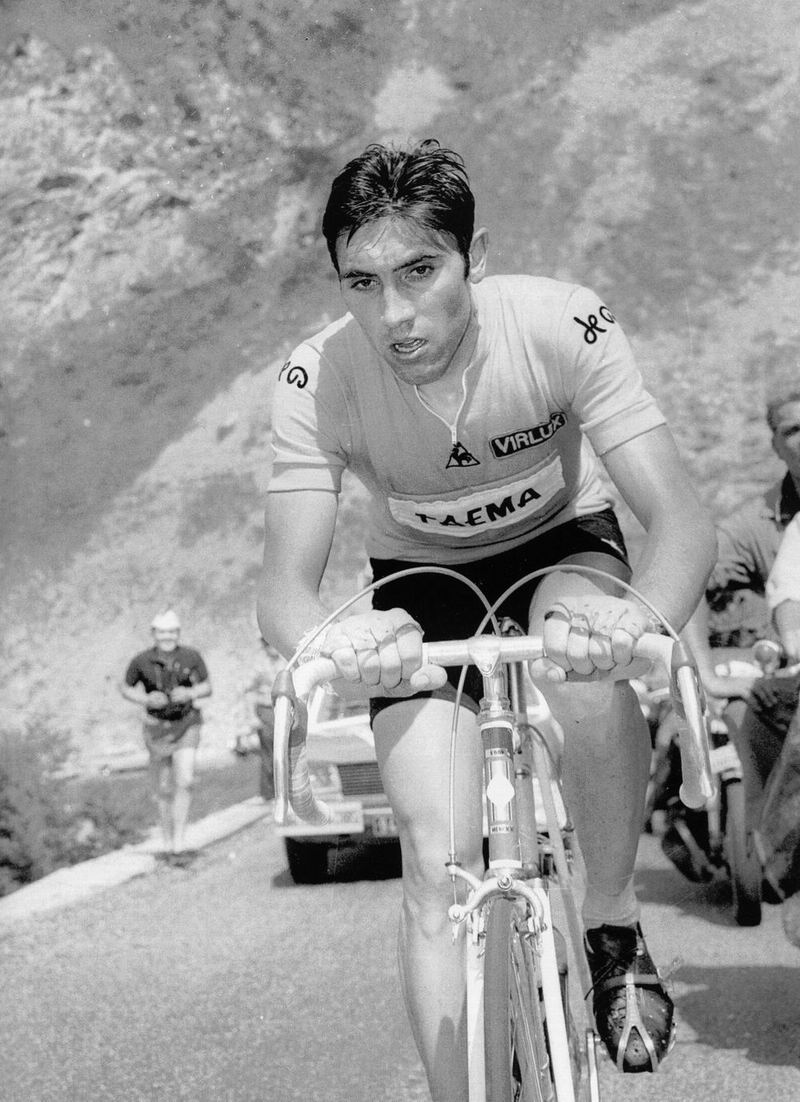
Belgian Eddie Merckx also won five races.

Eddy Merckx

The Giro d’Italia is one of the three jewels in the crown of the overseeing agency,  the UCI (Union Cycliste Internationale).  The other two are the Tour de France (est. 1903) and the Vuelta a Espana (est. 1935).  These three races comprise the Grand Tour of professional bike-racing.  (The UCI season consists of twenty-seven races held world-wide over a ten-month period.) Until 1960 The Italian race began and ended in Milano, the home of the Gazetto dello Sport; since then the city of departure has varied annually.  For a while the finish city also changed, but since 1990 it has, again, been Milano.  Since 1965 there have been nine starts outside Italy, and in 2012 the race will begin in Denmark.

So it’s a very big deal that the Giro is not only passing through Rapallo, but actually stopping here overnight, and then passing through again tomorrow on a route from Genova Quarto to Livorno.  Most of the downtown of Rapallo was closed to traffic in the afternoon and will be again tomorrow. 

And this is where the A#1 headache comes in.  We’ve been unable to find any definitive announcement of which roads are closed during which hours. The Captain had an errand in Sestri Levante, about forty minutes to the south on the coast road, the Via Aurelia.  When he went into town this morning he asked a policeman if he’d be able to get through and out of town mid-afternoon.  “No Problem!” was the reply.  Unfortunately when he set out he found the road was closed, so he couldn’t go.  The Aurelia was also closed where it enters town, as was the other road that connects Santa Margherita and Rapallo.  Bleachers have been erected, and no doubt there’s been no end of festivities, speech-making and shirt-presenting. But anyone who wants to get anywhere that involves traversing Rapallo is pretty much out of luck.  And because so many streets have been closed and cleared of all parked vehicles, there is no where to park even a scooter.  It is, to say the least, inconvenient.  BUT, it is a very big deal, kind of like having the Super Bowl or the World Series or the World Cup in your home stadium.  So we shouldn’t complain… well, maybe just a little.

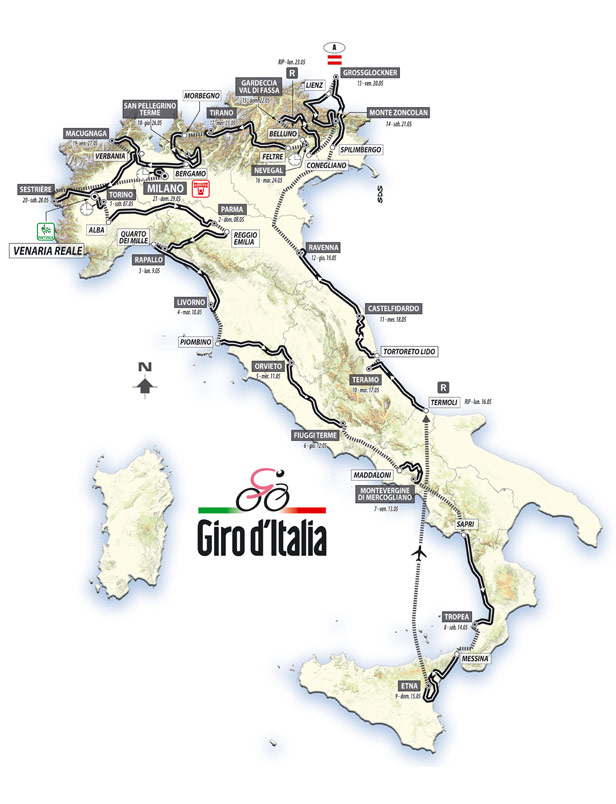
This edition of the Giro has been described as one of the most difficult in many years.  In honor of the 150th anniversary of Italy’s Unification the route encompasses the whole boot:


Note there is even a jog to Sicily, where the cyclists will bike up Mount Etna.  The entire route covers 3,524.5 km (2190 miles) in 21 stages, which range individually in distance from 12.7 km. to 244 km.  The normal day appears to be in the neighborhood of 200 km.  I can’t imagine.  Twenty-three teams left Torino on the 7th of May, and presumably all twenty-three will finish in Milano on May 29.

Not only can I not imagine pedaling two hundred plus km in one day, I can’t imagine the kind of planning that has to go into carrying off an event that involves so many people moving over such a great distance over so many days.  As disorganized as Italy sometimes seems, it takes logistical genius to carry off this race, road closures, grand-stands, publicity and all.

So we wish them well, and, to be honest, we wish them well on their way.  It’s great they came to Rapallo, and it will be great to be able to drive out of town again.

For some lovely photos of Stages One and Two of the race, click here.

Addendum:  It’s a terribly dangerous sport.  Five to ten racers die in race-related accidents every decade, according to Wikipedia.  Sadly, the list of names grew by one yesterday when Belgium’s Wouter Weylandt died of a skull fracture coming down the hill into Chiavari.  There is an account of the incident here.  So, no – there was no merriment in Rapallo last night and the podium ceremony was cancelled.  I suppose these young men know the risks when they undertake the sport, but surely each of them believes a deadly accident could never happen to him.  It’s seems such a terrible waste of a young life.  Expatriate joins all the others who are greatly saddened by this death, and whose hearts go out to the victim’s family.

Citizen Salamone

04 Wednesday May 2011

Posted by farfalle1 in Italian bureaucracy, Italian habits and customs, Italy, Law and order, Uncategorized

≈ 11 Comments

Tags

Italian bureaucracy, Italian citizenship, Trattoria del Sole

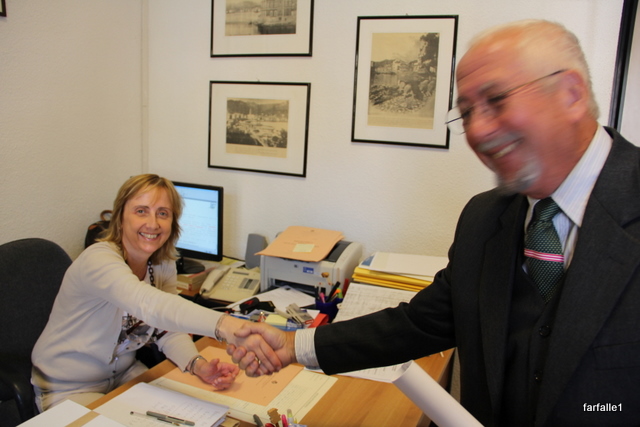
Meet Italy’s newest citizen, The Captain, aka Louis Philip Salamone.


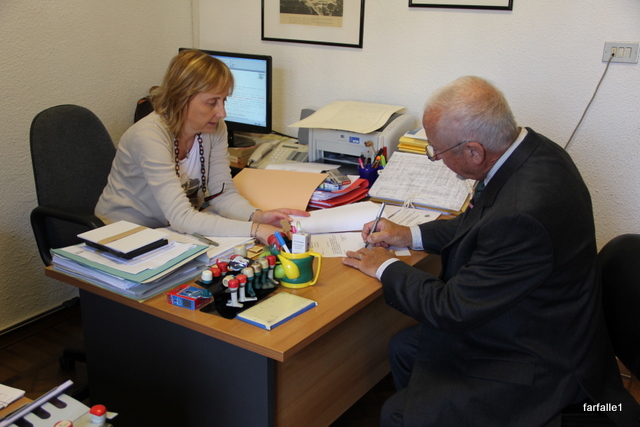
The procedure, I can’t call it a ‘ceremony,’ took place in the office of the head of the Ufficio Stato Civile, Dotoressa De Filippi this morning and was more casual than solemn (I would have liked a bit more ceremony, myself). Nonetheless, for us it was the culmination of several years of work and waiting, and we were both thrilled with the outcome and moved by the Captain’s new status.

At first we were afraid we were headed for a problem, one which has reared its ugly head in past administrative wrestling matches.  Whenever one gets a document, carta d’identita, permesso di sogiorno, etc.,  one must put place of birth on a form.  By place of birth Italian bureaucracy means town or city.  The Captain’s U.S. passport lists place of birth as ‘Wisconsin.’  This led to no end of trouble early in our stay here, but for some reason the good Dotoressa merely shook her head and commenced redoing the various declarations (they had to be further altered to correct the Captain’s misspelled middle name).  Then began the ritual ‘signing of the many forms,’ which occurred no fewer than four times.


Somewhere in the midst of the signing the Captain took an oath to uphold the Constitution and the Laws of Italy.  There was  no hand on heart, no holy book, no blood asked for or given, just a verbal promise to be a good citizen.

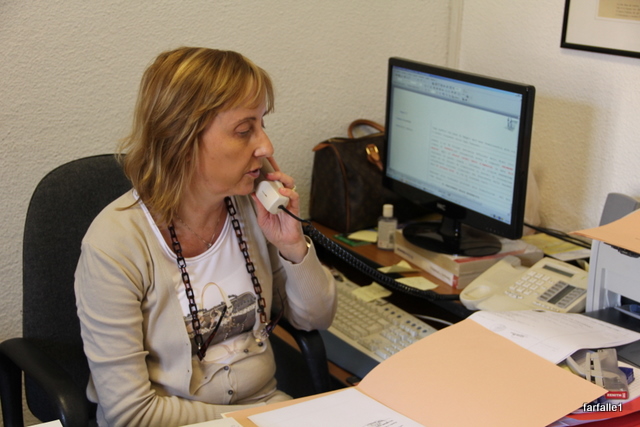
In the midst of all this the phone rang, and our proceedings were interrupted by a long discussion of what the caller’s daughter had to do to get her passport. 


It certainly detracted from the feeling that ours was a special moment, but we quickly got over it.
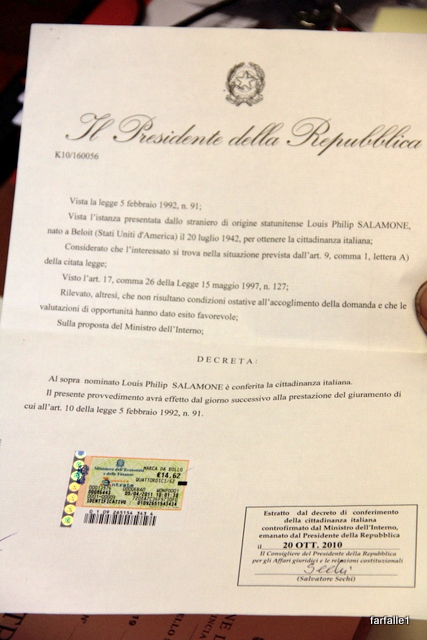
  Then the Dotoressa read a lengthy declaration to the effect that the President of the Republic had accepted the Captain as a citizen and showed us the Presidential decree, a photocopy of which was given to us later.


A quick handshake, and the deed was done.

I thought my Captain looked so handsome in his suit – it’s perhaps only the second time he’s worn it in the ten years we’ve been here.  I wish I could fit into clothes I had ten years ago!  He did not have a red, green and white tie, so he chose a green and white tie which we decorated with a bit of red and white ribbon, a not entirely unItalian thing to do. 

Today was the end of a long road that we began in 2005.  The quest began in the office of the very knowledgable and always helpful Anna Maria Saiano, the head of the Genova branch of the U.S. Consulate.  She led us to Signore Bevilacqua (Mr. Drinkwater!) who sent us to Dotoressa De Filippi in Rapallo.  She was disinclined to give the quantity of help we needed, so we returned to Sig. Bevilacqua in Genova, and he got things going for us.

There are many ways to become a citizen, one of the most common being ‘lineage.’  We had assumed this would be our route as both the Captain’s parents were Sicilian, one by birth, one by blood.  However, because the Captain’s father became an American citizen before the Captain’s birth, in effect renouncing his Italian citizenship, it became more complex.  We would have to go back to the grandparents, born in Sicily not all that long after the unification of the country.  Two world wars have had their way with that island – the odds of finding all the requisite birth certificates were low. 

We resorted to a ‘naturalized’ Citizenship, possible after five years of residence if either of the parents were born in Italy.  There are  other routes to citizenship, which you can read about here.  Gathering all the requisite data took some time, but was not especially difficult: 1) the application 2) Marca di Bollo (stamp) for E14.62  3) Income tax returns for three years  4) Father’s birth certificate  5) Captain’s birth certificate  6) FBI certificate / arrest record (done through fingerprints taken in Genova and sent to the US) 7) our marriage certificate 8) residency certificate proving length of residence in Italy  9) Permesso di Sogiorno  10) notarized copy of passport.  All documents in English required  certified translation, which we were able to procure from an office in nearby Chiavari.  The Captain did the translation himself; the certifying administrator didn’t speak English.

What the Captain didn’t have to do, which aspiring U.S. citizens must, is learn a lot of history and take a difficult test.  I’m happy to tell you that the Captain has read the history of Italy many times over, because it interests him, and I’m sure he could pass tests in both language and history.  But isn’t it interesting that in the U.S. there is a test to prove you are worthy, and in Italy it is simply a question of having the correct papers and forms?  Bureaucracy!  Having watched Craig Ferguson’s (The Late Late Show) citizenship swearing-in on TV I was surprised there was not a bit more pomp and circumstance, and at least an upraised hand when giving the oath. 

Once we filed the application and all the attendant paperwork we simply had to wait.  The State had  two years (actually seven hundred thirty days) in which to process the application and render a decision; they didn’t go too many weeks over.  News of our success reached us when we were in the U.S., and a visit to Dottoressa De Filippi was the first order of business when we got back to Rapallo. We were surprised to learn that the Captain was the twenty-seventh new citizen she had processed already this year.

So it was an exciting and momentous morning for us.  The Captain pursued citizenship for several reasons.  In a way it closes a circle that was opened when his father left Sicily for Ellis Island in 1921.  It makes life here much less complicated: no need to be traipsing off to Genova every few years for permission to remain.  Mostly it just gives official confirmation to something the Captain has known all his life: he is Italian.

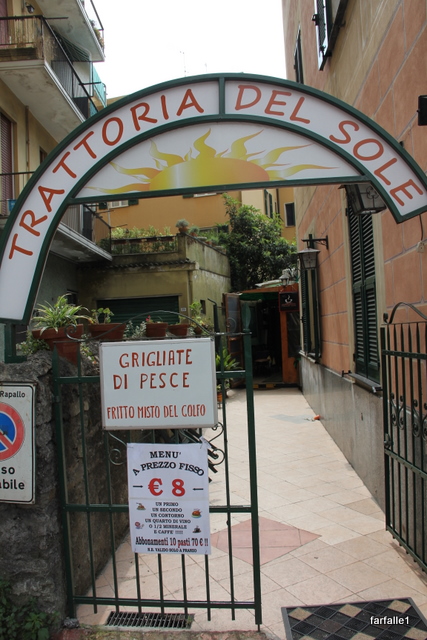
All that remained for us was a quick celebratory lunch at the delightful Trattoria del Sole across from the petrol stations on Via Mamelli where we took advantage of the daily special: penne with funghi; fried achiuge (sardine-like fish), carrots, potatoes, wine, water and coffee, all for the princely sum of E 8 each (Ligurians have the reputation of being tightfisted with their money – who are we to go against type?).


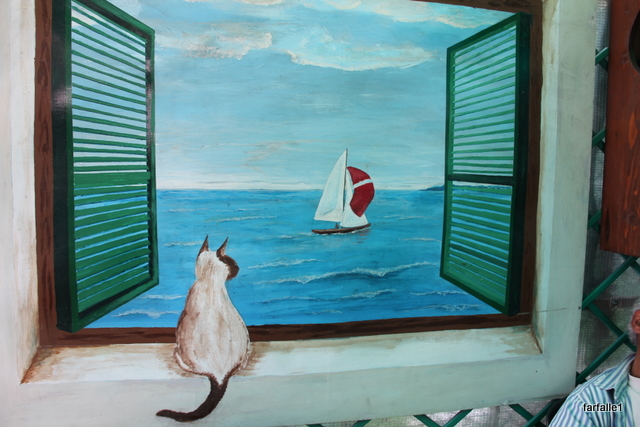
We hadn’t eaten here before, though the place has been beckoning to the Captain for some time, and were charmed to find examples of the owner’s art and crafts on the walls.

So came to a close a festive (for us) and memorable morning. Viva Italia!

On the Deck

26 Tuesday Apr 2011

Posted by farfalle1 in Building, Construction, Home maintenance and repair, Uncategorized

≈ 6 Comments

Tags

Composite decking, Decks, Renovation, Verandah decking

We should know from restoring our old house in Rapallo that no fix-it-up job is simple.  Unexpected complications always attend a home improvement project.  Our small deck in Arizona was no exception.

I’ve been lobbying for deck replacement for a couple of years.  The old deck was made of pressure-treated boards; they had cupped and splintered in the intense summer heat here, and it was a hazard to walk on them in bare feet.  We knew we wanted to replace the wood with composite boards when the time came; a sale of the Home Depot brand gave us the impetus to get started. Here’s a side-by-side comparison of the ugly old and sparkling new:

The first adventure was getting the boards home.  We needed 24 of them.  They are 12 feet long, a bit floppy, heavy, and, it turns out, very slippery.  Because of the weight we had to transport them atop my ancient car in two loads.  As I turned the next-to-the-last corner to get home the whole load slid off the front of the car and skittered across the road.  Fortunately there was no traffic, and even more fortunately two kindly knights stopped and helped me secure the boards for the short end of the journey.  Unfortunately some of the boards got pretty scratched up as they moved across the pebbly road.

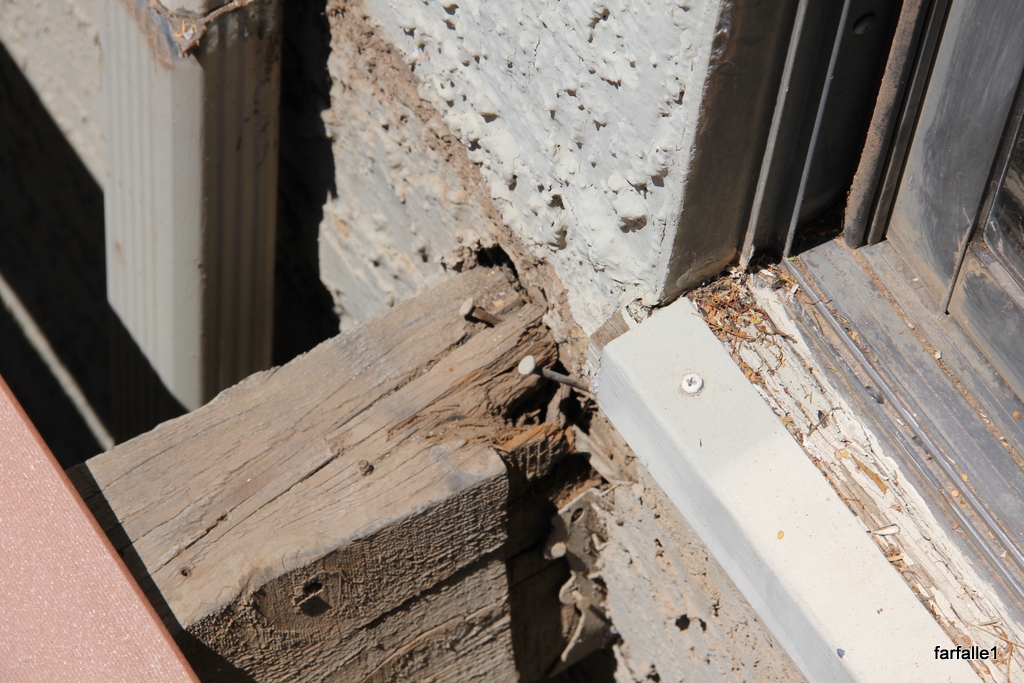
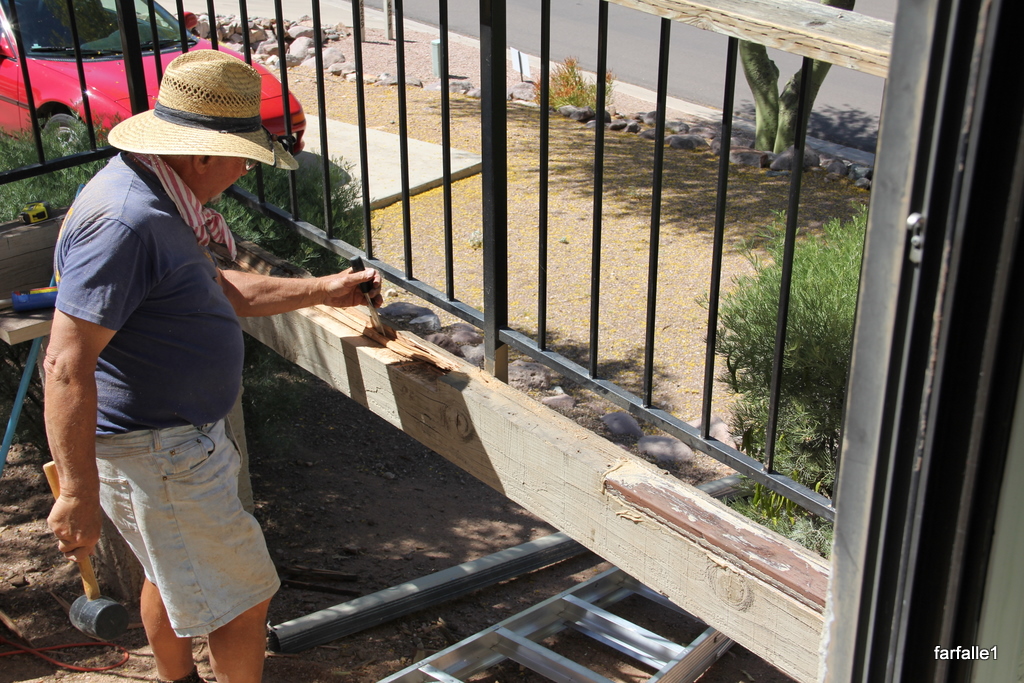
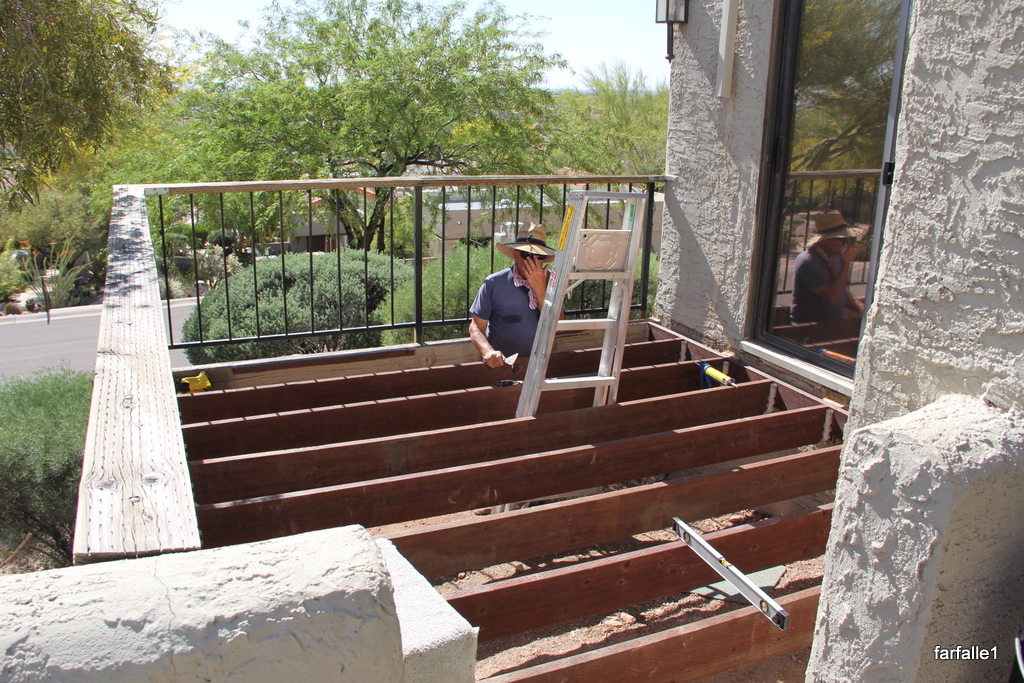
Removing the old decking was relatively easy; removing the three large joists that supported the old deck was more difficult.


Our friend John, who is ‘in’ construction, agreed that the outer supports of the deck were in sufficiently good condition to keep.  The old joists were spaced 32″ apart; the new decking required joists 16″ apart, so we went back to Home Depot and got seven pieces of pressure-treated joist wood.  We had not anticipated having to replace all the joists.  Nor had we anticipated having to patch and fill where the old joists met the house, nor where there was a bit of rot in one of the main supports.


It all takes so much time!  And it was hot – 95 F the day we placed most of the joists.


But life in Italy has taught us the phrase ‘piano, piano.’  Just start the job, keep at it slowly and carefully and, as they also like to say in Rapallo, “Wallah!” – eventually your job is finished.

So it was with the deck, and we are thrilled with the result.  We are also utterly exhausted from the work, especially the Captain who had to do all the heavy parts of it.


A quick word about Home Depot: the people there could not be nicer.  We received tons of helpful advice, all of it spot on.  When we bought a couple of small power tools the salesman told us, “If they don’t work the way you want them to for your job, bring them back.”  Home Depot is enormous – it’s the size of a football arena, and contains everything you could ever need for home or garden.  We love our ‘Fai da Te’ stores in Italy, but they are wee in comparison.  It’s not that there’s not a lot of do-it-yourself in Italy – there’s a tremendous amount, much of it extremely creative and very beautiful.  But if you want cement you go to the cement store, if you want wood you go to the wood store, and if you want nails you go to the hardware store – it’s not all under one roof.  And in Italy there’s a lot of use made of old materials; not much goes to waste there.

Speaking of Italy, we’ll be heading home in the next week, so your Expatriate will be silent for a week or two…

← Older posts
Newer posts →

Enter your email address to follow this blog and receive notifications of new posts by email.

Join 111 other subscribers

rss

Subscribe in a reader

Search the Blog

A. Useful Links

  • bab.la language dictionary
  • Bus schedules for Tigullio
  • Conversions
  • English-Italian, Italian-English Dictionary
  • Expats Moving and Relocation Guide
  • Ferry Schedule Rapallo, Santa Margherita, Portofino, San Frutuoso
  • Italian Verbs Conjugated
  • Piazza Cavour
  • Rapallo's Home Page – With Link to the Month's Events
  • Slow Travel
  • The Informer – The Online Guide to Living in Italy
  • Transportation Planner for Liguria
  • Trenitalia – trains! Still the most fun way to travel.

C. Elaborations

  • A Policeman’s View
  • Driving School Diary
  • IVA refunds due for past Rifiuti tax payements
  • Nana
  • Old trains and old weekends
  • The peasant, the Virgin, the spring and the ikon
  • Will Someone Please, Please Take Me to Scotland?

D. Good Recipes - Best of the Week winners are starred

  • 'Mbriulata
  • *Baked Barley and Mushroom Casserole*
  • *Captain’s Boston Baked Beans*
  • *Crimson Pie*
  • *Louise’s Birthday Cake*
  • *Melanzane alla Parmigiana*
  • *Penne with Cabbage and Cream
  • *Pizzoccheri della Valtellina*
  • *Pumpkin Ice Cream*
  • *Risotto alla Bolognese*
  • *Rolled Stuffed Pork Roast*
  • *Spezzatini di Vitello*
  • *Stuffed Grape Leaves*
  • *Stuffed Peaches (Pesche Ripiene)*
  • *Swordfish with Salsa Cruda*
  • *Tagliarini with Porcini Mushrooms*
  • *Tagliatelli al Frutti di Mare*
  • *Three P's Pasta*
  • *Tzatziki*
  • 10th Tee Oatmeal Apricot Bars
  • Adriana’s Fruit Torta
  • Aspic
  • Bagna-calda
  • Best Brownies in the World
  • Clafoutis
  • Cold cucumber soup
  • Crispy Tortillas with Pork and Beans
  • Easy spring or summer pasta
  • Fish in the Ligurian Style
  • Hilary's Spicy Rain Forest Chop
  • Insalata Caprese
  • Lasagna al forno
  • Lasagna al Forno con Sugo Rosato e Formaggi
  • Lemon Meringue Pie
  • Leo’s Bagna Cauda
  • Leo’s Mother’s Stuffed Eggs
  • Louis’s apricot chutney
  • Mom's Sicilian Bruschetta
  • No-Knead (almost) Bread
  • Nonna Salamone's Christmas Cookies
  • Pan Fried Noodles with Duck, Ginger, Garlic and Scallions
  • Pesto, the classic and original method
  • Pesto, the modern, less authentic method
  • Pickle Relish
  • Poached pears
  • Poached Pears
  • Polenta Cuncia
  • Recipes from Paradise by Fred Plotkin
  • Rustic Hearth Bread
  • Shrimp and Crayfish Tail Soup
  • Sicilian salad
  • Slow Food Liguria
  • Slow Food Piemonte and Val d'Aosta
  • Spinach with Garlic, Pine Nuts and Raisins
  • Stuffed Eggs, Piemontese Style
  • The Captain’s Salsa Cruda
  • Tomato Aspic
  • Zucchini Raita

E. Blogroll

  • 2 Baci in a Pinon Tree
  • Aglio, Olio & Peperoncino
  • An American in Rome
  • Bella Baita View
  • Debra & Liz's Bagni di Lucca Blog
  • Expat Blog
  • Food Lovers Odyssey
  • Italian Food Forever
  • L’Orto Orgolioso
  • La Avventura – La Mia Vita Sarda
  • La Cucina
  • La Tavola Marche
  • Rubber Slippers in Italy
  • Southern Fried French
  • Status Viatoris
  • Tour del Gelato
  • Weeds and Wisdom

Photographs

  • A Day on the Phoenix Light Rail Metro
  • Apache Trail in the Snow
  • Aquileia and Croatia
  • Birds on the Golf Course
  • Bridge Art
  • Canadair Fire Fighters
  • Cats of Italy
  • Cloudy day walk from Nozarego to Portofino
  • Fiera del Bestiame e Agricultura
  • Football Finds a Home in San Maurizio
  • Hiking Dogs
  • Mercatino dei Sapori – Food Fair!
  • Moto Models
  • Olive pressing
  • Rapallo Gardens
  • Rapallo's Festa Patronale
  • Ricaldone and the Rinaldi Winery
  • Rice Fields
  • Sardegna ~ Arbatax and Tortoli
  • Sardegna ~ San Pietro above Baunei
  • Sardegna ~ The Festa in Baunei
  • Scotland, including Isle of Skye
  • Slow Food 2008 Salone del Gusto
  • The Cat Show and the Light Rail Fair
  • The desert in bloom
  • Trip to Bavaria

Pages

  • Fagioli all’ucelleto

Archives

Recent Posts

  • Thursdays at the Shelter
  • Ahoy, Matey!!
  • The World’s Most Expensive Tomatoes
  • It all depends on how you look at it…
  • A Superior Visit
September 2026
M T W T F S S
 123456
78910111213
14151617181920
21222324252627
282930  
« Jul    

Member of The Internet Defense League

Blog at WordPress.com.

  • Subscribe Subscribed
    • An Ex-Expatriate
    • Join 111 other subscribers
    • Already have a WordPress.com account? Log in now.
    • An Ex-Expatriate
    • Subscribe Subscribed
    • Sign up
    • Log in
    • Report this content
    • View site in Reader
    • Manage subscriptions
    • Collapse this bar
Loading Comments...