
• Contact
  • Elaborations
    • A Policeman’s View
    • Driving School Diary
    • Great Danes
    • IVA charged on Tassa Rifiuti
    • Nana
    • Old trains and Old weekends
    • The peasant, the virgin, the spring and the ikon
    • Will Someone Please, Please Take Me to Scotland??
  • Recipes
    • ‘Mbriulata
    • *Baked Barley and Mushroom Casserole*
    • *Captain’s Boston Baked Beans*
    • *Cherry Tart*
    • *Crimson Pie*
    • *Louise’s Birthday Cake*
    • *Melanzane alla Parmigiana* – Eggplant Parmesan
    • *Penne with Cabbage and Cream
    • *Pizzoccheri della Valtellina*
    • *Pumpkin Ice Cream*
    • *Risotto alla Bolognese*
    • *Rolled Stuffed Pork Roast* on the rotisserie
    • *Shrimp and Crayfish Tail Soup*
    • *Spezzatino di Vitello*
    • *Stuffed Grape Leaves*
    • *Swordfish with Salsa Cruda*
    • *Tagliarini with Porcini Mushrooms*
    • *Tagliatelli al Frutti di Mare*
    • *Tzatziki*
    • 10th Tee Apricot Bars
    • Adriana’s Fruit Torta
    • Artichoke Parmigiano Dip
    • Best Brownies in the World
    • Clafoutis
    • Cod the Way Sniven Likes It
    • Cold Cucumber Soup
    • Crispy Tortillas with Pork and Beans
    • Easy spring or summer pasta
    • Fagioli all’ucelleto
    • Fish in the Ligurian Style
    • Hilary’s Spicy Rain Forest Chop
    • Insalata Caprese
    • Kumquat and Cherry Upside Down Cake
    • Lasagna Al Forno con Sugo Rosato e Formaggi
    • Lemon Meringue Pie
    • Leo’s Bagna Cauda
    • Leo’s Mother’s Stuffed Eggs
    • Louis’s Apricot Chutney
    • Mom’s Sicilian Bruschetta
    • No-Knead Bread (almost)
    • Nonna Salamone’s Famous Christmas Cookies
    • Pan-fried Noodles, with Duck, Ginger, Garlic and Scallions
    • Pesto
    • Pesto
    • Pickle Relish
    • Poached Pears
    • Polenta Cuncia
    • Pumpkin Sformato with Fonduta and Frisee
    • Rustic Hearth Bread
    • Sicilian Salad
    • Soused Hog’s Face
    • Spotted Dick
    • Swedish Tea Wreaths
    • The Captain’s Salsa Cruda
    • Tomato Aspic
    • Vongerichten’s Spice-Rubbed Chicken with Kumquat-Lemongrass Dressing
    • Winter Squash or Pumpkin Gratin
    • Zucchini Raita

An Ex-Expatriate

~ and what she saw

An Ex-Expatriate

Category Archives: Uncategorized

Hidden Charges – Part 1 of Daring Exposé of Italian Banking Practices

09 Saturday Oct 2010

Posted by farfalle1 in Italian banks, Italian bureaucracy, Italian habits and customs, Uncategorized

≈ 8 Comments

Tags

Bank charges in Italy

We have gotten so accustomed in the U.S. to banks being very open about the charges they make – not because they necessarily want to be, but because they are obliged to by law.  We’re spoiled in the U.S.!  We get free checking accounts, free credit cards, and if we go on the right day, free donuts and coffee.

It’s not as simple here (and I don’t mean just the donuts and coffee, which I have never, ever seen in an Italian bank lobby, never mind finding a bank branch in a super market or even a donut shop as you can in the U.S.). Every service the bank provides carries a charge.  It’s not that they’re hidden, exactly; we do receive a long list annually of bank services and their attendant fees.  It’s just that they are so unexpected.  We see them on the quarterly statement (quarterly!) that the bank provides… for a fee of E 5.70 every two months (actually, this fee is for the stamp that attests that the account is… what?  is something!  Correct? Still there?).

There’s a mysterious fee on each statement which is called ‘interessi e competenze’, usually about E5 or 6.  I can’t figure out exactly what it’s for; as it’s levied only once a quarter, perhaps this is the fee for the statement.  Anyway.  To my mind ‘interest’ is something the bank pays us for being kind enough to let them use our money.  To the Italian banker’s mind, ‘interest’ is something to be charged on a checking account.

One gets Telepass, the Italian equivalent of E-Z Pass  for automated payment of highway tolls, at the bank (I know!  Why??!) and it’s easy to arrange to have your tolls deducted right from your account.  Back when we first started with Telepass we had to pay a monthly fee for that convenience.  Fortunately in the last few years that fee has been dropped.  However, the bank gets a commission on your Telepass charges; not a lot (about 1.50 on our last statement), but still.

My favorite charge is the one we pay every month for the privilege of accessing our account online.  That’s E2.  Each month.  However, if we make two bill payments in one month  through online banking, the fee is waived for that month.  We’re not always able to do that, as not many places are set up for automated payment in this manner.  Recharging the cell phone credit is one good way to accomplish this mission, though.

Things are better than they were.  Of the 61 activities listed for a checking account for which the bank could charge, the 2007  list of applicable charges      reports 30 have been repealed and another 13 are listed with a charge of 0.  That leaves a mere 18 activities which carry charges.  It just happens that they are the very things many people do on a regular basis – use Telepass, access the bank online, carry a debit card.  To give them credit though (ha ha), they do not charge a per-use for the debit card.

I guess we shouldn’t complain.  The banks are open Monday-Friday from 8:30 to 12:15 and again from 3:45-4:30 – that’s real convenience!  The ATM’s, which we use to transfer US money to Italy (the easiest way to do it, and what we recommend to all traveling friends), frequently work, which is handy. That’s an improvement from ‘sometimes,’ which was the best they could do a few years ago.  In fact, I’ll give a little free advertising here to Deutsche Bank – their ATM’s always work (well, almost always), even when every other bank in town is spitting our card back with a suggestion to call our bank.

Bottom line?  Banks do very well in Italy.  You might want to invest in one!

Rapallo’s Pyramid

04 Monday Oct 2010

Posted by farfalle1 in Rapallo, Uncategorized

≈ 9 Comments

Tags

Rapallo Lungomare

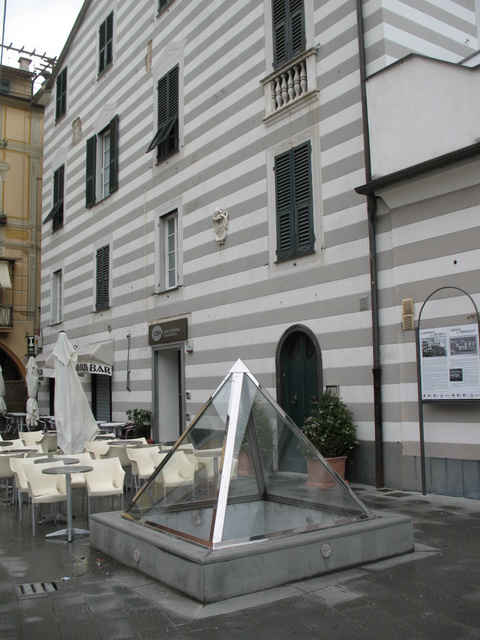
I.M. Pei has probably never visited Rapallo, but that hasn’t kept us from having our very own pyramid, which is quite reminiscent of the glass pyramid Pei designed for the Louvre Museum in Paris. Well, no, ours isn’t quite as large, but it does make its own quiet statement in the square on the Lungomare that holds the newly renovated bandstand.

In fact the whole of the piazza has been renovated over the last year or so, and that is why we have the pyramid in the first place.  It used to be that delivery trucks and cars could drive and park around the band shell; the road surface was removed and the piazza has been turned into a quite lovely pedestrian zone. While they were excavating the old road they came upon some stonework from the port, back when the sea came up almost to the buildings.  In the intervening years the Lungomare road and its neighboring broad seaside passagiata were built, evidently right on top of what was there before. Here’s what you see if you peer into our pyramid:

That’s a nice bit of stonework, isn’t it?  I would imagine the rusty hardware is an old mooring ring.  I think it’s great they took the trouble to preserve and show all of us a bit of maritime history. It would’ve been easier simply to cover it all up again.

Well, maybe it’s not quite as exciting as the Louvre.  But whenever I’m revisited by my lifelong and thus far unrealized wish to visit Egypt, I just go down to the Lungomare and gaze at the pyramid.

Il Molino Vecchio – The Old Mill

26 Sunday Sep 2010

Posted by farfalle1 in Italian folk tales, Italian habits and customs, Italy, Liguria, Photographs, Rapallo, San Maurizio di Monti, Uncategorized

≈ 20 Comments

Tags

Chestnut mill, Chestnuts, Giovanni Pendola, Italian frantoio, Italian molino, N.S. della Cipressa, Old Italian mill, Olive mill, Wheat mill

Sometimes it happens in Italy that you’re walking down a street, a lane, or a path in the country, and you come upon something that sends you back, in your mind’s eye, a few hundred years. “I can just imagine,” you say to yourself, “what it would have been like to be alive when this place was new and bustling with life.”

It happened to me not long ago when I took a walk with a friend. We came to the old and interesting Complesso Molitorio (Mill complex), which lies on a sentiero (walking path) that connects San Maurizio di Monti to Rapallo along the San Francesco torrente (fast flowing stream), on the opposite side of the narrow valley from the paved road.  The sentiero is not particularly well known, and does not appear on the trails map for this area. To reach it from San Maurizio you walk down what begins as an ever more narrow residential street, which finally turns itself into a path. From Rapallo the route begins on a paved street but soon takes the form of an old mule path which climbs and winds through the forest. According to the website lacipresse.it, the path is known as “Strada Antica di Monti,” a part of the “Antica Via del Sale” (The Old Salt Road – why there was a Salt Road here I have not been able to learn).

The Mill complex is comprised of four buildings, three of which you can see in the photo above. The large building in front was constructed in the 17th century and was an olive mill. A wheat mill was housed in the smaller building on the left; and the small building up above the others was a chestnut mill. The fourth building, not much more than a room really, is behind the large main building, and was used for collecting the refuse of the olive pressing.

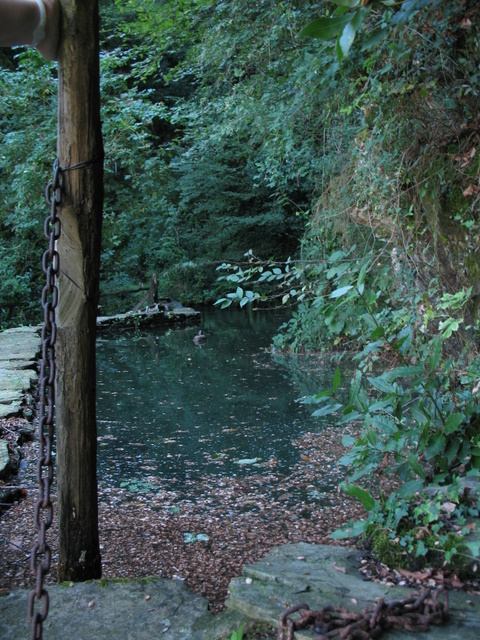
The San Francesco feeds a mill pond above the highest building:

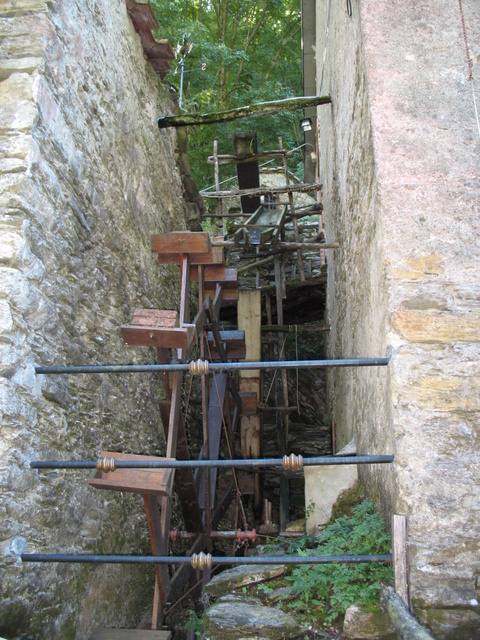
The water can be directed down an earth and stone canal to tumble into the waterwheels that powered the various milling operations:

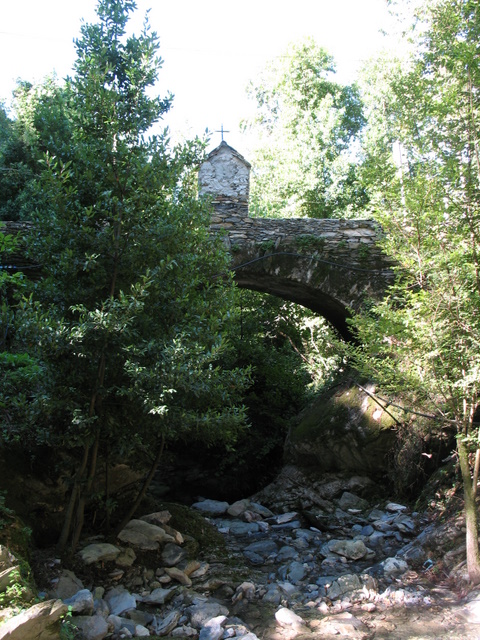
The oldest structure in the complex is the old stone bridge that crosses the San Francesco, built in the Roman style, quite possibly during Roman days.

The little chapel on the bridge, a recent addition, honors the Madonna of Montallegro and is called Nostra Signora della Cipressa.   According to the story, there was a chestnut tree that stood nearby. One day, during the plague years, the tree suddenly died – in just the one day! The belief is that the tree, through the intercession of the Madonna, absorbed the deadly disease and rendered it harmless, thereby saving the citizens of San Maurizio di Monti. (For more about the Madonna of Montallegro and the plague, see here).

There have been several re-structurings of various elements of the complex, including one in the early 18th century, one in the 1920’s, and another in the early years of this century . During the recent renovations the large building was turned into a museum, Il Museo della Civilta’ Contadina “Cap. G. Pendola” – the Museum of Rural Culture (named in honor of Giovanni Pendola, a heroic Captain in Garibaldi‘s Army). In it you will find old implements that farmers employed to wrest a livelihood from these steep hills, as well as accouterments of the mills themselves. It is open on the third Sunday of each month from 3 – 5 p.m., at which time a very well informed docent can explain the uses of the various tools, and tell about each of the buildings. (The renovations in 2001 won Second Prize in the 2003 Concorso  “Ama il nostro paese” – love our country – sponsored by the City of Rapallo and the Rapallo Lions Club.  In 2006 the Complex was designated a National Monument.)

Some centuries before our mill, but I like the image!
Although the mill was still functioning as late as 1940, it is much more fun to imagine what it would have been like in, say, 1750. You’ve gathered all the chestnuts in your part of the woods, have dried them over a smoky fire and have thrashed them out of their husks.


Now you put them in barrels that are firmly strapped, one on each side, to your mule. Slowly and carefully the two of you make your way up the path, your mule finding a careful foothold between the upturned stones on the steep parts of the road. You hear the mill before you see it; the water is rushing down the canal and the big wheel is squeaking a little as it turns. When you get a little closer you can hear the big gears groaning and clicking as they engage. There are a lot of other people there with their chestnuts, too. Chestnut flour is a staple, and a good crop might form the basis of your family’s diet for much of the year. (For an interesting article on historical food uses of chestnuts, look here.) While at the mill you have a chance to exchange gossip with neighbors you haven’t seen for a while and to catch up on the news of the town below. After you’ve left your chestnuts to be ground into flour, you might continue up on the mountain to give thanks at Montallegro for a good harvest, and to ask the Madonna to protect you through the short winter ahead.

There’s another great story associated with the mills. The present owner’s grandfather, the  Giovanni Pendola for whom the Museum is named,  was the owner of the mill in 1907 when he went to Genova to take aid to the victims of a cholera epidemic there. He contracted the disease himself, and died soon afterwards. His true love, a lady named Caterina who was, they say, still beautiful, lost her will to leave her house when she received the news of his death. Then, taken by an irresistible urge for freedom, she became a wild creature of the woods.

Painting by Patrick Soper, soperstudio.com

Still today, disguised as a fox with a soft tawny tail, she wanders during the coldest days, “those of winter when the cold north wind blows, or when windy gusts blow the last dry leaves, and the bare, rattling branches of  trees reach to the sky like imploring arms.” The tradition says that if you meet this fox and look into her eyes, you may lose your memory or be swallowed up by the woods.

If you’d like to see some more pictures of the mill, click here.  Click on ‘slideshow.’

Many thanks to the website lacipresse.it, from which I learned the content of this post.

Kumquats

19 Sunday Sep 2010

Posted by farfalle1 in Italian recipes, Uncategorized

≈ 6 Comments

Tags

Kumquat chicken, Spicy chicken with kumquats

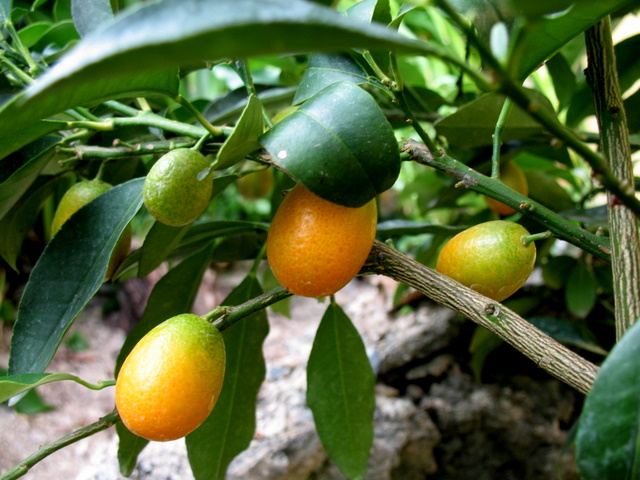
Kumquats are amusing because they are made inside out. Though they appear to the observer to be a normal, if rather small, citrus fruit, it becomes clear immediately to the eater that they have sweet skins and a very tart interior. Ha ha.

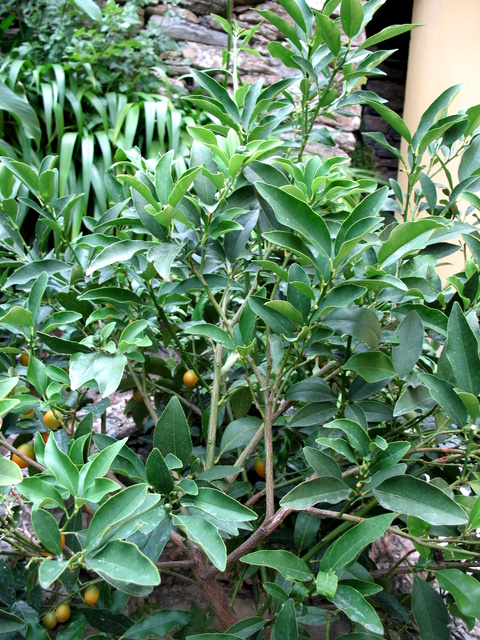
Wikipedia tells us that “they are slow-growing evergreen shrubs or short trees, from 2.5 to 4.5 metres (8 to 15 ft) tall, with sparse branches, sometimes bearing small thorns. The leaves are dark glossy green, and the flowers pure yellow, similar to other citrus flowers, borne singly or clustered in the leaf-axils. The kumquat tree produces 30 to 50 fruit each year.[dubious – discuss] The tree can be hydrophytic, with the fruit often found floating on water near shore during the ripe season.[citation needed]” I can’t speak for the hydrophytic (growing in water) nature of the tree, but the information on fruit production is dubious indeed. We have a very nice, short kumquat tree that we planted in ordinary garden soil a couple of years ago, and it gives us more fruit than we can count. Here is a photo of it after our most recent harvest:

“The plant is native to south Asia and the Asia-Pacific,” continues Wikipedia. “The earliest historical reference to kumquats appears in literature of China in the 12th century. They have long been cultivated in Japan, Taiwan, the Philippines and southeast Asia. They were introduced to Europe in 1846 by Robert Fortune, collector for the London Horticultural Society, and shortly thereafter into North America.” Their late arrival may account for the fact that they are not a particularly well-known or frequently grown garden tree in America. And their unusual taste guarantees that they are not going to be in a bowl on everyone’s table.

There are only so many one can eat in passing. Eating a kumquat really does wake you up. First you say, oooh, sweet. Then you say, yikes! sour!! A kumquat is a truly happy marriage of sweet and sour, in a pre-packaged and ready to eat form.

So what does one do with all the kumquats? We have asked ourselves that very question, but we are hardly the first to do so. Marmalade is the obvious answer, but we passed this year. Our shelves are already groaning under the weight of cherry, apricot and plum jam; we don’t need more jam. The people at Chow.com have some great answers to the question, all the way from soup to nuts… or at least from salad, through main course to dessert, with a nice rum drink to wash it all down.

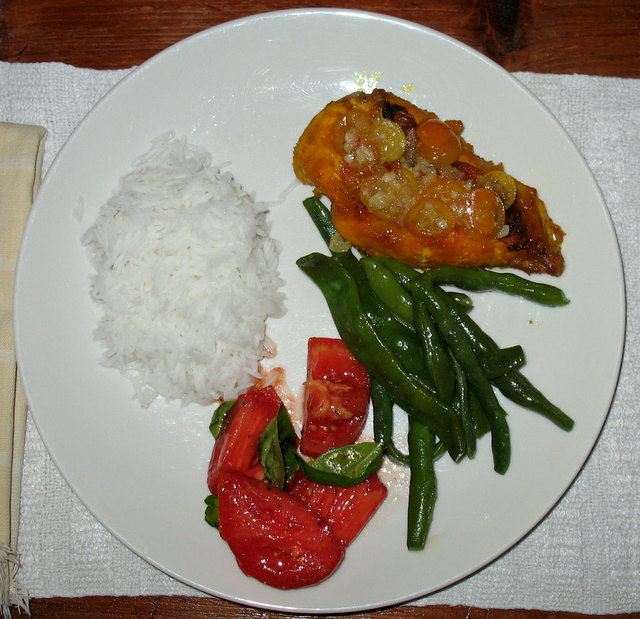
The Captain found and adapted a delicious and unusual chicken dish that uses kumquats on the epicurious web-site.

You can find the recipe here, or over on the right in the recipe index.

But whether you look at the recipe or not, I hope some day you’ll have a chance to eat some kumquats. They’ll make you sit up and say ‘howdy!’

Patience

06 Monday Sep 2010

Posted by farfalle1 in Italian habits and customs, Uncategorized

≈ 16 Comments

Tags

Lines in Italy, Waiting, Waiting in Italy

Patience is a virtue,
Posess it if you can.
It’s always found in woman
And seldom found in man.

My aged granny taught me that little bit of doggerel about a hundred years ago.

Patience.  If you are dreaming about moving to Italy, or even just having a visit here, it is a virtue you might want to cultivate.  One must wait in lines for everything here, from the Post Office to the Train Station Ticket Counter (allow extra time if you need to purchase train tickets at the station) to, always and ever, the food stores.  I’m always amazed at how patient everyone is as they shuffle slowly forward in whatever line they’re in.  Once a friend came late for tea, telling us that she had had to wait an hour at the Post Office.  An hour.

This is something that’s hard for Americans to wrap their heads around.  If there are more than three or four people ahead of us at the supermarket we become restive – quick! Open another register!

But with a slight attitude shift the lines and the waiting become rather fun.  First, they give a great opportunity for people watching.  Second, they give you the chance to remember the thing you forgot to get (if you’re at the market).  Third, they give the time to practice what you need to say in Italian (at the Post Office).  If you’re into meditation, the line is a great place to zone out and ommm for a while.

Also, the take-a-number system employed by many stores, offices and (hallelujah!) the Post Office now ensures that people are served in the order in which they arrived… or at least in the order in which they thought to take a ticket.  There’s something demoralizing, however, in taking a ticket at the deli counter and realizing that there are 18 people ahead of you.  But it’s better than the unchecked chaos that used to reign.

At the top is a photo of all the people waiting to check out at a nearby Ipercoop.  Granted it was a Sunday, so the store was quite crowded.  Che casino! as they say here – what a mess.  There were trolleys every which way, people with hand baskets and strollers trying to navigate through the lines, other people trying to sneak into the middle of a line.  What an adventure.  The postures of the women in the foreground tell the whole story: these are not people who are moving smartly along; these are people who are waiting.  What I said above about the waiting being fun?  I lied.  It really isn’t all that much fun, especially if it drags on for 20 minutes, as in the picture above.

Bells and Dogs

30 Monday Aug 2010

Posted by farfalle1 in Animals in Italy, Dogs, Italian Churches, Rapallo, San Maurizio di Monti, Uncategorized

≈ 8 Comments

Tags

Campanile, Church Bells, Howling Dogs

We’re bell-proud here in San Maurizio.  The church which serves this village of 500 people has six bells in the campanile.  Day and night the bells toll the hour in the usual fashion; or almost the usual fashion.   After ringing the appropriate number of times for the hour, the whole thing is repeated again three minutes later; maybe we’re particularly inattentive up here on the hill.

In addition to the hours, the bell rings once on the half hour.  This is fine for most of the day, but it leaves us unsure in the middle of the day and the middle of the night: 12:30, 1:00 and 1:30 all sound exactly the same, both a.m. and p.m.

Twice a day there is some bonus bonging.  At 7 a.m. and again at 8 p.m. a slightly deeper bell rings  50-60 times between the two soundings of the hour.  The reasoning for this, I’ve always imagined, is to say, in the first instance, “Hey, it’s time to go outside and start your work.  Get going!”  and in the second, “Okay, quittin’ time; dinner’s ready, home you go.”  Then on Saturdays and Sundays, and sometimes on Thursday afternoons the bells play a short selection of tunes, most quite jazzy.  Of course there is also extra ringing for weddings (few and far between) and funerals.

There is something awful about this for dogs.  The normal ringing of the bells doesn’t elicit any canine response, but the sonic frequency of the extra long, low peals as well as the songs must hurt their ears.  North, south, east and west, they all start to bark, howl, squeal and moan.  Every dog in town weighs in saying, “ow, ow, ow – stoooop!”  Finally the bells stop and so do the dogs.

There’s a sound clip of one of the regular tunes our bells play here. If you listen carefully you may hear some canine dissent.  Apologies for the quality of the video – my camera isn’t really designed for it, and I’m a bit jiggly at the start.

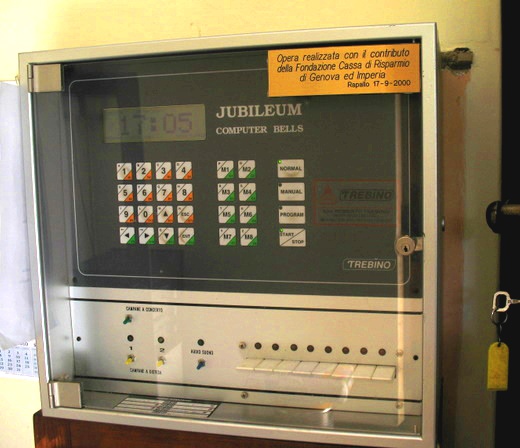
Don’t you have an image of a monk, robes flying, racing from one bell pull to the next to play so fast?  Or perhaps several, trying not to trip over each other?   Or maybe a Quasimodo figure up amongst the bells themselves, ringing them with a big mallet, as if they were a xylophone?  Alas, those days are over.  The bell ringing is done by computer.  There’s a control box under the bell tower, and the priest can select the music he wants to play.

The dogs don’t care how it’s done.  They just don’t care for it.

Marcus of Umbria

26 Thursday Aug 2010

Posted by farfalle1 in Animals in Italy, Dogs, Italian men, Italian women, Italy, Uncategorized

≈ 15 Comments

Tags

Books, Books about Italy, Collelungo, Dogs, Justine van der Leun, Marcus of Umbria

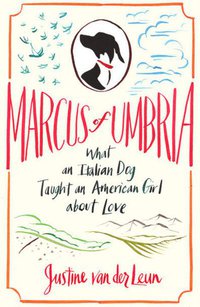
Book Jacket by Andre Mora

Seldom do I receive an offer to review a book; this was certainly a title I couldn’t resist accepting.  If you love Italy, dogs or both, you won’t want to resist reading it yourself.

Justine van der Leun is a young woman who knows what she wants, whether it’s walking on two feet or four.  Sometimes when she gets what she wants it turns out that she doesn’t want it after all (handsome Italian lover, horse), but sometimes when she gets what she wants it turns out to be life-altering (Marcus).

Justine moves to Italy to live with a man she’s known all of three weeks in the small Umbrian town of Collelungo, population hovering around 200.  There she quickly learns that she has not taken on just the man, but his entire family as well, and they have taken her on, too.  Without a strong extended family background of her own, the realities of an Italian family are a shock to our heroine, and one to which she can never entirely adapt. (There’s a lot here about the strength of the matriarch in the Italian family.)  Also shocking is for Justine to see Italy as it really is, not as we imagine it from movies and other move-to-Italian-paradise books.  Justine may have come to Italy, but it was no paradise.

She remains in Collelungo a year, during which time she adopts a darling but challenging canine whom she christens Marcus. (You’ll learn quite a bit about the rather unfortunate circumstances of Italy’s hunting dogs.)  Despite the doggy title, Justine ends up learning a terrific amount, not just about love but about life, from the family and from the town.  Even more, she learns to know herself a lot better.  That journey is the heart of book, and it is a delight.  Strong-willed, intelligent and, perhaps, a bit privileged and naive, Justine is thrown into a situation where people still kill their own food, where self-sufficiency is a way of life and a point of honor.  She has the grit , humor and humility to absorb the lessons that are offered by the experience.  She’s a modern, witty young woman, and she’s a terrific writer.

What I enjoyed most about the book is that it shows Italy as it truly is in a great many places.  She lived in the ‘real’ Italy, not the Italy of the touristic centers of  Venice, Rome, Florence, not the Italy of ‘Chiantishire’ in Tuscany, or the sun-drenched Riviera.  People in Collelungo are patient, they are sometimes slow, they work incredibly hard, they probably know how to hold a grudge.  Because they live in a town of only 200,  there is nothing they do not know about their neighbors, whom they are very likely to accept just as they are, and they have no secrets of their own. They are not sophisticated, traveled, particularly well-schooled (though some of the young now are); they remember what it was like to be impoverished.  But they know how to laugh, cook, eat, fight, and laugh some more.  As Justine says, they have tailored their expectations to what they have; they are happy.

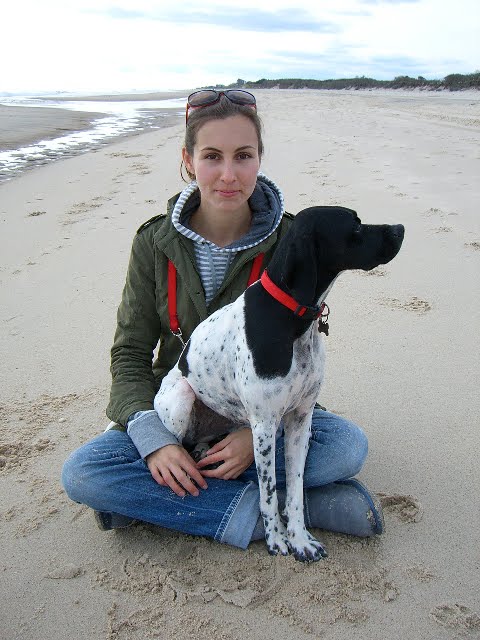
Photo by ?

And what about Marcus?  She (yes, she) is the agent of Justine’s greatest lesson: responsibility for our actions.  As she herself says, “I had willfully shifted another being’s course, and that meant that I was technically morally bounded to ensure her well-being for a lifetime”.  That doesn’t stop her from making a few more blunders, but one of the most refreshing aspects of this book is the humor with which Justine is able to admit her own shortcomings.

No, she’s not perfect; and neither is Italy or Umbria or her boyfriend and his family, or Marcus (bit of a chicken issue there).  But they all have something wonderful to offer and Justine is smart enough to take it all in.  Her boyfriend’s family, the Crucianis, are as warmly and honestly drawn as is Italy.   And always there’s the sense of humor.

There’s nothing pretentious about Justine van der Leun or her book.  I don’t know her, but having read the book I feel like she’s a friend.  I think you’ll like her too.

No Bad Dogs

22 Sunday Aug 2010

Posted by farfalle1 in Animals in Italy, Dogs, Italian festas, Italy, Liguria, Photographs, Uncategorized

≈ 16 Comments

Photo taken by by Pier Luigi Baglioni

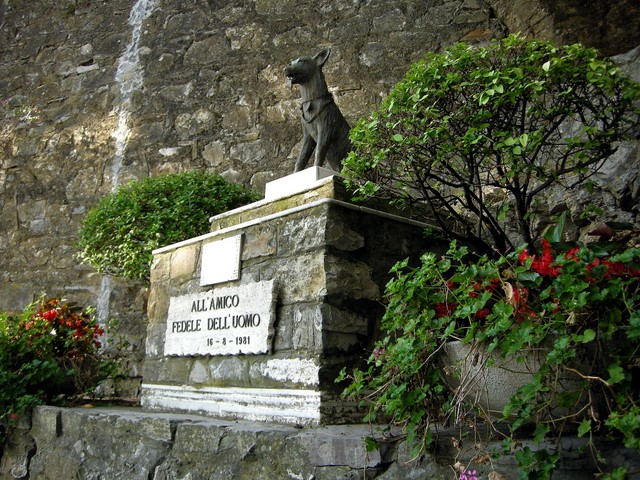
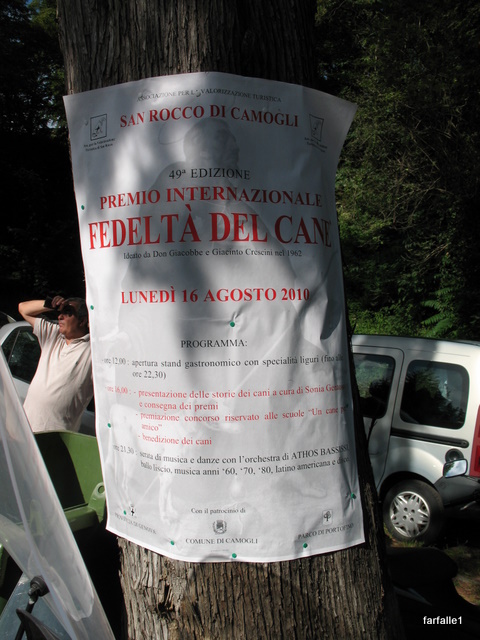
San Rocco di Camogli is a lovely frazione high on the hill overlooking its mother town.  The Saint for whom it is named is, rather alarmingly, the patron saint of contagious diseases.  He lived in the 1300’s and helped plague victims during his travels from his native France through Italy.  At one time he himself contracted the plague, and was saved in part by a dear dog who brought him crusts of bread in a cave where he’d taken shelter.

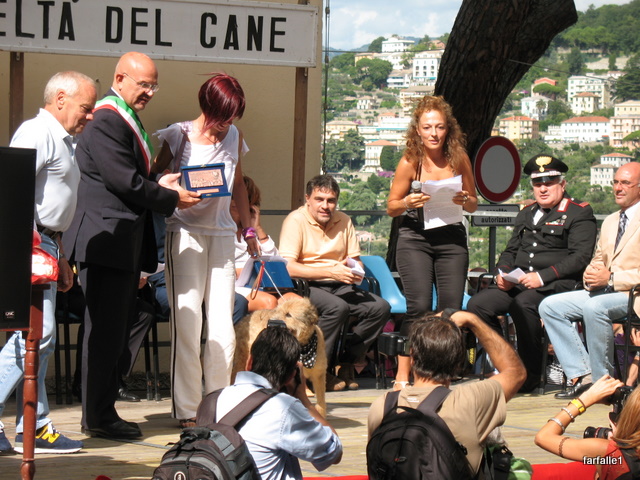
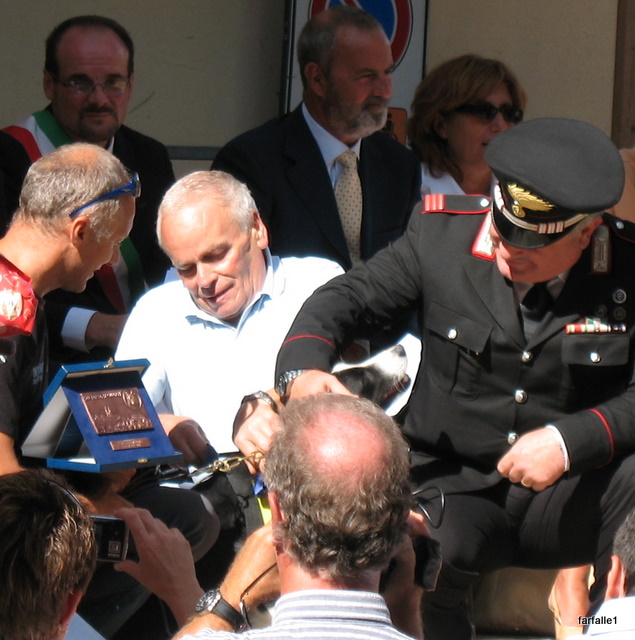
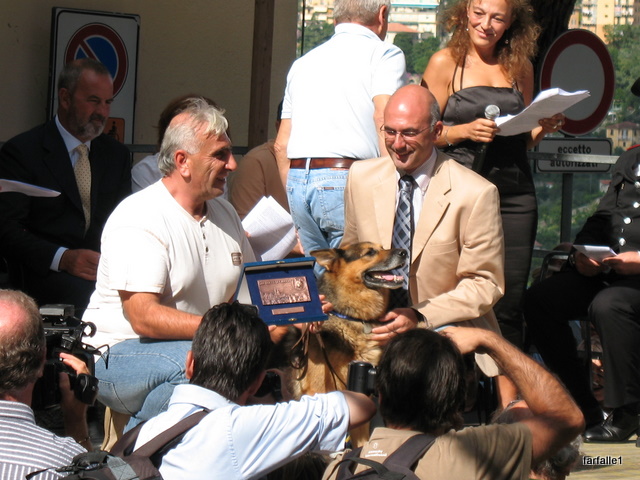
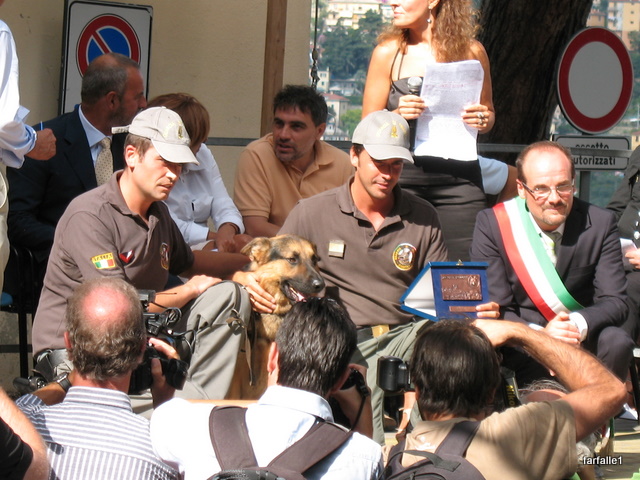
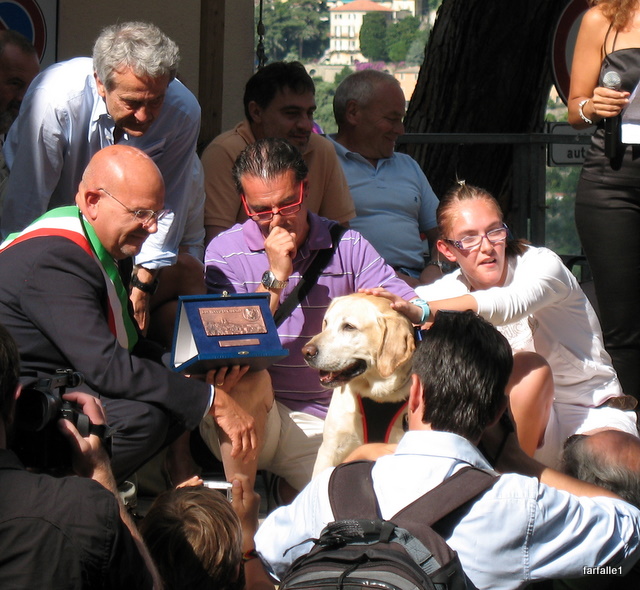
San Rocco’s day is August 16, and for 49 years now the eponymous town has given prizes to reward acts of bravery and courage by our four-footed friends, and to bless the species.As you can see from the photo above, it is exhausting!  But if you are a dog-lover it is a wonderful event to attend.  This year the weather smiled on the many dogs and even more people who came to meet the prize-winners and receive a blessing for the year ahead.  Sonia Gentoso was an excellent Mistress of Ceremonies; without leaving out any important information she managed to keep things moving in as orderly a fashion as possible, given the number of dogs present.  There were a number of important people on the dais for the ceremony, one in an impressive uniform and one with a very handsome ribbon across his chest (probably the sindaco – mayor – but I’m not sure).

The prize-winners were:

Antares.  Antares was not present to receive her prize, although one of the women in her story was there to accept it for her.  Antares usually spends her mornings with her ‘Nona’ while her mistress is at work.  She goes to the second floor and barks outside Nona’s door until she is let in.  One day a neighbor, familiar with this practice, heard Antares barking in the middle of the morning.  Strange, she thought – why is the dog barking now?  So she called the Nona and found that she was very ill from a hemorrhage.  The neighbor called the ambulance, and thanks to the early notice of trouble from Antares, the Nona did not suffer long-term consequences.

Bimba

Bimba saved her family in Genova from a fire.  Awakened in the garage where she sleeps by the smell of smoke, she made her way to the upstairs of the house and barked and scratched on the door until her master awoke and was able to get his wife and 4-year old daughter safely out of the house. But poor Bimba!  She was pregnant at the time, and because of the stress she gave birth later that night to a dead puppy.  The vet was able to safely deliver her of two healthy pups soon afterwards though, so the story has a happy ending for all.

Cody

Cody works with the Scuola Provinciale Cani da Ricerca di Trento and is an ace at finding people who have gone missing.  She did some very unhappy work in Abruzzo after the terrible earthquake.  She won her prize for an event with a happier outcome: an old gent wandered off from the rest home where he lives and was missing overnight.  Cody found him in the woods the next day.  Thanks to her, he did not come to any great harm.

Fado

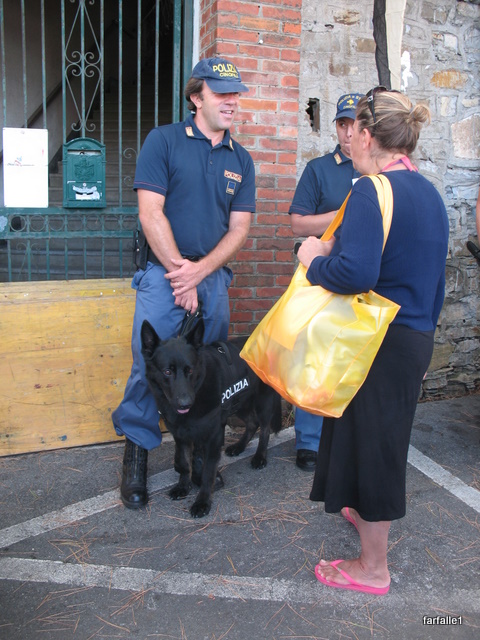
Clever Fado works with the Polizia di Stato in Genova as a drug-sniffer.  He recently found 5 kilograms of cocaine.

Ioda

You’ll have to look hard to find Ioda, but she’s there.  She won her prize for dragging her master away from the path where they were walking in Monza moments before a huge plane tree fell right where he had been standing.  Because of her, he suffered only some minor cuts instead of being completely crushed.

Lily.  Alas, my photo of Lily did not come out, a pity.  Lily is a 2-year old border collie from Belluno.  Lily works with her master, a volunteer of Soccorso Alpino di Agordo.  A Polish skier was caught in an avalanche and buried under a half-meter of snow for 35 minutes.  Lily found the skier and he was rescued, not long before his supply of air would have run out.

Rocky

Rocky made an incredible journey.  He was abducted from the beach while his master was bathing near Carrara three years ago.  Eventually he ended up in Salerno where he was abandoned by the nomads who had stolen him, and adopted by a kind family there.  But he kept running away, always heading north.  Eventually he left them a final time and made his way to Pisa, where a woman found him.  His collar gave the number of the family in Salerno and she called them.  They said, he is a lovely dog and we love him but he has never adapted to living with us, you keep him.  So she took him to a vet, who found the tattoo identifying his original owner.  They were reunited after 3 years.  It took Rocky 2 months to travel the 625 kilometers from Salerno to Pisa.

Talon

Talon works with the Guardia di Finanza in Genova and is another drug-sniffer.  He recently discovered 7 kilograms of marajuana and 3.5 kilograms of cocaine.

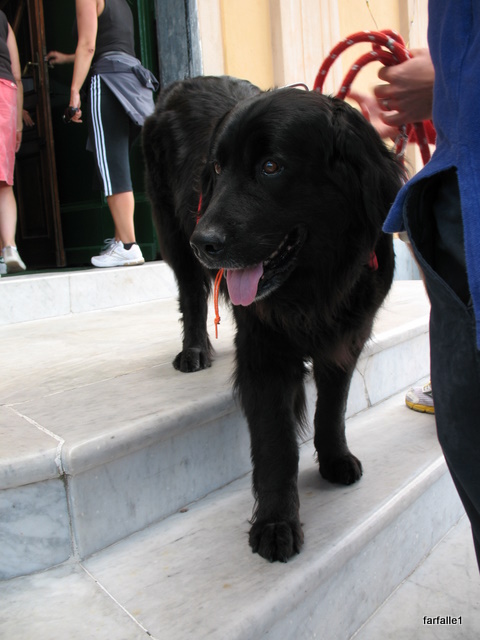
Zoe

Zoe, a 7 year-old Newfoundland, saved three swimmers near Pisa.  Two women were swimming with the 11-month old child of one of them when they were carried away by the swift current.  They shouted for help, and were some 80 meters from the shore when the life-savers and Zoe reached them and brought them to safety.

First Prize winner was Pongo

Pongo was walking with her master near their home in Settimo Milanese when they heard the cries of a 67-year old man who had slipped on the edge of a canal and fallen several meters into the water and mud below.  Though the water was not deep (40 cm – a bit more than 3 feet) the man was too stunned to extricate himself from the mud, and could only moan for help as he commenced drowning.  Pongo’s insistance on dragging his master to the edge of the canal undoubtedly saved the life of the poor man below.

There was the 4th Annual edition of an art contest for young people in conjunction with the event.  This year’s theme was -Un Cane per un Amico – a dog for a friend.  The art was charming, of course.

If you’d like to see some more photos of the event, click here for a web album.  As usual I recommend a slide show.

A dog’s life in Italy can be pretty comfortable; Italians dote on and respect their dogs, although they do not always train them well, and they almost never castrate or neuter them.  In America if you are a mixed breed dog, you are a mutt; in Italy, you are a ‘fantasia.’ I know which one I’d rather be!

Mobster Caught by a Plate of Spaghetti

18 Wednesday Aug 2010

Posted by farfalle1 in Crime, Customs, Italian men, Italian women, Uncategorized

≈ 14 Comments

Mobster undone by love of mamma’s cooking

Fugitive Camorra clan suspect captured while tucking in

17 August, 17:10

Mobster undone by love of mamma's cooking

(ANSA) – Naples, August 17 – A suspected member of the Neapolitan mafia, the Camorra, has been arrested by Italian police after being unable to resist his mother’s culinary delights.

Rosario Scognamillo, a 39-year-old suspected of being a high-ranking member of the Grimaldi Camorra clan, was captured by agents Monday while having lunch at his mother’s home.The man, who is accused of criminal association related to drugs trafficking, had been on the run since May. He may have thought his return home would not be noticed with many Italians relaxing on their summer holidays at the moment.

The above was in the English section of the morning’s ANSA web-site. Could there be anything that speaks more clearly of the Italian male’s love of his mother and her cooking?  I imagine she was doing his laundry while he ate, before heading over to the hideout to give it a good clean.

We have frequently been struck by the way Italian parents serve their children.  It is sweet and loving, but we’re not sure it’s doing Italian boys any favors.  According to an NBC report, more than half of Italian men between 25 and 35 years old still live with their parents.  The young women I know tell me they do not want Italian husbands – they are too spoiled.  I wonder if the same thing is going on in the US?

In any case, it certainly makes the job easier for the police, doesn’t it?

Tile Town

15 Sunday Aug 2010

Posted by farfalle1 in Italian Churches, Italy, Photographs, Uncategorized

≈ 9 Comments

Tags

mosaics, Ravenna, Theodoric

Nothing gets us stirring and away from our hillside like the arrival of curious company.  My sister, planning her visit, had requested a trip to Ravenna to see the incomparable mosaics there.  Fresh from a visit to Turkey she was eager to compare Italian Gothic and Byzantine art to that of the Ottoman Empire.  The Captain and I visited Ravenna a few years ago and enjoyed it immensely, so it took no arm-twisting at all to get me tapping away for reservations on Venere.

Although the city is across the boot, just a few miles from the Adriatic, it is a pretty and easy drive of only about 3.5 hours to get there from Rapallo.  In fact, years ago Ravenna was on the Adriatic.  Silt buildup since the year dot has now stranded the town some four miles from the sea.

We spent two nights in a lovely hotel, the Palazzo Galletti Abbiosi, which is centrally located, comfortable and has a terrific staff.  It was simplicity itself to walk from our digs to all the major sights in the city.

Ravenna offers tourists free bicycles!  We didn’t stumble on this great opportunity ’til our last day, but it is definitely the best way to get around this flat town.  Leave some identification and fill out a form at the Information Bureau and you will be given the key to your very own bike.

Happy sister with free bicycle

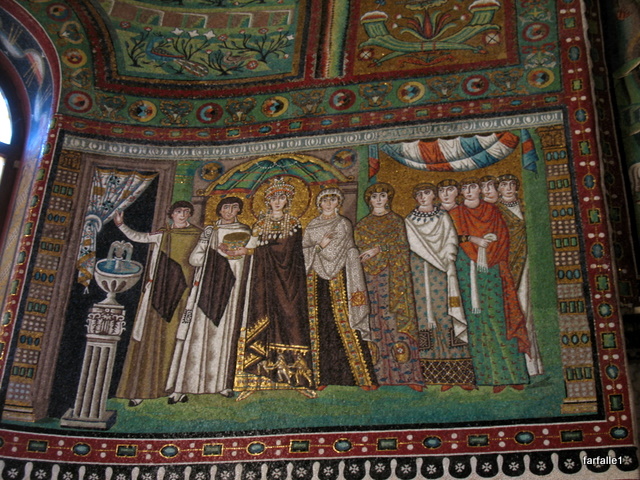
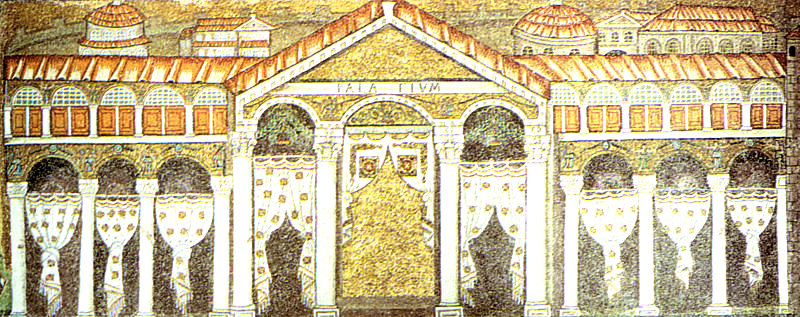
Ravenna is most famous for her mosaics, some of which date from  the early 5th century CE.  Theodoric,  leading an army of Ostrogoths, conquered the city in 493, beginning an enlightened and wise 33-year reign which saw extensive land reclamation and an enormous amount of construction.  Amongst his projects was his residence, The Palatium (now gone, but we know what it looks like from a mosaic):

(Interesting fact: after the death of Theodoric and a 9-year reign by his daughter, the Byzantines under Belasarius wrested control of the city from the Ostrogoths.  They removed what they could of Gothic images from the mosaics; in the photo above, for instance, figures have been replaced by curtains.)

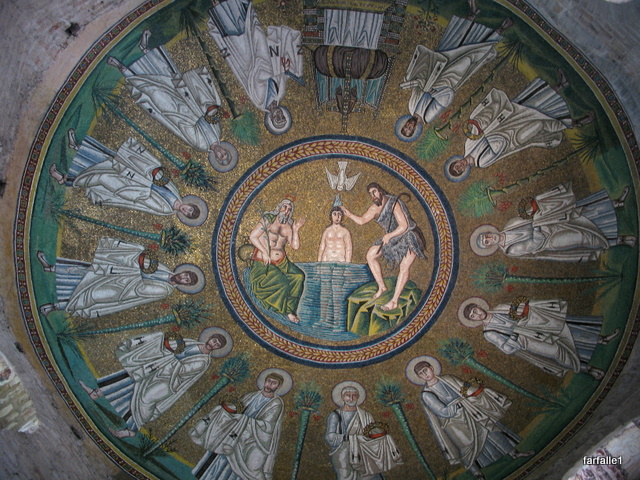
Others of Theodoric’s grand buildings include the Anastasis Gothorum, now the Church of Spirito Santo; and the incredible Basilica Sant’Apollinare Nuovo. (Theodoric was an Arian, that is he followed the teaching of Arius which had been condemned by the Council of Nicea in 325).

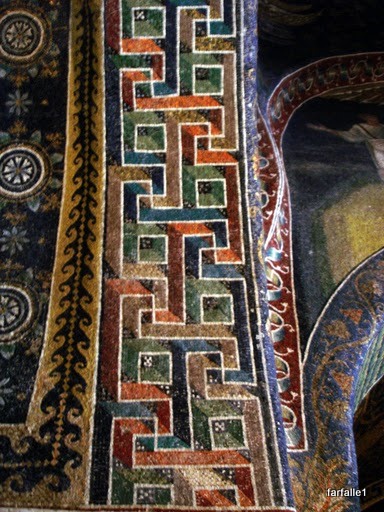
Ravenna’s concentration of Gothic and Byzantine mosaics is astonishing – and breath-taking.  There are several different ways to make mosaics; the ones in Ravenna are done in the most difficult way: the stones are placed directly into the wet cement on the wall or floor.  A special fast-drying cement was used,  so only a small section could be tiled at one time.  It’s hard (impossible?) to imagine how the artists could get such subtle variation in color tones, express such personality, and make such complicated geometric patterns when they could do only a little bit at a time and were using only small chips of colored stone, glass or gems for their medium.  I suppose they laid everything out ahead of time, but still…  it is all amazing and very beautiful.

Baptism of Christ, Arian Baptistry

Perhaps altered and renamed portrait of Theodoric, photo by Pidge Cash

Galla Placidia, photo by P. Cash

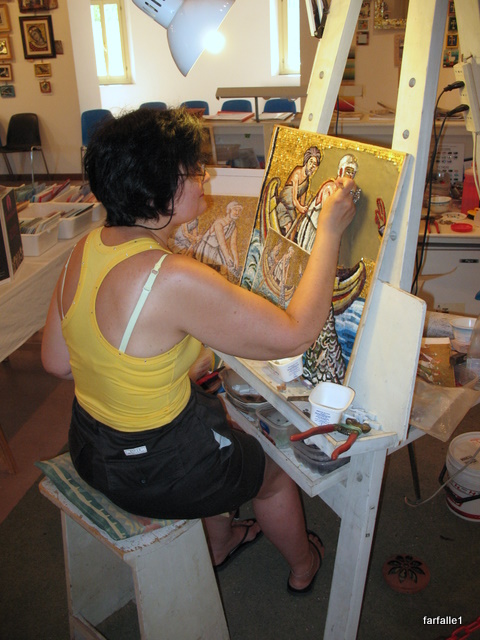
Other mosaic methods include sticking paper to the right side of the tiles with a soluble glue, mounting the tiles bottom side in the cement and then soaking off the paper and glue when the cement has dried; or sticking the tiles right-side up into wax and applying the cement afterwards, then mounting the whole on the wall or floor.  This very kind woman explained it all to us as she worked away on her own replica of an ancient mosaic:

The thing that is so difficult to fathom is the teeny size of the tiles used in the mosaics, and the snugness with which they fit together.  It’s enough to make one blind just watching a demonstration like the one above, never mind trying to make a mosaic oneself.

There is so much to see in Ravenna, and we saw almost all of it.  At the bottom of this post there is a list of monuments (eight in Ravenna are World Heritage Sites) with links for history and photographs.  Here is a link to my own web album from our trip.

But traveling in Italy is not just about seeing the beautiful art and learning some of the long and varied history of the country.  There is always Food (and it does have a capital ‘F’ in this country).  And there are always, and for me most interestingly, the people.  We had an experience in Ravenna which I’ve had once or twice before in Italy, but never in the US.

Our map-reading skills are not especially stellar, and at one point we found ourselves – or rather we lost ourselves – not knowing exactly where we were or how to get to the church we wanted to visit.  We were next to a shady park where two elderly gents were having a natter under the trees.  I brazenly interrupted them to ask directions; there ensued a long conversation between them about the best way to direct us, having quite a bit to do with a fruit store.  Finally they bid each other farewell, and one of them said, “Come with me.”  He then walked with us for ten minutes, depositing us on the threshold of our destination.  Evidently that was a lot simpler, or perhaps  more interesting, than just giving directions.  What a doll.

Salvatore and dog Willy, photo by P. Cash

Here is a linked list of the principal sites in Ravenna:

Mauseleum of Galla Placidia**
San Vitale**
Church of the Spirito Santo and the Arian Baptistry**
San Giovanni Evangelista
Sant’Apollinare Nuovo**
Sant’Apollinare in Classe *    **
Cathedral
San Francesco
Neonian Baptistry**
Archepiscoal Chapel**
Mauseleum of Theodoric**

* This beautiful Sant’Apollinare is in the town of Classe (which was a port city), located about 5 km from Ravenna proper.

** World Heritage Sites, built in 5th and 6th centuries

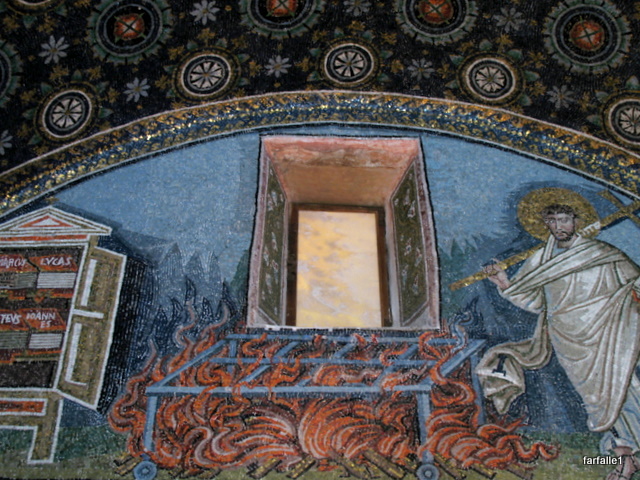
And finally – one of my favorite mosaics:

Hellfire in the Mausaleum of Galla Placidia

PS – Pat Smith has written here, in the Italian Notebook, about Orsoni, the company that makes the glass tiles that are used by many mosaicists.

PPS – Debra and Liz of the blog Debra and Liz’s Bagni di Lucca visited Ravenna in April. You can read their account and see their photos here, here, here, here, here and here.

← Older posts
Newer posts →

Enter your email address to follow this blog and receive notifications of new posts by email.

Join 114 other subscribers

rss

Subscribe in a reader

Search the Blog

A. Useful Links

  • bab.la language dictionary
  • Bus schedules for Tigullio
  • Conversions
  • English-Italian, Italian-English Dictionary
  • Expats Moving and Relocation Guide
  • Ferry Schedule Rapallo, Santa Margherita, Portofino, San Frutuoso
  • Italian Verbs Conjugated
  • Piazza Cavour
  • Rapallo's Home Page – With Link to the Month's Events
  • Slow Travel
  • The Informer – The Online Guide to Living in Italy
  • Transportation Planner for Liguria
  • Trenitalia – trains! Still the most fun way to travel.

C. Elaborations

  • A Policeman’s View
  • Driving School Diary
  • IVA refunds due for past Rifiuti tax payements
  • Nana
  • Old trains and old weekends
  • The peasant, the Virgin, the spring and the ikon
  • Will Someone Please, Please Take Me to Scotland?

D. Good Recipes - Best of the Week winners are starred

  • 'Mbriulata
  • *Baked Barley and Mushroom Casserole*
  • *Captain’s Boston Baked Beans*
  • *Crimson Pie*
  • *Louise’s Birthday Cake*
  • *Melanzane alla Parmigiana*
  • *Penne with Cabbage and Cream
  • *Pizzoccheri della Valtellina*
  • *Pumpkin Ice Cream*
  • *Risotto alla Bolognese*
  • *Rolled Stuffed Pork Roast*
  • *Spezzatini di Vitello*
  • *Stuffed Grape Leaves*
  • *Stuffed Peaches (Pesche Ripiene)*
  • *Swordfish with Salsa Cruda*
  • *Tagliarini with Porcini Mushrooms*
  • *Tagliatelli al Frutti di Mare*
  • *Three P's Pasta*
  • *Tzatziki*
  • 10th Tee Oatmeal Apricot Bars
  • Adriana’s Fruit Torta
  • Aspic
  • Bagna-calda
  • Best Brownies in the World
  • Clafoutis
  • Cold cucumber soup
  • Crispy Tortillas with Pork and Beans
  • Easy spring or summer pasta
  • Fish in the Ligurian Style
  • Hilary's Spicy Rain Forest Chop
  • Insalata Caprese
  • Lasagna al forno
  • Lasagna al Forno con Sugo Rosato e Formaggi
  • Lemon Meringue Pie
  • Leo’s Bagna Cauda
  • Leo’s Mother’s Stuffed Eggs
  • Louis’s apricot chutney
  • Mom's Sicilian Bruschetta
  • No-Knead (almost) Bread
  • Nonna Salamone's Christmas Cookies
  • Pan Fried Noodles with Duck, Ginger, Garlic and Scallions
  • Pesto, the classic and original method
  • Pesto, the modern, less authentic method
  • Pickle Relish
  • Poached pears
  • Poached Pears
  • Polenta Cuncia
  • Recipes from Paradise by Fred Plotkin
  • Rustic Hearth Bread
  • Shrimp and Crayfish Tail Soup
  • Sicilian salad
  • Slow Food Liguria
  • Slow Food Piemonte and Val d'Aosta
  • Spinach with Garlic, Pine Nuts and Raisins
  • Stuffed Eggs, Piemontese Style
  • The Captain’s Salsa Cruda
  • Tomato Aspic
  • Zucchini Raita

E. Blogroll

  • 2 Baci in a Pinon Tree
  • Aglio, Olio & Peperoncino
  • An American in Rome
  • Bella Baita View
  • Debra & Liz's Bagni di Lucca Blog
  • Expat Blog
  • Food Lovers Odyssey
  • Italian Food Forever
  • L’Orto Orgolioso
  • La Avventura – La Mia Vita Sarda
  • La Cucina
  • La Tavola Marche
  • Rubber Slippers in Italy
  • Southern Fried French
  • Status Viatoris
  • Tour del Gelato
  • Weeds and Wisdom

Photographs

  • A Day on the Phoenix Light Rail Metro
  • Apache Trail in the Snow
  • Aquileia and Croatia
  • Birds on the Golf Course
  • Bridge Art
  • Canadair Fire Fighters
  • Cats of Italy
  • Cloudy day walk from Nozarego to Portofino
  • Fiera del Bestiame e Agricultura
  • Football Finds a Home in San Maurizio
  • Hiking Dogs
  • Mercatino dei Sapori – Food Fair!
  • Moto Models
  • Olive pressing
  • Rapallo Gardens
  • Rapallo's Festa Patronale
  • Ricaldone and the Rinaldi Winery
  • Rice Fields
  • Sardegna ~ Arbatax and Tortoli
  • Sardegna ~ San Pietro above Baunei
  • Sardegna ~ The Festa in Baunei
  • Scotland, including Isle of Skye
  • Slow Food 2008 Salone del Gusto
  • The Cat Show and the Light Rail Fair
  • The desert in bloom
  • Trip to Bavaria

Pages

  • Fagioli all’ucelleto

Archives

Recent Posts

  • A Superior Visit
  • Fun at the Ranch Market
  • The MAC
  • Welcome Tai Chi
  • Bingo Fun for Ferals
January 2026
M T W T F S S
 1234
567891011
12131415161718
19202122232425
262728293031  
« Jul    

Member of The Internet Defense League

Blog at WordPress.com.

  • Subscribe Subscribed
    • An Ex-Expatriate
    • Join 114 other subscribers
    • Already have a WordPress.com account? Log in now.
    • An Ex-Expatriate
    • Subscribe Subscribed
    • Sign up
    • Log in
    • Report this content
    • View site in Reader
    • Manage subscriptions
    • Collapse this bar
 

Loading Comments...