Expatriate is on the move again, this time to visit family and friends far, far away. Will be writing again in a couple of weeks; please check back in December, if not before!
10 Tuesday Nov 2009
Posted in Uncategorized

Expatriate is on the move again, this time to visit family and friends far, far away. Will be writing again in a couple of weeks; please check back in December, if not before!
07 Saturday Nov 2009
Posted in Uncategorized

Some years ago our dear friend Hilary decided that we needed to eat in a more ‘heart-healthy’ way, and she sent us a recipe that she really liked to get us started on the road to salvation. There’s something about the words ‘heart-healthy’ that simply sounds unappetizing, at least to me. I know we want our hearts to be happy and healthy, but can’t we simply describe the appropriate food as ‘hearty?’ That sounds much better, conjuring up, as it does, great vats of steaming stew, mountains of fresh bread still warm from the oven with lots of butter gently melting into the slices. Maybe I’m missing the point, I hear you mutter. Well yes, maybe so.
We decided to give Hilary’s recipe a chance, though, or rather the Captain did, as he is the Chef of All Meals in this house. He perused the ingredients (chicken breast, vegetables and spices) and commented, “She’s left out the most important ingredient.” “What’s that?” I asked. “The sausage,” he answered “This is a recipe that wants sausage.”
He was right. He made it his way (you’ll find the recipe here and over on the right under ‘recipes’) and it was delicious. We revisit this dish every autumn when the winter squashes are in. This year we used half of our pumpkin crop (1 pumpkin) instead of the squash, which proved to be a happy (and healthy and hearty) substitution.
Where did the name come from? I have no idea. When Hilary sent us the recipe it was called something like “Heart Healthy Stew.” The Captain gave it a new name, and Rain Forest Chop it now is. And oh yes, Hilary likes it better our way, too!
03 Tuesday Nov 2009
Posted in Animals in the U.S., Cats, Uncategorized
Tags
Animal Shelters, Feeding Homeless Dogs and Cats, Freekibble, Freekibble.com, Helping Homeless Animals, Mimi Ausland
In April, 2008, 12-year old Mimi Ausland founded Freekibble.com in an effort to help feed dogs (and latter cats) in Oregon animal shelters. With two pet-food makers as partners, Mimi and her friends think up fun trivia questions every day, one on the subject of dogs, one on the subject of cats. Each time a person plays the game, 10 pieces of kibble are donated to animal shelters (the answers do not have to be correct, luckily).The success of Mimi’s website has been astonishing (over 1,700,000 meals earned since inception), and now she is helping feed animals all across the U.S.
On Nov. 5, each trivia player will earn five times the usual donation – so if you like dogs and/or cats and you’ve never played Freekibble, why not give it a try by clicking here? I get a daily e-mail reminder, and it takes less than a minute to play. 10 pieces of kibble doesn’t sound like much but it adds up quickly. Here’s a picture of Mimi with one of her friends:

You don’t have to be in the U.S. to play… and who knows, maybe one day Freekibble.com will expand to Italy…
01 Sunday Nov 2009
Posted in Driving in Italy, Uncategorized
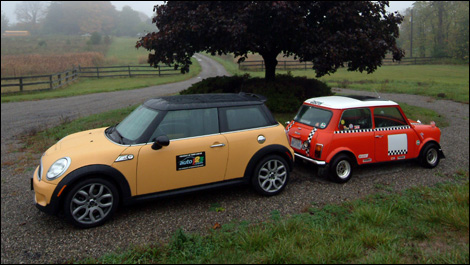
Most countries, it seems, used to have an automobile that in some way expressed the national character: the Germans had the uber-efficient BMWs and the VW Beetle, the Brits had the Mini Cooper (much favored in rally driving and now newly reborn as a BMW), the French had the quirky Deux Cheveaux (nicknamed The Ugly Duckling), Americans had a bunch of high performance ‘muscle cars’ (GTO’s, Chargers) and their affiliates, the ‘pony cars’ (Mustangs, etc.). Here in Italy we had the Fiat Cinquecento (cinquecento means ‘500’).
Fiat has sometimes been accused, affectionately I hope, of being an acronym for Fix It Again Tony. Back in the day this was not unfair, in fact, and the early Cinquecentos did require a certain amount of tuning and repair. But most cars did. The Cinquecento was originally made in Torino at the huge Fiat motorworks from 1957 to 1975 (I like the number inversion of the dates, don’t you?). It quickly became ubiquitous in post-war Italy; it was a relatively inexpensive way for the suddenly growing and more urban middle-class to get around. In 2007, fifty years after the first Cinquecento was made, Fiat reintroduced the model, and in 2008 Fiat/Abarth brought out a model with 135 hp, up from the 13 hp (!) of the original version.
What many of these cars have in common, muscle cars excepted, is that they’re all cute. I realize cuteness is probably not one of the main concerns of car designers, but dang, the Beetle, the Mini, the Deux Cheveaux and, especially, the Cinquecento are all as cute as can be. Take a look:

VW Beetle

Deux Cheveaux, photo from pollyvousfrancais.blogspot.com

Minis, new and old, photo from the MiniCooper News
And where is the Cinquecento, you ask? Well, last weekend about fifty of them were in Rapallo for the 15th annual gathering of Cinquecentos under the auspices of Rapallo’s Motoclub A. Olivari. I decided to go have a look.
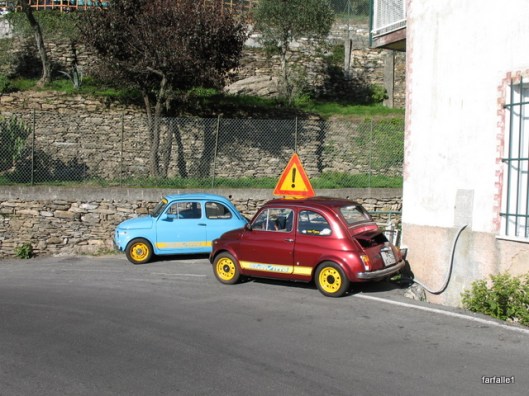
I didn’t have to go far; just around the corner from our house I found a couple of cars parked, the owners undoubtedly enjoying a mid-day meal at either Ristorante Paolin or Trattoria Rosa, San Maurizio’s justifiably famous eateries. It kind of looks like the red one is plugged into the house, doesn’t it? It’s not.

The main event was in the center of town near the port. One of the best cars there, I thought, was the Cinquecento’s predecessor, the Fiat Topolino, or ‘little mouse’, which dates from 1950. It made me think of the phrase ‘saloon car’ for some reason. The Captain, who does not think of ‘saloon car’ when he sees the Topolino, tells me that backward opening doors like this are called ‘suicide doors’ – you can imagine why.


What struck me is the time, effort, and yes, love that the owners pour into their Cinquecentos. The paint jobs, the interiors, the engines (I’m guessing about the engines) were all exquisite. Here are a few shots of the some of the cars. There is a small album here where you will find about fifteen more photos if you’re interested (slide show recommended, F11 for full screen).

Fancy paint job
The photo above gives a good idea of how small these cars are. Those are ordinary-sized people in the background, not basketball players. Once people are in a Cinquecento, though, they look like giants.

Call me a cab!

Strange wiper arrangement
When I originally saw the car below I thought, ‘Aha! I know what under sign this owner was born.’ But no. The Scorpion is the logo for Abarth. Abarth was an Italian racing car maker founded in 1949, which later branched out into tuning kits for for road vehicles, mainly Fiats. In 1971 Fiat bought Abarth. Many of these period Cinquecentos were sporting Abarth engine upgrades (the engine, by the way, is at the rear of the car).

It was all too exhausting for some of the participants. The day was perfect, the sun was warm, and I just have to imagine that someone had finished a fine luncheon not too long before I happened along.

The new Cinquecento is a very cute car too, in the roundy way of so many of the old-timey cars. I wouldn’t mind having one; we don’t need a car here, but perhaps someday in the States, if the Chrysler-Fiat marriage can arrange it, you will see this in our garage:

28 Wednesday Oct 2009
Posted in Time, Uncategorized
It’s over for another year – daylight savings time, that is – and suddenly the sun is going down at 5 p.m. instead of 6. Well bah! I guess it’s nice that the sun is arriving in Rapallo an hour earlier, but to tell you the truth, I miss it at the other end of the day much more.
New Zealander George Vernon Hudson first came up with the idea of our modern DST, back in 1895. He collected bugs and thought it would be useful to have more hours of light for his hobby after his work day ended. William Willet, a Brit, came up with the same idea independently in 1905. He was a golfer… need I say more? DST has been touted as an energy-saver, a boost to the economy, and a public safety boon; you can read a great deal about it here if you are interested.
Th
e problem of the seasonal Incredible Shrinking Day has vexed people since the concept of ‘time’ became important. Day – too long in the summer, too short in the winter. The Romans had a great solution – ‘hours’ were of varying lengths during different times of the year. The Water Clock, seen at the left, was a complex device that had a different scale for each month of the year… not very practical for modern life – and imagine what a wrist watch would look like.
Not everyone has bought into the idea of Daylight Savings Time. Arizona, for instance, doesn’t observe it – but it is the only United State that doesn’t. How confusing is that?! Most of Africa has no use for it, and neither does most of the former Soviet Union and part of Australia. It seems strange in these days of greater and greater uniformity that there would be such a discrepancy in something as important as time. Must be fun for the airlines.
Here in Italy we go off DST a week or two before the US, which makes it confusing for phone calls. Just what time is it over there anyway??
I e-mailed a friend the other day, and in a nyah-nyah-nyah kind of way exclaimed that we had gone off DST and I was an hour richer. She wrote back gloomily, ‘another hour of darkness.’ And it does rather feel that way with the afternoon becoming evening so early. No matter how you divide it up, the fact is that in the northern and southern parts of the world there is always a part of the year when the days are just plain too short. Maybe we should all move to the equator.
By the way, for any who have trouble remembering when the clocks go forward and when back, just think about a kitten attacking a string: Spring forward, fall back.
23 Friday Oct 2009
Posted in Italian men, Italy, Law and order, Photographs, Rapallo, Uncategorized
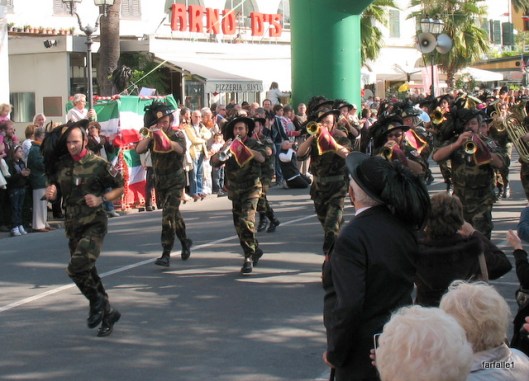
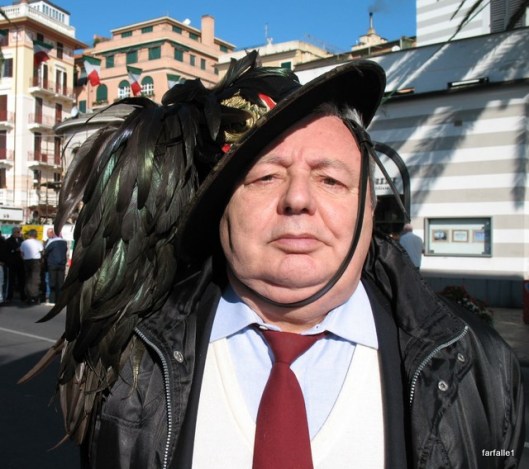
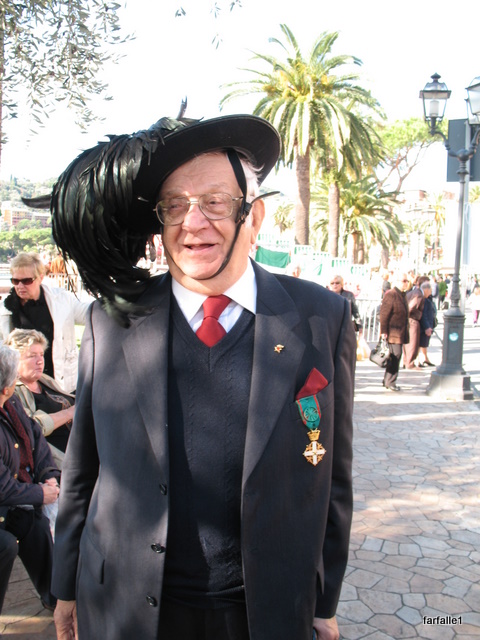
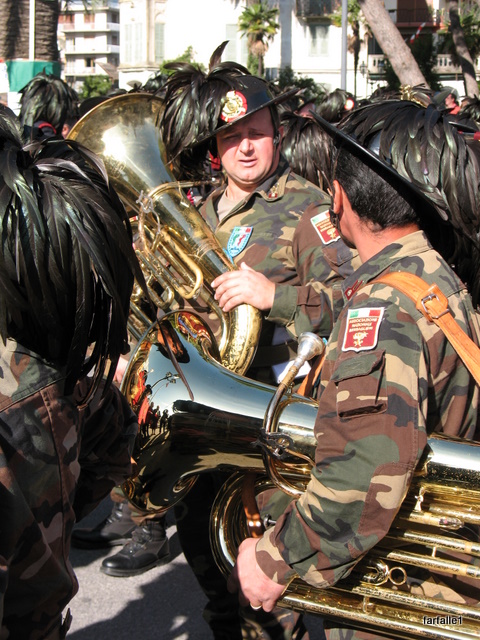
For a couple of weeks the main streets of Rapallo have been criss-crossed with hundreds of little Italian flags. Why? we wondered. This weekend we found out: the Bersaglieri visted Rapallo and some neighboring towns for a gathering of the Corps from central and northern Italy. There were many events around their visit, including a concert on Saturday evening and a parade on Sunday morning. We were able to go to the parade for a few hours, which made us swell with pride, if not for being Italian, at least for living here.

There’s something about a uniform – or at least there always has been for me – and the signature feathers of the Bersaglieri hat are so over the top (oh excuse the pun) that they are divine. Where did that idea ever come from? Was it a type of ill-thought-out camouflage? Perhaps it was to suggest the speed of flight (though wood grouse, the source of the feathers, have never been noted for speed)? Me? I think it was simply a Style Statement, and a very fine one, too.
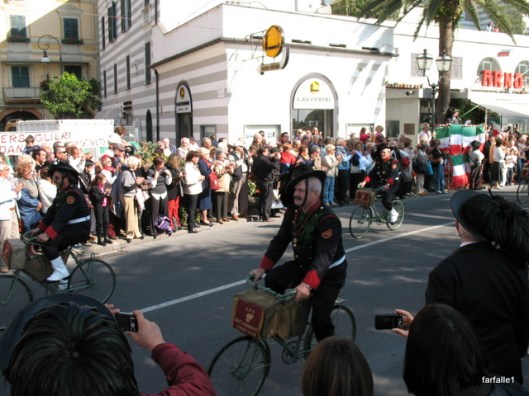
The Bersaglieri were founded in 1836 to serve as high-speed infantry in the Piemontese Army (this was before Italy was unified). Piemonte could not afford a large, expensive horse-mounted cavalry, so instead developed a superb corps of sharp-shooters that featured quick movement, either on foot or bicycles, and later on motorcycles. The Bersaglieri never walk – they run everywhere, whether in training, in the field, or in a parade. Their demanding physical training made them useful as mountain troops, too; the Alpini, the elite mountain troops, were founded in 1872, and there is still a friendly rivalry between the two groups (there were several groups of Alpini in the parade and some proud veterans watching). While there have been as many as 12 regiments of Bersaglieri in the past, today there are six, and they are all now mechanized.

In addition to unique headgear and running everywhere, the Bersaglieri are famous for their fanfara, the brass bands that accompany every regiment. The musicians must be adept not only at playing, but at playing as they run, because they, too, are obliged to run everywhere they go. The Fanfara from northern and central Italy formed the major part of Sunday’s parade, and they certainly impressed with their musical skill and physical stamina!

During World War II there were both bicycle and motorized troops:


There was a huge ovation for the oldest gent on a bicycle – 92 years old and still going strong:

And how about the fellow who has to ride a bike AND play the trumpet??

I find it very moving to see old Vets watching a parade, and Sunday was no exception. There were scores of former Bersaglieri watching the parade; it wasn’t always easy to read their expressions.


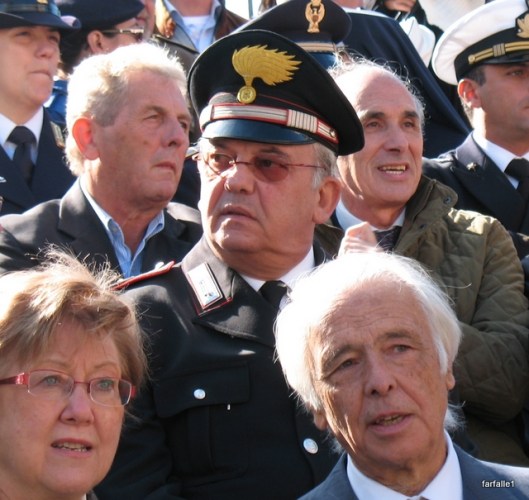
And of course there was a viewing stand full of dignitaries:

A parade is always fun, and a military parade particularly stirring. But only in Italy, I think, will you find a military parade that showcases such stamina, showmanship and style in one package: The Bersaglieri.
If you’re interested in some more photos of the parade, you may see them at a web album here. I recommend a slide show, F11 for full screen.
19 Monday Oct 2009
Tags
Oh, the dreaded Colpo d’Aria! If you’ve suffered a Colpo d’Aria you’ve been struck by some moving air, most probably chilly air, and most probably on your chest or perhaps the back of your neck. If you live in Italy, it can be deadly; ask any Italian! I’ve heard Colpo d’Aria blamed for everything from stiff muscles, to inner ear infections, chest colds and even heart attacks. I have not yet heard anyone say that a Colpo d’Aria caused his cancer, but that, and gum disease, are about the only illnesses for which a stiff breeze has not been held responsible.
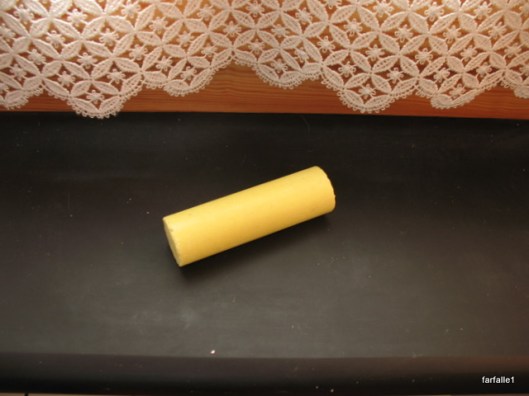
Fortunately there is some good treatment available should you fall victim to an evil air current. The first thing you want to do is go to the pharmacy and get a bastone di zolfo, a stick of sulphur.

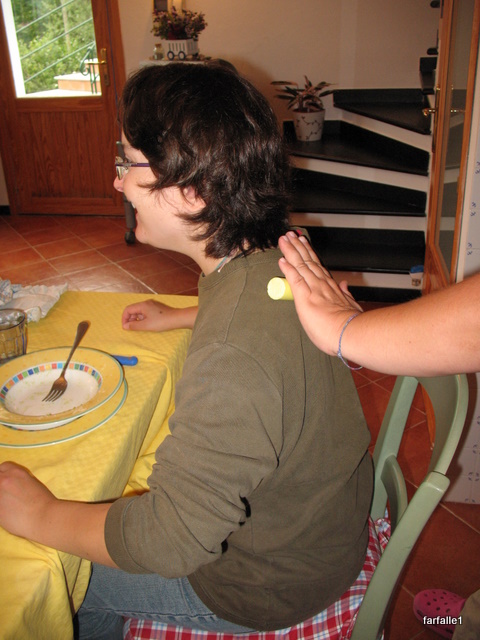
You roll this stick back and forth across the skin of the afflicted area (our model was shy).

The great thing about the bastone di zolfo is that when it has outlived its usefulness it crumbles or breaks. Then you know it’s time to buy a new one. Evidently the sulphur absorbs… what? moisture? bad vibes? infection? My guess is moisture, but I wouldn’t swear to it.
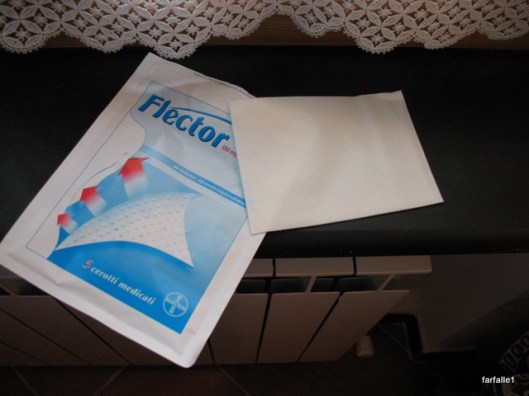
The next line of attack is the Flector patch, a bit of treated rubbery material, about 4″ X 5″, that is slightly adhesive on one side so it will stick to your skin. It is in the NSAID family of medicine, and delivers a non-steroid anti-inflamatory drug topically. From all reports it also feels good.

There are probably as many treatments for Colpa d’Aria as there are sufferers. My prescription would be a day in bed with an endless supply of hot tea with lemon and honey, and a good trashy novel. The best line of defense though is always prevention: stay out of drafts! I grew up sleeping with the windows wide open, and still do – it’s a miracle that I’ve survived so long. If you live in Italy the only thing worse than a colpa d’aria is a colpa d’aria in the dark. Many Italians sleep with their windows tightly closed and shuttered. Also, now that the cool weather has arrived, don’t forget to bundle up when you go out, and remember especially to wear a good warm scarf to protect your chest and neck from the dangerous air currents.
I’m making light of this notion, but I’m not so sure there isn’t a measure of truth in it. It falls in the category of folk belief, but such beliefs are often based on years of experiential evidence. I may laugh at the idea of a colpa d’aria harming me, but I have a great collection of scarves and never go out without one in cool weather. As they say here, ti raccomando!
10 Saturday Oct 2009
Posted in Driving in Italy, Italy, Law and order, Piemonte, Uncategorized
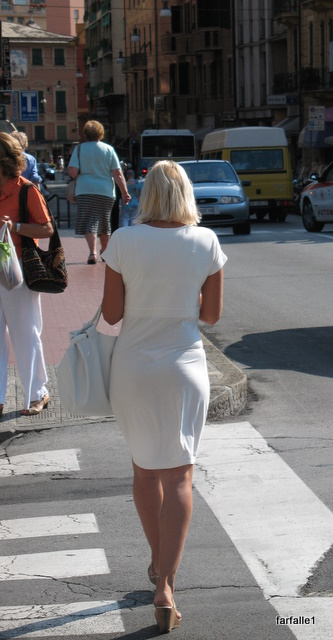
We are very dull here in Rapallo, I am beginning to think. Granted, there’s lots of traffic and hubbub downtown, scooters darting in and out of traffic, pedestrians crossing outside the zebra stripes. But it is the stripes themselves that makes me think we are dull. Our stripes are the plain old white stripes depicted in the driving manual. Here’s an example:

(This is an old photo so it shows more of the crosser and less of the crosswalk, but you get the idea…)
This past week we were, once again, in Piemonte (about which you’ll hear more in an upcoming post). Now there’s a region that knows how to make its crosswalks attractive and eye-catching. How about this snappy blue?

Red has ever been the color of caution, and this red crosswalk would make any pedestrian feel safe.

But my very favorite is, granted, a variation on the white theme, but done with such artistry. Nothing says class, whether it’s in the foyer, the bath, or inlaid in the street, more than marble.

Say… isn’t that the captain crossing outside the stripes? I bet he didn’t stay in the lines when he colored as a kid, either.
In the spirit of fairness I have to say that just in the last year Rapallo has added some very sparkly little lights that blink feverishly at night along the boundaries of some of the zebra crossings. But only some of them, which makes me wonder if the others aren’t more easily overlooked by speeding motorists expecting the twinkling visual cue? In any event, they look quite modern and marvelous… when it’s dark outside.
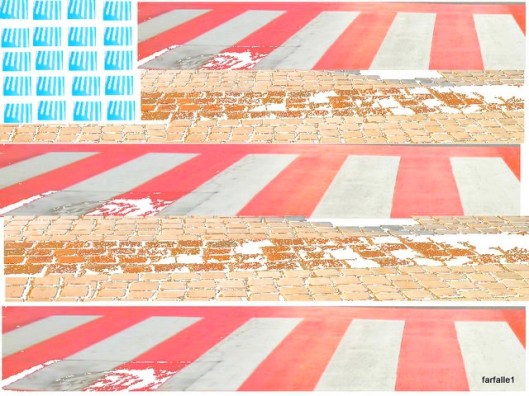
I’m feeling pretty good about Obama winning the Nobel Peace Prize, so I’ve come up with my own design for a crosswalk, using all the others for inspiration:

05 Monday Oct 2009
Posted in Photographs, Travel, Uncategorized
Tags
Across the fields of bounding heather ~ (click link for wonderful old Beers Family recording of Dumbarton’s Drums…)

* * * * * * * * * * * * * * * * * * * * * * * * * * *

The Isle of Skye is a big lobster-shaped island to the west of Scotland, near Inverness. It is part of the inner Hebrides and is considered part of the Highlands. The above photo is of Five Sisters Peaks; on the advice of a delightful woman who filled our car with gas we made a diversion to climb a hill (by car!) to get a good view of the mountains. It was well worth the short amount of time it took, and was one of our first tastes of the excitement the Skye scenery offers.
The woman who gave us our gas was no exception; everyone we met on Skye was friendly and helpful to a fault. Consider this: the host at The Salento B&B actually offered us the use of his washing machine to do our laundry. It didn’t work out with our timing, but the fact that he offered amazed us. He was typical of the people we met – eager to help, happy to chat, informative and fun.
We were on Skye for only three full days, not nearly long enough to explore the whole island. My favorite day included a brief stop at the Isle’s capital Portree:

followed by a walk through the woods called “Two Churches Walk.” Much of Skye is windswept and feels barren, but this walk through a tall piny forest gave us a good feeling for the large Norway Spruce forests that have been planted on the mainland and to a lesser extent on the island in the years since WWII.

This walk began and ended at St. Mary’s Church, a small ruined chapel where many of the chiefs of the MacLeod clan are buried.

No, it wasn’t especially warm that day…
From there we went to Dunvegan Castle, home for 800 years (with a brief 20th century lapse) of Clan MacLeod. In addition to the castle itself

there are extensive and beautifully maintained gardens, including a water garden and a circle garden.


But for us the most exciting and fun part of the experience was the ride in a small boat to see the seal population of Loch Dunvegan. We had wanted to take a boat tour this day, but our plans had been scotched (oh ha ha) by winds and tides. To our delight the Dunvegan boats were operating, and we were the only two aboard with Captain Allan, who gave us a good history of the clan, the seals and the area in general. I couldn’t stop taking pictures of the seals – they are very cooperative.


Note the guy having a big yawn up there in the grass… or judging from the others’ expressions, maybe he just told a really stupid joke.

Is there anything more picturesque than sheep calmly grazing?

There may well be more four-footed inhabitants of the Isle than two – it certainly seemed that way to us as we drove around – and frequently the cows and sheep are not fenced in.

The real story of Skye, though, is the scenery and the light. Clouds and showers come and go with frequency, shifting the light and changing the landscape before your very eyes. None of it is easy to catch with a camera, but we both loyally tried. Here are some photos from our drives around the island, and from a short hike we took up a hillside to view the water on both sides of the peninsula we were on:


Those are the Cuillin Hills in the background, some of which are over 3,000 feet in elevation. Here is another view of them:

They are a dark and brooding presence on the south part of the Isle.
On our last evening on Skye we went a short distance onto the mainland to the picturesque town of Plockton where, we were told, many movies and TV shows have been filmed. There we ate haggis at the cozy old Plockton Inn – an experience no one should miss when visiting Scotland.

We were sad to leave the Isle of Skye – it has many more secrets than we had time to discover. As we drove away we looked back at the castle of Eilean Donan, not far from the Isle – it summed up for us all the magic of the preceding days, and issued a mute but compelling invitation to return.

If you’ve any patience left at all, you will find about 60 photos of the whole Scotland trip here. (I recommend the slide show, full screen (F11) – the quality of the photos is much better than in this post…)
01 Thursday Oct 2009
Posted in gardening, Travel, Uncategorized

I’ll try to keep this as short as possible, but when you have visited a place so different from your usual haunts, and so utterly atmospheric and magical, it is hard to be terse.
The background: My sister spent two weeks on the Isle of Iona, after which I joined her for one-week stay, mostly on the Isle of Skye. While she was on Iona one of her friends remarked, “Scotland… it’s all about the light.” I agree, but would add it’s also all about hospitality as an art form. We had generally good weather, which in Scotland means it isn’t raining. Of all our days we had only one where it rained on and off all day; the rest of the time was a delightful mix of sun and clouds – which is what makes the light so delicious.
We met up on a Tuesday in Edinborough (not the original plan – for an elaboration of a travel nightmare, click here) and drove immediately to Forres, a little north and east of Inverness, where we found the very comfortable Cluny House B & B. In true Scottish fashion, when I called to tell owner Susan that we wouldn’t be there the night before (see elaboration…) she was more concerned about our discomfort than about losing one or possibly two nights of rental income. The village of Forres itself was delightful, featuring an amusing public garden full of ‘topiary’ – which proved to be iron frames in which plants were growing, rather like enormous chia pets.

Our main purpose in going to Forres was to position ourselves for a visit to Findhorn, the ecovillage and commune founded in 1962 by Peter and Eileen Caddy in a trailer park. We had wanted to see the gardens which were, over a period of years, created under rather inimical conditions, and perhaps to get a spiritual taste of the place. What we found was very much an institution, complete with property management and fund-raising offices prominently placed. Of gardens we saw only one, though it was quite pretty.

Most of the land around the many houses seemed unkempt and there was lots of junk lying around. The cottage gardens of Findhorn village were much more interesting and far better maintained. It had the feel of a place that was started for all the right reasons, but, once institutionalized had become somehow less. We were surprised when Susan told us that the community there does not do much outreach or give programs for area children. When we visited it made sense. I’m sure the programs they offer are excellent, and we were there for just half of one day – during which we felt we’d seen all there was to see – no doubt one has to immerse oneself in the community itself to get full benefit.
Our next port of call was Inverness, a small bustling city, where we stayed at the Bannerman B&B, another comfortable house where the owner fed us a huge and hugely satisfying breakfast. Chocolate Lab Hugo was extremely welcoming. The river Ness, on both sides of which lies the city, is interrupted by three islands that have been turned into a large and inviting forest park. The city has a 19th century castle on a hill which gives an impressive view of the rest of the city, including the spire-less cathedral.

But our true destination was the Isle of Skye, and that’s where we went next. I’ll tell you all about that in the next post…
Meanwhile, for a slide show of photos of the whole trip, click here.