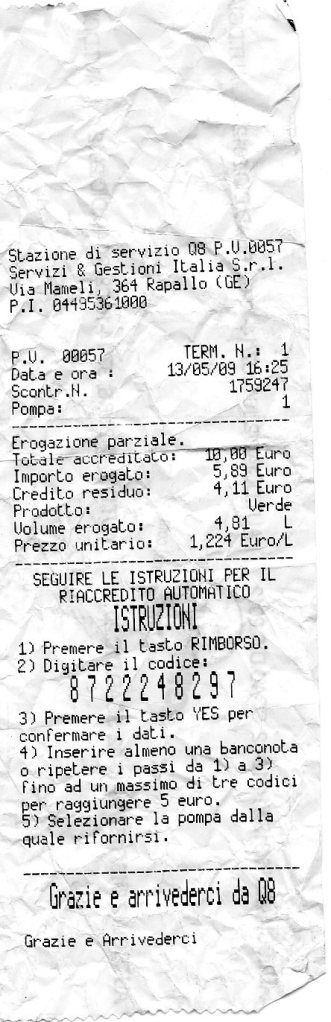
You get what you pay for, right? Well, sometimes when you buy your gas at Q8 you don’t get anything at all!
Here’s the story. Way back in May I filled my scooter, which has a small tank, and paid with a E 10 note. There was a credit remaining of E 4.11. I wasn’t sure how to use the credit slip, though, even though a thorough explanation is given at the bottom. My Italian just doesn’t always measure up to the fine print. I know! It’s my fault, I should be better at my second language. But I’m not. Yet.
Wanting help with this credit receipt, I kept waiting for there to be an attendant at the Q8 station, which is, it seems, a rare event. Finally about a month ago there was a man there who explained to me that because my credit was less than E 5 I wouldn’t be able to use it without putting in more money. Huh?? When is a credit not a credit?? When it’s for less than E 5 at Q8, that’s when.
It seemed mighty peculiar to me, but I said ok – and as it happened I already had plenty of gas that day, so I didn’t take advantage of the attendant’s presence and actual willingness to help. I figured I’d catch him another day.
Fast forward to last week (can you believe how much effort is going into a credit for E 4.11??!). The door to the attendant’s box was open, so I whizzed in to buy some gas. There was a young woman there, and I asked her, is it true that I can’t use this credit without adding more money? “I don’t know,” she said, “Can you come back on Monday when the regular guy will be here?”
“Well, okay,” I replied, but can you give me change for this E 50 so I can pump some gas? I don’t want to put E 50 in the machine.”
“No,” she answered. Sooo, I went to the grocery store just behind the Q8, bought a few necessities and returned to the gas station with a crisp E 5 note. The attendant had fled.
I began the automated process to get gas, and one of the choices indeed was for a receipt number, so I punched in the number on my credit. Immediately what came up was the original screen suggesting, ‘Go ahead, put some money in here and see if you get lucky.’ At least that’s what I think it said. I really just wanted the credit’s worth, so I tried again. No luck. Then I stared around in agony and asked the Gas Goddess to come to my assistance. Then I punched in the credit code again and got a message that it was invalid. So I just put in E 5 and got my gas, puzzled as could be.
Today my tank was low again and guess what! There’s a GAS STRIKE in Italy over the next two days so it will be difficult to buy gas (amusingly, one of the strike issues is ‘long working hours’). It seemed prudent to fill up, and, to my amazement, the door to the attendant’s box at the Q8 was open again, and sure enough there was a man seated at a desk within. I went right to him and said I wanted to use my credit to buy gas. He looked at it and said, “There’s not enough credit on here, you need at least E 5, so you will have to put more money in.” (Can you tell me what difference it makes to an automated system if your credit is for E 4.99 or E 5.01? It shouldn’t matter one whit.)
I explained that I had tried to do that but that it hadn’t worked. “Can you help me with this?” I asked – and I was still being extremely polite. Can you guess what he said? He said, “No.” Then he said, “The instructions are written down here.”
“I know,” I said, “but when I put my credit number in it doesn’t work. Can’t you help?” Rolling his eyes to the heavens and heaving a mighty sigh he… you think I’m going to say he got up, aren’t you? No, he didn’t budge his skinny ass. He punched a few buttons on the computer in front of him and said, “This number is invalid. Didn’t you take a new receipt when you tried before?”
“No,” I explained (and I was getting a little irritated by now), “I didn’t because there wasn’t one to take.”
“There was,” he assured me, “and you should have taken it.”
“So what you’re telling me is that Q8 has my E 4.11 and I’m not going to get any gas for it?”
“This receipt is invalid.”
“But I didn’t get anything for it. I’m just giving Q8 my money and not getting any gas in return.”
He gave the final, infuriating, ‘tough shit’ shrug and turned away. That’s when I crumpled up the receipt (but didn’t throw it at him – I’m so glad because now I can show it to you!) and informed him tartly that I wouldn’t be buying any gas from Q8 ever, ever again. You know, I don’t think he cared.
As a side note, during the long wait for this story to unwind I received another credit slip from the Shell station in the middle of town, this one for E .94. The attendant (who is there morning and afternoon, daily) took my slip and applied it to my next gas purchase. So easy!
May I tell you what would have happened if this had occurred in the U.S.? 1) the attendant would have been there more than ten minutes a week. 2) he would have made at least a cursory effort to help and 3) he would have believed me and would have made good on the credit.
Now you might say I’m the victim of my own ignorance, and I guess that’s true, but I think people who are selling things should try to be helpful to customers. You might call my wish to have the gas credit honored the typical unreasonable American sense of entitlement. I call it honesty.




![DSCN1769[1]](https://farfalle1.blog/wp-content/uploads/2009/07/dscn17691.jpg?w=529 "DSCN1769[1]")

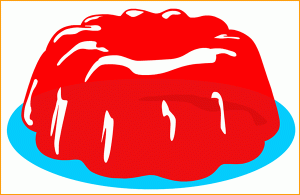 One thing I’ve never seen here, though, is Jello, the kind of wobbly, luridly colored Jello that we have in the States. There are ‘budino’ (pudding) mixes – chocolate, lemon and so forth. But not jello, per se, which is too bad, because it is a really silly, fun food. (If you want to read a fairly cantankerous and thoroughly amusing history of non-commercial and commercial gelatin, which may or may not have been written by S.R. Brubaker, click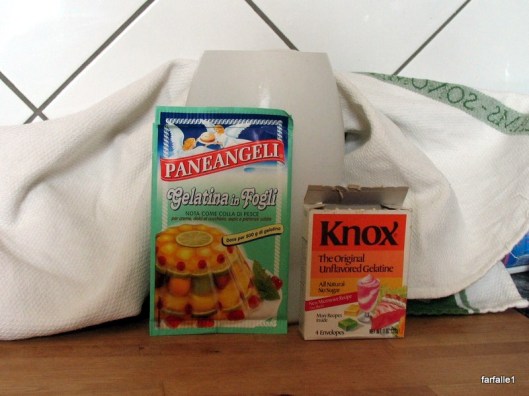





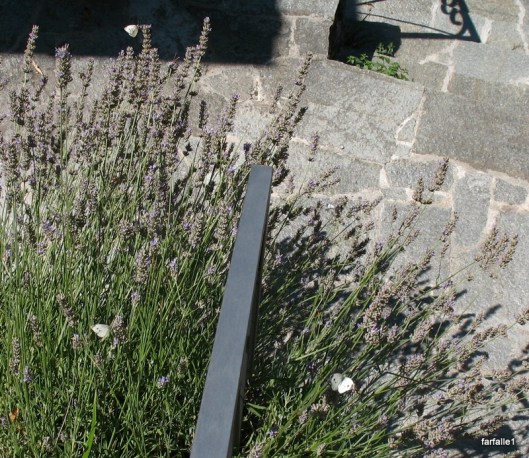



















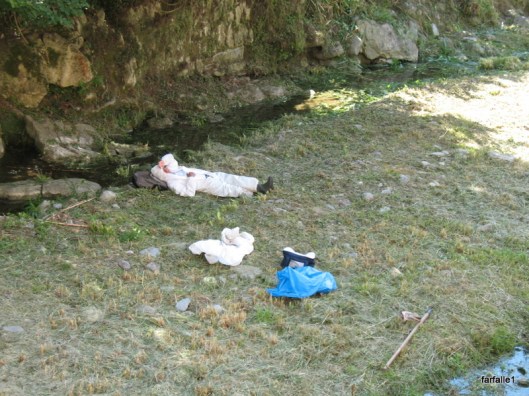
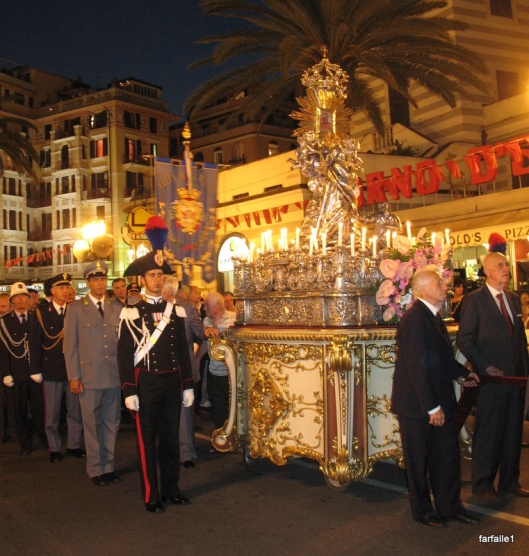
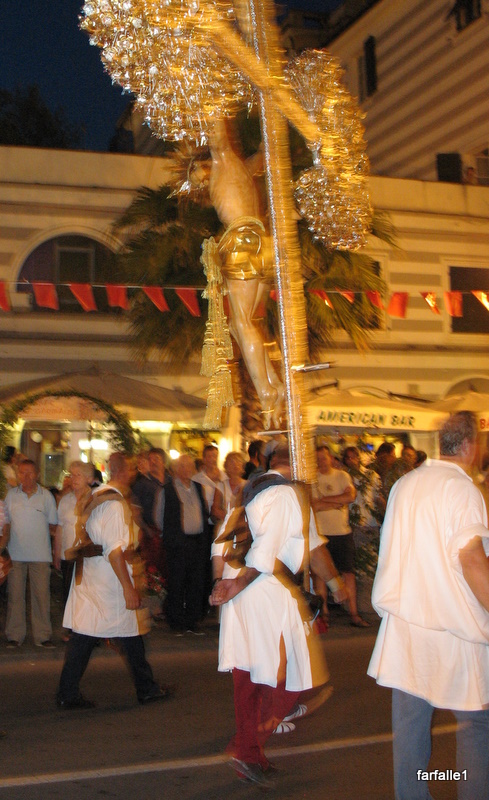
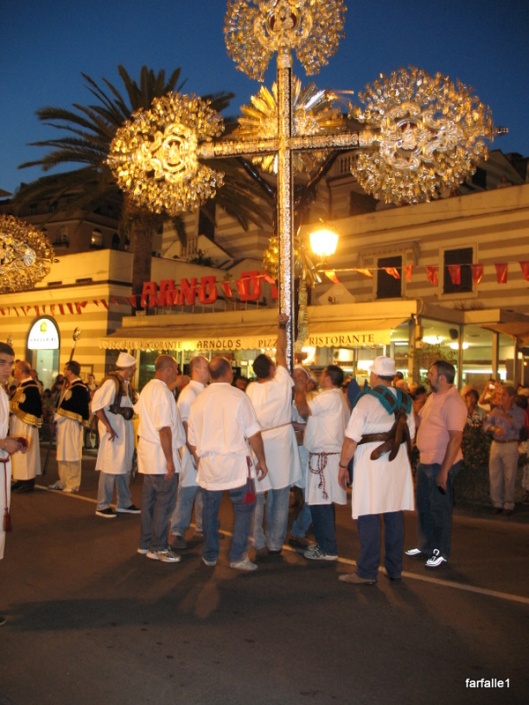
 We might have celebrations and fireworks in the U.S.on the 4th of July, but good old Rapallo celebrates for three full days, and at almost the same time. July 1, 2 and 3 are the days of the Feste in Rapallo which commemorate the appearance of the Virgin Mary at Montallegro, 452 years ago. (You can read about that event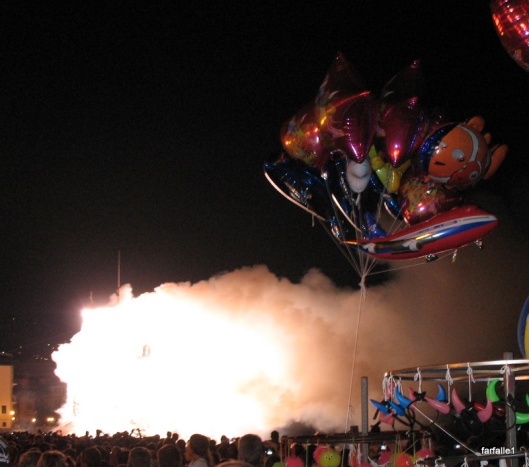
 Oh! The things we take for granted in the United States, things like peanut butter and pickle relish. Neither of these items is readily available in Rapallo, and usually we don’t miss them very much. But watch out – the 4th of July is just around the corner. You can’t get through the 4th of July without a hot dog or a brat, and according to me, you can’t eat either without pickle relish on top.
 was up alone, and they made a big flash of light and then a loud bang when they landed on the front terrace. And there were 17 of them, which seems excessive, and that doesn’t count the dozen that were set off in our mailbox. I finally woke up the Captain who went outside and shook his fist and shouted at the departing figures, lads from a nearby settlement we surmise. That was harmless, all in all, but it was unsettling because they were not throwing the flash booms anywhere except at our house.
 Nonetheless, I’m feeling paranoid. It’s always such a shock to see or suffer from an act that is just purely mean. It happens the world over, I guess. The firecrackers were probably just kids goofing around. But the car and the rock are on a different order – those were done with intent to damage. And I’m thinking about surveillance cameras… what a way to live. Or maybe… maybe we’ll call Cugino Rino in Genova. He has a menacing laugh that would scare the devil – we’ll just get him to come over here and laugh around the neighborhood a little, and then no one will dare harm us or our property again!
 An Ex-Expatriate
