Fabulous Italian Footwear

Tags

, , , , ,

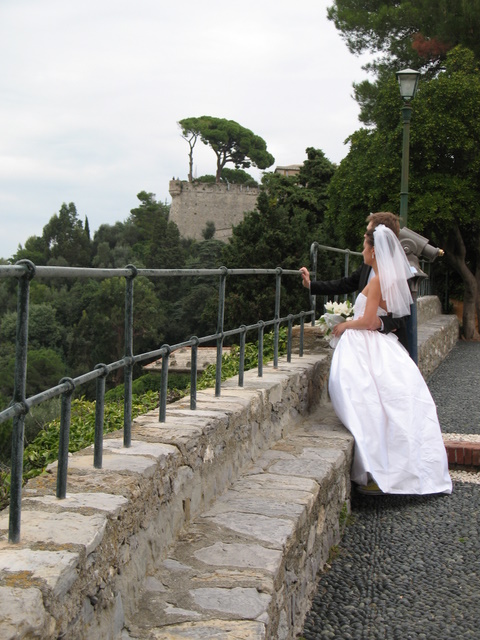
Recently we took a friend over to see Portofino, and were well rewarded for the effort when we came upon a young bride and groom having a photo-shoot at Chiesa San Giorgio, above the port.

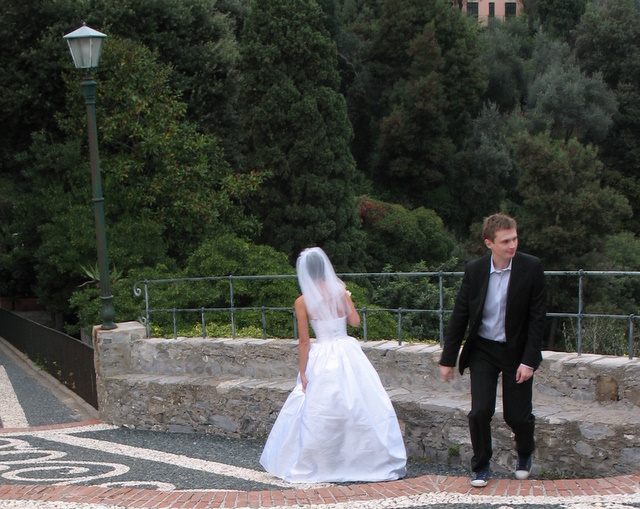
Aren’t they adorable?  That’s Castello Brown in the background.  And no, we have no idea who this happy couple is.  At first we just thought, ‘aw shucks, how sweet…’  Then we got a closer look at the groom and noticed his unusual footwear:

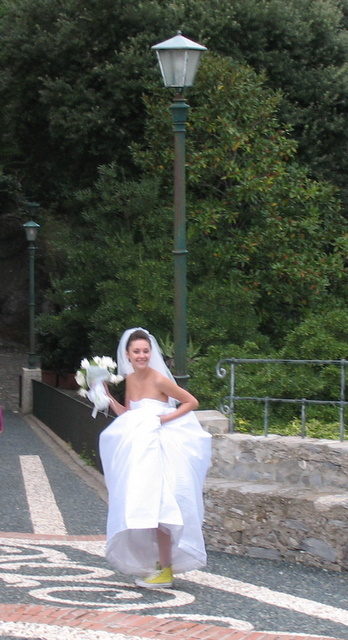
Hey!  Those are blue high tops!  What an improvement over tight shiny leather when you have to be on your feet and feeling your best for the afternoon and evening.  But best of all was when we realized that the bride went to the same shoemaker:

I don’t know which I like better, the blue or the yellow.  I think maybe the yellow.  The bigger question, though, is this: is this the new Wedding Style for the year ahead?  Will all brides and grooms be cantering down the aisle in athletic footwear?  Not a bad idea, now that I think of it, very handy when they try to escape from all those people who are throwing things at them after the ceremony.  And oh!  how comfortable!

Stuffed Eggs Piemontese Style

Tags

, ,

A stuffed egg is a wonderful thing. Eggs in general have suffered a lot of bad press from the cholesterol police, but for some of us they remain irresistible. I’ve always been a passionate enjoyer of stuffed eggs. My recipe is simple – it calls for the boiled eggs, mayo, a bit of mustard, and a parsley sprig on top for decoration.

On a recent visit to Piemonte our friend Leo taught me his recipe for stuffed eggs. It is a different animal altogether, not nearly as cloying as my recipe; no doubt it is healthier.

Here’s what you’ll need:

Eggs, as many as you want
A big handful of fresh Italian (flat) parsley, leaves only
2 or 3 anchovies
a piece of bread, broken into pieces and soaked in milk
olive oil
vinegar

The first step is to hard-boil the eggs, of course, then peel them, slice in half and remove the yolks.  Put half the yolks in a bowl, and save the other half for some other use (or salt and pepper them and eat them in the kitchen when no one is looking).

Next finely chop the parsley together with the anchovies and the bread, from which you’ve squeezed the excess milk.  Your mixture will look something like this:
Note the mezaluna – if you haven’t got one in your kitchen you may want to consider getting one and learning how to use it – it can really cut down chopping time.  Plus it’s loads of fun to use.

Smush the egg yolks with a fork and add to them the parsley mixture.

Mix in enough oil to make a nice clumpy filling for the eggs, and add just a dash of vinegar to brighten the flavor.  Nibble a bit and add salt and pepper to taste.

The rest you know.  Fill the eggs, arrange on a plate and serve.  My plate above was rather plain; Leo later decorated it with sage leaves and it looked a lot prettier.

Like all ‘deviled’ eggs these have mysterious evaporative properties; just look away for a moment and you’ll discover half of them are gone!

A Slice of Humble Pie

Tags

, , , , ,

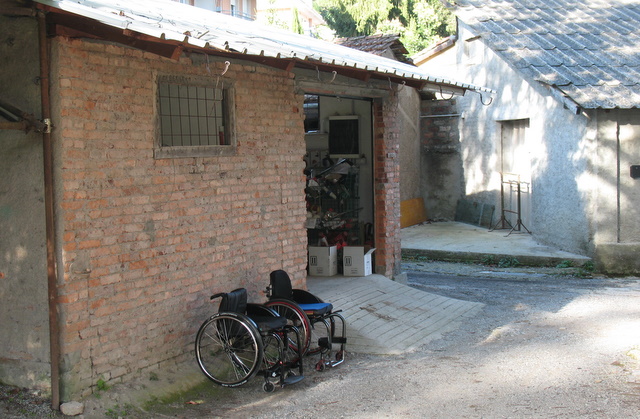
Every golfer begins each round with a handicap, but some golfers wake up every morning with a handicap.  Recently at Rapallo we were privileged to watch a tournament for people who may not be able to jump out of bed and walk down to breakfast, but are still motivated to get out and play golf.

The Comitato Italiano Paralimpico sponsored a two-day golf tournament at the Rapallo Golf and Tennis Club, and they had a full roster of entrants. (If you’re handicapped and want to participate in a sport, take a look at the Paralimpico website – you will be amazed, I think, at the scope of activities available.)

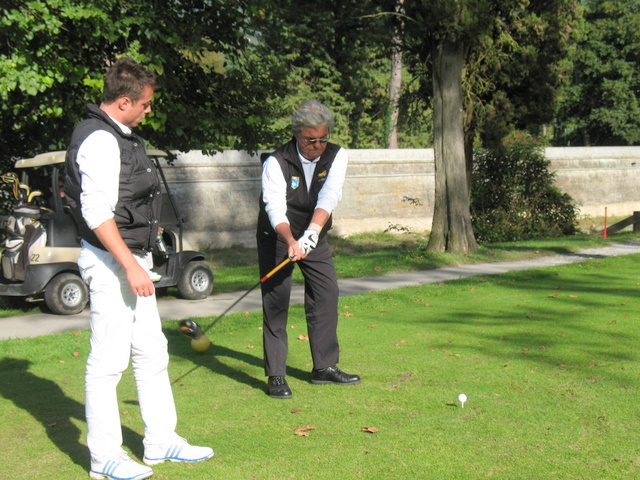
The Captain and I visited briefly on the first afternoon, and were truly humbled by the spirit – and skill! – of the golfers we watched.  We weren’t there long enough to get too many photos, but this Italian man was kind enough to allow me to take his picture.

His shot?  It was was straight and true, and went about half the distance to the little flag you can barely see at the end of the fairway.


Isn’t that an amazing vehicle? It’s the Parabasetec by Paragolfer.  If you want to see it in action, click here for a Youtube demo.  A similar vehicle is made by Powergolfer; we saw a number of those on the course.

Paraplegics were not the only golfers present.  Some people were missing a leg or two and played with prostheses; others had muscular dystrophy.  Several, like this man, were blind.  I know!  But you should have seen his shot – it was excellent.

Of course many of these sportspeople (yes, there were some women playing too) needed some assistance to play.  For instance, in the case of the man above the volunteer placed the ball on the tee, and held the head of the driver on the ball so the player could position himself appropriately.  A legion of wonderful volunteers from the Golf Club gave their time to make the event a great success, and happily the weather co-operated as well.  Golfers came from all over Europe as well as the United States.

There was a gala dinner at the end of the second day of the competition.  Rapallo’s Sindaco (the mayor), Avvocato  Campodonico, was present, as were a number of gents in very impressive uniforms.

So… if either one of us ever feels cast down because we didn’t hit the ball well, all we have to do is remember the golfers we met on a late October day in Rapallo.  We truly were humbled by the spirit, sense of fun, good sportsmanship and excellent play that we witnessed that day.

GONE GOLFIN'


A Visit to the Bank – Part 2 of Daring Exposé of Italian Banking Practices

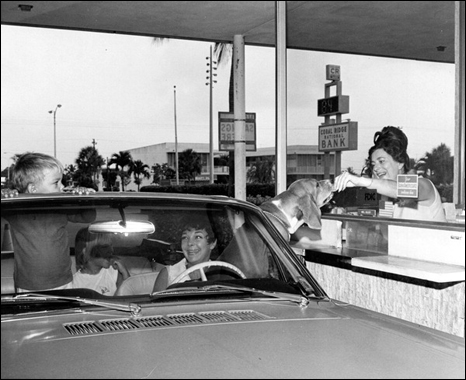
Going to the bank in Italy is never a casual affair.  For starters, you have to remember when your branch is open, and try to get there early so the line will not be too long.  Typically the banks are open most of the morning and an hour or two in the afternoon.  Drive through banking?

Not for you in Italy, and certainly not for your dog.

Though come to think of it, there is an element of drive-through banking that exists here.  You know those plastic tubes that you put your transaction in if you’re at a drive-through bank bay away from the teller’s window?  There’s some sort of pneumatic whoosh and the plastic tube is whisked away to the desk of the person who can take care of your business.  A minute or two later it arrives back with another whoosh, containing your receipt.  Well, when you want to enter many banks here you step into something that looks like a person-sized version of that plastic tube.  One side of the tube slides open, you step into the tube, the open side closes, you stand there trying not to panic, and then, finally, the bank side of the tube opens and you are in the lobby.  Phew!  At least you don’t have to do the whooshing bits.

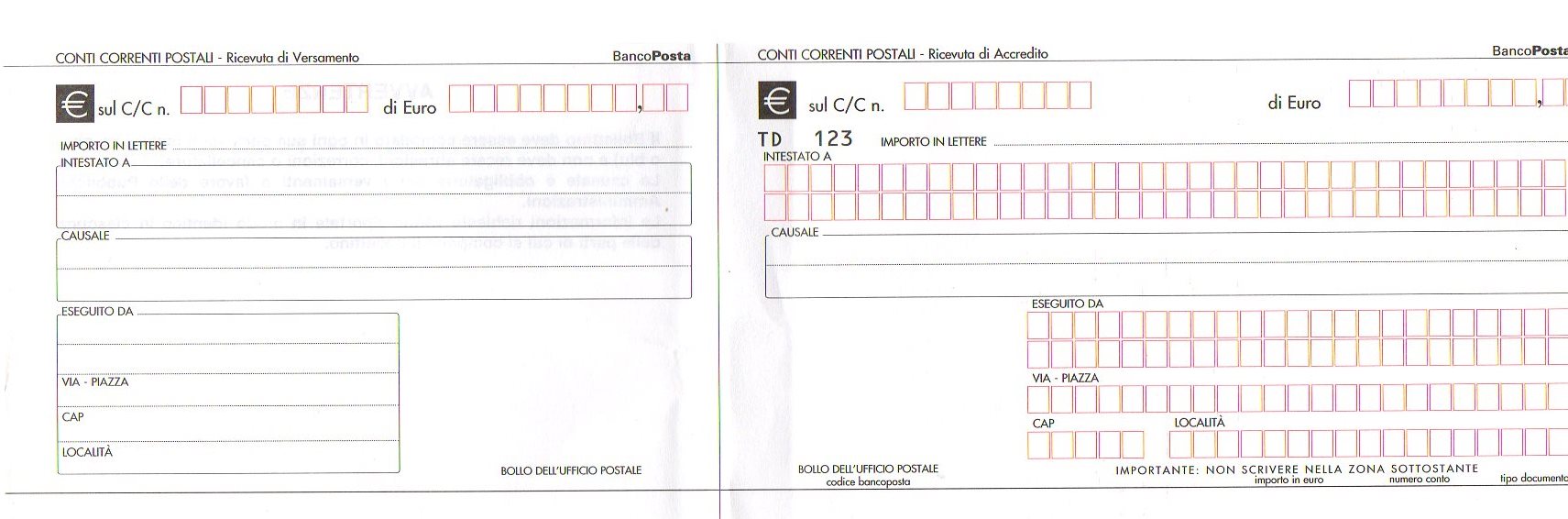
Once safely inside you take a number and wait your turn.  With luck your wait will not be more than 5 or 10 minutes.  You can do all the usual things at an Italian bank, it just takes longer.  People don’t use checks in Italy as much as in the U.S.  Frequently if you have a bill to pay you will go to the bank and pay what you owe directly into the other person’s account.  Which of course means that if I owe you money, you will give me your account number.  Why thank you!  Many times bills come with a payment/deposit form (called a ‘bollo’) attached, which has the payee’s bank info and the amount owed already printed on it.  Here’s what a blank one looks like (click on the image to see it in a more legible form):

You or the bank employee fill in the right side, which includes payee’s bank account #, amount to be paid, reason for payment (!), name and address of payee.  The part on the left is your receipt and proof of payment.

I watched a bank employee (let’s call him Carlo) dealing with a check the man in front of me had evidently deposited.  First Carlo stamped the check.  Then he ran it through some kind of scanning machine.  Then he took his scissors and nipped one corner off the check.  Then he paper-clipped it to a large form, signed the form and stamped it,  and put it on top of his to-do pile.  I was there to make a deposit in the checking account which is, mysteriously, in only my husband’s name.  It led to this very amusing exchange:

Me: “I’d like to make a versamento (deposit) and this is my account number.”

Carlo: “Is your account in this bank?”

Me: “No, it’s in the Zoagli branch.”

Carlo.  “Ah.  Zoagli.”  big sigh.

Me:  “Is there a problem?”

Carlo, haltingly: “No, no…” followed by much tapping at his keyboard.  A long pause.  “Captain Captain is the name on the account?”

Me, delighted: “Yes!  That’s the account.”

very long pause

Carlo: “The address is That Wee Village Road, #27?”

Me:  “That’s right.”    longer pause, worried (both of us).

Carlo: “This account has a masculine name; you are a woman.”

Me: seeing the light (and rather glad he noticed): “Ah yes… that is my husband’s account.”

Carlo, in great relief: “Good, good, alright then. Your husband.  You are the wife.”  Paper in machine, tap-tap-tap, paper out, my signature, his signature, stamp, stamp.

Success!

Here are some of the quirky (to us) things about Italian banks.  1) Various branches of the same bank are not necessarily connected to each other electronically.  They are always happier if you do your banking in your particular branch.  2) Should you write a check to someone, it is not returned to you canceled after it has been cashed.  Nor is it returned to your bank.  It stays in whichever bank your payee deposited it.  Which means if you need to capture proof that you’ve paid someone, you need to know where he stashed the loot.  3) A mortgage is readily available, especially if you can prove that you already have the money to pay it all back.  4) The Post Office is also a bank, and judging from what we see in the lobby, it does more business with banking than with mail.  But you can’t buy a stamp at your bank.  5) Sometimes other agencies serve as banks – for instance, we pay our vehicle insurance and tax bills at the Automobile Club of Italy.  6) Sometimes one bank will be an agent for a particular vender, so you can pay your bill at that bank for no charge or a small charge, whereas paying it at a different bank will carry a larger charge.

But for all their quirks, and for all the waiting and complications and charges, we have always found the people who work in the banks to be invariably patient and helpful.  We are not always good at explaining what we want, and we frequently don’t know the correct words, but the bank employees work with us for as long as it takes to make us satisfied customers.  And not just for us foreigners; they are courteous and helpful to everyone.  I expect that is part of what makes for the long waits…

Hidden Charges – Part 1 of Daring Exposé of Italian Banking Practices

Tags

We have gotten so accustomed in the U.S. to banks being very open about the charges they make – not because they necessarily want to be, but because they are obliged to by law.  We’re spoiled in the U.S.!  We get free checking accounts, free credit cards, and if we go on the right day, free donuts and coffee.

It’s not as simple here (and I don’t mean just the donuts and coffee, which I have never, ever seen in an Italian bank lobby, never mind finding a bank branch in a super market or even a donut shop as you can in the U.S.). Every service the bank provides carries a charge.  It’s not that they’re hidden, exactly; we do receive a long list annually of bank services and their attendant fees.  It’s just that they are so unexpected.  We see them on the quarterly statement (quarterly!) that the bank provides… for a fee of E 5.70 every two months (actually, this fee is for the stamp that attests that the account is… what?  is something!  Correct? Still there?).

There’s a mysterious fee on each statement which is called ‘interessi e competenze’, usually about E5 or 6.  I can’t figure out exactly what it’s for; as it’s levied only once a quarter, perhaps this is the fee for the statement.  Anyway.  To my mind ‘interest’ is something the bank pays us for being kind enough to let them use our money.  To the Italian banker’s mind, ‘interest’ is something to be charged on a checking account.

One gets Telepass, the Italian equivalent of E-Z Pass  for automated payment of highway tolls, at the bank (I know!  Why??!) and it’s easy to arrange to have your tolls deducted right from your account.  Back when we first started with Telepass we had to pay a monthly fee for that convenience.  Fortunately in the last few years that fee has been dropped.  However, the bank gets a commission on your Telepass charges; not a lot (about 1.50 on our last statement), but still.

My favorite charge is the one we pay every month for the privilege of accessing our account online.  That’s E2.  Each month.  However, if we make two bill payments in one month  through online banking, the fee is waived for that month.  We’re not always able to do that, as not many places are set up for automated payment in this manner.  Recharging the cell phone credit is one good way to accomplish this mission, though.

Things are better than they were.  Of the 61 activities listed for a checking account for which the bank could charge, the 2007  list of applicable charges      reports 30 have been repealed and another 13 are listed with a charge of 0.  That leaves a mere 18 activities which carry charges.  It just happens that they are the very things many people do on a regular basis – use Telepass, access the bank online, carry a debit card.  To give them credit though (ha ha), they do not charge a per-use for the debit card.

I guess we shouldn’t complain.  The banks are open Monday-Friday from 8:30 to 12:15 and again from 3:45-4:30 – that’s real convenience!  The ATM’s, which we use to transfer US money to Italy (the easiest way to do it, and what we recommend to all traveling friends), frequently work, which is handy. That’s an improvement from ‘sometimes,’ which was the best they could do a few years ago.  In fact, I’ll give a little free advertising here to Deutsche Bank – their ATM’s always work (well, almost always), even when every other bank in town is spitting our card back with a suggestion to call our bank.

Bottom line?  Banks do very well in Italy.  You might want to invest in one!

Rapallo’s Pyramid

Tags

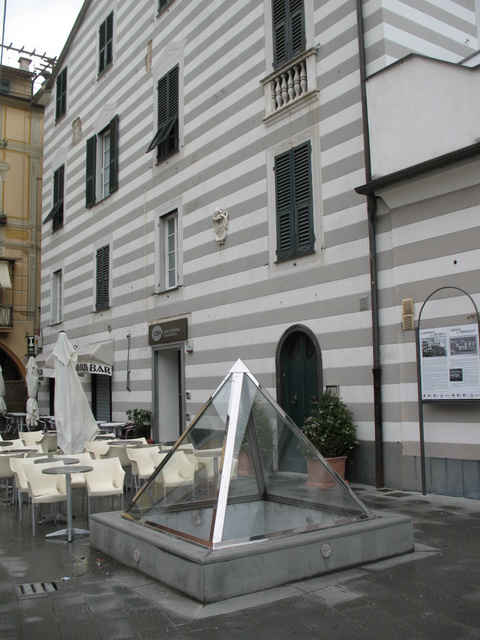
I.M. Pei has probably never visited Rapallo, but that hasn’t kept us from having our very own pyramid, which is quite reminiscent of the glass pyramid Pei designed for the Louvre Museum in Paris. Well, no, ours isn’t quite as large, but it does make its own quiet statement in the square on the Lungomare that holds the newly renovated bandstand.

In fact the whole of the piazza has been renovated over the last year or so, and that is why we have the pyramid in the first place.  It used to be that delivery trucks and cars could drive and park around the band shell; the road surface was removed and the piazza has been turned into a quite lovely pedestrian zone. While they were excavating the old road they came upon some stonework from the port, back when the sea came up almost to the buildings.  In the intervening years the Lungomare road and its neighboring broad seaside passagiata were built, evidently right on top of what was there before. Here’s what you see if you peer into our pyramid:

That’s a nice bit of stonework, isn’t it?  I would imagine the rusty hardware is an old mooring ring.  I think it’s great they took the trouble to preserve and show all of us a bit of maritime history. It would’ve been easier simply to cover it all up again.

Well, maybe it’s not quite as exciting as the Louvre.  But whenever I’m revisited by my lifelong and thus far unrealized wish to visit Egypt, I just go down to the Lungomare and gaze at the pyramid.

Il Molino Vecchio – The Old Mill

Tags

, , , , , , , ,

Sometimes it happens in Italy that you’re walking down a street, a lane, or a path in the country, and you come upon something that sends you back, in your mind’s eye, a few hundred years. “I can just imagine,” you say to yourself, “what it would have been like to be alive when this place was new and bustling with life.”
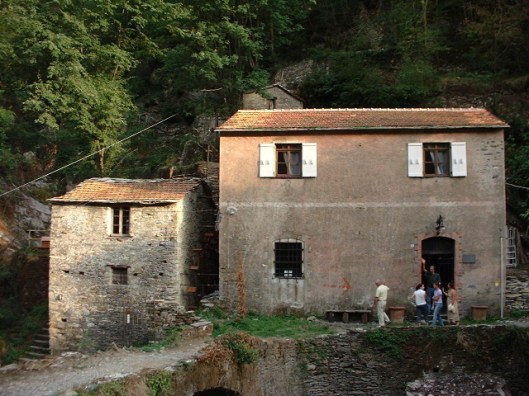
It happened to me not long ago when I took a walk with a friend. We came to the old and interesting Complesso Molitorio (Mill complex), which lies on a sentiero (walking path) that connects San Maurizio di Monti to Rapallo along the San Francesco torrente (fast flowing stream), on the opposite side of the narrow valley from the paved road.  The sentiero is not particularly well known, and does not appear on the trails map for this area. To reach it from San Maurizio you walk down what begins as an ever more narrow residential street, which finally turns itself into a path. From Rapallo the route begins on a paved street but soon takes the form of an old mule path which climbs and winds through the forest. According to the website lacipresse.it, the path is known as “Strada Antica di Monti,” a part of the “Antica Via del Sale” (The Old Salt Road – why there was a Salt Road here I have not been able to learn).

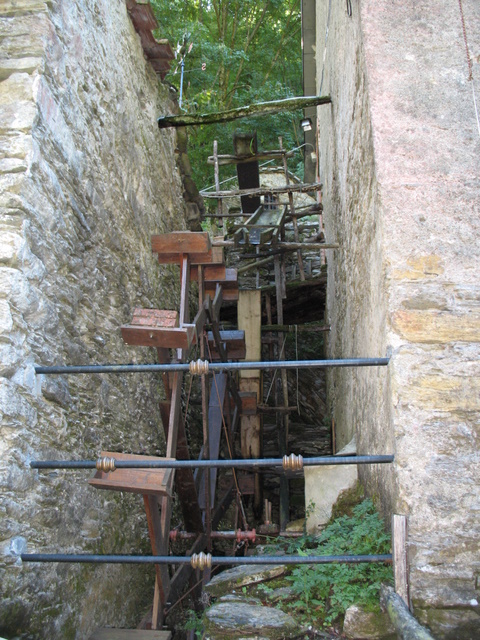
The Mill complex is comprised of four buildings, three of which you can see in the photo above. The large building in front was constructed in the 17th century and was an olive mill. A wheat mill was housed in the smaller building on the left; and the small building up above the others was a chestnut mill. The fourth building, not much more than a room really, is behind the large main building, and was used for collecting the refuse of the olive pressing.

The San Francesco feeds a mill pond above the highest building:
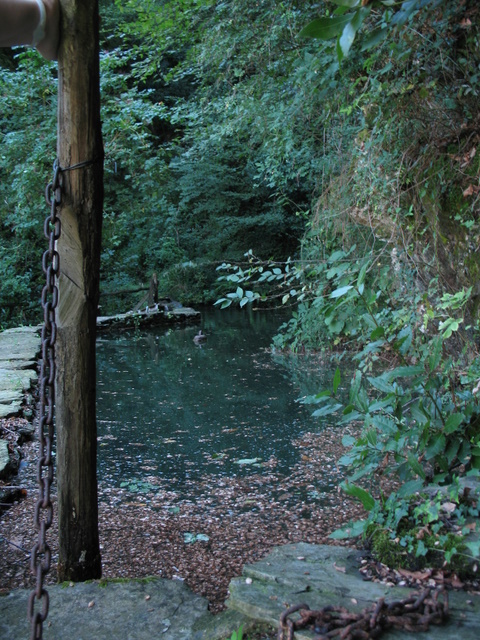
The water can be directed down an earth and stone canal to tumble into the waterwheels that powered the various milling operations:
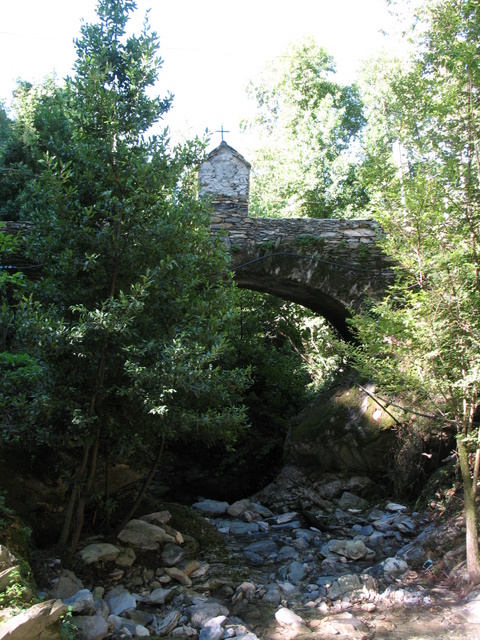
The oldest structure in the complex is the old stone bridge that crosses the San Francesco, built in the Roman style, quite possibly during Roman days.
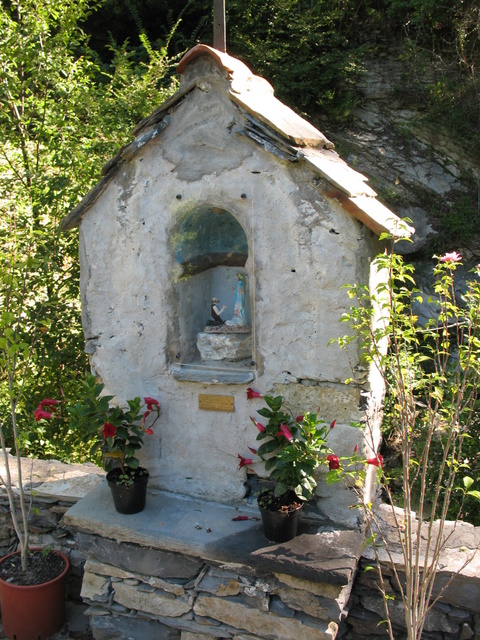
The little chapel on the bridge, a recent addition, honors the Madonna of Montallegro and is called Nostra Signora della Cipressa.   According to the story, there was a chestnut tree that stood nearby. One day, during the plague years, the tree suddenly died – in just the one day! The belief is that the tree, through the intercession of the Madonna, absorbed the deadly disease and rendered it harmless, thereby saving the citizens of San Maurizio di Monti. (For more about the Madonna of Montallegro and the plague, see here).
There have been several re-structurings of various elements of the complex, including one in the early 18th century, one in the 1920’s, and another in the early years of this century . During the recent renovations the large building was turned into a museum, Il Museo della Civilta’ Contadina “Cap. G. Pendola” – the Museum of Rural Culture (named in honor of Giovanni Pendola, a heroic Captain in Garibaldi‘s Army). In it you will find old implements that farmers employed to wrest a livelihood from these steep hills, as well as accouterments of the mills themselves. It is open on the third Sunday of each month from 3 – 5 p.m., at which time a very well informed docent can explain the uses of the various tools, and tell about each of the buildings. (The renovations in 2001 won Second Prize in the 2003 Concorso  “Ama il nostro paese” – love our country – sponsored by the City of Rapallo and the Rapallo Lions Club.  In 2006 the Complex was designated a National Monument.)
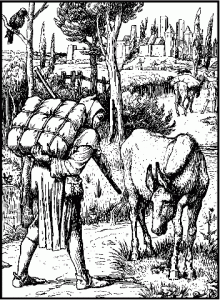
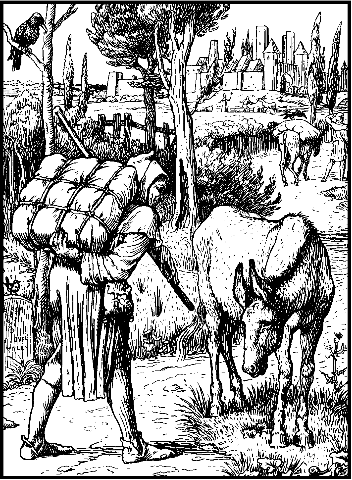
Some centuries before our mill, but I like the image!

Although the mill was still functioning as late as 1940, it is much more fun to imagine what it would have been like in, say, 1750. You’ve gathered all the chestnuts in your part of the woods, have dried them over a smoky fire and have thrashed them out of their husks.


Now you put them in barrels that are firmly strapped, one on each side, to your mule. Slowly and carefully the two of you make your way up the path, your mule finding a careful foothold between the upturned stones on the steep parts of the road. You hear the mill before you see it; the water is rushing down the canal and the big wheel is squeaking a little as it turns. When you get a little closer you can hear the big gears groaning and clicking as they engage. There are a lot of other people there with their chestnuts, too. Chestnut flour is a staple, and a good crop might form the basis of your family’s diet for much of the year. (For an interesting article on historical food uses of chestnuts, look here.) While at the mill you have a chance to exchange gossip with neighbors you haven’t seen for a while and to catch up on the news of the town below. After you’ve left your chestnuts to be ground into flour, you might continue up on the mountain to give thanks at Montallegro for a good harvest, and to ask the Madonna to protect you through the short winter ahead.

There’s another great story associated with the mills. The present owner’s grandfather, the  Giovanni Pendola for whom the Museum is named,  was the owner of the mill in 1907 when he went to Genova to take aid to the victims of a cholera epidemic there. He contracted the disease himself, and died soon afterwards. His true love, a lady named Caterina who was, they say, still beautiful, lost her will to leave her house when she received the news of his death. Then, taken by an irresistible urge for freedom, she became a wild creature of the woods.

Painting by Patrick Soper, soperstudio.com

Still today, disguised as a fox with a soft tawny tail, she wanders during the coldest days, “those of winter when the cold north wind blows, or when windy gusts blow the last dry leaves, and the bare, rattling branches of  trees reach to the sky like imploring arms.” The tradition says that if you meet this fox and look into her eyes, you may lose your memory or be swallowed up by the woods.

If you’d like to see some more pictures of the mill, click here.  Click on ‘slideshow.’

Many thanks to the website lacipresse.it, from which I learned the content of this post.
Kumquats

Tags

,

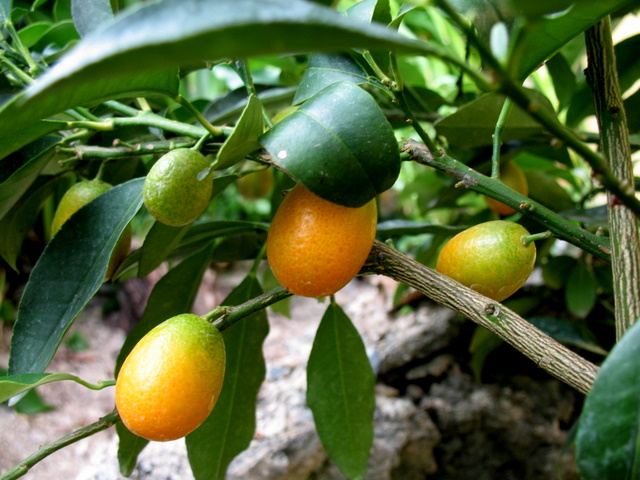
Kumquats are amusing because they are made inside out. Though they appear to the observer to be a normal, if rather small, citrus fruit, it becomes clear immediately to the eater that they have sweet skins and a very tart interior. Ha ha.

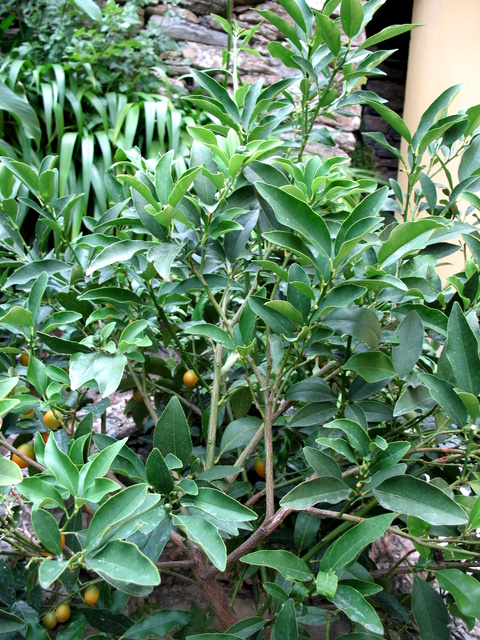
Wikipedia tells us that “they are slow-growing evergreen shrubs or short trees, from 2.5 to 4.5 metres (8 to 15 ft) tall, with sparse branches, sometimes bearing small thorns. The leaves are dark glossy green, and the flowers pure yellow, similar to other citrus flowers, borne singly or clustered in the leaf-axils. The kumquat tree produces 30 to 50 fruit each year.[dubious – discuss] The tree can be hydrophytic, with the fruit often found floating on water near shore during the ripe season.[citation needed]” I can’t speak for the hydrophytic (growing in water) nature of the tree, but the information on fruit production is dubious indeed. We have a very nice, short kumquat tree that we planted in ordinary garden soil a couple of years ago, and it gives us more fruit than we can count. Here is a photo of it after our most recent harvest:

“The plant is native to south Asia and the Asia-Pacific,” continues Wikipedia. “The earliest historical reference to kumquats appears in literature of China in the 12th century. They have long been cultivated in Japan, Taiwan, the Philippines and southeast Asia. They were introduced to Europe in 1846 by Robert Fortune, collector for the London Horticultural Society, and shortly thereafter into North America.” Their late arrival may account for the fact that they are not a particularly well-known or frequently grown garden tree in America. And their unusual taste guarantees that they are not going to be in a bowl on everyone’s table.

There are only so many one can eat in passing. Eating a kumquat really does wake you up. First you say, oooh, sweet. Then you say, yikes! sour!! A kumquat is a truly happy marriage of sweet and sour, in a pre-packaged and ready to eat form.

So what does one do with all the kumquats? We have asked ourselves that very question, but we are hardly the first to do so. Marmalade is the obvious answer, but we passed this year. Our shelves are already groaning under the weight of cherry, apricot and plum jam; we don’t need more jam. The people at Chow.com have some great answers to the question, all the way from soup to nuts… or at least from salad, through main course to dessert, with a nice rum drink to wash it all down.

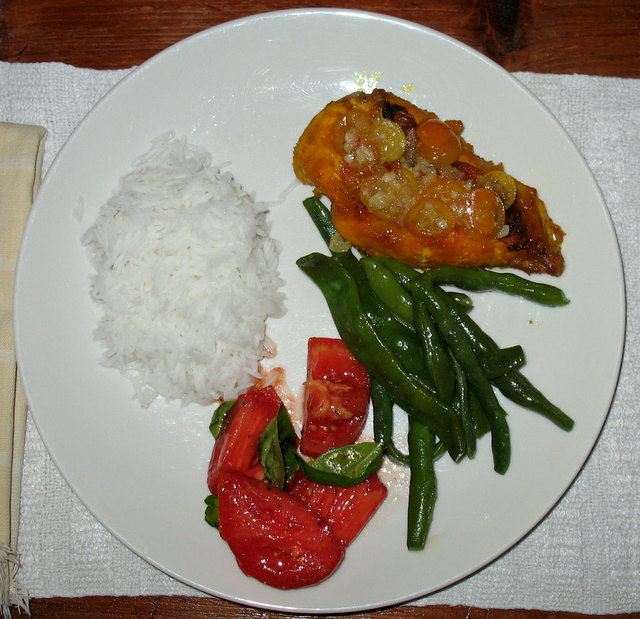
The Captain found and adapted a delicious and unusual chicken dish that uses kumquats on the epicurious web-site.

You can find the recipe here, or over on the right in the recipe index.

But whether you look at the recipe or not, I hope some day you’ll have a chance to eat some kumquats. They’ll make you sit up and say ‘howdy!’

When in Rome…

Tags

,

The Ristorante Da Meo Patacca was a great favorite of the TWA crews years ago when the Captain was flying to Rome frequently. One of the most popular dishes of that discerning group of eaters was spinach prepared with garlic, pine nuts and raisins. Yes, raisins. Yum.

The recipe is simplicity itself. The quantities listed will make enough (barely) for two; adapt as required for your table.

2-3 Tablespoons raisins
1/2 kilo (1 lb) fresh spinach
2 Tablespoons olive oil
1 garlic clove, crushed
2-3 Tablespoons pine nuts

First put the raisins in a cup with some warm water and let them soak for a while – 15 minutes to half an hour should be sufficient.

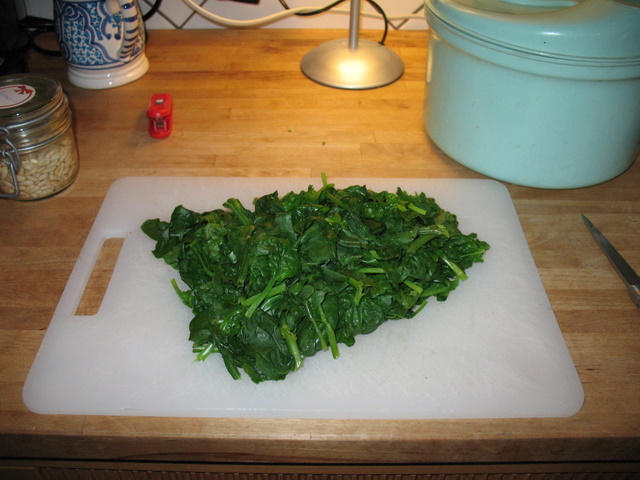
Wash the spinach well and put it in a big stock pot with a little bit of water. Cover and bring to a boil, flipping the leaves around frequently so they cook evenly. Cook them only until they are wilted and dark green; do not finish cooking them. Pour into a colander and let sit for a while or, if you’re in a rush, press the remaining liquid out with a wooden spoon.

Wipe out the stock pot with a paper towel, put it back on the stove and put in the olive oil. Put the garlic in the oil and cook until it is nicely browned, then remove it.

Add the pine nuts to the oil and cook until only just beginning to turn brown.

Toss in the spinach and the raisins and cook, stirring frequently, until the spinach is cooked to the degree you like it. Add salt and pepper to taste.

It couldn’t be easier, and it is absolutely delicious. The raisins are a wonderful surprise.