The Best Thing We Ate This Week – Penne with Cabbage and Cream

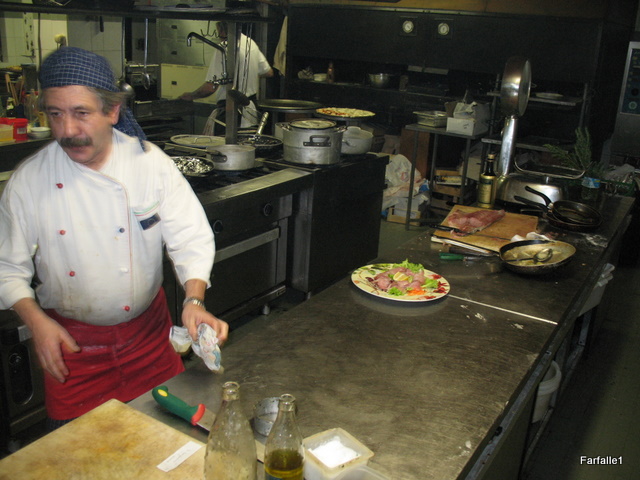
Photo courtesy of thedailygreen.com

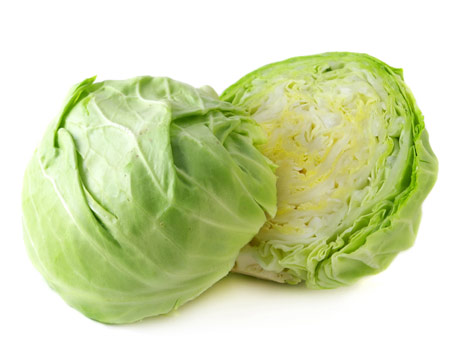
‘Tis the season to eat cabbage, a wonderful and woefully underused vegetable.  Cheap, too!  You get a whole lot of cabbage for your money; perhaps if your family is small it seems like you get way too much cabbage for your money.

We love homemade coleslaw and made a batch not long ago.  Shortly afterward some friends from Italy, came to visit us.  Their visit posed some interesting and difficult problems for Chef Captain; one of the women is a vegetarian, the other has an extremely restricted diet that excludes onions, garlic, tomato and soup.  In addition, the second woman is not very fond of fruit and likes only certain vegetables.  A knotty problem indeed.

On many of the evenings our guests were with us the only solution involved separate dishes, one with the offending ingredients (onions, garlic, principally), and one without.  Such was the case the day the Captain decided to take on the half a cabbage that was left over from our last coleslaw binge.

He fussed and muttered in front of the computer screen for quite a while, but in the end he came up with a recipe for Penne with Cabbage and Cream that is divine. While I credit him with its deliciousness, he insists it is but an adaptation of various recipes he found while researching food of the Alto Adige in Italy, a region that loves its cheese.  The dish is a great combination of the Virtuous (cabbage) and the Sublime (cream, cheese).  I hope you’ll try it… and don’t leave out the onions and garlic unless you absolutely have to.  You can find the recipe here.

Church!

Tags

, , ,

Here’s a switch.  usually I write about my experiences as an expatriate, either in Italy, where I truly am one, or in Arizona, where I mostly just feel like one.  Our friends Elena and Michela arrived from Italy yesterday, and now I get to see our country through their expatriated eyes.

Being practicing Catholics they went to mass this morning at the closest appropriate church, the Church of the Holy Cross in Mesa which is a half hour’s drive away.  Now if only they were Mormons, Methodists, Baptists or Lutherans I could have accommodated them in a matter of a few minutes.  Don’t let the photo above fool you – the place was mobbed for 10 a.m. mass.  I had to go to a nearby shopping center to find a parking place while I waited for my friends.  There are two churches, and there was standing room only.

How was it different? I asked.  In lots of ways, it turns out.  First, in Italy going to church is mostly women’s work.  If you see a solitary man in church he is very likely a recent widower, according to Elena.  Here you see many couples and families worshipping together; it is more the rule than the exception.  And it is beyond rare in Italy to see the church packed to the gills and overflowing for Sunday mass.

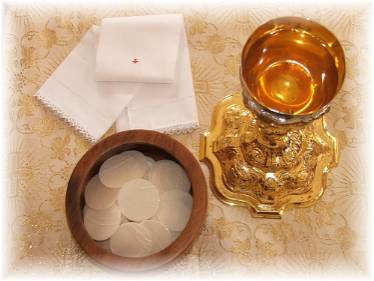
In Italy the congregants are offered only the host.  Here they are offered both host and wine, either for sipping or dipping.

The wafers are thinner and yellower than those in Italy, but Elena opined the caloric value was probably about the same.

Going to the altar for communion can be very disorderly in Italy with everyone getting as close as they can as fast as they can.  Likewise, people come and go at will, frequently not remaining for the whole mass.  At the service today Elena observed that everyone formed a line to take communion, and each person patiently awaited his turn.  No one left early.

She was enthusiastic about the music, which was almost like a concert.  Everyone sang!  In Italy only a few wurbley-voiced matrons participate, but here the singing was hearty and heart-felt.

So what were the impressions she came away with in general?  She was impressed by the number of people and the active and orderly participation in all parts of the service.  But she found herself wondering if there was the same spirit of joy in today’s mannerly congregation as she frequently sees in the smaller masses of her home church in Italy.  She couldn’t say yes, or no, but it was an interesting question for all of us.

Swedish Tea Wreath

Tags

,


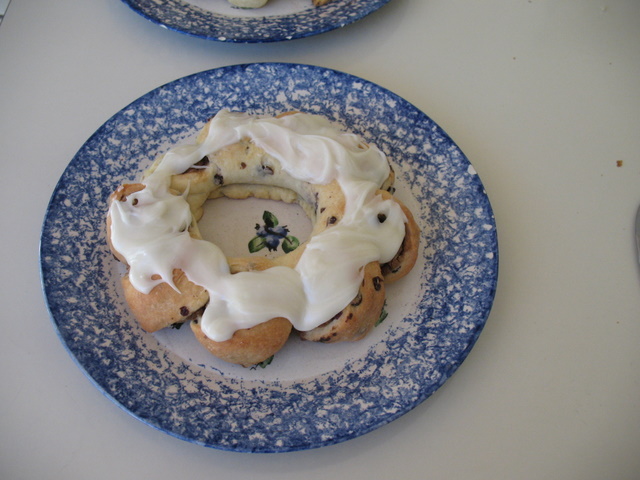
Between traveling to the States for a lengthy visit, flying to Tennessee for a familial visit and negotiating the madness that is Christmas here, it has been a busy time for the Captain and yours truly.  We took some time out to enjoy cooking special holiday treats, though, such as the cookies the Captain learned to make at his mother’s knee, and the Swedish Coffee Cake we’ve enjoyed on Christmas mornings for the past few years.  Be warned: you may want to make an appointment with your cardiologist before embarking on this recipe.

I found the recipe at about.com, where it is called Swedish Tea Log, by Linda Larsen.  We’ve made very few changes – why mess with success? – but have changed the shape to give it a more Christmasy appearance.  Every year I say to myself that the frosting is too thick and should be runnier and applied more sparingly.  I’ve adapted the recipe to accommodate that opinion.

There’s no reason not to make this yummy treat any time of the year.  Everyone loves it, which makes it well worth the little bit of extra effort (really time, more than effort) it takes to make.

Click here for the recipe, invite some friends over for tea and have fun!

Sometimes he doesn’t ring at all…

Tags

,

Image courtesy of scrapologie.blogs.com

This morning my friend Deborah called from San Francisco called to say that the letter I mailed to her from Rapallo on October 18 had arrived yesterday.

What wonders did my letter see on its long journey from me to Deborah??!

I guess we’ll never know, because although it’s full of words, it’s not talking.  Guilty conscience, no doubt.

Vanity, vanity

Tags

,

Dear Mr. Berlusconi,

It has come to our attention that Italy, like the United States, is in dire financial straits.  Austerity budgets, tax increases, benefit reductions – these are the cures being tossed at this world-wide epidemic (except in the U.S., where we are extending tax cuts and increasing spending… but that’s a topic for another day).

Mr. Berlusconi, you are missing a grand opportunity for raising funds.  It is easy to do – in fact, it is already being done in the U.S., Canada and many other countries.  We can’t imagine why, in these troubled economic times, the EU has not embraced the Vanity Plate for automobiles.

What is it, you ask?  It is a personalized license plate for your vehicle.  Yours, for instance, might simply say BERLU – or perhaps PRM MIN, or maybe even LOTHRIO… anything that’s not already taken and is not obscene is up for grabs.

Here in North America we first issued license plates in 1903 (Massachusetts and Ontario).  They didn’t look anything like they do now – they were made of leather, rubber, iron and porcelain.  By 1920 the familiar embossed metal plates had arrived, and in 1956 the size of license plates was standardized.

The first personalized American plate was issued in Pennyslvania way back in 1931.  (I haven’t been able to find out what it said.)  For years and years each state had its own color scheme for license plates with raised numbers in a contrasting color – New York was orange, Vermont was green, Arizona was a sort of maroon brown.  All that changed over the years. Now there are any number of different types of plates available, depending on your State.

Mr. Berlusconi, did you know that in the U.S. and Canada there are 9.7 million vehicles with personalized plates?  3.87% of cars in America proudly carry a personalized message and each one of those plates cost money, money that went into the coffers of the issuing State!

And it’s not just the States that benefit.  Many States offer a personalized plate that supports a belief, a school, a sports team.  Here in Arizona we have a choice of 38 plates touting anything from cancer awareness, to the environment to Arizona State University.  Once you’ve chosen your type of plate, you can choose the letters and/or numbers you want on it.  Prices vary from state to state.  In Arizona it costs $25 to apply for a vanity plate, and $25 a year to keep it.  If you have chosen a plate that supports a charity, a hefty portion of the annual fee will go to the charity (here it’s typically $17 of each $25 renewal).

Think of it!  If you could sell, say, 1,000,000 plates a year in Italy, and you charged E 50 a year, that would be 50,000,000 a year.  Granted, it won’t solve Italy’s financial crisis, but it would help.

There’s another benefit Mr. Berlusconi – it’s much easier to remember a plate that spells out a word, even in an abbreviated form.  This would be helpful for all those times you have to write your plate number on a form, which seems to be about once a week in Italy.  How much simpler to remember BERLU than, say 135 MIN.  Also helpful if you need to report a hit and run to the police.

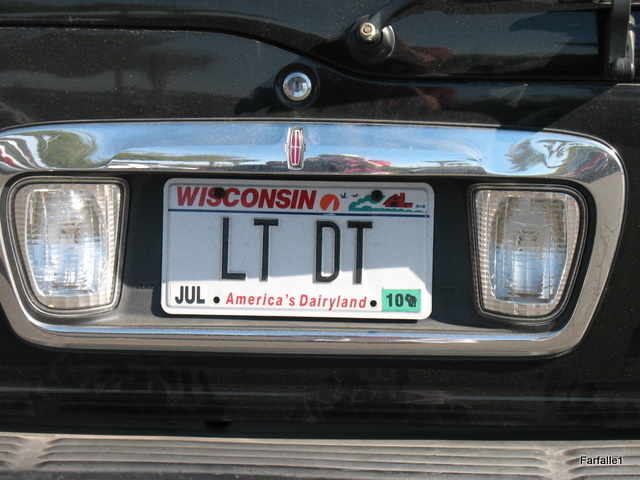
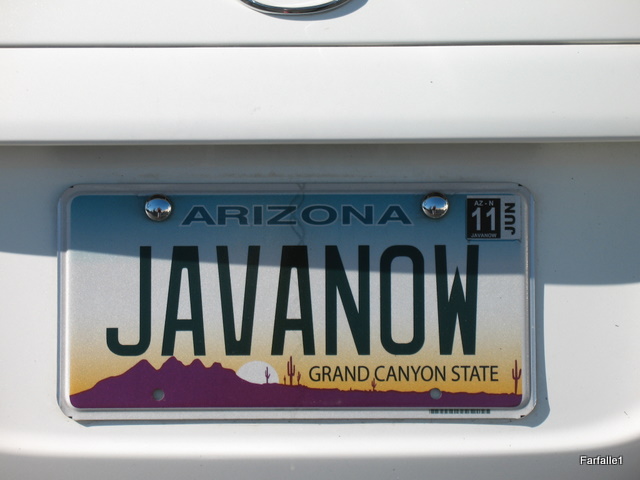
Are you thinking it might be hard to come up with a good idea for a plate?  Well, there are a lot of ways to approach it.  Some people opt for the simple name or initials plate:

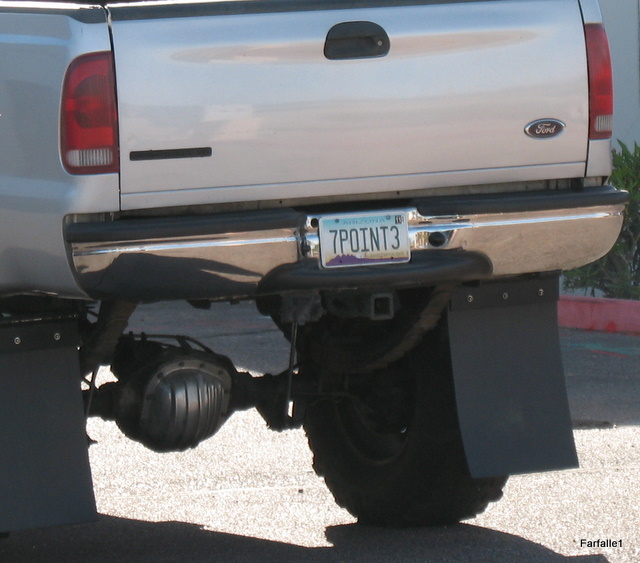
Others like to come up with clever sayings to tell other motorists something about themselves – a sort of highway tweet:

Born to fight? Tanned from outside battles?

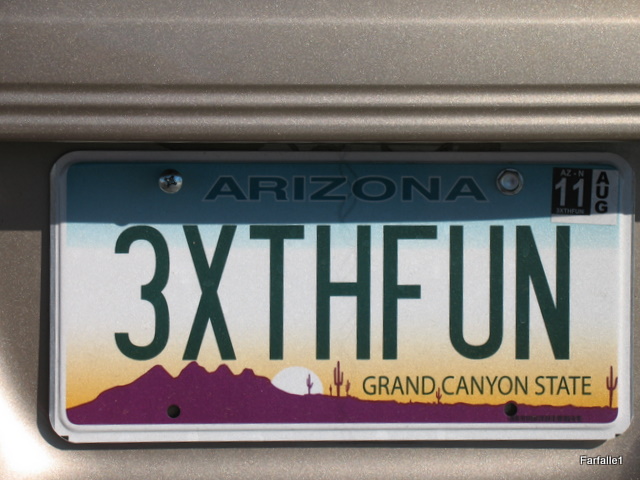
Then there are the ones that mean something to the owners, but are, perhaps, a bit mystifying to readers:

Multiple personalities, perhaps?

Proud scholar?


Note that the one above is a special plate for a veteran.  Does it mean Corporal Tom?  Or perhaps it belongs to someone who did code work?

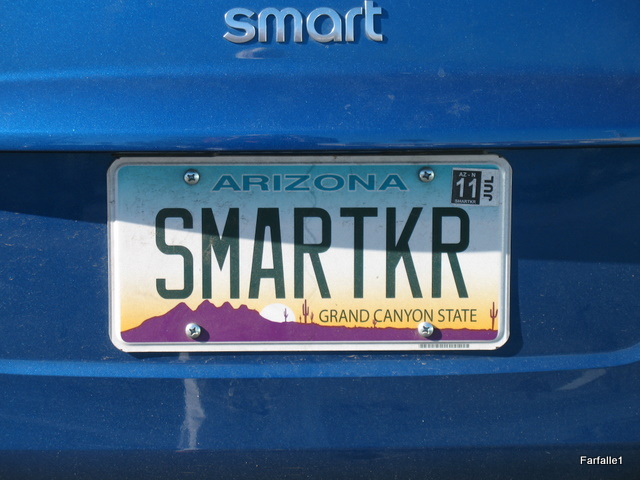
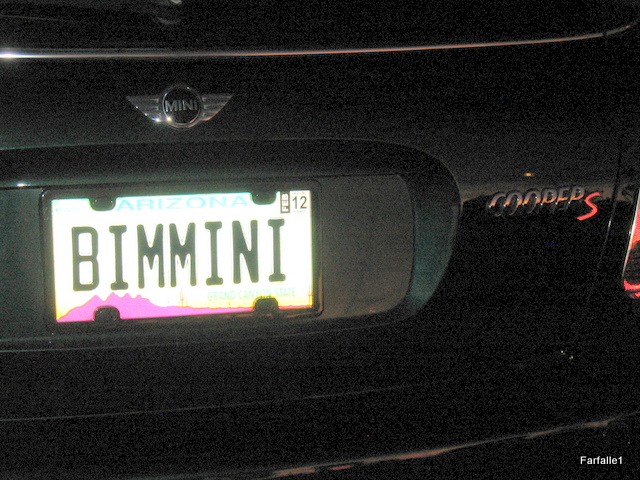
Many is the car owner who is proud of his car and wants you to know it:

This is on a Mini Cooper S… and perhaps it combines with another favorite vanity plate, the place name.

Plates are a pretty inexpensive way to advertise, and they reach a wide audience:

Is that advertising Zinfandel?  Or something else?

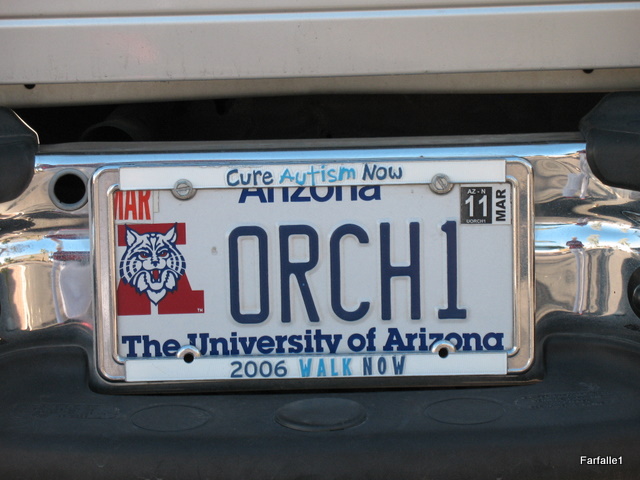
The University of Arizona has a vibrant music department – could this be a proud member of the orchestra?  Or simply someone who likes good seats at concerts?


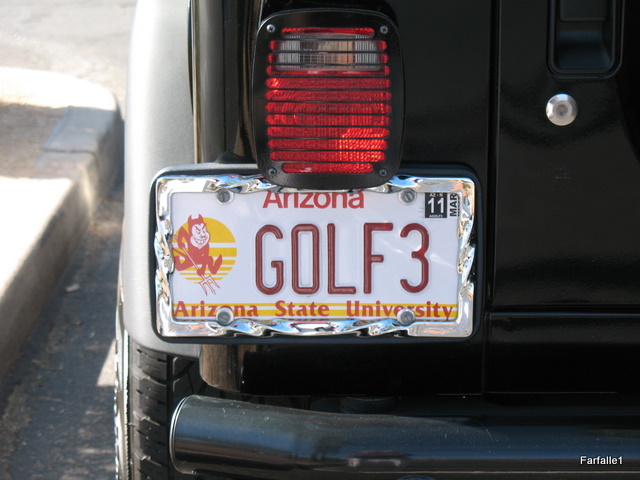
Sports themes come up a lot on the back of cars:

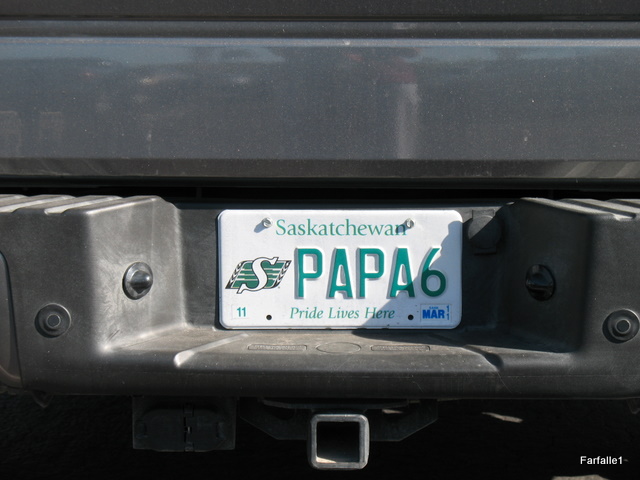
Other people just want you to know where they fit in the family:

Mr. Prime Minister, you could make a great public relations gesture and give the Pope the Papa 1 plate, free of charge.

I hope, you’ll consider this fund-raising suggestion, Mr. Berlusconi; surely vanity plates would be a hit in Italy. And if none of the above gives you ideas for your own plate, you can check this link to find hundreds of suggestions.

Sincerely,
Farfalle1 (who will apply for the Farfal1 plate as soon as they’re available)

It’s Your Responsibility

Tags

, ,

In Italy people tend to take much greater responsibility for the little details in life than we do in the United States.

Take bills, for instance.  Certainly we receive many, too many we often think!  But actually, we receive too few in Italy.  There are many obligations which we must remember we owe, track down the amount due, and then pay in a timely fashion.  These include automotive taxes, health insurance (which we pay for because we are not citizens), automotive insurance, other taxes (income and property – of course! – though the property tax on primary residence has been repealed), and various inspections – motor vehicles, gas heater and so forth. Helpful reminders are not forthcoming, and penalties apply for late payment.  We forgot to pay the car tax a couple of years ago and the penalty was substantial – about E 100 if memory serves.  Auto registration and driving licenses  are also on the list of things we must remember to renew without benefit of a reminder.  The Captain has created a great month-by-month calendar on the computer so that we won’t forget what to pay when.

It’s not consistent, though.  For example, we receive bills for the TV tax, the Road Access tax (don’t ask), and the Garbage tax, but not for the various taxes noted above.  Who decides these things?  How do they decide??

And even when help is available its isn’t always, well… helpful.  When we bought our tumbling down house in the hills above Rapallo we were stunned to discover that property tax bills were not forthcoming.  The Captain went right away to the appropriate office for help in figuring out what we should pay for the ICI (property tax, pronounced ‘eetchie’) each year.  They were  helpful, and we were thrilled because it was about € 35 a year – a real bargain!  When the reconstruction of our house was finished our geometra registered the change of house category with the regional property office, which should, one would think, have triggered a change in taxes owed. (A geometra is a cross between an engineer and an architect, in our case the man who designed the reconstruction and oversaw its realization)

We have always asked a ‘commercialista’ (an accountant) to prepare our Italian taxes, and after a couple of years the man who does them was able to calculate our ICI due from information on record about our house, saving us our annual jaunt to the nice lady in the ICI office.  Years passed.  The ICI was repealed for primary residences.  The very year the repeal went into effect we were summoned to the ICI office; we were in arrears.  To make a terribly long story shorter, the ICI office had never updated the valuation of our house, in spite of the category change being registered, so we paid years of taxes on an uninhabited rustico instead of an occupied house.  In addition, the house is in both our names (which are different).  Each year when the Captain went to the office to ask what we owed and later, when the commercialista took over, the figuring was done on the Captain’s share of the tax.  No one realized Farfalle owed tax too.

We were able to negotiate the dismissal of the huge penalties and interest on unpaid taxes since the proper forms had been filed after the work was done.  But still, we owed some six years of taxes at a higher rate for the Captain, and all taxes for Farfalle – it was well over € 1,000, a truly horrid surprise.

Another responsibility people in Italy carry is keeping track of their own health records.  Certainly doctors will have records but if, for instance, you get an X-ray, the film is given to you to carry home, not filed at the doctor’s office or in the hospital or lab where it was made (do they have copies I wonder?  Surely they must).  In fact, all lab results are given to the patient, not sent to the doctor. This is very convenient if you decide to visit another doctor for a second opinion.  But it’s really inconvenient if you go to the doctor and forget to take your files with you!

Vets do the same thing.  Each patient has a ‘libretto’ – a record book of visits, treatments, procedures.  I recently disposed of the late Luciano‘s records (with a bit of a cry) which included some mysterious X-rays I couldn’t recognize.  A paw, perhaps, or maybe a bit of tail. It was easy to keep track of his records – I simply left them all in his cat carrier.  If only I could come up with such a reliable system to keep track of our own records!

We’re in the U.S. now.  The Captain had some blood tests done over a week ago.  They have not been forwarded to his doctor yet, and the lab absolutely refuses to release the results to him.  They treat us like incompetents here.  Inconsistent as things are in Italy, at least we are generally treated like adults.  And while I may not have brought the results of the Captain’s previous blood tests over here with us, I know where I’ve filed them in Italy.  Take that, LabCorp, who can’t manage to get them to an office in the same building within a week!  Why not allow us just a little responsibility… but maybe not quite as much as in Italy?

Focaccia col Formaggio

Tags

, , , ,

In all of Italy it is the province of Liguria that is most famous for focaccia, the exquisitely delicious flat, oily bread.  In all of Liguria, the town of Recco is most famous for its focaccia.  And in Recco, one of the most famous places to find focaccia col formaggio is Ristorante Vitturin 1860.  Yes, the date at the end of the name is the date the restaurant was established.  As they proudly state on their business cards: ” ‘Il piu antico di Recco’, 150 anni e non sentirli” (the oldest in Recco, 150 years and we don’t feel it).

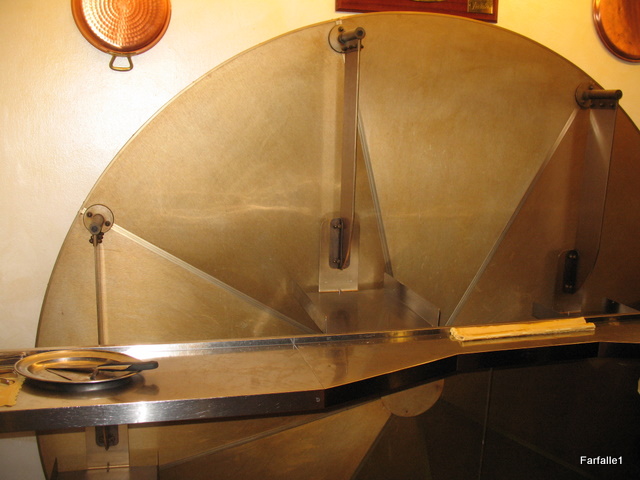
Before leaving  for the States we met our Genovese cousins at Vitturin to enjoy some seafood and some of the restaurant’s well-known focaccia col formaggio (quite unlike the more usual bready styles of focaccia).  Once inside the restaurant we were amazed to see the enormous paddle-wheel apparatus that delivers meals from the kitchens below to the diners above.

There are about eight of these trays mounted on the wheel; obviously they must stay horizontal as the wheel turns – it is a most ingenious system and must save a million steps a day for the wait staff.

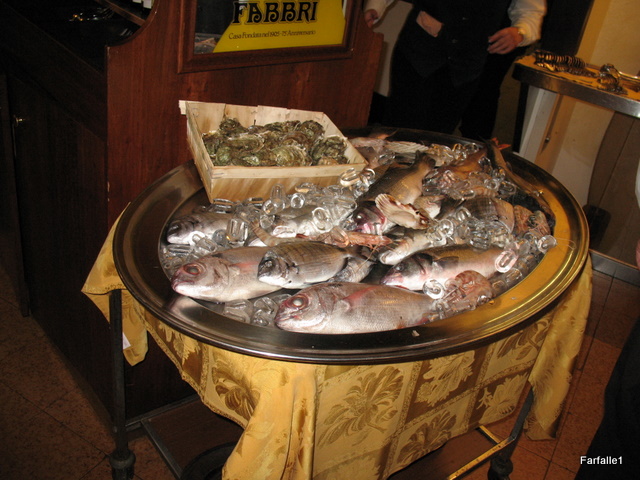
Fish and focaccia are the main events at Vitturin; they give the merest nod in the direction of meat.  This big platter of fish would entice any diner.

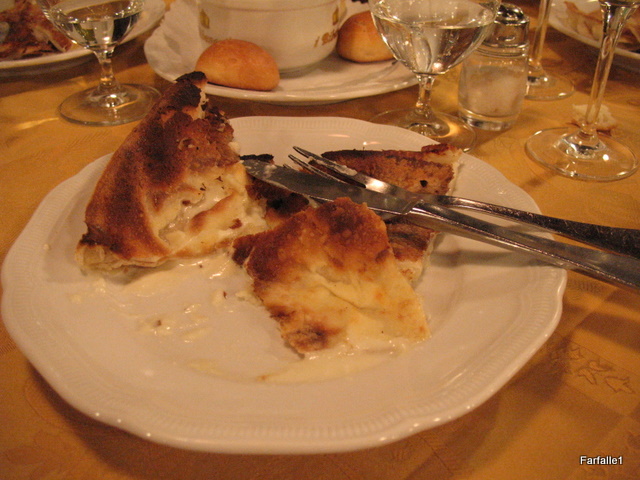
Here is a close-up of my partly devoured focaccia col formaggio:

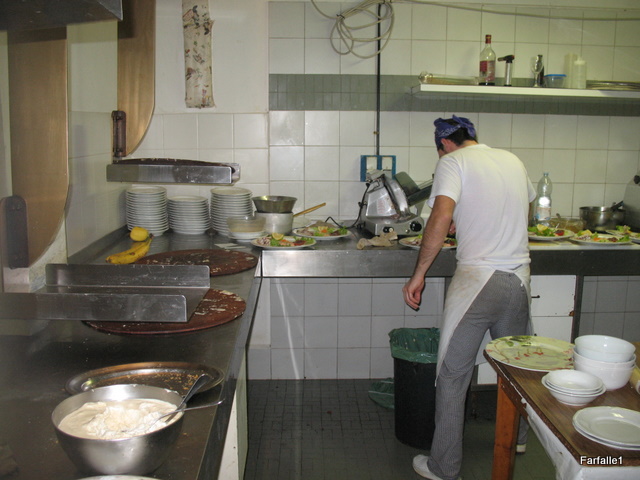
What was the highlight of the evening?  It was a long visit to the kitchens below the restaurant proper.  The Captain asked the Maitre D’ if we could see what the delivery wheel looked like down below, and he immediately escorted us to the nether regions.  There we saw the wheel looking much as it did above – plates of steaming food going up, empty plates coming down.

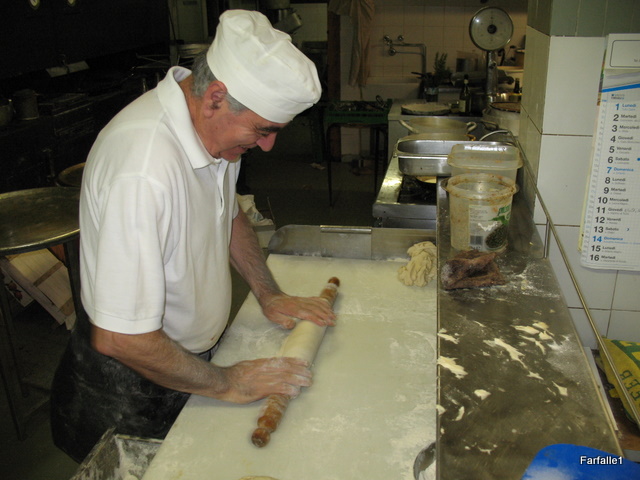
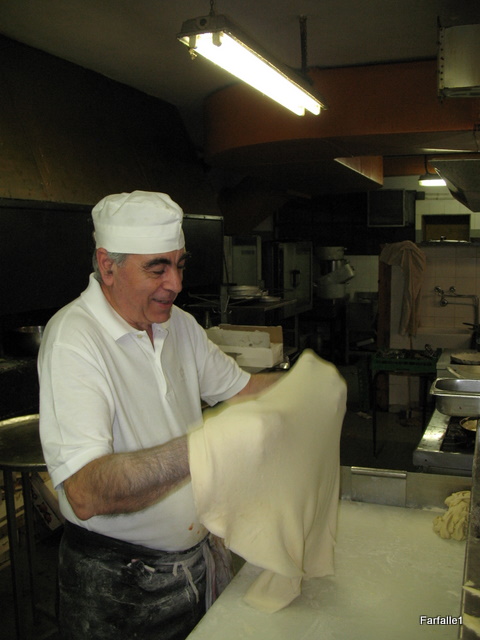
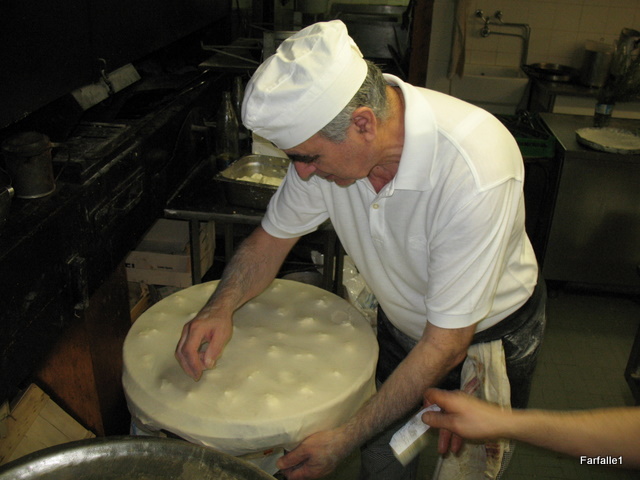
Over on one side of the kitchen we met Filippo, who makes, he proudly told us, about 120 focaccia col formaggio every evening.  He begins by mixing his dough in the early afternoon and letting it rest.  When he’s ready to make a focaccia he takes a big knob of dough and rolls it out.

When the dough is thin enough he picks it up in his hands and does the stretching maneuver we associate with pizza-makers.

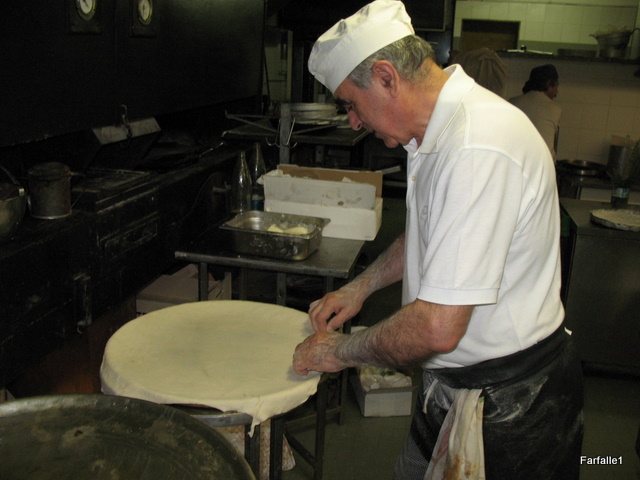
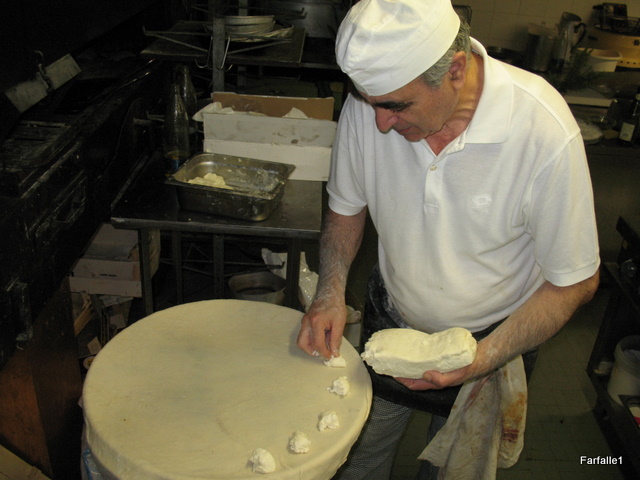
He puts it on the large round focaccia pan and puts dabs of stracchino cheese on top, about 750 grams for a regular focaccia, up to 1500 grams for a large size (that’s more than a pound for the regular, and about 3 pounds for a large). (!)

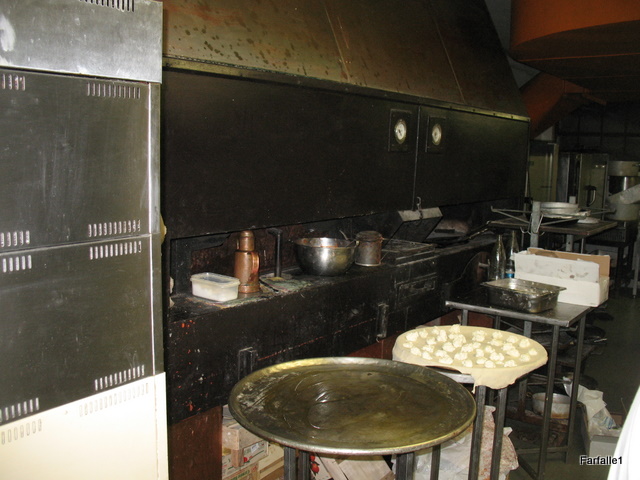
(It’s pretty hard to see in the photo, but that’s the old wood-fired stove in the background.  The restaurant now uses an electric oven.)

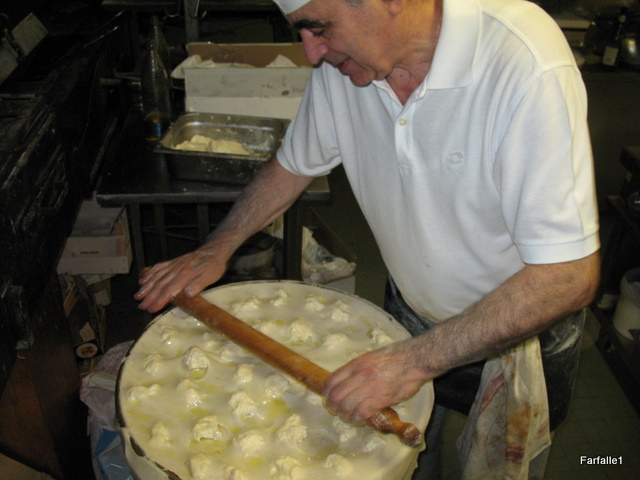
Then Filippo rolls out another sheet of dough, just the way he did for the bottom of the focaccia, and puts it over the cheese.  With a quick, nipping movement he tears some holes in the top layer of dough over some of the cheese knobs.

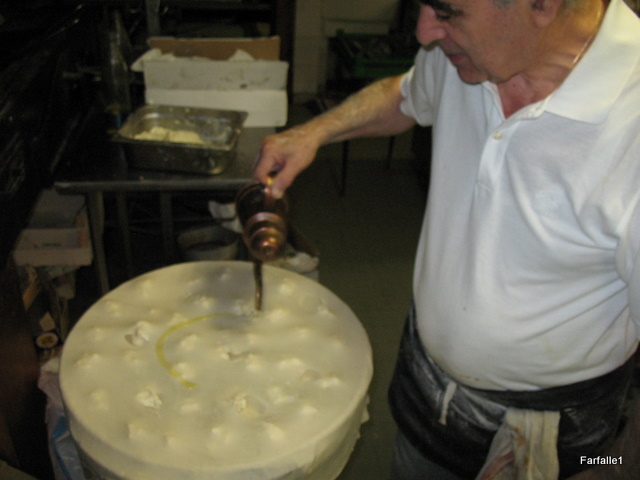
The final ingredients are put on top – a sprinkling of salt and a nice drizzle of olive oil.

All that remains is to trim the excess dough and pop the whole thing in a very hot oven.

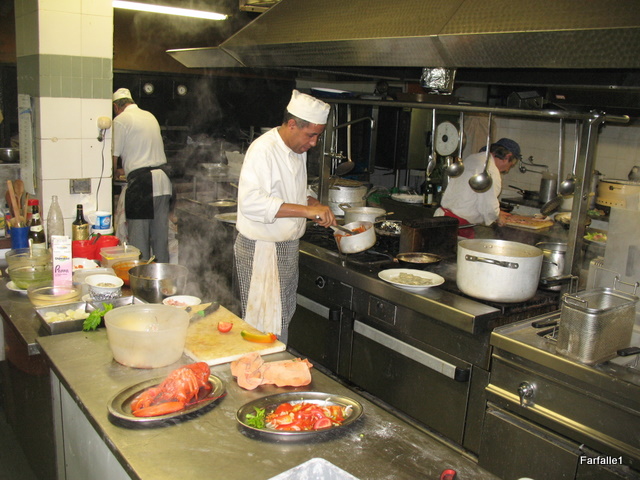
It was such a treat to be able to nose around the kitchen.  Everyone was clearly proud of the operation, and with good reason.  It was all orderly, clean and efficient.

Oh yum – a lobster!

They all move so fast; there were not a great many people down there, and they were putting out well over a hundred dinners.

As we were leaving the kitchen the dish-washer called us over and presented us with a little bowl of appetizers, and gave me a hearty handshake and a Buona Notte.  She was so cheerful, and so happy to see us.  We felt very welcome at Vitturin, both upstairs and down.

Genova, part 2

Tags

, ,

When we left our first Genova tour we had just eaten our fill of farinata at the Antica Sa Pasto.  Now that we’ve eaten so much we can barely walk, let’s roll down the hill to the port area.  While Genova still has an extremely active port (it’s the place to bring little boys who want to see really big boats), a large section of it, the Porto Antica,  has been refashioned as a cultural and tourist center.  On the city side of the busy street you can see Palazzo San Giorgio, constructed in 1260, and obviously tarted up in the centuries since.  It was the home to one of the world’s first banks.

Photo courtesy of cepolina.com

From about 1900 it served as the Port Authority; it now has several rooms that have been turned into exhibit space.  Cross the busy street and you will come to the Pirate Ship, one of the silliest of Genova’s offerings, maybe even sillier than Elvis.

Yo Yo Ho!  Arrrrrgh, let’s all talk like pirates!  Called Il Galleone Neptune (would you have guessed??), this replica of a 17th century pirate ship was built for the filming of Roman Polanski’s movie Pirates in 1986 (starring Walter Matthau as Cap’n Red).  You can go aboard for a fee, and it turns out to be rather fun.

A little bit farther along the road we come to Genova’s famous Aquarium, built in 1992 and justifiably known as the finest in Europe.  It is immense; you can easily spend a whole day, and you may want to – it’s not cheap to enter.  The displays are imaginative, interesting and clean; the whole thing is a delight.

In addition to all the usual fishy displays you would expect, you will also find a hummingbird house, and a glass biosphere designed by Renzo Piano at the time of the G8 meeting in Genova in 2001 (in fact Piano had a hand in the whole refashioning of the Port area).

The Aquarium is just a part of the so-called AquarioVillage which also includes the gigantic (5 floors) and fascinating Galata Museo del Mare (Museum of the Sea).  This museum is particularly appropriate to Genova, which was one of the four Maritime Republics in the Middle Ages (the others were Venezia, Amalfi and Pisa – yes! Pisa, which was once on the sea). Here you can see a full size model of a galley, numerous models of all kinds of ships,

reproductions of early globes,

and a letter written by Christopher Columbus.

There are tools of the sea-faring life, life-size models of shipwrights at work, a studio where model-builders work their magic, a part size model of a Vessel and of a much later Steam ship, and a reproduction of a submarine.  Attached nearby is a submarine, the Nazario Sauro, which is part of the museum and which guests can visit.  At present the Museum has an exhibit called “La Merica” about Italian emigration to the U.S.  I found it particularly interesting as the Captain’s father made the trip from Sicily to America in the early years of the 20th century, the period covered in the exhibit.  In addition to being informative it’s just plain fun.  Visitors are issued reproduction Italian passports, circa 1920, as well as an entry document.

Leaving the Port complex we’ll take a not-very-long walk to the Palazzo Principe, built by Andrea Doria around 1530 and now a museum.  iPods with tons of information about the exhibits are issued when you buy your ticket. Picture-taking is not allowed inside, but you can snap away to your heart’s content in the gardens.

See the cruise ship in the background?  No doubt Doria liked to keep an eye on his own ships at anchor beyond his Palazzo.

Well, that ends my extremely superficial tour of part of the beautiful city of Genova.  From here it’s a short walk to the other main rail station, Principe, where you can catch a train to wherever you’re going.

There are huge portions of the city that I haven’t mentioned (because I’ve never seen them), and many sites worth visiting (which are still on my own to-do list), including The Palazzo Bianco, The Palazzo Rosso, Palazzo Reale and the fabulous Staglieno Cemetery among many others.  There’s even a cog railway from Principe to Granarolo – sadly not operating the day I was there.  I can’t wait to go back!

The Balmy Riviera…

Tags

Yesterday and today’s main topic of conversation: the hail storm of yesterday morning.

Fortunately the ‘grandine’ weren’t large enough to do serious damage, but we lost our entire pomegranate crop – both fruits. A grave disappointment. As well a struggling patch of late season lettuce was flattened.

It’s olive picking time again, and our neighbors have put up their nets. As you can see from the photo above, though, so far they have collected only hail, and plenty of it. Though it arrived yesterday morning, it is still in the nets this evening.

I was able to do our olive ‘harvest’ in about two hours today; this is the second year post-pruning that we have not had a crop. However, if you’re interested in reading about and seeing photos of our 2008 harvest, click here and here…  We didn’t have a hail storm that year.