Driving me Crazy!

Tags

, ,

There has not been time to post fascinating entries about Life in Italy because of the time-gobbling demands of Learning to Drive in a Foreign Language (foreign to me, that is).  To make up for it, I have added two recipes on the right (Fish in the Ligurian Style and Adriana’s Fruit Torta) and have added to the Driving School Diary in Elaborations.

Above you see my present nemesises.  These four lads sit behind me and chatter away through each lesson.  Professoressa Elena intersperses her lecture with many a  “Silenzio!” but to no effect.  These guys have a lot to say and it’s all really important and can’t wait 30 minutes until class is dismissed.  Evidently it is all hysterically funny, as well, because it is all punctuated with frequent snorts and giggles.

The Italian word for ‘chatter’ is wonderfully onomatopoetic – it’s ‘chiacchiera’ (kee-ah-kee-yehr’-ah), and that’s what it sounds like behind me during driving school classes. I’m not really grumpy about it, to tell the truth.  I remember giggling for about 4 years running when I was their age.  In fact they seem like really nice kids. I just wish it weren’t so distracting as I try to focus on what Elena is saying; my problem, not theirs.

The text for the driving exam is 250 pages long. I think it’s kind of pathetic that the first book I’m reading in its original Italian is the Driving Manual, rather than, say, The Divine Comedy or the poetry of Montale. I have managed to read 200 of the pages; what lies ahead?  First Aid – that will be fun!  I have already learned from practice exams that we do not want to peel cloth off burn victims and that we do want to immerse their limbs in cold water if possible to alleviate pain.  I can hardly wait for my first accident!  Then, last but hardly least, there are the engine parts – that will be a sort of maze for me, I think – there are lots of parts that run with oil (brakes, engine), and other parts that run with water (radiator, window-cleaning), leaving out gas for the minute. Fortunately the questions on engines are rather basic, and Elena has already told us that any question including the words ‘change the tire pressure’ is false.  A useful clue.

Let me leave you with the most interesting thing I learned in my reading yesterday (insurance (which was incomprehensible), and driving under the influence (equally dangerous in any language)):  we really do not want to get behind the wheel of a car if we’ve just eaten a heavily spiced meal, or one heavy in fats or fried foods.  Who knew?

The Best Thing We Ate This Week – Barley Mushroom Casserole

Tags

, ,

Do you find the cooler autumn weather gives your appetite a big boost?  I do!  These days it seems I can’t stop eating, and there is no end of good food here, alas.

Yesterday I was charged to bring home potatoes to go with the Saturday Night Steak.  But a friend and a glass of wine detained me, so the Captain was left with only his imagination and what was already on hand for the starchy part of our meal.

What he came up with was the perfect dish for the season, combining ease of eating and the wonderful Fall flavors of mushrooms and grain.  It does take a bit of planning ahead as there is a fair amount of let-it-sit time in this recipe.  But if you don’t need to whip something up in five minutes this dish is the perfect accompaniment for any meat you may be serving.  I think it would be great at Thanksgiving. If you’re not a meat eater this can be used as a healthy main course. Barley retains its bran and germ, which are nutritious.  (According to the European Journal of Clinical Nutrition, eating whole grain barley can regulate blood sugar for up to 10 hrs after consumption compared to white or even whole-grain wheat, which has a similar glycemic index.)

So there it is: good for you, satisfying to eat, filling and, most importantly, yummy – you’ll find the recipe here or over on the right under recipes, *starred* as a Best.

Zoom Zoom

Tags

, , , , , , ,

Sunday in Japan Valentino Rossi won his sixth Moto GP Championship.  That’s motorcycles, and a happy result for Italy.  And in Singapore Filipe Massa and Kimi Raikkonon did not win the Formula One race for Ferrari.  That’s cars, and cause for a national day of mourning in Italy.

Should you care?

Well, that depends.  If you live with or are going to talk to one of the 90% of all Italian males or 60% of the males in the rest of the world (and who knows what percentage of females) who follow motor sports closely, the answer is Yes.  You will want to be at least familiar with the main players so as not to appear a complete dunce.

Personally I stopped watching Formula 1 when Michael Schumacher retired.  There was something about his utter focus, determination and single-mindedness that warmed the cold northern cockles of my heart. (If you haven’t heard of Schumacher, he was the Tiger Woods of Formula One.  If you haven’t heard of Tiger Woods you need a subscription to Sports Illustrated.)  The new Ferrari ace, Massa, is a cute kid, but he doesn’t seem to have the killer instinct that Schumacher had.  And I never did watch the motorcycle races; those boys lean over way too far.

If you live in Italy, however, there’s a more pressing reason for you to keep abreast of at least the racing schedule, if not the results.  Within half an hour of the completion of either of these races the ordinarily gutsy driving of the Italian male becomes downright lunatic.  Sunday morning as I coasted sedately down the hill to Rapallo, shortly after the completion of the MotoGP, a young kid on his all terrain bike came screaming around a car in the opposite direction on a blind curve; he was in the middle of my lane, and very fortunate I wasn’t driving my gravel truck today.

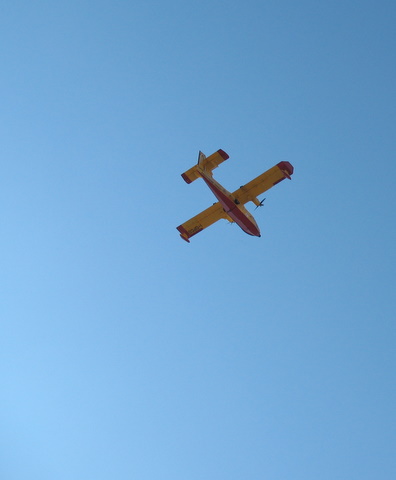
We were on our way to the beautiful city of Chiavari just down the coast from Rapallo.  There is a Mercatino dei Sapori (a food market!) on the last weekend of each month; vendors come from all around the country with absolutely delicious things to eat. Over on the right you can find a link to an album of photos of this delightful event.  This week, however, my interest strayed from the comestibles to the sky, because there was a Canadair flying from the sea to an inland fire and back again, over and over.

The Canadairs are small 2-engine airplanes with big stomachs.  The pilots, who must have to pass an insanity test for the job, skim over the sea and pick up a belly-full of water which they then carry back to the site of the fire, on which they dump their load of water, back and forth, back and forth.  Again on the right you’ll find a link to photos of the Canadairs fighting fire – both from Sunday and from a couple of years ago when they were flying over the hill just behind us.  They engage in amazing feats of flying prowess, aiming right towards a hillside, for instance, and pulling up at the last possible moment, at the same time releasing their water which inertia carries forward to the burning hillside.  It’s incredible to see, much more exciting than either of the races that were on TV that morning.

There’s a great urban myth about the forestieri finding the charred remains of a swimmer, in full scuba outfit, high on a burned out mountain.  He must have been scooped out of the sea by a Canadair and dropped right into the heart of the fire!!  I believed this entertaining tale the first three times I heard it; then the penny dropped.

The pilot this morning flew back and forth low over the city of Chiavari instead of over a less-populated area.  We could hear the low grumble of his engines as he neared the city; the sound growing to a roar as he passed low over the narrow streets, which sent the sound bouncing back and forth till we weren’t sure from which direction it was coming.  The Captain, who should know, says he was between 300-400 feet above us, which sounds like a lot until it’s an airplane flying over your head.  Then it doesn’t seem like nearly enough.

As we were scooting home we watched this hot dog fly parallel to the coast up towards Rapallo.  He then banked sharply and flew directly at a cruise ship in the bay outside Portofino, banked very sharply and flew between the ship and the land, banked again in the other direction around the Portofino lighthouse, and headed back up to the airport at Genova where the Canadairs are based (rather poor pictures of these maneurvers, blue tinted for some reason, on the right).  Anyone on the ship or at the lighthouse will have had a more exciting morning than they had planned. The Captain says that the pilots eat in the cafeteria at the Genova airport at 12:30.  As it was 12:10 I’m sure this fellow was on his way back for lunch.  But he couldn’t resist giving the folks on the land a bit of a thrill.  No doubt he had watched the motor cycle race that morning.

If you see a path, take it

Tags

, , ,

Not always good advice, but as often as not it works out well here, so if you’re planning a trip to Italy, be sure to pack your walking shoes.

We used to wonder why so many places in Italy were built in ‘inconvenient’ locations, for example San Fruttuoso, which was once a very important abbey.  Nowadays you can reach it only by boat or on foot.  But of course, we finally realized, in the 1200’s when it was built it was as convenient for it to be there as anywhere else, in fact being on the sea made it more convenient.

Italians are inveterate walkers.  You can be out in the middle of nowhere on some trail that you figure no one has been on for a century; you’ll round a corner, and there will be a middle-aged lady in her straight skirt and high heels walking towards you.  The passagiata is one style of walking, and ‘footing’ along the sentieros is another, slightly more energetic approach. After that I guess you graduate to hiking.  One reason Italians seem so much slimmer and healthier than Americans, I’m sure, is because walking is still central to life here (leaving out the Mediterranean diet for the moment).  In the town where we used to live in the U.S., people routinely drove to the Pharmacy to pick up their newspapers, then got in their cars and drove about 100 yards to the Post Office to pick up mail. The pace of life here accommodates the time it takes to walk in a way that the hurried life in America frequently doesn’t.

Almost every community, certainly every region, has  available maps of the public paths, so it is not difficult to find places to walk.  Not all paths are on these maps, however; there’s no substitute for an ancient neighbor who can tell you which unpromising looking set of steps to take to get someplace quickly. Every place in Italy is connected to every other place by these paths.  Some have been turned into roads since the invention of the automobile, but the shortest distance between two locales is frequently still the ‘sentiero’ – the path.  A good example is the connection between Rapallo and San Maurizio, the frazione where we live.  It’s about 8 kilometers by car, but it is surely not more than 4 or 5 by foot through the woods.  Now that autumn has arrived it is a lovely walk, dry scuffling leaves underfoot and cool breezes off the sea just when you think you’re becoming overheated.

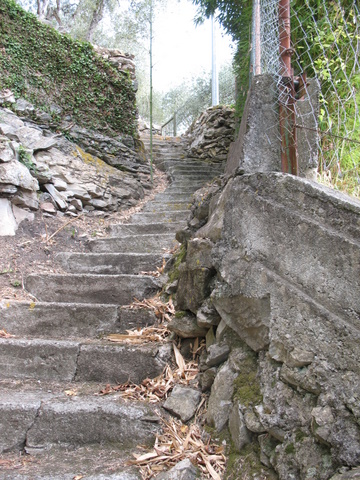
I walked into town yesterday, partly for the sheer pleasure, and partly because my moto was receiving its new back tire.  Here are some photos of the journey.

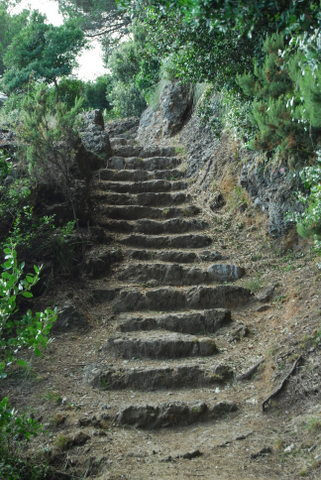
After leaving our street I walked down this long flight of steps, cutting out 2 switchbacks in the road – isn’t it inviting?

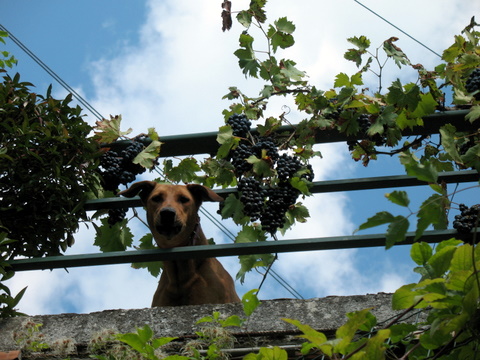
Then I crossed the street and walked down a curving road through a small settlement. Now I know where all the barking we hear comes from. I’ve never seen so many watch dogs.
One house had 3, each fiercer than the last!

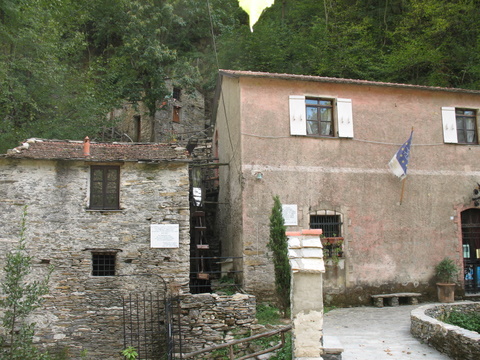
Continuing down the hill I arrived at the old mills, which have recently been restored. We’re told there used to be five or six mills in this narrow valley; now there is just this one, but it served double purpose, milling both olives and chestnuts. The old mill wheel between the buildings could be used for both milling operations. Now it is a civic museum and quite interesting to visit.


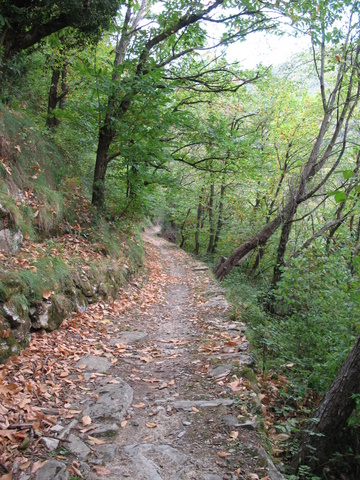
The stone paths here have always interested me – they’re the devil to walk on because so many of the stones are set end-up rather than flat. I don’t know why, but have decided it was to give better traction to the mules as they made their way up and down these trails loaded with goods.


It was unusually quiet walking down this path. I didn’t hear scooters, or buses honking, or dogs barking, just the occasional bit of birdsong.

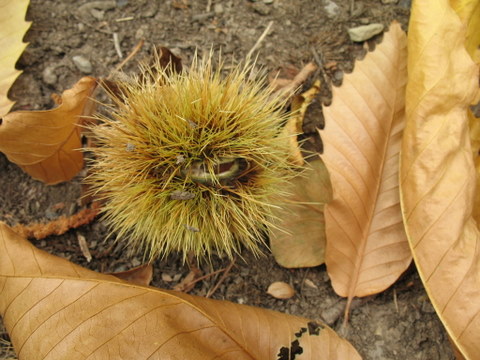
You know it’s autumn when you start finding chestnuts on the ground. The ones on the ground now are a bit early; the recent big winds brought them down before they were ripe. The wild boar, cinghiale, love these nuts, so it’s a good idea to keep your eyes and ears open when you’re in the chestnut forest, even though the boars are usually nocturnal.

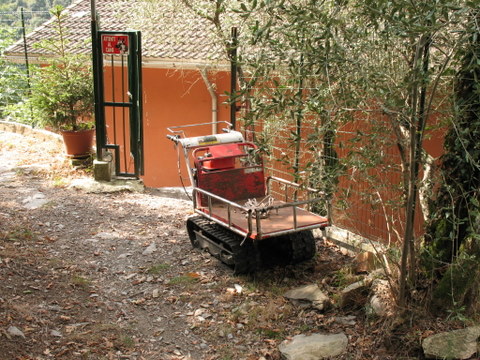
Amazingly there is a ‘last homely house’ well along this path. I met the woman who lives in it several years ago; she works in the hospital and has (of course!) a lot of dogs. It’s impossible to drive to her home; she parks about a quarter of a mile down the hill and uses this ingenious device to get her goods up to the house – the Modern Mule.

At last I arrived in Rapallo. It took me over an hour to make this walk, but only because I stopped to take so many photos. It was a glorious day to be out and about and hard to find an excuse to be indoors.

But I had to go to driving school

Aquileia, Croatia and Great Food

Tags

, , , , ,

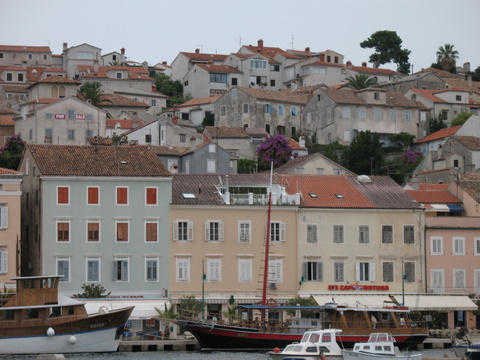
Cikat Bay, Mali Losinj

We’ve been away for a week visiting a friend in Mali Losinj, Croatia.  If you’re looking for a gorgeous spot for a vacation, let me recommend the island of Losinj.  It was developed as a tourist area in the late 19th century and now that Croatia once again has a market economy, it is flourishing.

Mali Losinj

The only culture shock we suffered was linguistic.  What a lot of consonants!  But I know what happened: all the vowels ran away and are now in Italy where they live happily (and pronounced) at the end of every word. Once we learned a couple of tricks (‘j’ is pronounced like the English ‘i’; ‘c’ with a little hat on it is pronounced ‘ch’) we were able hesitantly to begin to sound out a few words.  It’s a nice language to hear spoken, full of swishy sibilants and rounded sounds.

Croatia is not yet part of the EU so we had to cross through border control, which seemed oddly quaint and old-fashioned. They use a currency called the Kuna, seven of which will buy you one euro.

The water of the Adriatic there is the clearest and cleanest we’ve ever seen.  The food is good: Italian from the days when this part of Croatia was a part of Italy, with a healthy mix of northern cuisine from the days when it was part of the Austro-Hungarian empire, and Slavic from eastern influences.

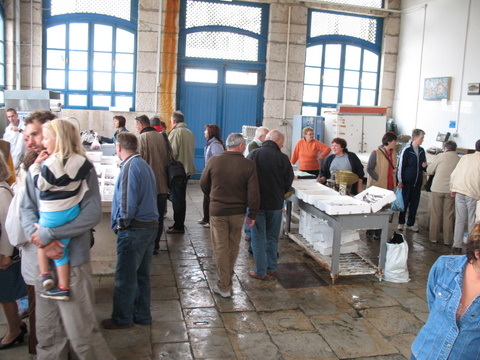
Fish Market in Mali Losinj

We stayed with one of the three best cooks I know, the Captain and the Contessa being the other two (she’s not a Real contessa but she’s a Real Cook).  Our friend Adri buys her lamb by the animal from the farmer who lives in the hills behind her house, cuts the beast up and puts it in the freezer.  The fish comes either from her neighbor who’s a fisherman, or from the local fish market.  It is always whole and never more than 8 hours caught when she receives it. You get a much better sense of what you’re eating when you see your food whole than you do when you buy it neatly packaged in the grocery store.

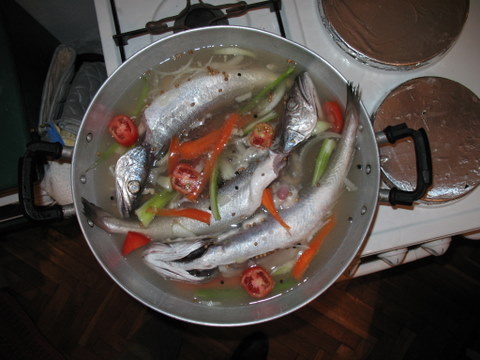
Nasello ready to be cooked

The Best Thing We Ate This Week is many things: Adri’s poached nasello (hake fish), her slow-cooked lamb, her dessert made with plums the first day, apples and pears the next, the Captain’s chicken gizzard sauce.  I did nothing but eat while the other two spent companionable hours in the kitchen whipping up one delicacy after another.  I hope to be able to give recipes soon for some of these treats; but both cooks work without measuring, so I need to experiment before being secure enough to pass on the procedures.

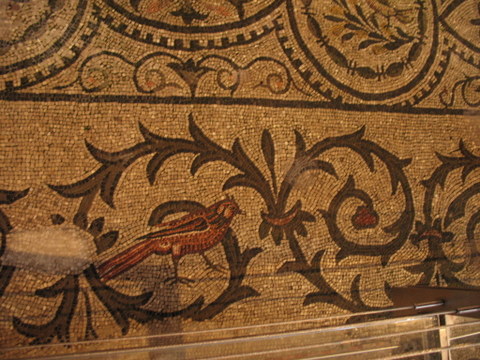
Mosaics in the Basilica at Aquileia

On our way to Croatia we spent the night near a town called Aquileia, which is the site of extensive Roman ruins and the largest early-Christian mosaic floor in the world (3rd-4th century, 700 square meters).  It was a complete surprise to us, and thrilling to see.  How could we never have heard of it before?  We stayed in a charming Agriturismo which I cheerfully recommend to you called Villa Asiola.  Parts of it date from the 11th century.  And they serve ham and cheese with breakfast!

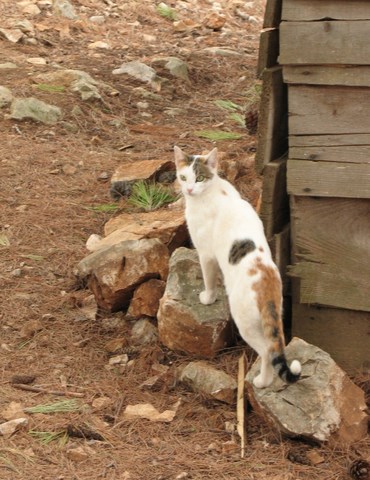
There’s a photo album over on the right under Photographs, Aquileia and Croatia, if you’d like to see some pictures of our trip (including some very photogenic cats). As usual, I recommend a slide show.

The Best Thing We Ate This Week – Tagliatelli al Frutti di Mare

Tags

, , ,

Spring cleaning around here happens in August, if at all.  I don’t know why I wait until just before the mice move in to clean the house from stem to stern, but that’s what I do.  Like clockwork, I finished the Deep Clean of the kitchen last week, and the first mouse walked into the live trap three days later.  Bah!

While cleaning, though, the Captain and I went through all the cookbooks in the kitchen to see if there were any we could live without (there were three).  We stumbled upon a very slim magazine called “Primi Piatti, Speciale Pasta Corta” that was languishing on the top shelf.  Neither of us can remember where on earth it came from.  But it was great fun to rediscover it.

The Captain is a meat eater, first and always.  But on Fridays he frequently cooks up something yummy from the sea.  Lately we seem to have been on a fresh tagliatelli kick – well, perhaps I should say ‘fresh’ as we’ve been buying packaged fresh pasta at the grocery store.  It is not, perhaps, as fresh-fresh as from the pasta fresca shop, but it is a lot fresher than dry pasta. Although the recipe from our funny magazine is for farfalle (all the recipes are for short pasta), we substituted tagliatelli with no ill results.

This is easy to fix, and a joy to eat. It’s almost a meal in itself, but we followed up with a tomato and red onion salad, and then nectarines. The recipe is over on the right under recipes.

Buon appetito!

Another fun way to find wine

Tags

, , , ,

In an earlier post I mentioned the filling-station style of wine procurement.

An even more satisfying way to get your wine is to go to the vineyard where the grapes are grown and the wine produced.  This is a popular pastime in Tuscany, which is famous for its red wines, especially Chianti and Brunello, and where many of the vineyards are large and have impressive tasting rooms.

It’s no less a pleasure in Piemonte, which in fact boasts more grape varieties and wines than our neighbors to the south in Tuscany. (As the Italianmade website says,  “For craftsmenship, respect for tradition and devotion to native vines in their historical habitats, the Piedmontese have no rivals in Italy.”)

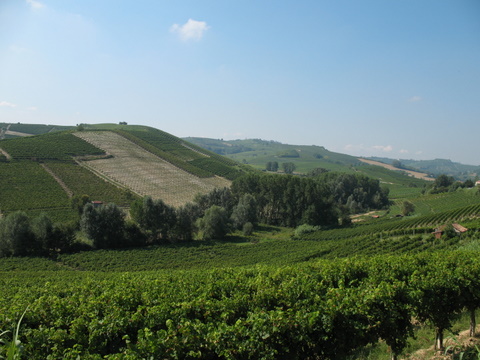
I don’t want you to think I’m working for the Region of Piemonte… it’s just that because of family and friends it is a frequent destination when we travel.  It is, in my opinion, every bit as beautiful a landscape as La Toscana; however it is much less touristic.  Here is a photo of some rolling hills of vines.

I also really don’t want you to think I’m in the employ of the Rinaldi family. They are one of many Piemontese wine producers; it’s just that we’ve happened to visit their vineyard twice now,

The Rinaldis are a small producer of wine.  They live, grow grapes and make wine in Ricaldone, a tiny town (population +/- 750) famous in Piemonte for the high quality of its wine.

We first discovered them  a year ago, on the Monday after Easter, which is a holiday here.  We were driving through the countryside after a visit with our cousins near Aqui Terme, and their sign looked welcoming.  The gate was open, so holiday or not, we drove in and threw ourselves on their mercy.  We had providently brought our 20-liter plastic jug.  The young Signor Rinaldi, who is both knowledgeable and extremely enthusiastic, was nice enough to interrupt his holiday, give us a tour and a private tasting, and fill our container with his delicious dolcetto.

We arrived unannounced again this year with our jug (never travel without your camera, your trowel and your wine jug!), on a Saturday afternoon not too long ago.  To our amazement Andrea Rinaldi and his mother both remembered us and gave us a very warm welcome.  After giving us a tour of all her pretty gardens, La Signora dug a bunch of her portulaca for us to bring home and put in our own garden. Her son was, once again, as lively and enthusiastic as could be.  Carrying a wine glass, he took us right down to the cellar where he pulled tastes for us from the spigots at the bottom of the huge stainless tanks in which the grape juice becomes wine.

The wine stays in the big tanks for a while, and later is put in casks if required.  This year we fell in love with his moscato, a sweet wine that is perfect with dessert.  It turns out that 55% of his production is moscato, something we didn’t realize last year.  A small producer, he makes 1,200 quintale a year.  A quintale is 100 kilograms and one Kilogram = 1 liter, so that’s 120,000 liters of wine.  Sounds like a lot to me, but as wine production goes it’s on the small side.

The Rinaldi wine is prize-winning; near the office there is a wall of plaques and certificates to prove it.  Can you get the wine in the U.S.?  As a matter of fact, you can; at least you can get the moscato.  It is marketed there under the somewhat dubious name of Bug Juice.  Did we fill our containers with Moscato?  We did not.  It is not sold in bulk.  We bought a half case and for the princely sum of E 1.55 per liter filled our 20-liter jug with Rinaldi’s wonderful cortese, a crisp, light white wine.

There are some photographs of Ricaldone and the Rinaldi Winery in Photographs on the right.  If you have the chance, visit a winery some day.  You don’t have to be in Tuscany or California to do so; there are wineries all over the US as well as Italy.  It is great fun, and an economical way to buy your wine.

License to… drive

Tags

, , ,

Many years ago I passed both written and practical exams for a driver’s license in the US.  It was easy.  Of course I was only 16 years old, and things that went in my brain actually took root there rather than drifting away on the air currents like a dandelion seed puff, which seems to be what happens now.  As I recall the written exam had a lot to do with the safe distance to be behind the car in front of you (1 car length for every 10 mph you are traveling – see??  I still remember!) and how far away from a fire engine you could park (75 feet? Well, okay, I don’t remember everything).  The driving test was also easy.  Obey the speed limit, signal before a turn, parallel park and there you go.

A group of us were in the class of a man who was either very stupid, very brave, or both; he not only ushered us through the theoretical aspects of driving, he also took us out on the road to learn how to move an actual vehicle in actual traffic.  I don’t remember his name – I guess we could call him Mr. Silly.  He instructed us to ‘hug the center line’, the theory being that this would give us the greatest amount of space to maneuver should we have a problem.  Of course it also scared the bejesus out of anyone coming in the opposite direction.  Mr. Silly had two verbal quirks.  One was that in his lexicon ‘curb’ became ‘curban,’ as in “Watch out for the curban!!” usually delivered at full voice just moments before he snatched the wheel from one of us.  He also had a great deal to say about “historical women drivers,” by whom I think he did not mean Betsy Ross and Eleanor Roosevelt.

Eventually the Big Day came; we all passed our written exams, we all passed our practical exams and we were given Driving Licenses and set loose.  It was huge.  Freedom!  The open road and our parents’ car!  And gas that cost less than .50 a gallon.  A lot less.  Then came the part when we really learned how to drive – which was harder on some of us than others, unfortunately.  My own lessons were relatively gentle, the worst being the Driving on Ice Lesson which fortunately resulted in only minor damage to car, tree and girl.  I got to go to court (‘driving too fast for existing conditions’) and if memory serves my license was suspended for two weeks.

Quick forward about 30 years.  The Captain became an avid amateur race driver after a three day school at the Skip Barber Racing School.  Being a kind soul he decided to give me the one-day Better Driving class so I could share the fun.  And it was loads of fun, sashaying around cones, skidding on the pad, learning that you don’t gain anything by lane-shifts in slow highway traffic.  It was an excellent day and I recommend it to anyone who is within shouting distance of one of Skip’s schools (no, it’s not cheap exactly, but costs way less than an accident). The climax was zooming around the Limerock Race Track at what felt like, but wasn’t, break-neck speeds in a Dodge Viper, which is way too much car for me.  I left feeling I had become a modestly better driver, and that I hadn’t been a terrible driver to begin with.

All this is lengthy preamble.  After all this time I’m back to square one: studying to take a written exam for a driver’s license.  Citizens from other EU countries can trade their country’s drivers’ licenses for an Italian one.  Not so the hapless American.  We can drive on our US licenses for one year after taking residency in Italy; then we are obliged to get an Italian Patenta.

So last Monday I went to the Gilberto Scuola di Guida and signed up.  I received a 258-page book detailing rules and regulations of the road.  In Italian. *

There are lots of pictures, but the print is small.  This is not easy!  I was also given  a larger book with 301 pages of practice quizzes.  Also in Italian, of course; this is Italy.  Here’s the thing about the questions though: they’re sneaky!  They try to trick you by using a negative where you would expect a positive, by changing one word just a little bit to change the meaning (‘al meno’ vs. ‘a meno’).  This book was not written by the helpful, considerate Italians I’ve come to know and love over the past few years.  It was written by insane people sitting in cramped offices who want to torment others.

The Captain went through this process about five years ago.  He says two things worth repeating.  One is that in his whole life he’s never encountered a greater chasm between theory and practice than with Italian driving.  The other is that he thinks that after you pass the driving exam they take out your brain and give you a license.  It’s true.  The best way to describe Italian drivers is Wild and Crazy.  But when you read the book you realize that the actual rules are precise, logical and designed to make for safe highways.  Ha.

Over in elaborations on the right you can find a weekly recap of the Great Driving School Adventure.  (Not the one under ‘pages,’ the one up above.) I am far and away the oldest person in class, most of the others seem to be in their 20’s, with one teen-ager and one woman who is perhaps 40.  Here’s the thing that cracks me up.  I assume we’re all there because we need driving licenses.  After class we all go out, hop on our scooters, and disappear in clouds of dust.

*Disclaimer ~ the text is available in an English translation, and one may take the written test in English.  I was told the School would not take responsibility for the accuracy of the translation, however. hmmmm.

The Best Thing We Ate This Week – Stuffed Rolled Pork Roast

Tags

, ,

A couple of years ago the Captain and one of his buddies added a rotisserie to our bbq using inexpensive and readily available parts. He uses it almost weekly in the summer and the results are always stupendous.  If you don’t have room for a rotisserie, check out the Ron Popeil counter-top appliance, or one of its cousins from Ronco – Just Set It and Forget It!  Our friends H & J have one and have successfully cooked legs of lamb amongst many other things. A rotisserie chicken that you cook yourself is 1,000 times better than the salt- and water-filled birds from the supermarket.

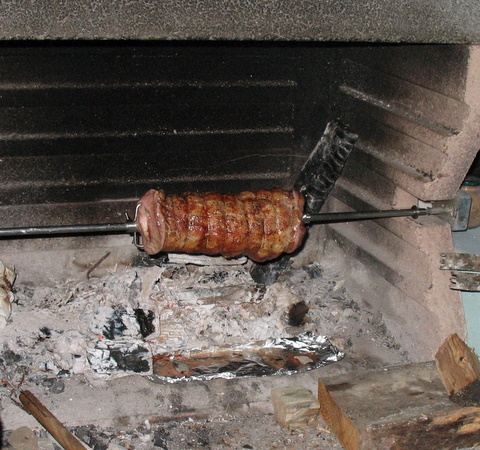
This week’s Best Thing was the rolled stuffed loin of pork that the Captain cooked on the rotisserie. It is a simple dish, but the flavors of the prosciutto and the marjoram make the happiest of marriages with the pork. He cooked it for about an hour and a half, but of course cooking time is always dependent on the size of the roast, the temperature of the fire, and the distance of the meat from the fire. You will have to be the judge of when it is done.

And if a rotisserie is not available to you, this roast can be cooked very satisfactorily in a 375 oven.

The recipe is on the right, under ‘Recipes.’  Buon Appetito!

Easy Quiz

Tags

, , , , ,

What do the following have in common:

Zip,  Vitality,  Looxor, Phantom,  LibertyVivacityFlipper,

Joy-max,  Movie,  MajestyForesightPantheonHeroism,

Cinderella,  Sportcity,  Duke,  Typhoon,  Cygnus,  Atlantic,

Skyliner,  Steed,  Forza,  Xciting,  @,  Nikita,  Elkon,  Password,

Joyride,  Phantom, People, Hornet, Runner, Beverly,  Agility,

Byte, SkipperFiddleCarnabyNakedSquab, Stalker, Booster

If you haven’t already guessed, here are some more:

Burgman,  Dink,  Silver Wing, Geopolis

Still guessing?  Here are the giveaways:

Spasso, Scarabeo, Il Mio,  Vivio,  Vespa

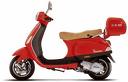
That’s right!  They are ALL names of various models of motorini (scooters). If you doubt me, take a look at the logos of all of these over on the right in Moto Models under Photographs.  (Proof, if you needed it, that I have far too much time on my hands.)

We’ve always been entertained by the Italian fascination with English words.  A few years ago tee-shirts with nonsense English were all the rage; you still see quite a few.  They say things that make no sense, like “Princess University – at Top Scale.”  Huh?  When I’ve  translated for the wearers of such shirts, they are always amazed for a moment, then just shrug.

I digress.  Back to the Motos (about which there will be more posts – stay tuned).  I took pictures of every name I found (not counting letter-number combos, like X-150), and as you can see, they are

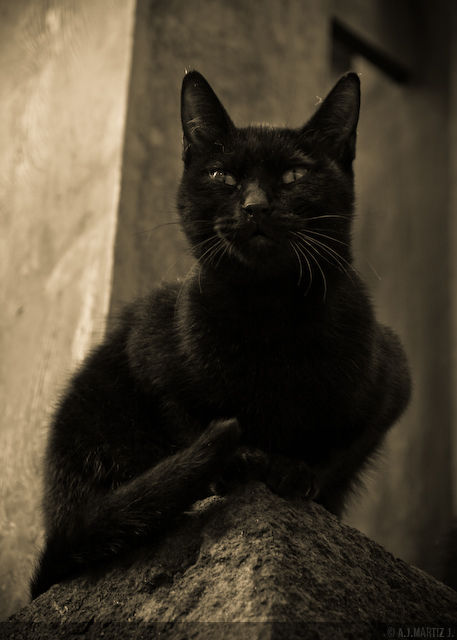
Photo by Alfredo J. Martiz J.

Photo by Alfredo J. Martiz J.

predominately English.  My favorite has always been Dink because it sounds so silly, and because of Stoker-Dink, cat extraordinaire.  Who would want to drive a ‘Dink’ when he could have a ‘Steed?’  Lots of people, it turns out.

What I wonder is this: are the names regional?  I’ve seen few Burgmans here in Rapallo, but zillions in Genova – here we seem to favor People, Dink and, of course, Vespa, the classic, classy and ubiquitous Piaggio model.  (Vespa so quintessentially says ‘motorscooter’ that it has become the generic name for a moto.  Even people who drive Dinks will say, “Now where did I park my Vespa.”)  Those of you who live in other parts of Italy, do you see other names on the scooters?  How about in the States?  Elsewhere?