Permesso, Part the Third

Tags

, ,

In May and August I wrote about our efforts to renew our permessi di sogiorno, this time with 6-year permits (you can read about it here and here).  In addition to the phone call we received in August instructing the Captain to report to the Questura in Genova, we each got a letter telling us when to appear.  Unfortunately my date was yesterday, his today.  Sigh.

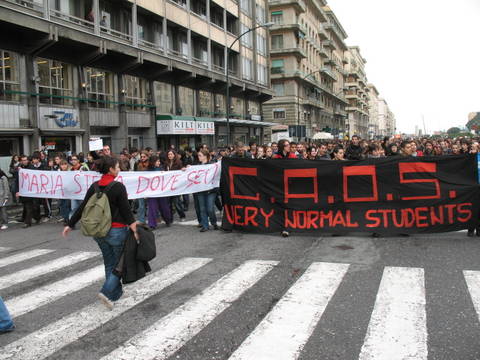
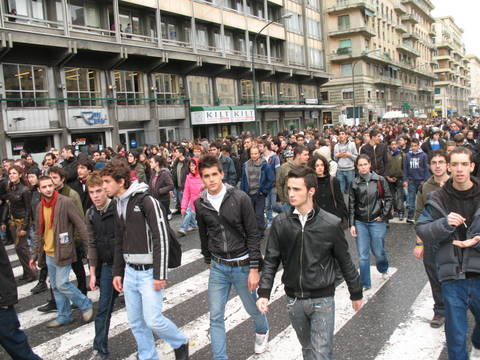
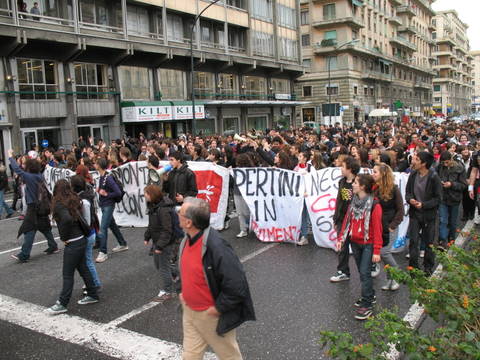
So yesterday we jumped in the Mini and tore off for Genova in the rain. We arrived a little early and were doing some window-shopping when suddenly we heard a great babble of voices, accompanied by police sirens.  We ran across a highway to catch sight of this:

obama-table-002

obama-table-003

obama-table-005

The students were on strike again yesterday!

There have been nationwide strikes since Prime Minister Berlusconi proposed and the Parliament passed a budget which contains massive cuts for education  (E 9 billion).  The elementary schools have been hardest hit with the new legislation as 130,000 jobs have been cut, but all schools will suffer, from primary through university.  You can read a bit more about it here.  Maria Stella, the name in the top photo (“Maria Stella, where are you?”), is the minister of education.

And what of the Permesso process?  We went to the United Nations waiting room again but there were only about 40 people this time.  My appointment was for 11:47 (yes, they’ve got it down to the minute!) and promptly at 12:15 my name was called with several others.  We reported to sportello #6 as instructed, and then had to wait another half hour or so, but this time with few chairs (why is it that in Italy if there are 3 chairs and 40 people who might want to sit down, mothers immediately put their small children in the chairs?  Is it the same in the States these days?  Back when I was a girl…. grumble, grumble, grumble…)

Part of the wait was due to the computers going down.  To his credit the police officer on the other side of the sportello’s glass was embarrassed – “It’s a shame,” he said in excellent English, “The Italian system is a shame.”  I don’t actually agree with that assessment, but it was nice he was so sympathetic to those who only stood and waited.

Finally at 12:35 I was called to the window and given two pieces of paper.  On one I had to print my full name; on the other I had to print my full name, phone number and e-mail address. Then I had to wait again.  The computers came back to life and I was summoned in my turn to show my passport and my present permesso, which expired some months ago. Then the big moment: Fingerprints!  They take them electronically now, and I was so looking forward to it.  Everyone before me got to leave all ten prints.  In my case, though, I gave only right thumb and index finger and then was told, “Basta!”  I don’t know if the machine broke again or if I simply look innocent (darn), but that was the end of the whole thing.  All that time and energy expended for two printed names and two fingerprints.  It is all a great puzzle.

The nice officer told me to visit the Questura web-site in 2-3 months and there I would find some information about my permesso.  I hope I remember to do it.  I hope I live that long!!

The Best Thing We Ate This Week – Risotto Bolognese

Tags

,

Actually it was last week, and, alas, there’s no photo of this delicious dish.  You will simply have to imagine a steaming bowl of slightly golden risotto, with a big dollop of meaty bolognese sauce nestled in the center, the whole topped with a light dusting of freshly grated parmigiano cheese.  Neither component is especially original, but the combination is something a bit more unusual. As I write the rain is beating against the windows and it is chilly outside.  Many parts of the US and of Italy are preparing for the cold dark months ahead; there’s no better winter comfort food than a perfectly cooked risotto. With the Bolognese sauce, a salad on the side and a good bottle of wine this dish will restore your good will and sense of well-being.

The Captain has always used Marcella Hazan’s recipe for bolognese, but a couple of times ago when he made it he discovered we had none of the called-for celery, so he simply made it without. We discovered we preferred it that way.  The celery announces itself with just a bit too much emphasis in a bolognese we think.

As for the risotto, try to find carnaroli rice; it is the best variety.  If you can not find it, use the best arborio you can find.

As mentioned in an earlier post, Arborio is the most ordinary-looking little farm town you can image.  I had always imagined a sweet little fancy village filled with restaurants.  No.  Here is Arborio:

autostrada-sostegno-autogrill-permesso-papers-076

As always, the recipes are over on the right (not above). Buon appetito!

A Pressing engagement – Olives, part 2

Tags

, ,

Saturday, the day we took our olives to the press, was a gorgeous day. It turned out we had 99 Kilograms of fruit, not the 111 our funky scale told us (we weigh using the unreliable technique of standing on the scale with the olives, then without, then subtracting the difference; it’s kind of comical, especially the shocking ‘without olives’ part).  Mixing ours with T and J’s 75 K gave us a total of 174 K from which we got a total of 26 K of oil.  My trusty calculator tells me that almost 15% of each olive is oil.

We came home with 16.3 liters of oil, and T & J came home with 12.3, giving a remarkable liter of oil for every 6 K of olives picked, a very good result.  We were all happy except for T & J who had picked only half their trees.  Fortunately they were able to pick the rest the next day during a brief respite from the rain, and got them pressed with a batch of another friend at a different frantoio.

frantoio-and-church

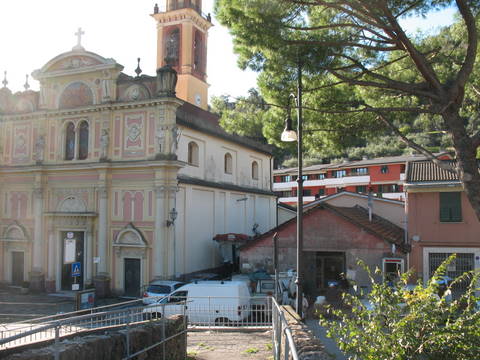
The frantoio is in the teeny little building above, squished between San Pietro church and a building housing a delightful restaurant where we ate an enormous lunch (don’t even ask).  The olives are weighed, dumped in a chute, washed, and then disappear into a vast array of machinery with pipes, hoses, gears and belts.  Eventually one is told to put a container under a nozzle and, as they like to say here, Wah-Lah!  Olive oil, golden green and slightly bitter, arrives.

The bits that don’t come back to you as oil are pumped off into a big truck just outside the building.  All this muck is taken off to another kind of mill where it is heated and somehow even more oil is extracted.  What we received is the Virgin (or, I suppose, Extra Virgin) oil.  What is made from the leftover is ‘olive oil.’

Now the oil will sit in its demijohn for about 4 months.  Impurities will sink to the bottom, and somehow the bitterness will disappear and we’ll be left with the mellow, rich oil for which Liguria is justly famous.  It’s hard to wait!

There is a series of photographs of the process available here. Some of the photos look very hazy.  That is because the interior of a frantoio IS hazy – it must be from tiny particles of olive oil floating in the air.  They get into the back of your throat when you walk in and you wonder if you’ll be able to continue breathing.  It must be very good for the complexion.

So the Olive Adventure of ’08 is over.  Our trees will be pruned rather severely this winter, so it may be a year or two until we pick again – unless we can help our friends pick, which is always fun.  It was a Banner Year.

Olives!

Tags

,

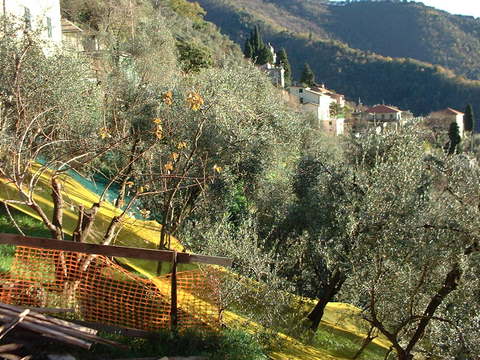
‘Tis the season to be harvesting olives.  All around us the hills are festooned with colorful nets, principally orange and yellow.  They are wrapped around the trees and are attached one to the next making the steep terraces look like a brightly colored slopes.  The olives drop into pockets in the low parts of the nets, whence they are easily collected.

Our friends T and J have 51 trees which have been beautifully pruned and cared for.  They do not use nets, but instead hand-pick the olives, which is easy to do with their trees, none of which is much taller than we are.  The pruned and umbrella-shaped trees are much more productive than trees which are ‘let go.’

Our trees are in the latter category, very much in need of a pruning, which they will receive this winter.  They had been untended for at least 20 years when we bought our place.  Just after we moved in a friend sent a friend over who pruned some of the trees, but none of them very dramatically, and we’ve done nothing about it since.  This means the trees are huge.

We use a system that falls somewhere between the Old-Timers’ and T and J’s.  We have one net, which we carry from tree to tree (we have only about 15 trees).  Then we spend a very long time positioning poles to hold the net in place and form a bowl under the tree we’re working on.  There’s usually a fair amount of good-natured discussion about the placement of the poles, but eventually the net is positioned in a more or less stable way.  Then the Captain takes a long, thick bamboo stick and whacks the trees to make the fruit fall.  This is a time-honored way of removing fruit, but it’s fallen out of favor with modern olive-culturists.  The preferred method for removing fruit these days is the olive rake, a plastic rake with tines spaced just less than the average olive.  You attach the rake to the weapon of your choice (bamboo stick for us, this year as in photo) and comb out the branches.  The tines pull the olives off and send them spraying all over the place.  With luck a large percentage of them end up in the net.  The Captain alternates whacking with a stout stick and whacking with the rake on a long pole.  Meanwhile I use a rake on a small pole and wander around looking for low branches to strip.  I’m also crazy about finding olives on the ground and putting them in my basket – treasures!

This year the weather has not co-operated with many Ligurian harvesters.  We’ve had heavy rains and very strong winds, the heaviest since the great storm of 2000. A lot of olives have come down, and the weather for several days was just too nasty for gathering those that are still on trees.  Those who got their nets up in a timely fashion are doing very well (it’s a stand-out olive year).  Those who waited will have lost a lot of the crop unless, like me, they like to creep around on their hands and knees under the trees – not an efficient way to gather.

Once the olives are collected it’s good to get them to the mill, the ‘frantoio’, within three days.  Our favorite frantoio over the mountain in Val Fontanabuona went out of business while we weren’t looking last year (there was no olive harvest for anyone in Liguria last year – no olives). So instead yesterday we went to a different mill here in Rapallo.  Stay tuned for the report.  In past years we’ve gotten a liter of oil for each 7 or 8 kg of olives.  We had 111 kg this year (we also didn’t get all of our fruit picked before the weather turned on us).

If you’re really interested in olives, Mort Rosenblum has written a delightful book called ‘Olives’ and subtitled “The Life and Lore of a Noble Fruit,” which is stuffed with history, culture and even some recipes.  If you enjoy Life-in-Italy tales, Extra Virgin by the Englishwoman Annie Hawes is an engaging account of her purchase of a rustico and grove of olive trees above Imperia some twenty years ago; she writes appealingly and amusingly of her neighbors and of the land itself.

Icing the cat’s nose

Tags

, , ,

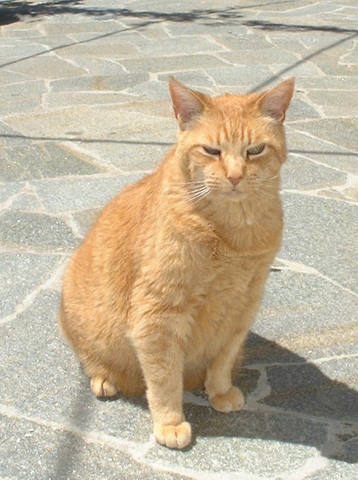
Luciano is an old cat, but at 16 not exactly ancient. He has, however, a panoply of interesting ailments that keep us in frequent contact with his doctors. He has three: Ralph Siegal, Fausto Finetti and Veronica, who is a brand new vet and whose last name we have not yet learned. Ralph has been waiting for Luciano’s kidneys to carry him off for three years now, but the cat keeps cashing in his extra lives and fooling all of us. Luciano’s other main diagnosis is hyper-thyroidism.

As prescribed, Kitty eats special food that is kind to kidneys – high in fiber and relatively low in protein.  It is available commercially for E 2 a tin, of which he can eat two a day.  Rather than bankrupt ourselves any sooner than absolutely necessary, we decided to make our own cat food, using an excellent recipe we found (of course!) on the internet. Here is a link to a site with cat food recipes for cats with various ailments.  We’ve been making a variant of the Hills kidney diet food.

There is no perfect cure for the thyroid problem, according to Dott. Ralph, but there is a pill that can help.  Unfortunately it is not available in Italy, but can be found in France.  So we have prevailed upon our friends who travel that way to carry back the cat’s medicine.

Which brings me around to the subject of medical care, the approach to which is much the same for animals as for people: caution! don’t over-medicate! wait and see!  Poor Luciano developed a big bump between his eyes last week.  When we took him to the vet (Dott. Veronica this time) she suggested that since the cat is pretty much blind (left that out, didn’t I) he had probably run into something and had a great big bruise.  So we left the office with instructions to ice the lump and administer cortesone pills.  Have you ever iced a cat’s nose? It’s interesting.  Actually, Luciano is quite patient with it, but I sure wouldn’t want to try it on a cat with teeth (I forgot to mention he’s toothless, didn’t I).

I believe that had we been in the US that an X-ray would have been taken on our first visit.  Instead we spent five days icing the cat’s nose and watching the lump grow.  Then we took him back and Dott. Fausto recommended an X-Ray, given the following day in a different office.  So, after three trips the cat’s lump, which proved to be an abscess, was X-rayed, opened and cleared up.  I’m not in any way saying that we don’t all receive excellent medical care here, but sometimes I think the caution is less than helpful.  The poor old cat had to make three trips to accomplish what, in the States, would have been done on the first trip. And if it had been a bruise?  There would have been one wasted X-ray.  And that’s one difference between Italy and the US.  Here waste is anathema – you don’t want a test unless it’s 99% certain to tell you something really useful, and only if other less expensive approaches have failed.  Is it dangerous?  No, because doctors and vets here are just as smart and well-trained as they are in the US, and they are careful.  Is it inconvenient?  Frequently. Is it frustrating?  Absolutely! We’ve been back for one aftercare visit, and will return again Monday for another, making a grand total of five visits.  We haven’t been billed for anything yet, but one aspect of cautious care is that it does seem to be less costly.

We’ve seen the same approach in our own medical care here.  Problems are discussed for ages and curative steps are incremental.  But then, Italian doctors don’t have to worry about the malpractice suits that threaten American doctors.  Eventually (so far!) we always get better.  And I have to add that when one of us had a very serious acute condition the initial care was immediate and excellent. Once danger was past, however, caution was again the watchword, and a condition that was treated in three days in a US hospital took twelve days for the exact same outcome in Italy.

I’m not sure what any of this proves.  Socialized medicine certainly has its pluses and minuses, and this is not an appropriate forum for that topic.  I guess if we’ve learned anything new from the last week’s experiences it’s this: it’s really hard to ice a cat’s nose.

It’s not over till the fat lady drives

Tags

,

And here I thought the written part of the driving license would be the hardest.  I’ve been driving for more years than you’ve been alive – many of you (ha!) – and am famous amongst my friends for being a smooth and confident ‘autista.’  Here in Italy I am a Loser behind the wheel.  Here are the things I did wrong in my first driving lesson:

  1. hands in wrong position on wheel, therefore all steering and cornering a dead loss
  2. crossed the solid center line (repeatedly)
  3. did not look frequently enough in side mirror
  4. drove too close to center line
  5. and the auxiliary to #4, didn’t stay near the right curb in curves
  6. forgot to use the turn signal at every opportune moment
  7. used incorrect hand position on shift knob, which lead to embarrassing gear errors
  8. didn’t slow to 30 kmh (that’s 18 mph, and it’s really s-l-o-w) at the first glimpse of a road work sign
  9. didn’t shift into third whenever possible
  10. used gas and brakes too much on slopes – should have used engine
  11. drive too damn fast in general

That’s all I can remember at the moment but I’m sure there were other transgressions.

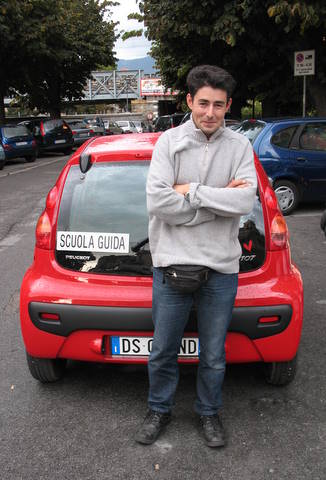
Every cloud has its silver lining, though.  Here is a picture of my driving coach Ivo:


The Best Thing We Ate This Week – Slow Food

Tags

, , , ,

The opposite of fast food.  That’s the premise behind the organization Slow Food, which was started in 1989 in (of course!) Italy.

Every two years the organization sponsors a Salone Internazionale del Gusto in Torino which, for the first time, was joined this year by Terra Madre, an organization that promotes sustainable agriculture and food production, with a focus on the small producer and preserving taste and biodiversity.  The two groups have much in common in that they both have an interest in the responsible production of delicious food.  Terra Madre focuses more on the agricultural side of the equation, Slow Food on the side of finished food products.  Terra Madre had a much smaller group of exhibitors than did Slow Food, but they were much more interestingly attired (see web album). One theme of this year’s Salone was environmental protection.  Everything was recyclable or made from already recycled materials.

The Salone ran from Oct. 23-27 in the Lingotto Fiera, a HUGE group of pavilions which are a part of a former Fiat manufacturing site.  The whole Fiat plant there has been redesigned as a exhibition center, including the Fiere halls (70,000 square meters) and an auditorium, museum, and exhibit spaces.

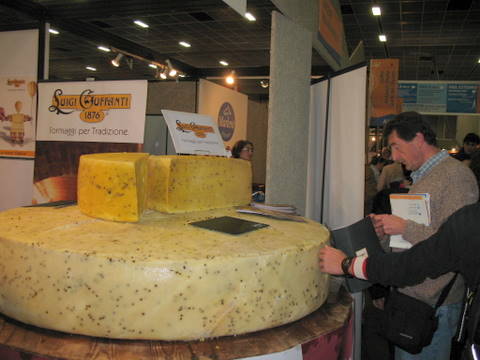
Imagine two long aisles of nothing but cheese producers!  A beer hall with at least 10 different beers on tap.  Aisles and aisles of meat products.  Chocolate!  Pasta!  There’s not much that you can eat that wasn’t at the Salone del Gusto… except fast food. And there were not many fresh foods on view; some fruit, not many vegetables, and the meat was all cured in one way or another. One aspect of the Salone which we didn’t take advantage of (nor did many others I’m sure) is the great number of classes, conferences and so forth on various aspects of food, its growth, its preparation and presentation. Over 250 Presidi (chapters of Slow Food) from around the world had exhibits (or something?) – we never got to that pavilion.

Many of the exhibitors were from Italy, but there was a good representation also from Germany and Austria and even someone from Mexico.  And almost all of them gave little tid-bits of their food to taste (except for the caviar and chocolate people, darn it).  You can eat enough for a week on your E 20 admission ticket (and if you’re very lucky, as we were, friends will give you a brace of tickets).  Even the wine was available to taste in small amounts. (Mysteriously all the wine-tasting ground to a halt between 12:30 and 2:30, a great inconvenience to our friend Frank who had developed a powerful thirst.)  Beer of many types was on tap for E 3 for a generous glass.

I truly can’t single out what the very best thing we ate was, it was all fabulous.  We were very careful though, and came home with only one salami and one cheese.  It got easier to resist temptation as the day wore on and our stomachs filled with all our tasting.

Two years ago there were 160,000 visitors at the Salone.  It felt like they all came back on Friday when we were there – it was mobbed.  I can’t imagine what Saturday and Sunday must have been like.  The food people were all unfailingly friendly and pleasant – big smiles and no hard-sell.

It was a fabulous day, but a sensory overload.  There was entertainment in the background almost constantly, and the pavilions are not designed to cut down on sound bouncing around.  There was so much to look at, and to taste, that it was hard to take it all in at once (literally and figuratively).  Will I go back in two years?  If you’d asked me on Friday I’d have said Never!  Too exhausting.  Today?  Well I’d certainly be tempted.  It’s unlike anything I’ve ever seen in my life.

Here’s a photo album you can look at if you’re interested.  It only scratches the surface of what we saw, but it does give… the flavor.

Giovanni Castagneto

Tags

Giovanni Castagneto, aged 87, died on Sunday.

He was already an old man when we met him.  We caught glimpses of his sister (she of the long skirts and kerchiefed head) and of him from time to time when we moved to San Maurizio, but it wasn’t until we’d been here for about 5 years that Giovanni decided it was safe to make our acquaintance.

There was a knock on the door one day, and there was Giovanni, paying an official call.  With him he brought two small pages, on which he had carefully written the first names of everyone in his family.  He introduced us to each in turn, lingering over the cousin, “I should have married.”

He never did take a wife, and lived always with his older sister.  She never took to us, at least not to the point of actually meeting us.  But then, she had not had his cosmopolitan experiences.

Giovanni served in the Italian Army during World War II.  He was sent to Russia, where he suffered terrible hardships during the failed winter siege of Stalingrad.  (You can read about the Italian Army’s Russian misadventures here). We don’t know what befell Giovanni in Russia, but we know this: he walked back to Italy. That’s a hike of 2,680 kilometers (1,665 miles), undertaken in appalling conditions.  In his old age it was those battles and that long walk home that filled his mind.  Whenever we met, the conversation invariably turned to Russia. He would get a distant look in his eye and say, “I was in Russia,” almost as if he couldn’t believe it himself.  Was he 8th Army? Alpino?  We don’t know, the conversation never got beyond the fact that he’d walked back, that most of those walking with him died on the journey, and that it was cold winter.

Giovanni was, in the years we knew him, a contadino.  He took care of his vines, his olive trees, his chickens and his garden.  He was too old to be a fast worker, but he was steady and efficient.  And he was generous.  Frequently we would open our door to find a little basket filled with grapes or figs, or just some flowers.  Whenever he gave us something we’d try to use it in a way we could share with him.  Grapes became grape jam (not the staple here that it is in the US), erba Luisa (lemon verbena) became liquor.  It was the only way we could think of to repay his kindnesses.  That and when, as always happened, a conversation turned to Russia, showing honest interest and a truly felt amazement at the transformative experience of his life. I wonder if, as he drifted away at the last, he was once again in a snow-blind day putting one foot in front of the other, walking home.