Meet me at 50.0 LMT at the Castello… we’ll do lunch

Tags

, , ,

Remember when the US tried to go metric?  Disaster!  Just how much is a gram, a liter, a kilo??

One of the vexing aspects of living in the EU is trying to adapt to the metric system.  Somehow 27 C doesn’t sound nearly as warm as 80 F, at least not to my American ears.  We encounter conversion woes every time we are given a recipe.  The result is that we’re living in a half-way house, marooned between metric and imperial measures.  An example is the new lasanga recipe over in the Recipes link to your right – I asked Louis to write it out for me (he made it several nights ago and it was very well received , especially by Massimo).  When he gave it to me the ingredients were in grams, for both solids and liquids, and the temperature was in Fahrenheit; fortunately a quick visit to a terrific conversion site made it easy to list the imperial equivalents for American and British friends.  Somehow I don’t think we’ll ever be completely at ease in this metric world.

Don’t even get me started on clothing sizes (bras come in 1, 2, 3 or 4… what does that mean??). And shoes (my size 39 sounds huge, but it’s really only 8.5).

At least the clock looks the same here – what would a metric clock look like?  We’d have to dispense with 2 hours on our clock face and come up with all kinds of strange names.  Turns out it’s been done!  It takes us about half a centiday (+/- 12 minutes) to drive from our house to downtown Rapallo… I think.  No, let’s stick with our present clocks with their friendly faces.  It’s hard enough to figure out how many grams of cheese to put in the lasagna!


Fill ‘er up

Tags

, , ,

Some people don’t drink wine.  I know!  But it’s true.  And those that don’t usually have very good reasons for not.  But for those who do, Italy is a great place to live.  According to Italianmade.com, Italy produces and exports more wine than any other country, and according to Patrick McGovern, an expert on ancient beverages, wine may well have been made as long ago as the Neolithic age (8,000 – 4,000 BC)(how much would a 3,000 year old wineskin of Neanderolo fetch at auction, do you think??)  Italians have been making wine for a very, very long time, and they’re very, very good at it.

Mountainous Liguria does not have a vine-friendly geography, and most wines here are made by families for home consumption, though there’s some lively production down in the Cinque Terre.  But our neighbor to the north, Piemonte, though ranked only 6th of Italy’s regions in production, has more DOC zones than any other region.  Delicious wines come from Piemonte, and many of them make their way to Ligurian tables, as do Tuscan wines.  Piemonte vines include barbera, dolcetto, grignolino, freisa, cortese and nebbiolo (from which come Barolo, Barbaresco and Gattinara wines).  (All these fascinating details come from the italianmade site.)

Here’s a quick primer on the four categories of Italian wine: 

Vino da Tavola, or table wine, is just that.  It’s usually pretty undistinguished, but often pleasantly drinkable. It comes from who knows where and generally comes in one of two colors – red or white, and one of two states – fizzy or still.

Vino a Indicazion Geografica (IGT) means that the wine is from a particular geographical area.  Other than that, see above.

Denominazione di Origine Controllata (DOC) means, again, that the wine is from a particular geographical area, but there are stringent guidelines relating to its production and naming.

Denominazione di Origine Controllata e Garantita (DOCG or DOC/G) means the same as DOC, except that the rules for production are even more rigid, the amount produced is limited, and the wine must be tasted and approved by a committee – how can one serve on that committee, I’d like to know!

You might think that with so much wine washing around the country the inhabitants would be staggering about in a constant state of inebriation – not so!  Of course Italy has, like most other countries, a certain amount of alcoholism and other diseases and problems related to over-consumption.  But in general Italians are relatively careful drinkers, and they drink far and away more wine than beer or spirits (The World Health Organization reported in 2002 that almost 16% of Italians abstain from drinking completely, and the amount of alcohol consumed has been decreasing steadily since the 1960’s). 

So, just how much do Italians drink?  Ha.  The answer might surprise you (it did me).  WHO statistics from 2003, the most recent I could find, show a per capita (over 15 years old) alcohol consumption of 8.0 liters a year, which doesn’t seem so much to someone who can put away half a liter with dinner.  The U.S. figure is 8.6 liters.  Who drinks the most?  Ugandans!  17.6 liters, and who could blame them?  Who drinks the least (and perhaps fibs a little)?  Yemen and the United Arab Emirates at 0.0.  Germans drink 12.0 liters and Irish 13.7 liters per year.

But enough facts and figures.  The whole point of this exercise was to talk about the beauties of Italian wines, from the residue-laden bottles produced at home and lovingly stored for years in dusty cantinas, to the agri-produced gleaming bottles that are exported and sold for lots of money.

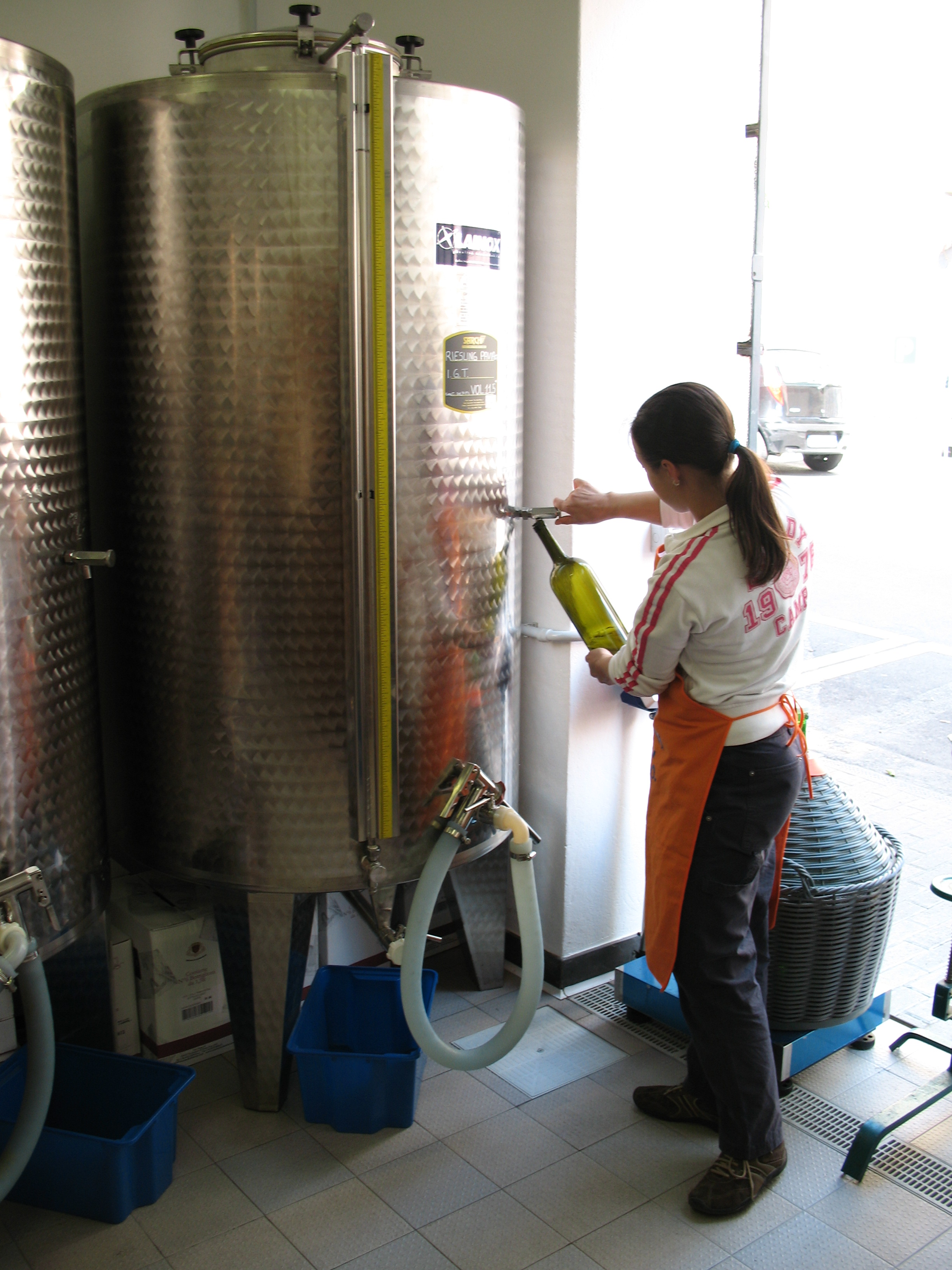
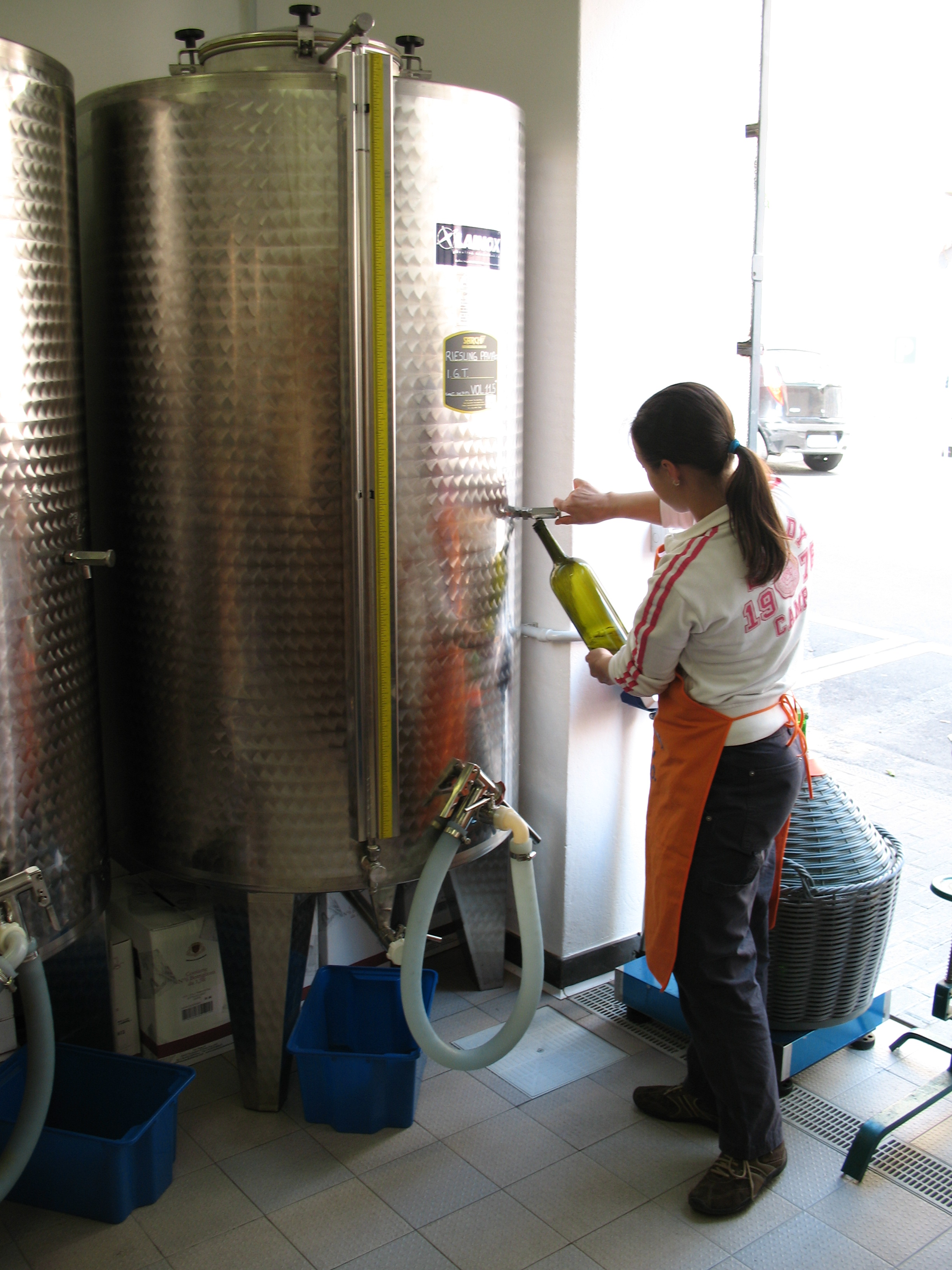
You can buy your wine many places (including often at the producing vinyards themselves) – at a specialty shop, where you will find your DOC and DOCG wines along with the others; at the super market where you never know exactly what you will find; or, as we like to do, at the ‘filling station’, a store where you can buy wine in bulk and carry it away in your own container.  This picture was taken at a new cantina in Santa Margherita Ligure, and the young lady is filling a sample bottle for me with Riesling.  They have several other wines available as well.  Big Market in Rapallo (Corso Mameli) also sells vino sfuso, that is wine in bulk.

How much will you pay for your wine?  That all depends, of course.  Oddly, price is not always tied to quality.  It is possible to get some very decent wines at a reasonable cost.  In the specialty shops you are likely to pay E 4 and up, way up, for a bottle; at the super market you can buy beginning at about E 2; vino sfuso?  At the Santa Margherita Cantina I paid E 1.70 a liter for that Riesling – pretty reasonable, I think.

Wine is central to Italian culture and eating.  Best of all, it is delicious, it can make you feel delightfully giddy, and if you ask your doctor, he may well recommend one glass of red a day because of all the good flavonoids and other antioxidants contained therein.

Cin Cin!

Cats in Italy

Tags

, ,

Italy is full of cats: country cats, city cats, polite cats, rakish cats, fat cats (!) and hungry cats.  Just the other day when I went to throw away the garbage a cat leapt out of the box and made me jump a mile.

Every town has at least one Cat Lady (or man, but usually a lady – why?) – that person who puts out an old tin pan of food for the cats whom no one else is feeding.  Cats come and go as they wish.  If a door or window is open, sooner or later a cat is going to go through it.

Last time I was in Rome I noticed there were a lot fewer cats than the previous visit.  Perhaps there is a cat control policy there now – I hope so.  Anyone know?

I’ve been addicted to taking photos of cats since we moved here.  No matter what the scene, a cat seems to make it more picturesque. Over on the right in Links you’ll find Cats of Italy – click on it (if you dare!) and you will be whisked away to a web album of part of my collection.  I really DID edit some of them out – honest.  (It took a lot of self-control not to put all of Luciano’s portraits in.)  I recommend using the Slideshow option if you really are going to look at all those cats.

One reason to love living in Rapallo…

Tags

, ,

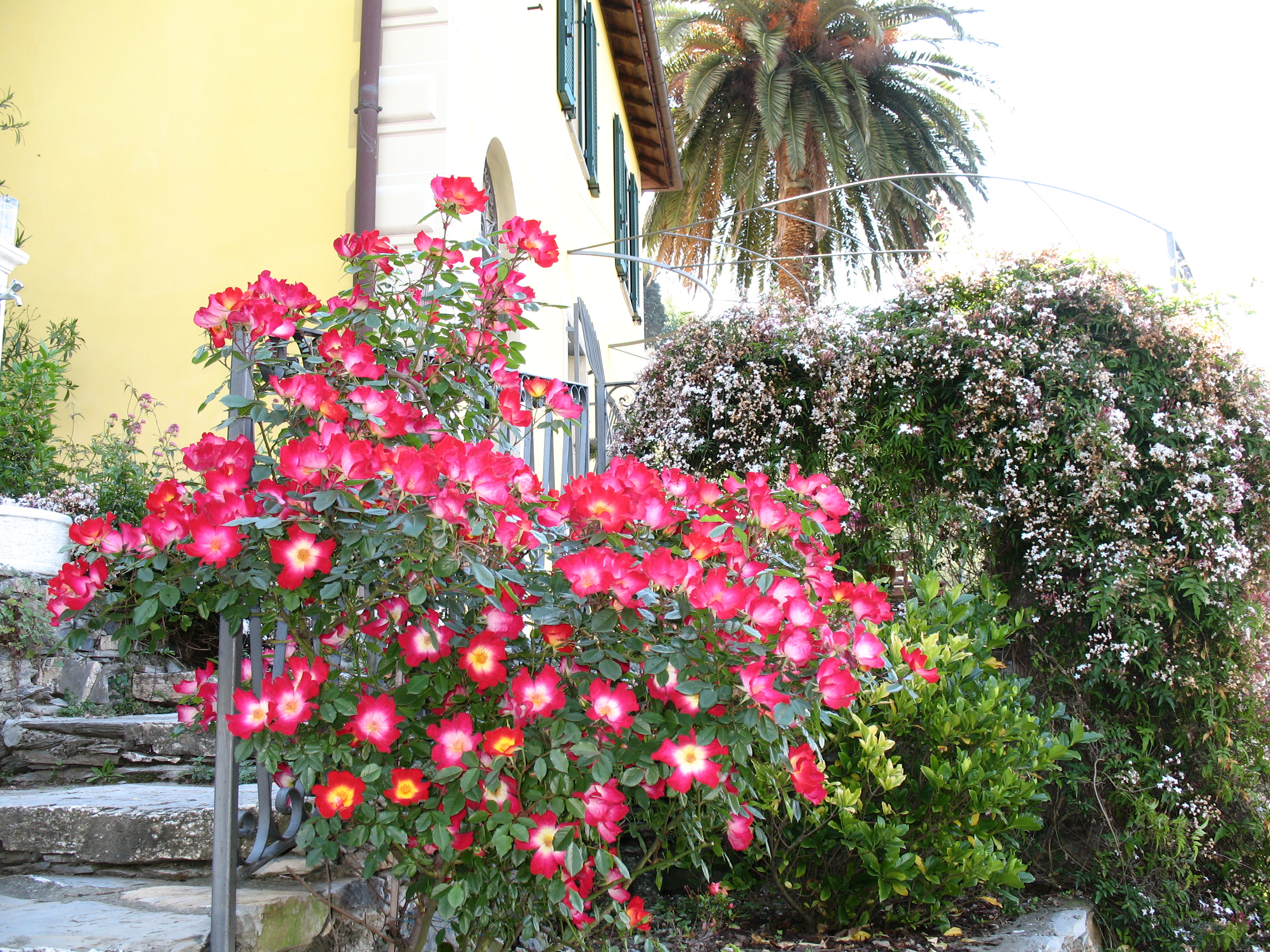
Climbing roses in front of jasmineThere’s something in the soil, the air, the water, the light, or perhaps all of them, that makes it impossible for things NOT to grow here.  This climbing rose began its life in Liguria as a little branch cut from the climbing roses that cover one side of the house of friends in Piemonte.  We stuck it in the dirt and the next spring we had a small rose bush ready to plant; it flowered the first year.  Now we have to prune it severely to keep it from running wild.

The jasmine, just fading away behind the rose, is another case in point.  It was here when we bought our house, but we enlarged the terrace and were quite sure that we had destroyed the jasmine.  We were sad about that, but accepting, because having a larger terrace was worth the cost in jasmine flowers.  To our surprise the next year the jasmine reappeared, and it, too, is a wanderer and spreader.  It has moved to the neighbors’ walls below us, and it is threatening to hide completely a small faucet/sink on the other side of the steps.  There’s no stopping either of these plants.

Italians are famous for their love of life; its true of the plants here too.  Especially in spring everything is bursting, flowering, fruiting, promising much and delivering more. 

We suffered in New England with our perennial gardens, coaxing and spoiling the plants, feeding, begging them to grow, flower, reproduce.  We worked on the soil, took out rocks, added mulch, and in general treated our gardens like spoiled children.  Here the soil looks unpromising.  It is very heavy with lots of clay and is full of rocks.  Evidently it’s just what the plants want.  I guess the moral is that the easiest path is not always the most productive (groan… well, there has to be a moral, right?)

Welcome…

Tags

, , ,

Moving to another country is interesting, infuriating, exciting, difficult, fun –  it stretches the mind and opens the eyes. 

This blog will explore life as lived by an outsider in one of the most beautiful corners of the earth, the Italian Riviera.  How do customs here differ from those of our home country (the US)?  What ideas do we take for granted which have no currency here?  Where can we get (or how do we make!) a great bowl of pasta al pesto?

This will be a ‘sometimes’ blog.  Comments are welcome, especially if you have news or views from the Portofino peninsula and the neighboring Ligurian towns.