What is it?
27 Sunday Oct 2013
Posted in Mystery Photo, Uncategorized
27 Sunday Oct 2013
Posted in Mystery Photo, Uncategorized
21 Monday Oct 2013
Posted in Liguria, San Maurizio di Monti, Uncategorized
Tags
“We believe, with Rudyard Kipling, that smells are surer than sounds or sights to make the heartstrings crack.” ~ Charles Weiss, 1959 interview on CBS’s To Tell the Truth.
My friend Taffy and I used to fantasize about ‘smellavison’ when we were young – wouldn’t it be great if we could smell all the things we were watching on that small flickering box? Actually, I fantasized about television, period, because we didn’t have one, but Taffy was nice enough to let me come over and watch with her pretty frequently.
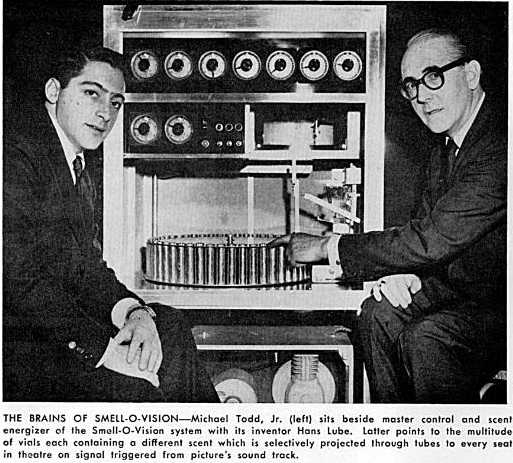
Well ha, ha! It turns out that we weren’t the only ones with such an idea. 1959’s Battle of the Smellies pitted Mike Todd, Jr.’s film ‘The Scent of Mystery’ against Walter Reade, Jr.’s ‘Behind the Great Wall.’ The former featured Hans Laube’s technique, called ‘Smell-O-Vision,’ of releasing scents from tubes connected to the movie theatre seats. The projectionist could control the timing and release of the various aromas.
courtesy of http://www.extremetech.com
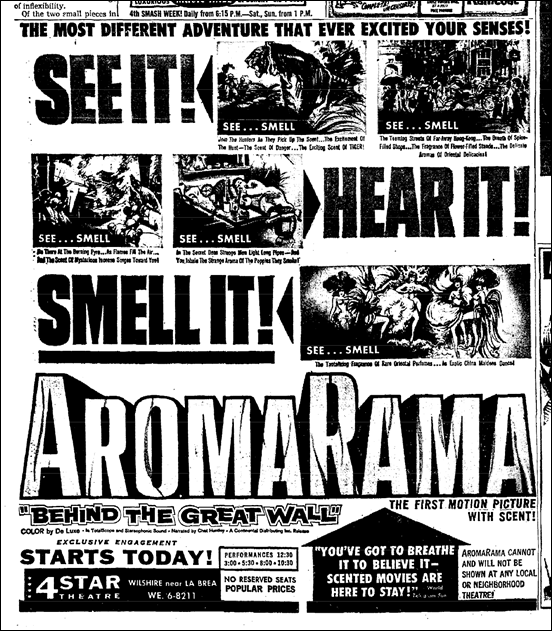
‘Behind the Great Wall’ used Charles Wesiss’s process, called AromaRama, to broadcast smells through the theatre’s air conditioning system.
Both systems had drawbacks, and these were the only two films released with scent dispersal systems. Later efforts included the use of scratch-and-sniff cards to add the sense of smell to film. (You can learn more about this movie history and some of the amusing problems it encountered, in this article.)
What does this have to do with Rapallo? Only that so many times as I ride my scooter from San Maurizio into town I wish that I could record the scents for this blog. Invariably the first smell is something delicious that Rosa is cooking up at the Trattoria across the street – rabbit stew? roasted veal? Rarely it is a very unpleasant smell: stoccafisso (which I’m sure smells divine to people who like stoccafisso, of which I am not one. We have a friend, a stock-fish lover, who declares it smells like a baby’s breath. I beg to differ. Fortunately it is a seasonal dish, served only in the cold winter months).
Farther along the road our old neighbors have fired up the wood stove which still provides their heat and their means of cooking. The smell of a late-fall woodfire is enough to make me want to go right home and curl up with a good book and a cup of tea. Farther down someone else is burning a brush pile. This smells slightly different that the wood fire, more punky, no doubt because a lot of what’s burning is green. When we first moved here there was a lot of plastic burning, but I’m happy to report that there is very little of that any more. That is a truly distressing aroma – you can feel your cells dividing in misery.
One of our neighbors hasn’t harvested his grapes yet; they hang, deep purple and slightly withered, from the wires running between rustic wooden posts. The smell of over-ripe grapes is sweet with an almost, but not quite, overlay of decay. It’s no wonder I can hear the hum of bees over the scooter’s engine (well, not really – but I can sure see the bees) – they love the sugar produced by grapes beginning to ferment on the vine.
About half way down the hill there’s a house with a superb garden. I’ve never seen the whole thing, but what’s visible from, and hanging over, the road is gorgeous. Flowers, figs, fruit trees – there is always something in bloom at that house, and as often as not I pick up a sweet floral scent, sometimes lavender, sometimes lemon, sometimes something unidentifiable. It lifts the heart.
Via Betti, the famous Via Betti – about as wide as a U.S. single-lane road, it is the Rapallo end of the road we live on, and it serves as a major access road over the mountain to the valley on the other side. Traffic adventures are a daily occurrence, but it is something one gets used to. Something I will never get used to or take for granted is the gorgeous smell of baking bread that wafts over the street from Panificio Schenone Giorgio. Warm and yeasty, it makes me instantly starving.
Now in the heart of Rapallo I take a left and continue along the river towards the Castello. Ah yes, the waste treatment plant. That smells like old wet newspapers that have sat overlong in a cellar. It’s not a garbagey smell, but it’s definitely nothing you would confuse with the smells from the bakery. Then on to the sea with all its inherent smells: a little salty, a little fishy, a little like a fresh breeze. Our part of the Mediterranean does not have the astringent salt smell I associate with the Atlantic off New England, but if your eyes were closed you would still know you were next to the sea.
And that is why I wish this blog could be brought to you with smellavision. The scents of Liguria are as evocative as the sights and sounds, and yet they cannot be shared in the same way. Maybe someday they will, though – according to a Scientific American article in 2011, scientists have developed a programmable odor-emitting device capable of reproducing 10,000 scents. How I would love to program this short article to give you the smells that define where we live. And I’d be interested to hear what are the smells that say ‘home’ to you.
13 Sunday Oct 2013
Posted in Building, Building in Italy, Liguria, Rapallo, Uncategorized
Tags
Building restructuring in Italy, Decorated houses in Liguria, Decorative building painting, Exterior painting Liguria, Re-doing a building in Italy
One of the big condominium/bank buildings in Rapallo has been undergoing a face-lift since March of this year. What a job! It’s not just a question of applying a fresh coat of paint. All the old stucco is being removed from the stone building underneath, new stucco applied and, finally, painted.
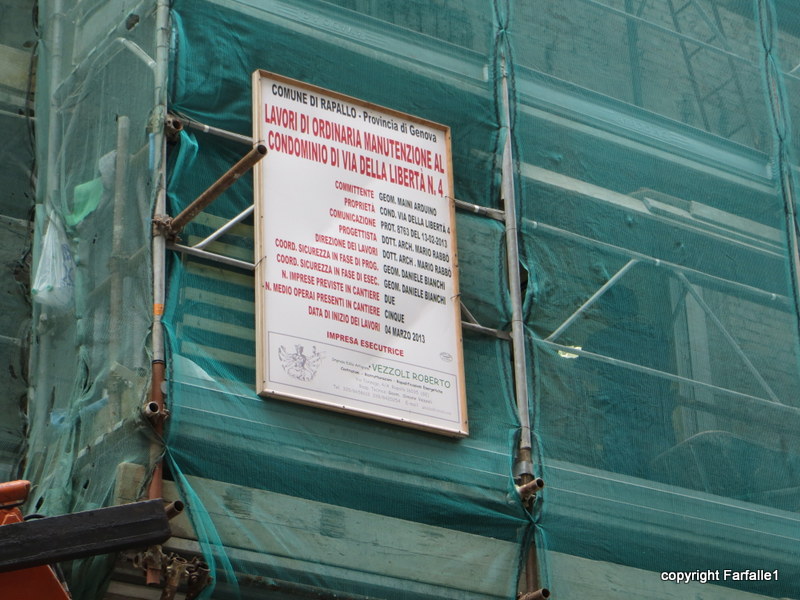
One of the fun things about building repair and restructuring in Italy is that the work permit must be prominently placed for all to enjoy. It details the ownership of the property, the people responsible for the job, when the work commenced and, often, when it will be finished – which is always, always a joke. They were clever enough to leave the last off the sign for this project, seen above. Even so, they are moving right along.
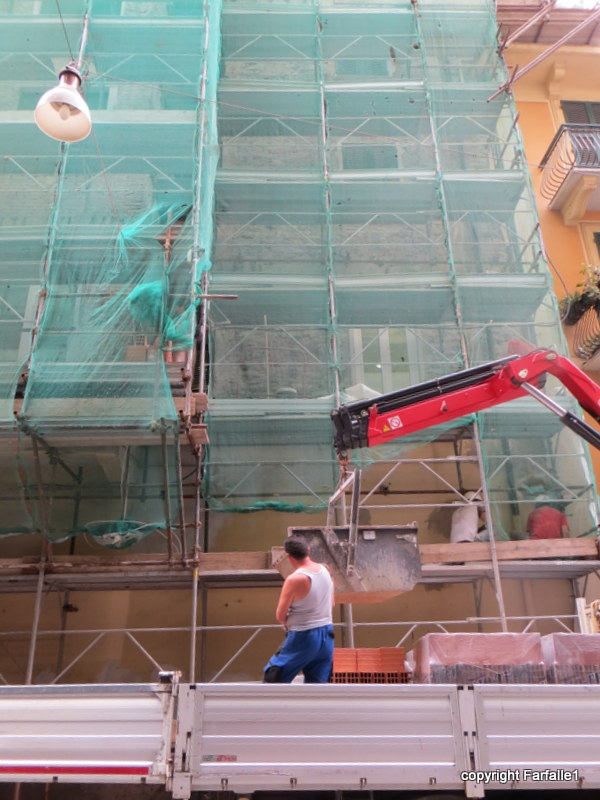
A delivery of brick blocks is being made above. It’s hard to see through the protective netting placed around the work, but if you squint you can make out the stucco still on the building at the bottom, and the stone under-facade up above. The lower floor is made from huge cut granite blocks; the upper floors, which will be covered by the stucco, are made of the smaller stones that are so abundant here, and of which most older buildings are made. The new blocks will probably be used to repair gaps that have occurred in the stonework during the removal of the stucco, and perhaps for some window work, or perhaps some interior walls. (Clearly I don’t know!)
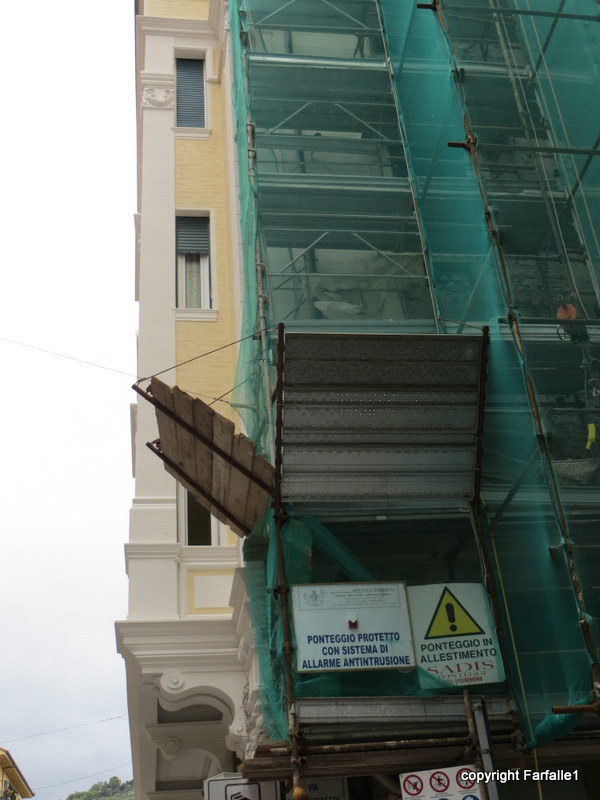
Interestingly the scaffolding is required for any work done on a building over 10 meters in height – that’s 32.8 feet, not all that tall. It’s not cheap; the scaffolding company has to be licensed and insured, and has to have gotten approval for the ‘project’ of installing the scaffolding for each particular job. Additionally they have to install at least one copper cable lightening rod. So there’s no scampering up a tall ladder to do the work yourself if your house is over 10 meters tall.
The completed work is visible on the left, work still in progress on the right.
Here is the south side of the building, all finished (note the large stones on the lower level):
It’s rather plain, isn’t it? There are very strict rules about changing any aspect of the exterior of buildings in Liguria. For instance, when we restructured our house we wanted to put two small balconies on the south side, one outside of each bedroom. Permission denied: it would alter the appearance of the structure too much. Likewise above, even if they had wanted to do some fanciful painting on the new stucco, they would not have been permitted to. It has to be made to look the way it looked before the work began, in materials, color and design. While this adds enormously to the expense of a project, it means that old buildings retain their original character – which we think is an excellent idea.
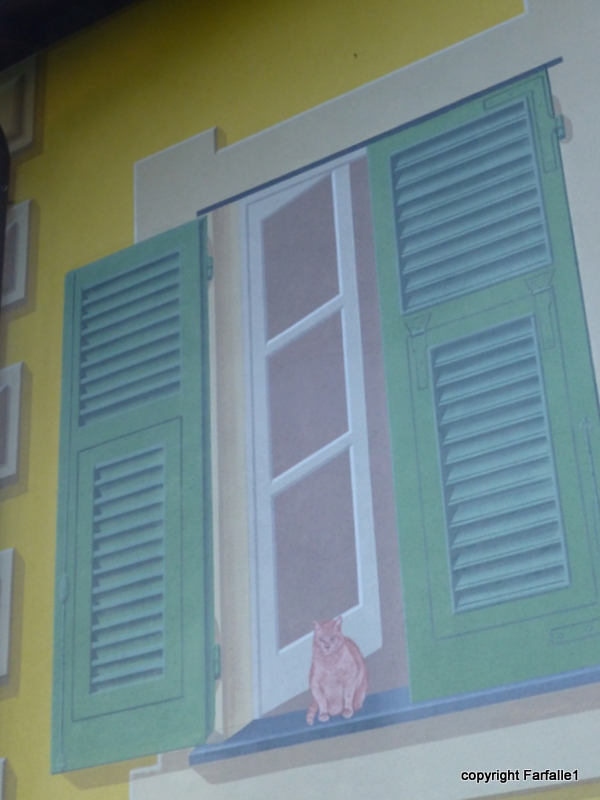
We were fortunate when we did our house – there was no original color left on the exterior, though some of the original designs could still be made out. A neighbor recalled that it had once been yellow, so Speedy chose a pleasing shade of yellow and went to see the town architect. “Yes,” she opined, “that house looks like it might have been yellow.” So we got the color we wanted; wasn’t it lucky we wanted yellow? We did sneak in one little addition that wasn’t part of the original exterior painting:
By the way, the bank that occupies the ground floor of the office building described above has one of the greatest names ever for a bank: Banco di Chiavari e della Riviera Ligure (Bank of Chiavari and of the Ligurian Riviera). Once upon a time they put out a quite beautiful annual calendar, a real work of art. In fact, that is one of the reasons why we chose them to be our bank. Alas, the calendar has gone the way of so many ‘extras’ in the last years, but the great name remains on all their buildings, in spite of the bank having become a part of a very dull sounding much larger bank: Banco Popolare.
So, the next time you have to touch up the trim around your windows, or even paint your whole house, thank your lucky stars you don’t live in Ligura, where painting your house can be an enormous undertaking – unless of course you do. (Then thank your lucky stars that you live in a little piece of paradise.) Thank you to our friends who are surviving a house-painting as I type , complete with scaffolding and lightening rod; they provided the details on legal requirements for this kind of work.
09 Wednesday Oct 2013
Posted in Italian food, Italian men, Rapallo, Uncategorized
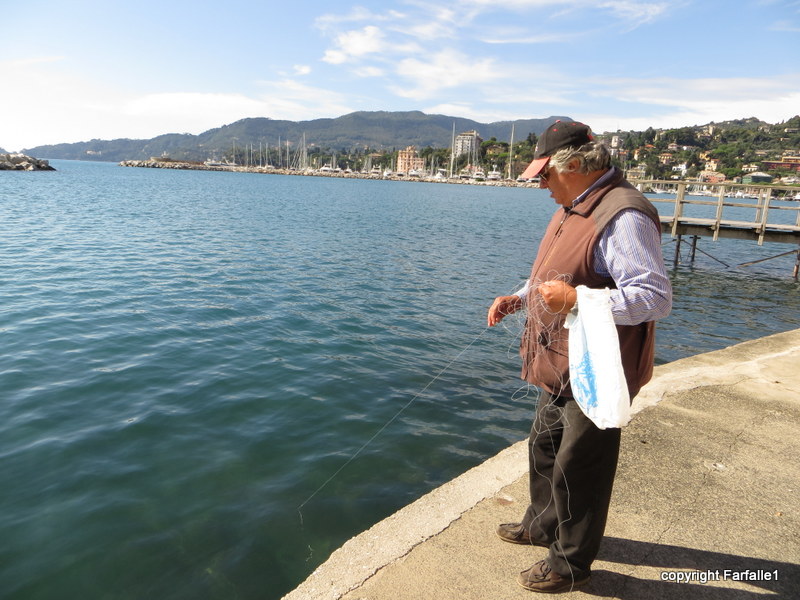
Yesterday Angela and I toddled down to her beach to enjoy some unexpectedly fine sunshine and to dangle our feet in the rather chilly sea. As we chatted about this and that we watched a couple of men fishing for octopus.
The gear they used was real DIY material. A thick piece of cardboard, about the size of a shirt cardboard, around which was wrapped a good bit of nylon filament. Their method was to throw the baited line out as far as they could, and then reel it in, ever hopeful that they would find an octopus firmly attached to the bait. We watched for an hour or so, but none of the resident octopi obliged, and our friends left disappointedly empty-handed.
Here is Paolo, pulling in his line. You would think he’d end up with a hopeless snarl of nylon, but he never did.
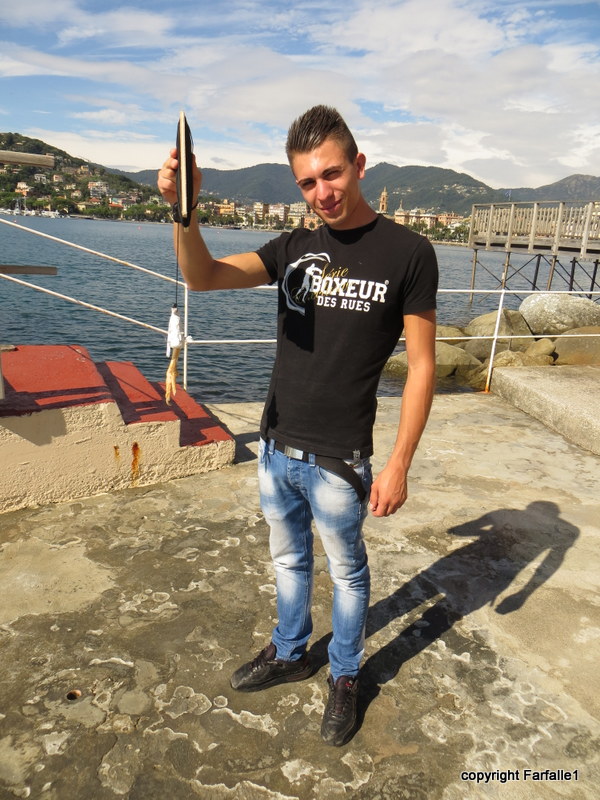
And this is Giuseppe, showing off the bait: a chicken’s foot! Evidently it is irresistible to an octopus.
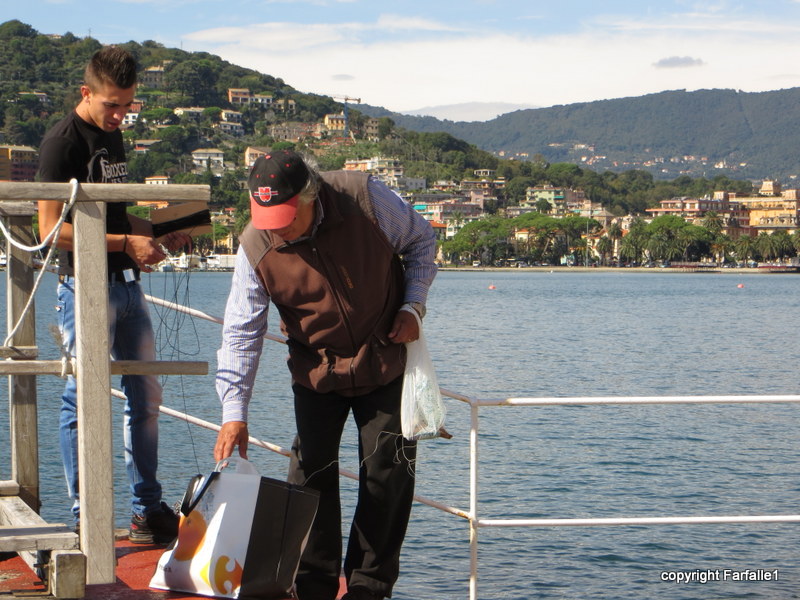
Paolo spent some time giving Giuseppe instruction in the finer points of octopus fishing as they prepared to try their luck in a different spot:
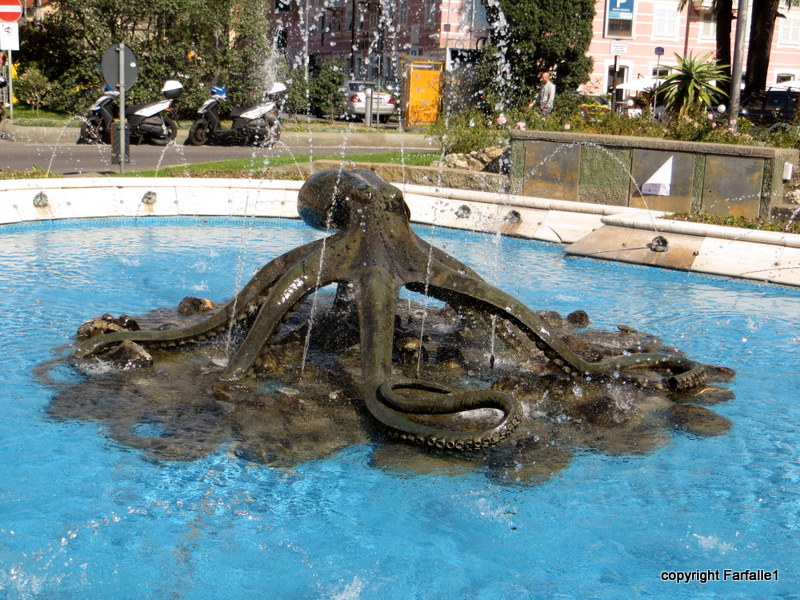
There is a beautiful fountain across the street from the castello which, happily for me, was in operation the day we met Paolo and Giuseppe. It was dry for much of the summer, but whatever the problem was, it seems to have been fixed, as you can see:
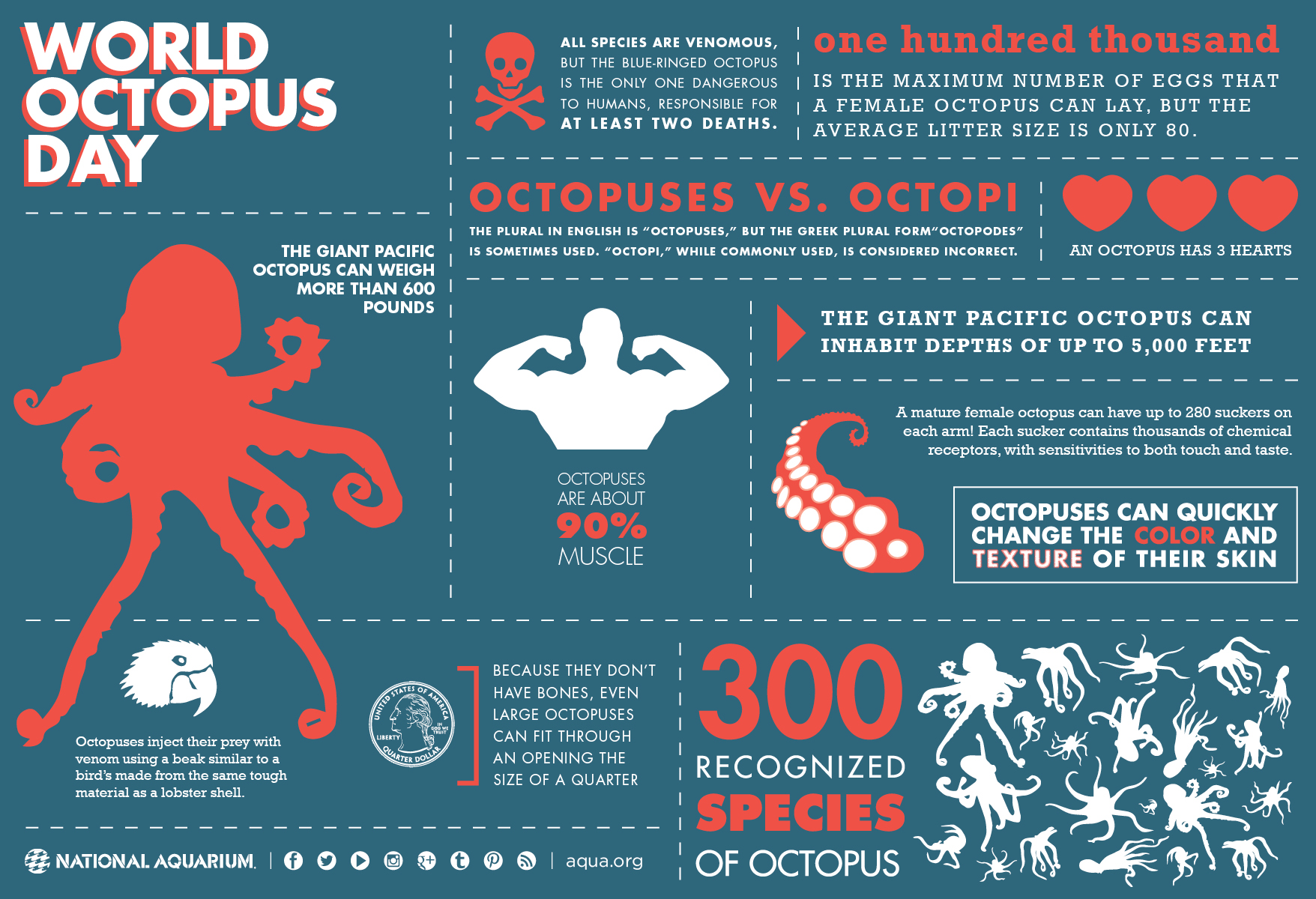
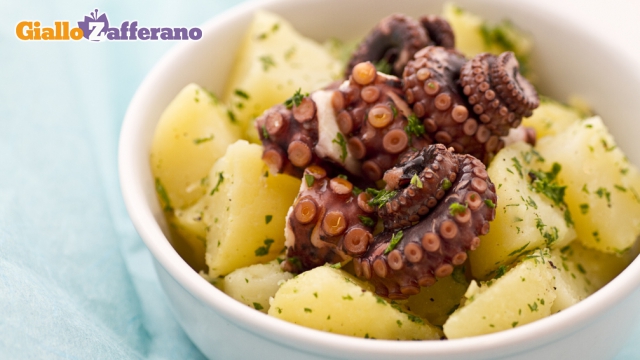
Thanks to IFLS I learned that today is World Octopus Day. This poster will tell you more than you ever wanted to know about octopuses (click on it it see it larger). What it fails to mention is how absolutely delicious octopus is, especially when served in the Ligurian style with boiled potatoes.
Happy World Octopus Day everyone!
02 Wednesday Oct 2013
Posted in Hiking in Italy, Humor, Uncategorized
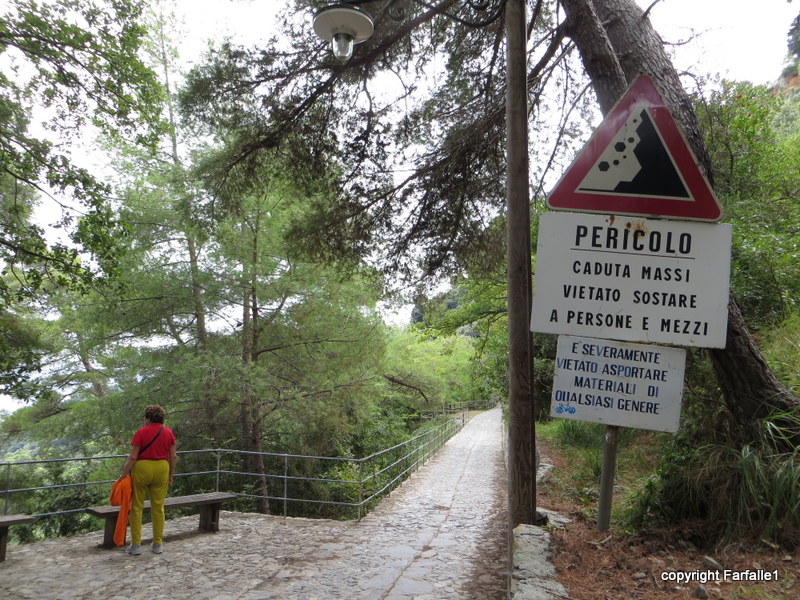
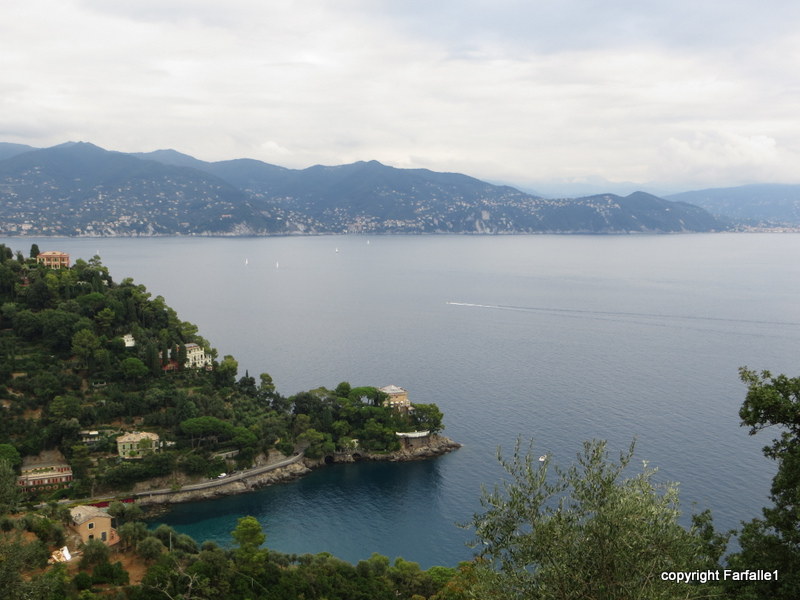
On the beautiful walk from Nozarego, above Santa Margherita, to Portofino we came upon this very confusing place. The top sign says “DANGER – Rockfall – It is prohibited for both people and vehicles to stop.” The one beneath it says “It is severely prohibited to carry off material of any sort.” Then they, whomever they are, thoughtfully provided benches and, farther along the path, a pull-out for vehicles which also offers a splendid view.
How can one NOT stop to take it all in? I think my head is going to explode.
27 Friday Sep 2013
Posted in History, Holidays, Italian Churches, Italian festas, Italy, San Maurizio di Monti, Uncategorized
September 22 is San Maurizio’s Saint Day, so of course there is a procession here in San Maurizio di Monti, and lots of other celebration too. But who was he? According to Wikipedia there is some disagreement about the veracity of the tale. However, it is said that he was a general at the head of the legendary Theban Legion, which operated in Mesopotamia during the third century CE. Later Emperor Diocletian sent the legion to Gaul to subdue both barbarians arriving from the north and a rebellious local population.
Diocletian’s successor, Emperor Maximian ordered the legion to persecute and kill the local population of Valais, whom he felt were not being loyal to Rome. Many of this population had converted to Christianity, and the Legion was also Christian; they refused to murder their fellow believers. Now it gets really bloody. Maximian, angered by this mutinous behahavior, ordered a decimation of the Legion, that is, one of every ten soldiers was to be beheaded. After this gruesome punishment he again ordered the killing of the Valais population. Again the Legion demurred and a second decimation ensued. Still they refused to kill their fellow Christians. This time the furious Maximian ordered that the entire remaining Legion be killed. This extreme punishment was carried out in what is now Saint-Maurice-en-Valais, in Switzerland (by whom I couldn’t discover). As general of this steadfastly Christian legion Maurice, or Maurizio here in Italy, is the one who became a saint.
He is usually depicted with a sword and, here in Italy, with a red cross. He is the patron saint of the Alpini, the incredibly brave and strong Italian Alpine military group. And he is depicted as either black or white. He is assumed to have been born in Egypt, and was perhaps Nubian.
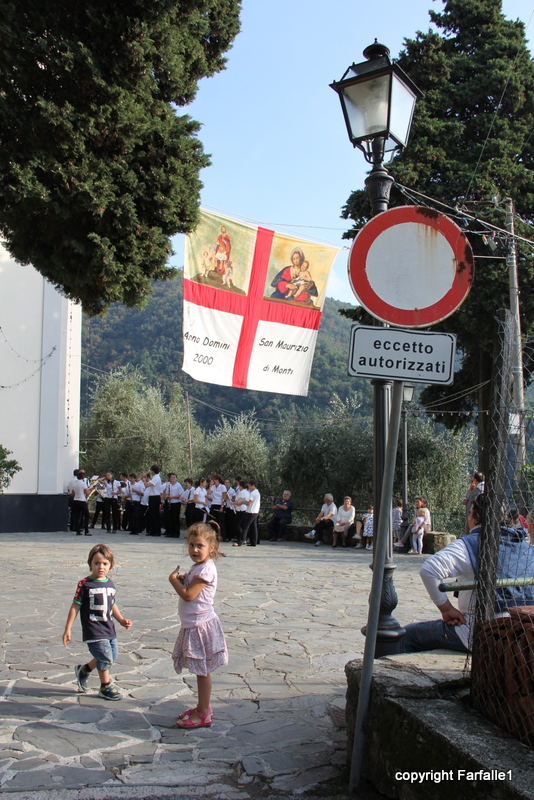
The celebrations in San Maurizio di Monti included the usual food stand, music and dancing for two evenings. As well we had our very own fireworks display. The serious part of the celebration took place in the late afternoon on September 22.
The Rapallo Band gave a short band concert before the celebratory mass, including some pretty snappy numbers. Here are a couple of shots of the piazza in front of the church during the concert:
When the church was gussied up for the second millenium the portrait of San Maurizio over the door was repainted.
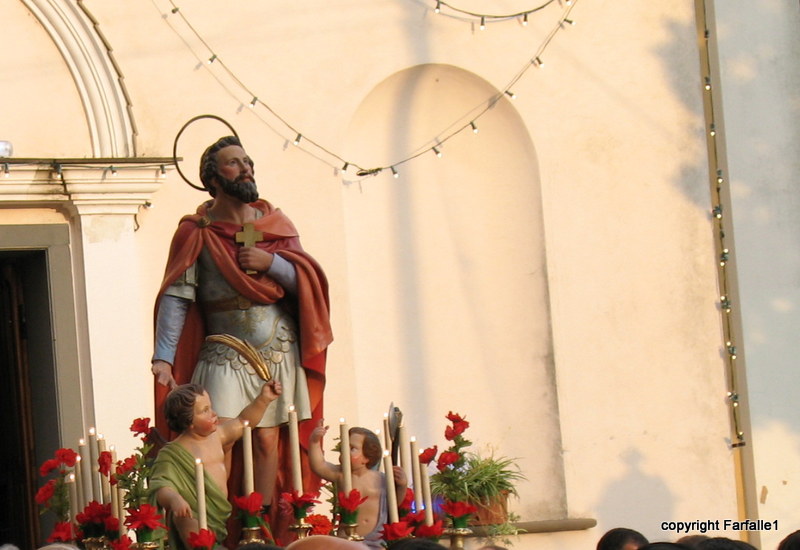
Is it just me, or does he look kind of goofy? At the very least he looks like he has a very good secret. That’s one of his faces in San Maurizio. The other is much more serious, and can be seen on the statue that is the central part of the procession through town (‘through town’ is a grand way of saying the procession leaves the church, marches up the road about 400 meters to a fork in the road, turns around and marches back to the church for the conclusion of the mass).
On the statue Maurzio’s expression seems wistful – perhaps he would like to get out in the air more than once a year. You can see a short video of the procession going from the church (with prayer) here, and another of it returning (with music) here.
He is our mystery saint, black or white, goofy or sad – like the rest of us, he’s… complicated.
16 Monday Sep 2013
Posted in Italian sports, Sports, Sports in Italy, Uncategorized
One of my favorite Honeymooners episodes features Ed Norton and Ralph rehearsing for a play. At one point Norton has a line containing two words which he pronounces as one word: ‘poloponies’ (which he pronounces pah-lop’-own-ies). I can never hear the word ‘polo’ without remembering this and giggling.
In Italian it’s called ‘palla’, which means ‘ball,’ not ‘polo’ – but it still makes me chuckle, and pretty often. Water polo (or pallanuoto, swimming ball) is a big sport all over Europe, and especially in Italy. There are quasi-professional teams here that, like soccer, are placed in divistions, Serie A and Serie B.
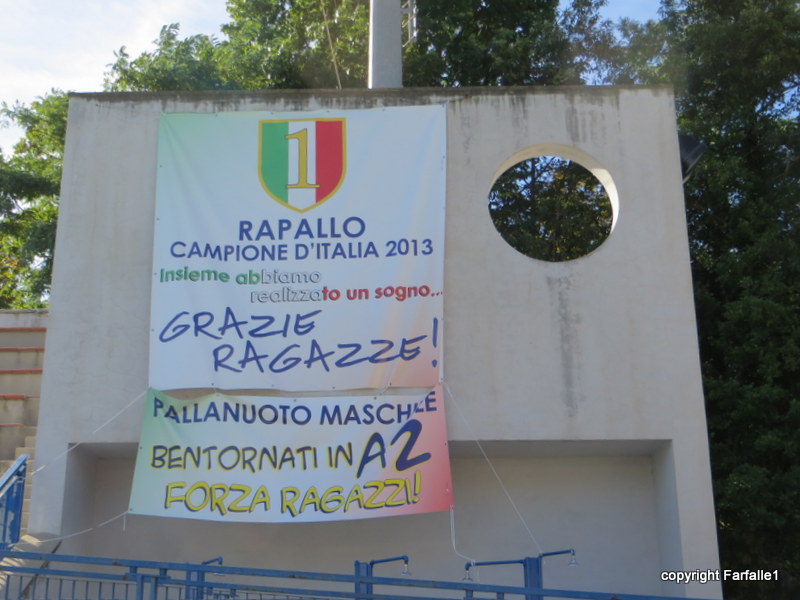
Rapallo, like many other Italian cities, fields (pools?) its own pallanutoto teams. The men play in Serie B. The Women? This will tell you:
That’s right! The women’s team won the national championship of Italy last year – very exciting. The sign says: “Rapallo, Champions of Italy 2013, together we realized a dream, thanks girls! Men’s Pallanuoto – welcome back to A2 [serie]- Go guys!”
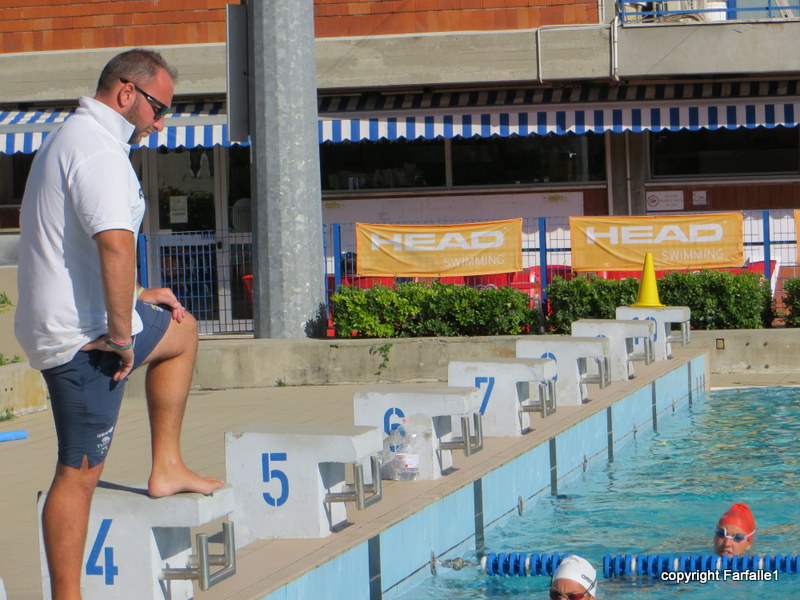
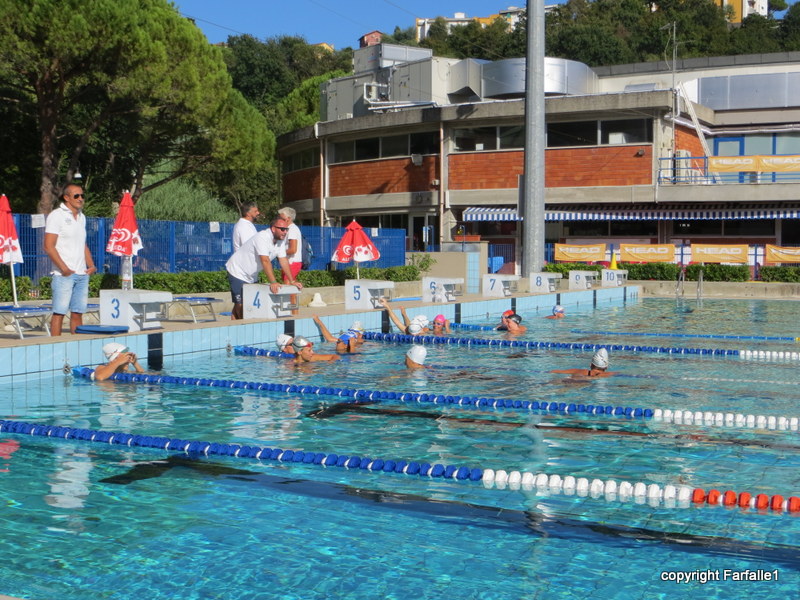
The 2013-2014 season is about to begin. Last week the women gathered for their first workout, and I had a chance to speak very briefly with one of the coaches (it was clearly not a time for chatting; he was very busy).
He explained that the pallanuoto teams are not professional in the way that, say, soccer teams are; that is, the players do not receive huge salaries. “But are they paid?” I asked. “They are reimbursed,” which left me not a lot further ahead. I suspect they are paid some kind of living expenses, but I don’t believe there are any huge salaries.
There are 10 teams in Serie A in Italy. There are two divisions in Serie B,, each with 12 teams – one in the north and one in the south.
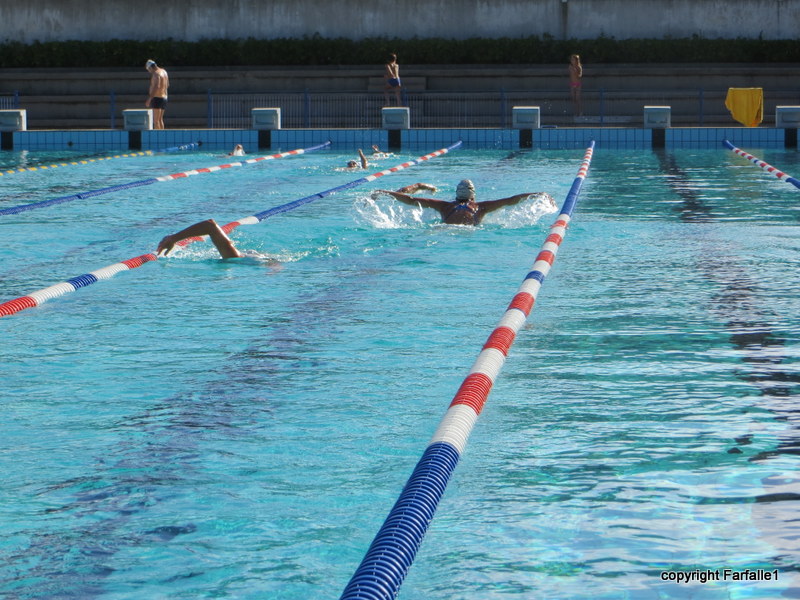
And that was all I was able to learn about the organization of the sport here in Italy. It was a huge pleasure to watch the women swim their warm up laps – they are strong and graceful. As one who struggles gamely, but slowly, in a pool, I can only watch with awe.
In the U.S. I believe water polo is played as a club sport, in schools and universities, and of course in the Olympics, where it has been a sport since 1900 (for women since 1986). If you’re interested in the details of the game, you can learn about it here. FINA is the governing body of water polo (as well as other water sports) here in Italy and much of the rest of the world. They oversee the various tournaments. I’m hoping to have an opportunity to learn more about it firsthand in the coming weeks.
Years ago we had a young friend who played water polo with his secondary school team. He told us that we could not imagine what goes on under the water – players who sharpen their toe nails so they can scratch their opponents, trunks being pulled down, anything to gain an advantage without being caught. I found myself wondering if the same nonsense goes on in the professional games.
It’s clearly a sport enjoyed by many, as this game in the sea at Santa Margherita Ligure suggests:
The game above must just be for fun – I don’t think there is a full complement of players present (6 players and 1 goalie per team), unless some are hiding under the water. (Besides, I’ve never heard of a pro team in Santa.) Think how difficult it would be if there were big waves!
28 Wednesday Aug 2013
Posted in Food, Italian food, Tandoor cooking, Uncategorized
Clever Speedy dreamed of making pizza in his new tandoor oven, since the temperatures get so high. But how to do it? He found a square piece of slate on the property and cut it into a circle that just fit into the top of the oven. Then he fashioned an aluminium cradle for it that hangs over the top of the clay cooking chamber, but allows for the cover to fit on well.
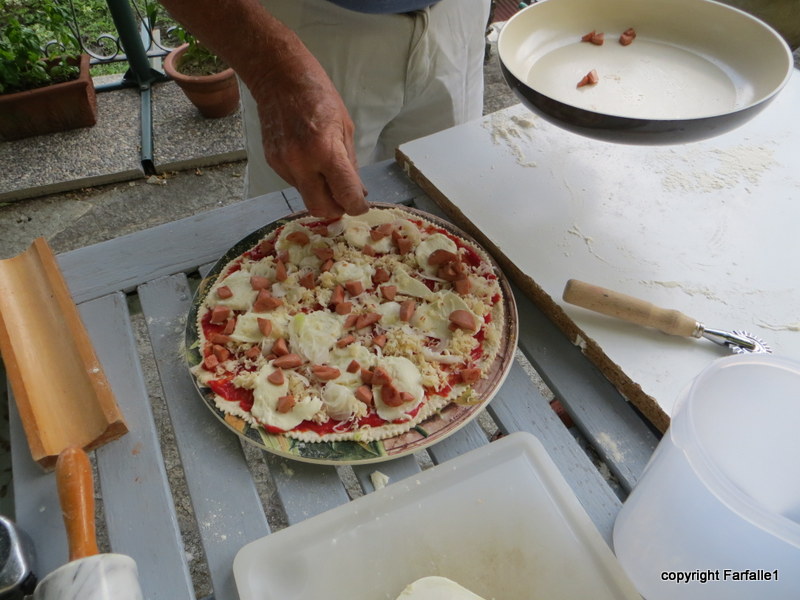
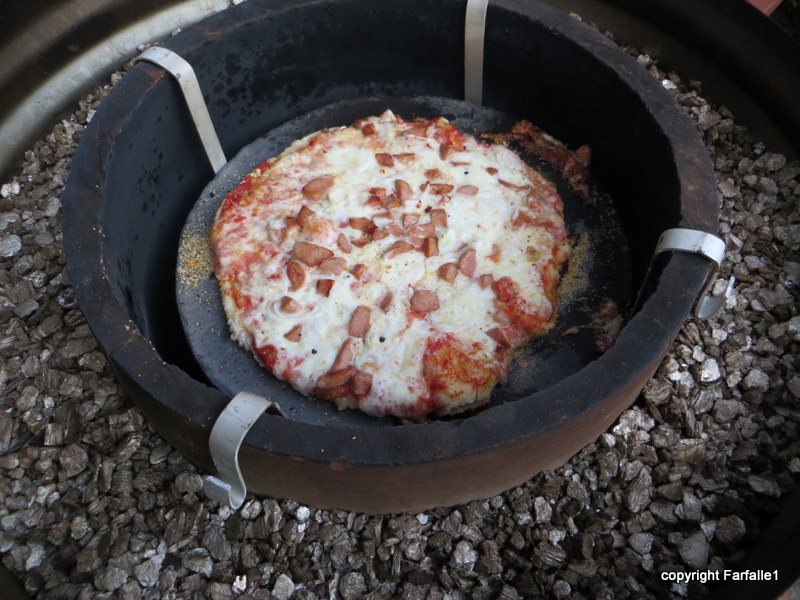
He rolled out the dough; we dressed it with tomato sauce, fresh mozzarella, grated hot pepper cheese, onions and wurstel; then popped it in the tandoor:
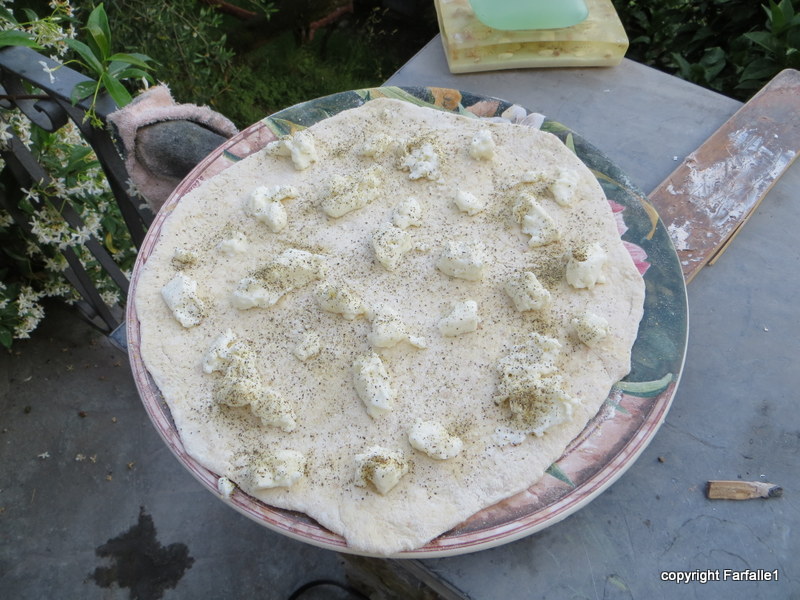
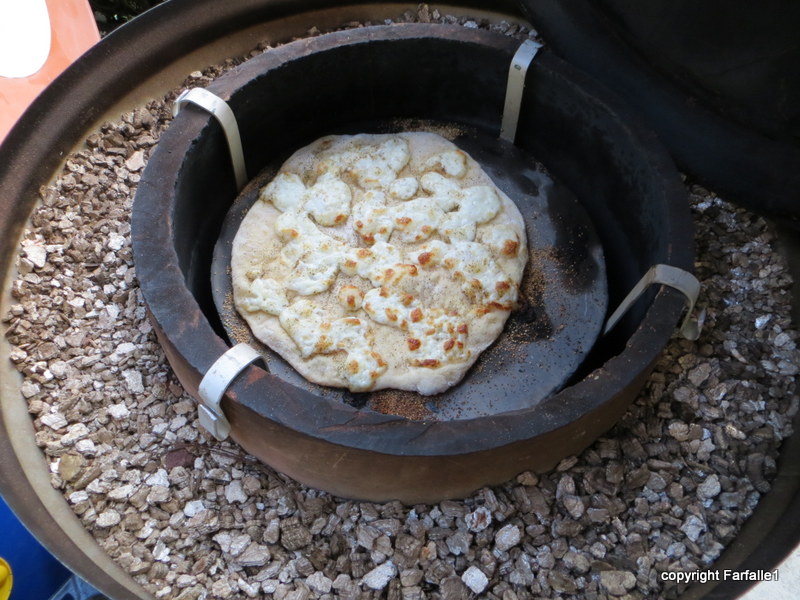
While the pizza was cooking, we rolled out more dough to make a stracchino focaccia:
Pizza’s done!
As the lid of the tandoor doesn’t reflect down a lot of heat we put the pizza under the regular oven’s broiler for a couple of moments to finish off the top. Then one of us dressed her side with ruccola and we sat down to eat while the focaccia cooked.
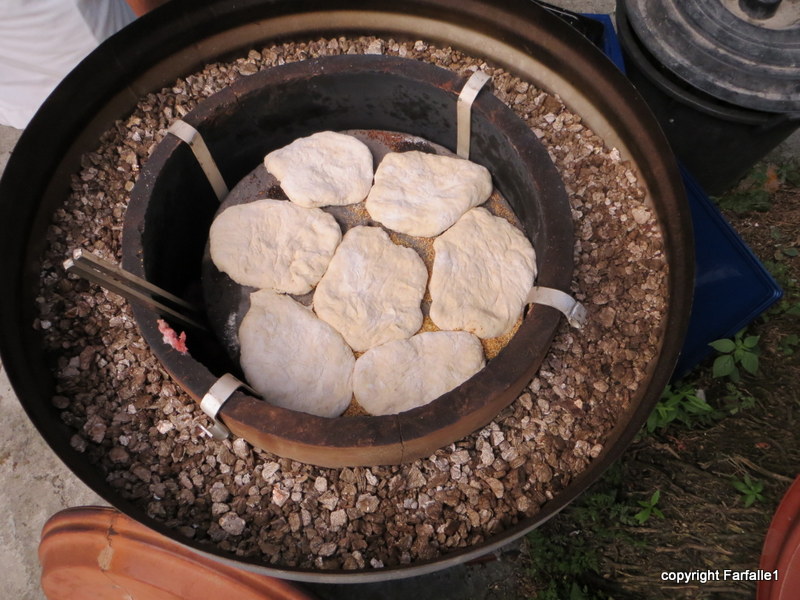
No sense in wasting a good hot fire, so we shaped up some rolls for sandwich making. Out came the focaccia and in went the rolls:
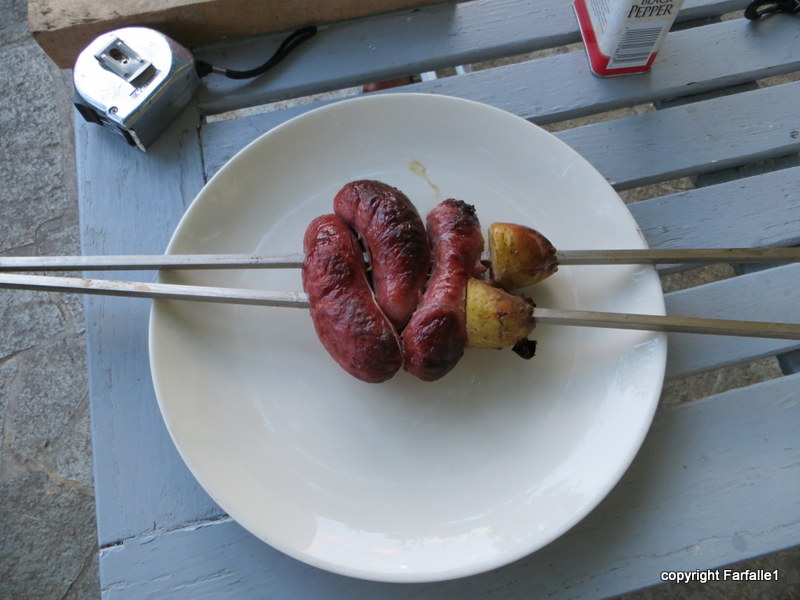
And while those rolls are cooking, we might as well cook up a few sausages on vertical skewers under the stone (see above). For some, a meal is not complete without meat.
A side salad complemented the various courses. It was a delicious meal, fraught with jumping up and down to take one thing out and put the next thing in – great fun and very satisfying.
24 Saturday Aug 2013
Posted in Animals in Italy, gardening
There were a pair of exotic insects creeping along the stems of the lemon tree last week – or so I thought. On closer inspection it proved to be something sadder:
I’m pretty sure these are bugs that have been infected with a cruel yet beautiful fungus, which one I do not know. There seem to be a lot of fungi that infect various animals and insects; in fact there’s research being done in the use of fungi to control unwanted pests.
It was sad to see these two little critters, though. Such an infection doesn’t end well for the host, as you might imagine. And while it’s hard to tell exactly who is under the disease, I suspect they are small bees – and we need all the bees we have.
18 Sunday Aug 2013
Meet our computer wizard here in Rapallo, Andrea Canessa:
This year when Speedy’s home-built computer finally got tired and decided not to cooperate with us any more we paid a visit to Andrea. Speedy, who makes limited demands on his computer, had the brilliant idea that Andrea could build us a machine from bits and pieces for much less than a new one would cost. And he was right! We got exactly what Speedy wants for about half what a spanking new machine would have cost.
While we were with Andrea we admired his new electric car:
Cute, isn’t it?
Then Andrea started bending our ears about alternative forms of energy. We’ve been admiring our friend Leo’s extensive work of that sort at his house in Piemonte – he’s put in photovoltaic panels for electricity and solar panels for hot water – so we were pretty well up on what Andrea was speaking about. What we didn’t know, and what he soon told us, is that he has become an agent for NWG, a company that installs alternative energy systems all through Italy.
Andrea’s a man we trust, and someone who has a firm grasp of technology. To make a long story short, we decided to install a photovoltaic system for our house. We have enough space for 10 panels which should produce about 2.5 KW of electricity when the sun is shining brightly. Since our regular electrical service is 3 KW, and we never seem to exceed that, it seemed enough. Besides, if we need more current than the sun is giving us at any particular moment, Enel kicks in to give us the extra that we need. The project was not cheap, but there were several factors (aside from the 80% financing offered by NWG) which made it seem timely and The Right Thing To Do.
First, the Italian government has a scheme in place that will refund 50% of the cost of the project with tax credits over a 10-year period. No, we may not live (or live here) long enough to collect it all, but the rebate is attached to the project, not to us; it can be transferred if someone else lives in our house within the time period. The government’s incentive program is not just for photovoltaic cells. It covers other energy-saving projects as well. Why is the government being so generous? Well, (aside from it being The Right Thing To Do) it is an effort to stimulate the economy – for the manufacturers of green energy systems and for those who install and maintain them. This tax incentive has been increased to 65% for some systems this year. Lots of projects are covered in whole or part – restructuring a house to make it more energy-efficient; energy-efficient windows; hot water heaters and heating systems; even some kinds of furniture for the newly done-up house are covered.
Second, the electric company cooperates by buying from us any energy we produce which we don’t use. We buy energy from them for .32/KWH; they buy it from us for .16/KWH, which seems fair to me. We get a certain amount of black-hearted glee from knowing that it is our neighbors who are buying our excess, heh heh heh. We don’t have the capability to store what we don’t use, so when the sun sets, or when it decides not shine at all, we are once again at the mercy of Enel.
This leads to an interesting case of teaching old dogs new tricks. We’ve tried for decades to use energy during the low-cost hours, which are usually after dark. Now we have to school ourselves to do our energy-intensive chores, such as laundry, dish-washing by machine, and oven use, during the brightest parts of the day. Turns out it’s not so hard to adjust.
The first step of the project was to get all signed up – which in Italy of course means many, many signatures. To our amazement, though, everything was done with great efficiency and relative speed, and a month after an acceptable engineering study and our subsequent agreement to go forward, it was time for the installation. It was done in two steps in one day.
A very jolly crew of five men from AMS, based in Lucca, arrived shortly after 8 a.m. The first step was to prepare for the panels. This involved some amount of wiring inside the house and placing frames on the roof to accept the panels.
Here’s what our indoor electric panels looked like before the installation:
Here’s what they looked like at the end of the day:
The jolly lads from Lucca sang as they worked; it was so cheerful:
Once upon a time I would have climbed up on the roof myself to photograph progress, but I couldn’t do that this year. The photos taken from the roof itself are courtesy of the gents who did the work. The frames are not massive at all:
The panels were supposed to arrive at mid-day, which was about the time the electrical work was done. The men went to lunch. They came back from lunch. They tidied up some. Along about 3 p.m. they were finally able to track down the panels which had left Prato, near Florence, and mysteriously bypassed Rapallo on their way to Genova, where they now sat (a thoroughly Italian route). Our expectation was that everyone would shrug and say, ‘Well, see you tomorrow.’ Not this outfit. Two of them hopped in their panel van, drove to Genova, retrieved the panels and at 5:30 the roof was crawling with activity.
By 7:30 the work was done and the connections had been tested successfully.
It was time for a bit of refreshment (and a few more signatures):
The crew didn’t linger however; they had a two-hour drive to get back to Lucca, and another system to install the next day.
Here are a few more pictures from installation day:
It takes a panolply of tools to effect this sort of installation, but they kept everything neat and tidy (tools, house, everything).
So, everything was in place… now we had to wait for the men from Enel to come and make the connection. This also was done in two parts. There was the outside team:
They swapped out our one-way meter, which measured only what we used, for a two-way meter for what we use AND what we sell them. (ha!) Then another technician came and checked the indoor wiring and turned it all on:
Ta-Dah! We are now using old Sol to run our day-time appliances, and it makes us feel just great. Our first reading:
Everything is working as it should with but one little wrinkle. NWG keeps track of all the power coming in and going out. They like to do it using the Vodaphone cell-phone system, but our hill-side coverage is not good enough to send the data. Their technician will return in a week or two to attach everything to our ADSL line to transmit the reports. Then we should be able to see daily graphs of what we are producing and what we are using. I can’t wait!!
Are we off the grid? Not by a long shot, but we’ve taken our first baby steps. Next year, who knows? Maybe solar panels for hot water. Stay tuned…