My favorite picture of the week

Tags

,

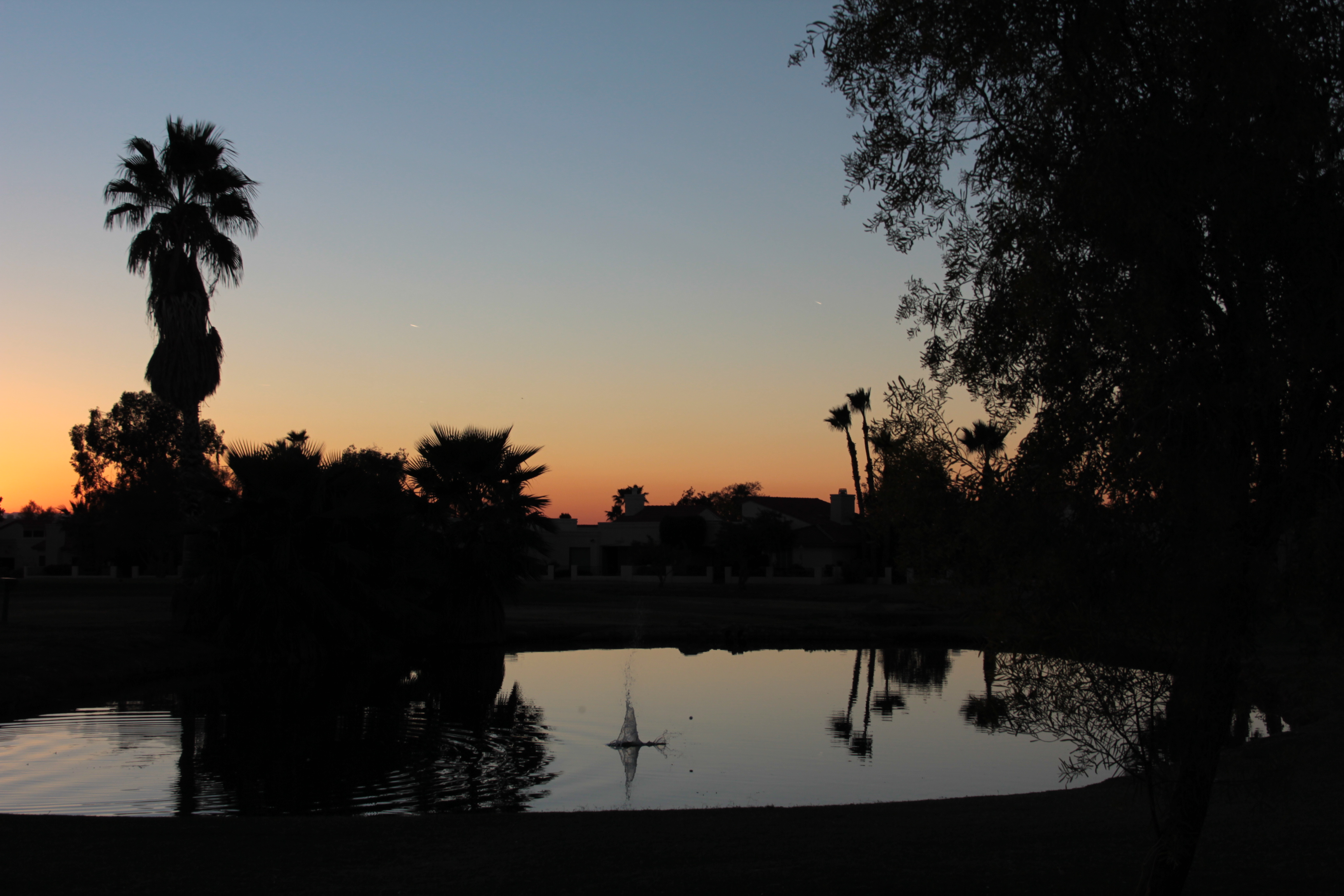
Bob's least favorite shot of the day

I apologize that this has taken a bit longer than usual to load.  I left the photo in its large format because I hope you will click on it to see the amusing detail in the center.  This was our golfing friend Bob’s least favorite shot of the week.  It was just by chance I caught it when I did.  It is a spot where I’ve lost many a ball myself, the devilishly placed water hazard that guards the green on the par-4 #13 hole at Painted Mountain in Mesa, Arizona.

Nonna Salamone’s Christmas Cookies

Tags

, ,

christmas cookies

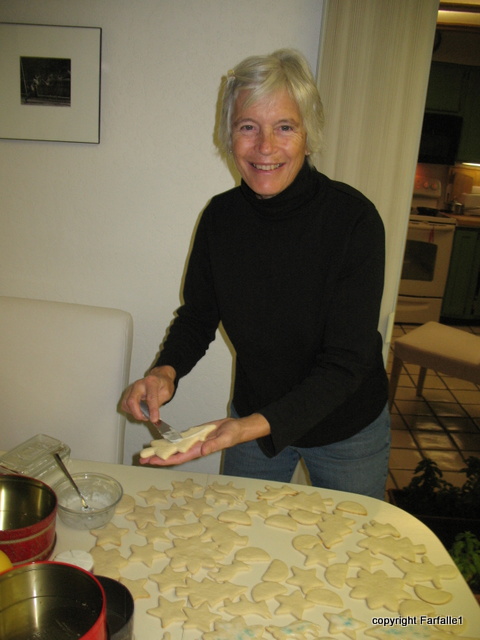
Bowing to the clamor from at least three faithful blog readers, I herewith present you with the recipe for Speedy’s mother’s Christmas cookies.  Too late for this year, I know, but tuck it away for early next December.

Speedy’s father came to the U.S. from Sicily, and his mother was born here shortly after her parents arrived from the same island.  Somehow through all the years that I’ve been scarfing down these yummy cookies I figured that they were adapted from an old Sicilian Christmas recipe.  Not at all.

In fact, if I were to be completely honest, this recipe should be called Mrs. Stockwell’s Christmas cookies.  I asked Speedy what the history of his Mom’s cookies was and he said, “I don’t know.  They were just always there.  Ask my sister.”  So I did.

Back when Speedy wasn’t even a twinkle in his father’s eye his parents lived across the street from Mrs. Stockwell; her divorced daughter, Darlene Johnson; and her little boy Jerry Johnson. Little Jerry and Speedy’s sister Fran were best friends when they were very young, and frequently played together.  On the days when they were not allowed to play together each would sit on his own curb and they would converse across the then-sleepy Wisconsin Avenue.

They went to kindergarten together, Fran and Jerry, and Fran remembers that Jerry was quite a talker.  In fact, she well remembers the day the kindergarten teacher ran out of patience with Jerry’s continual chatter, put tape across his mouth and deposited him in the cloak room.  Somehow I can’t see that happening nowadays.

And the cookies?  Well, they were Mrs. Stockwell’s recipe, and she shared it with Mrs. Johnson’s friend Nonna Salamone who turned them into her own Christmas tradition.  I got wondering about the Crisco – was that even around in the mid-1930’s when all this recipe exchanging and mouth-taping was going on?  Yes, it turns out that Crisco was introduced in 1911 and packaged sour cream was introduced a year later.  So there had been plenty of time for this great recipe to be invented. I like to imagine that maybe Mrs. Stockwell and Mrs. Johnson invited Frances over to bake cookies with Jimmy – can’t you just picture it?

I have no idea who that other little boy is – must be another of Jerry’s friends invited over for the fun. Isn’t Fran adorable?  Hard to imagine we just celebrated her 83rd birthday!

These are the simple cookies of long ago.  They’re fun and easy to make with children, and tasty to eat.  While Crisco has had a lot of bad press over the years, and still suffers a dubious reputation, the Smucker Company has done much to improve it in recent years – you can read its rather interesting history here (I am always amazed at what we can learn from Wikipedia).  It’s probably just fine to use it on those infrequent occasions when you make Nonna Salamone’s Christmas cookies and ‘Mbriolata.  The cookie recipe is here.  I hope you enjoy making (and eating) these cookies as much as Speedy and I do.

Just a bit more then I’ll stop, I promise

A very good friend has written a blog with a point of view quite different from  mine expressed in my last post (he usually writes about education, with an insider’s view; his blog is well worth reading).  Here’s what I put in his comment section:

Here’s a voice of reason… I’ve been thinking over your post and the various comments made in response.  I don’t see how a total ban on ‘guns’ would ever work.  But I do think there are a panoply of weapons that have no business in the private citizen’s gun cupboard.  Hunting guns? certainly.  Small hand guns for protection? if you must.  But automatic weapons that are designed for a battlefield?  no.  So why not a partial ban? We do that with fireworks, for heaven’s sake.  Small are okay, large, not (because they are dangerous). Then, I also think that anyone who wants to use a gun must prove that s/he knows how to use it responsibly.  We have to do that before we are allowed to drive automobiles.  People who have guns could be required to carry insurance in case of unforeseen accidents.  Perhaps the insurers would be more careful about background and mental health checks than gun stores are!  We require our doctors to carry insurance lest they hurt us; we require vehicle drivers to have both licenses (after passing two kinds of test) and insurance.  Why should we not regulate guns in the same manner?  They are every bit as lethal as cars, and I’m guessing a lot more lethal than your typical doctor.  And the regulations would not be any more onerous than those already in place for other situations.

********

I’m willing to back off my No Guns Ever Under Any Circumstances stance because I begin to see it’s probably impractical at the very least.  But I think the above are some pretty good ideas!

I promise to return to more light-hearted and on-blog-topic posts very very soon…

Slaughter of the Innocents

Tags

, , , ,

Illustration courtesy of goboxy.com

Illustration courtesy of goboxy.com

“A well regulated militia being necessary to the security of a free state, the right of the people to keep and bear arms shall not be infringed.” (Second Amendment to the Constitution of the United States)

“When Herod realized that he had been outwitted by the Magi, he was furious, and he gave orders to kill all the boys in Bethlehem and its vicinity who were two years old and under, in accordance with the time he had learned from the Magi.” (Bible, Book of Matthew, Chapter 2. There’s nothing modern about killing children.)

We don’t much like guns and we don’t have any.  Many of our friends, though, do like guns and do have them.  These friends fall into three categories: hunters, who keep their rifles and ammunition locked up in gun cabinets; target-shooters, who also keep their weapons under lock and key; and those who keep weapons for self-defense.   Presumably these later keep their weapons loaded, locked and close at hand.  The reason I don’t like guns and don’t want one anywhere near me is I’m afraid I might use it, against someone innocent, someone guilty, or on a really bad day, myself.

Gun ownership in the U.S. is an incredibly complex issue. Exactly what the Second Amendment, quoted above, means has been hotly debated pretty much since it was adopted (you can read about Second Amendment cases that the Supreme Court has heard here, earlier Second Amendment cases seem to have had more to do with States versus Federal Rights rather than the right to bear arms per se).  In any case, so far the judges have found in favor of the interpretation that private citizens have the right to own, keep at home, and use pretty much any kind of gun. Forty-nine states have laws which allow carrying concealed weapons of varying types.

As we are all too sadly aware in these days, there are plenty of guns to go around.  The best estimate I could find on various web-sites was about 300,000,000 or more guns in the U.S., which works out to almost one for every man, woman and child in the country.  The following chart offers lots of interesting gun statistics, including the most obvious: that the US has more guns per capita  than any other country in the world. Italy, in comparison, has about ten guns for every one hundred people. In many parts of the world there are fewer than ten guns per hundred citizens.

gun ownership
I know – it’s teeny.  If you click on it it will be larger, and if you want to see it in much larger format, click here. The graph on the right show people in favor of gun control (white line) and those against it (black like).  The number of Americans against gun control in the U.S. has been growing in the last few decades.

There is no end of data available about gun ownership and use in the U.S.  The question we all must face, and answer, in the days ahead is this: how can we keep guns out of the hands of people who will abuse them, without abrogating the rights of those who use them responsibly?  Regulation has been a joke up to now.  I’m adding my voice to the growing chorus saying enough is enough.  The precious right of all of us to carry a weapon (assuming the Constitution gives us that right, and I’m not convinced that was the framers’ intention) is not worth the lives of the twenty little six- and seven-year-olds and six adults who were gunned down in school in Newtown last week.  It just isn’t.  Let the guns be held in militia headquarters and if you want to go hunting or target shooting, go check one out.

I hear my friends howling that they have the absolute right to protect their loved ones.  But I have to ask, is your right to protect your family worth the lives of all the children who have been slaughtered in the spate of school shootings over the past years?  Have you ever actually needed or used your gun for self-protection?

It is such a can of worms.  95% of gun owners are probably responsible and careful. The people we know are obsessively careful with their weapons.  But the havoc wreaked by the other 5% in gang shootings, murders, and rampages ruins it for everyone else.  The number of people killed by accident by guns is astonishing (680 in 2008) and again, it is frequently the children who suffer.  According to The Survivor’s Club, every day five children in the U.S. are injured or killed by handguns.

I wish there were an easy answer, but there so clearly isn’t.  And I wish a rational and calm discussion could take place, but I think that’s unlikely as well.  People who have guns become enraged at the idea of having to give them up  (being someone who has gotten on very well for many years without a gun I have to wonder why) and people who want gun control are equally emotional, vituperative and accusatory.  Anti-control voices tell us there are so many guns already in circulation that limiting their purchase or ownership now would be next to useless in stemming the violence, that we would be removing guns from the law-abiding while the crooks and nut-cases would still have access to theirs.  That may be true, but somehow it would at least feel like a start.

Can we not all work together to keep guns out of the hands of those who will misuse them?  It shouldn’t be impossible to identify those individuals.  If you haven’t read “I am Adam Lanza’s Mother” you can do so here for an idea where we could start.  It would be nice to think we have evolved, at least a little, since the days of Herrod.
Saguaro

Tags

Reavis cheerful band of saguaro

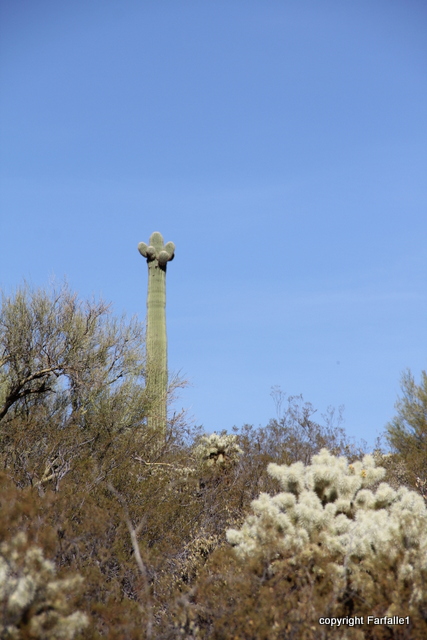
Pronounced Sah-Wha’-Roh,  this beautiful cactus is probably the most recognized symbol of the American southwest (along with the rattle-snake).  Native to the Sonoran Desert, the saguaro often grows  in ‘forests’ like the one seen above.

It’s a slow-growing critter.  Night-blooming flowers form  in bunches on the tops of the arms from April through June, and the resultant red fruit produces seeds to make more little saguaros. The flowers (the saguaro is the State Flower of Arizona) are pollinated mostly by bats, and often stay open into the morning hours.

photo courtesy of Phoenix.about.com

photo courtesy of Phoenix.about.com

The first arms don’t form on a saguaro until the plant is about seventy years old, so when you see a big one with a lot of arms, you know it’s old.  They can live for one hundred fifty years or more.

Saguaro babies like to begin their lives in the shade of nearby shrubs which give them protection from passing animals.

Reavis baby sugauro

Once they’re old enough they’ll put out their first stubby little arms:

Reavis new arms

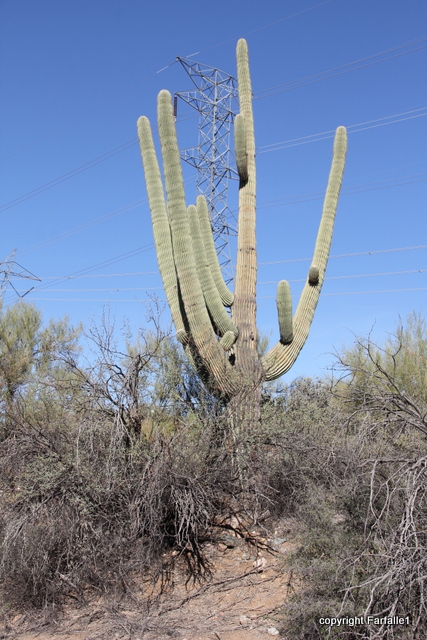
And if they’re lucky and get enough water and nutrients over the years, they will grow into the giant specimens that can be seen in the Tucson -Phoenix area, southern California and down into Mexico. Here’s a picture of one that began its life long before the electricity running behind it was harnessed.

Reavis Old cactus

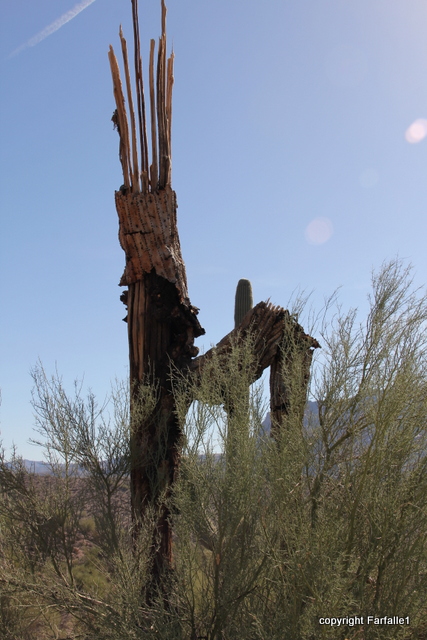
Eventually, like all of us, these giants succumb to to illness or just plain old age:

Reavis dead saguaro-001

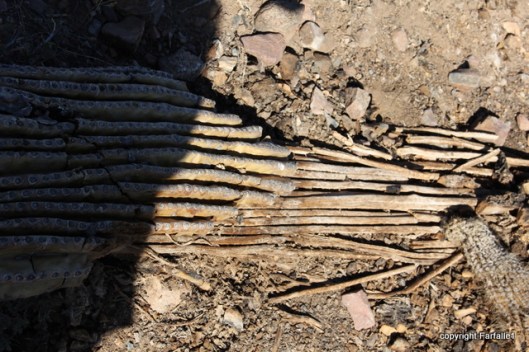
It’s then that they share the secret of their interior architecture. Their bodies and arms are full of long pipes that hold any scarce water the plant is able to absorb during the rainy season. When they die, they look like a bundle of old bamboo sticks on the ground.

Reavis saguaro bones

Birds like to nest in the saguaro, and for reasons I can’t quite fathom, hunters like to shoot them, so you often seen them with holes of one sort or another.

Victim of too many errant shots on the golf course

Victim of too many errant shots on the golf course

When a hole is made in its skin, the saguaro heals on the inside by forming a sort of wooden bowl that keeps the hot dry air out. The Gila Woodpeckers like to make fresh nest holes every year in the cactus. Other birds, such as cactus wrens, flickers and finches then can use this bowl as a nesting site.

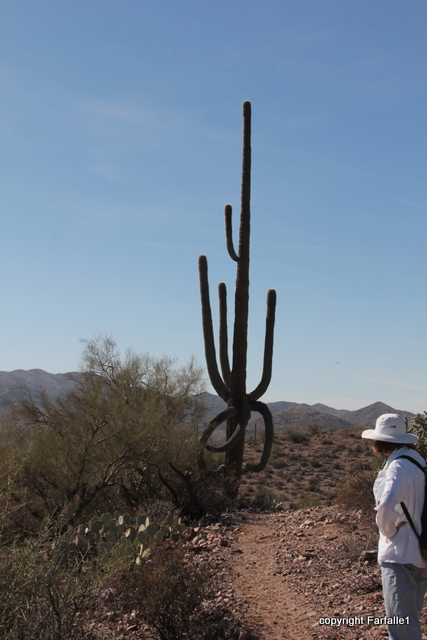
While most of the saguaros lift their arms in surrender, every now and then you come upon a comedian.

Reavis weird cactus

It’s hard to imagine what would make those lower arms form in that way. Can you come up with a good caption for the photo?

In 2011 Curt Fonger made some wonderful photographs right here in Gold Canyon of a bobcat which had climbed to the top of a saguaro to avoid being caught by a mountain lion. You can read the story here and see other photos.

photo copyright Curt Fonger/solent

photo copyright Curt Fonger/solent

I love seeing the saguaros on hikes, but if I ever start talking to them, I’ll know it’s time to hang up my hiking boots.

Hard Landing

Tags

Once again, as every year, culture shock has blind-sided me.  Yes, it is gorgeous here (see above) and yes, it is warm (even hot) and dry.  But it’s not Italy, is it?  Sounds so obvious, but somehow it takes me aback annually.  In fairness, I have to say that there will be a repeat of culture shock, in reverse, when we return to Rapallo in April or May.

But just what is the shock?  Size is one thing – everything is so darn big here.  When it comes to living quarters, I like that.  When it comes to servings when eating out I don’t.  Cars? no.  Sense of humor? yes.  Noise is another thing: there are non-stop sounds in Rapallo; scooters dash up and down the mountain, dogs bark non-stop, the rooster who can’t tell time crows his ignorance, diners clink their cutlery against their plates at Rosa’s and even, if they’ve had enough, break into song or begin to cheer loudly. Over at Case di Noe someone has fired up a brush-cutter, and every half hour the church bells remind us what time it is. (Speedy has addressed this part of the problem by down-loading chimes to sound the hours on the computer – not the same as the jazzy bell concert San Maurizio gives us each Sunday, but better than nothing.)

There are plenty of noisy places in the U.S., but we don’t happen to be in one of them.  Our neighborhood has forty homes, of which probably one-third are occupied now, it being still early in ‘the season.’  The family with small children who lived across the street have moved – how we miss their constant activity and cheerful little voices.  If we listen carefully we can hear the hum of traffic from the highway that’s about a mile away.  When the birds visit our feeders they are likely to squabble.  The humming birds sound like teeny little power saws when they zoom in and out.  But mostly it’s just very quiet and peaceful.  That’s nice, it really is, it’s just such a change.

The biggest change, though, and the hardest to adapt to, is the societal difference.  Italians are out and about for a good part of the day.  One must shop daily, the passagiata awaits at the end of the day.  There are friends and family to visit and ‘news’ to be discussed endlessly.  The silence in our neighborhood is but a reflection of a larger silence that I think of as particularly American.  People are afraid to discuss ‘issues’ for fear that they will offend or anger the person to whom they’re speaking. Somehow Italians have found a way to express differences without letting it get personal, and without letting it get in the way of friendships.  Here people are afraid to make eye contact with strangers, unlikely to greet strangers on the street (any one of whom may be carrying a weapon, concealed or otherwise, at least here in the wild west), and uncomfortable with the idea of discomfort.

Of course Italy is far from perfect.  But part of culture shock, I think, is the tendency to idealize the place one has left, to look back through the fuzzy lens of rosy glasses, while looking at present circumstances with the critical lens of a microscope.

I’m not asking for sympathy, believe me.  We are terribly fortunate to be able to enjoy life in two such diverse places, and yes, we are Thankful that we are able to (’tis the season).  I’m just saying that the transition is, for me at any rate, difficult, but difficult in an interesting way, not a painful way.  So please, stick with me for a while?  Pretty soon I’ll have my feet under me again and will share some more of the excitement of life in a most peculiar state.

Roissy

Tags

, , , , , , , , ,

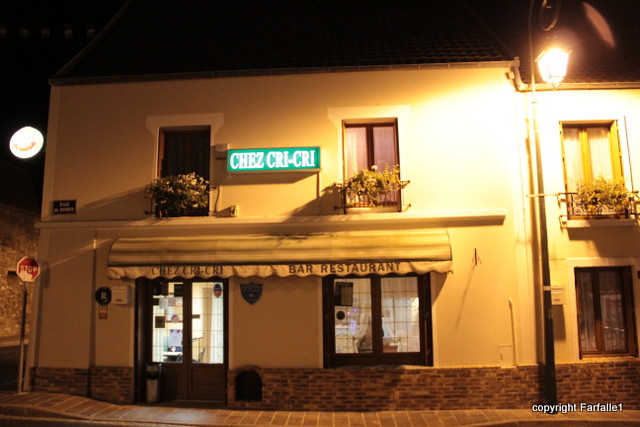
Daniel Dambreville, the charming publican of Chez Cri-Cri in Roissy, told us that 165,000 people pass through Charles deGaulle Airport every day.  CDG is a major hub for visitors to Paris as well as those traveling on to the rest of the world. Opened it 1974, it is Europe’s second busiest airport, after London’s Heathrow.  It covers 12.5 square miles over 6 communes, one of which is Roissy.  The airport’s location was plucked from a dwindling amount of undeveloped land around Paris in the mid-1960’s, and it has been a boon to the formerly sleepy little communes it occupies.

One-quarter of the airport lies in Roissy-en-France (in fact the airport is also known as ‘Roissy’).  To the town’s great benefit the airport has to pay taxes and so forth for the land it occupies.   This works out very well for the roughly 2,500 residents of this still largely agricultural town.  Monsieur Dambreville told us that in addition to the handsome public garden and a modern and very active cultural center, L’Orangerie, the income from the airport and its satellite hotels allows the town to offer a free vacation every year to residents. (This, by the way, is not that uncommon in Europe.  Our Dutch friend tells us that in the Netherlands the elderly and the blind are regularly treated to a small holiday; in our own Rapallo the elderly used to be taken for a week’s holiday in the mountains – a practice abandoned during the current fiscal crisis). And not only do they get a holiday – they also get free heat and free potatoes – all the potatoes they can eat!  Wouldn’t that be great??!

The point of all this is to say that it’s great fun to stay over in Roissy if Paris, or a change at CDG, is in your travel plans.  It’s a small village, but there are at least nine very comfortable hotels.  We stayed in The Campanile, a centrally-located three-star with shuttle service to and from the airport.  “Centrally-located” is relative – Roissy is not large, and there are not a lot of non-hotel amenities in the village.  The aforementioned Chez Cri-Cri is a lovely place to stop in for a beer and a chat.

If you’re there at mid-day you can have lunch as well.

Photo courtesy of Clicsouris

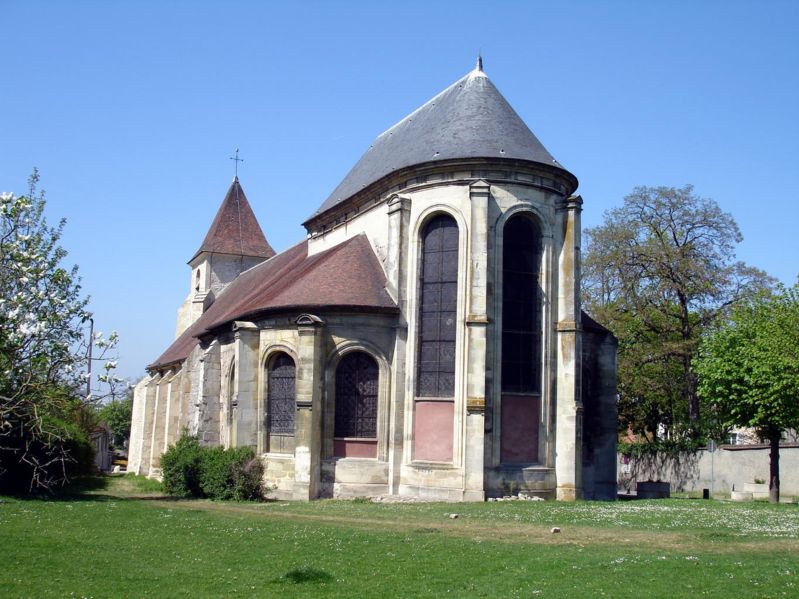
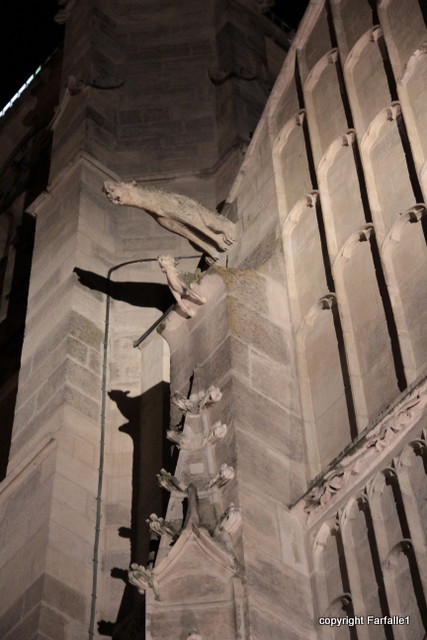
Next door to Chez Cri-Cri is the elegant little gem, Saint Eloi.  It was built around 1650 on the site of a 12th century church which itself was built atop the remains of an ancient shrine (7th – 10th century).

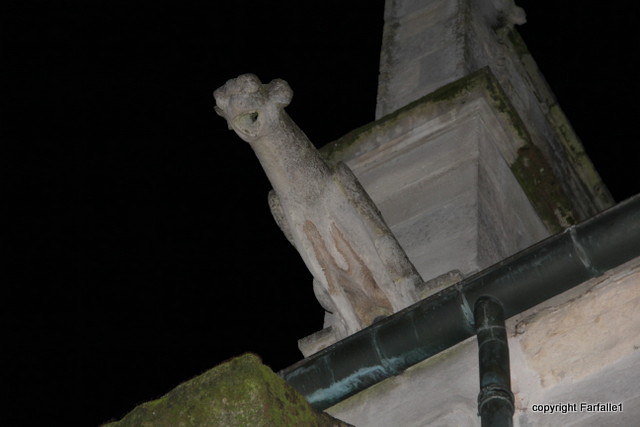
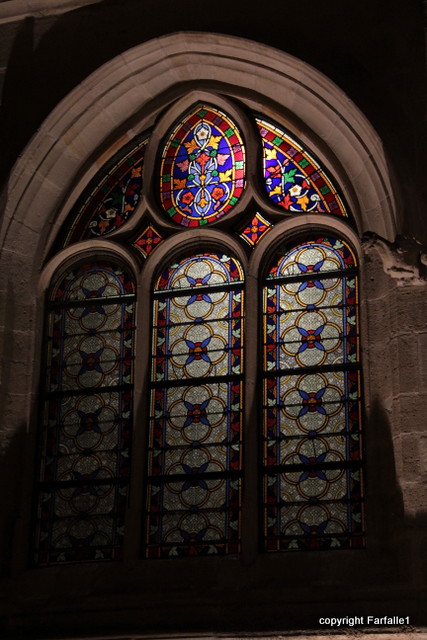
As you can tell, we were there at night, so we were unable to get inside to see the 16th century restored stained glass windows from the inside (restored in 1984), the organ (acquired in 1989 by the municipality – thank you CDG) and the tombs of   Jehan Sauvage and his wife Perrette de Thyois:

Photo courtesy of Clicsouris

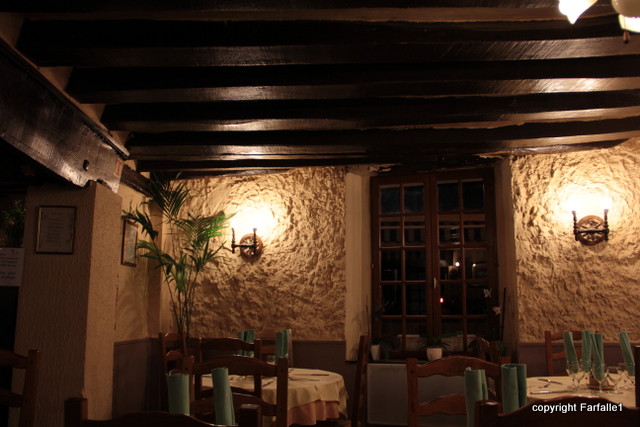
Across from our hotel we found the seemingly charming restaurant Pomme d’Or:

Under different management it would have been a pleasure to eat there.  The hostess was barely polite; she gave us food because she was obliged to.  When, for instance, I asked her how old the building was she said she didn’t know.  Nonsense.  She said I could photograph inside the restaurant, but couldn’t take her picture.  Fair enough.  So I took this picture of our chicken cooked in beer, which sounded heavenly:

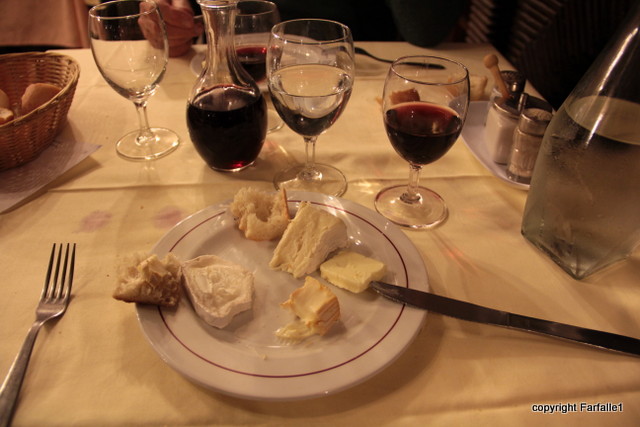
The farfalle were overcooked and completely cold.  The chicken was tepid.  Let’s just say it wasn’t the best eating-out experience we’ve ever had.  They put together a nice cheese plate for dessert, though – hard to ruin good French cheese:


As Speedy said, next time we layover in Roissy we’ll eat in one of the hotels, since Cri-Cri doesn’t serve dinner.  Too bad, because the locals hang out there.

We chatted briefly with this gentleman; what he really wanted to know was how old Speedy is.

Last time we passed through CDG it was a madhouse; there was practically grid-lock of passengers and luggage trying to navigate the terminal.  There was none of that this time.  For whatever reason everything seemed to be working very well.  We had made a point of avoiding the airport because of the crowds and hassel, but having discovered the delights of Roissy-en-France and finding the airport more efficient, we’ll be sure to pass through again.

Autumn

Tags

,

The cold winds blow, the rain lashes the pavements, umbrellas blow inside out and look like scary black tulips.  What to eat, what to eat?

Pizza!

Our neighbor very likely delivered this wood, which will soon be fueling a pizza oven. He works like a demon cutting and splitting wood, and then delivers it to pizzerie all over town. As you probably know the big domed ovens carry an outer ring of firewood which brings the temperature very high.  That’s why you can, here anyway, order a pizza and be eating it twelve minutes later.

Ligurian pizza has an almost paper-thin crust, so it’s an easy matter to eat a whole one oneself.  The only hard part is deciding what to have on top – so many choices, and each as yummy as the others. At this time of year a lot of them feature fresh mushrooms.  My last pizza was called ‘Inferno:’ fresh mozzarella, gorgonzola, tomato, and, supposedly, hot peppers.  I didn’t taste a shred of heat – but it was a fabulous pizza nonetheless.  Alas I was without a camera, so I can’t show you how beautiful it was.

Speedy and I are leaving shortly for the U.S. of A., so Expatriate will be even more dormant than usual for the next little while.  But I’m looking forward to posting again soon from the wild world of coyotes, gila monsters, hummingbirds, the Arizona Cardinals and golf nuts.

Revisione

Tags

,

For all the ways that life in Italy seems different, there is one thing that is absolutely familiar – vehicle inspection.  That’s kind of surprising, given how many layers of administration there usually are to the simplest of tasks in this bureaucratic nation.  But getting the scooter inspected proved to be very simple.

The first step, of course, was to stop in at our mechanic Simone’s shop so he could give my bike the once-over for any glaring deficiencies.  He felt everything was okay, but encouraged us to tell the examiner that he was our mechanic if there were a problem – we presume that would have eased whatever might have followed.

In the event, it wasn’t necessary as the scoots passed with flying colors.

They check all the same things here that they check in the U.S.: lights (luci), brakes (freni), suspension (sospensioni), play in the steering mechanism and the chassis (prova gioca and prova deriva), emissions test (analisi gas di scarico) and finally a visual inspection (ispezione visiva) and in pretty much the same ways: there’s the spinning doodad for testing brakes:

and the pokey thing that goes in the tail pipe:

So all in all, it turned out to be not terribly interesting in terms of being ‘different’ – but it’s always fun to visit any Italian office and jaw with the people there.  Here is Speedy discussing this and that with the very cheerful and helpful Francesca:

And wait – there are a few differences.  In Arizona we simply drive up to one of the Testing Stations (after first looking online to see how long the wait might be – always short where we live).  Here we had to call about a week ahead to make an appointment.  To our great satisfaction we didn’t have to wait at all; they were expecting us.

The testing stations in Arizona are rather large; they have to be to accommodate some of the giant trucks that come through.  It’s a tight squeeze for a car to get into the entrance of the Rapallo site (top photo), two 90-degree turns are required.  No 4 X 4’s here, please (although presumably there are other testing stations for all the trucks we see on the roads).

Here’s another difference: cost.  In Arizona we pay $27.75.  Emissions testing there is tied to auto registration: both have to be done every two years.  Everything but the actual emissions test itself can be done online.  It cost us €65.50 (about $85 given the present exchange rate) for the revisione of my scooter, which is also good for two years.

But all in all, it’s one of the simplest of bureaucratic tasks that we undertake here, and the people at the testing center (Francesca and Paolo) are kind and efficient. Here’s a strange fact of automotive life in Italy: you have to be a legal resident here to own a vehicle of any sort.  As a resident of another country you can own a house, but you can’t own a vehicle.  Isn’t that odd?