The Vagabond Niece

Tags

, , , , ,

The education we began with Wijnand Boon (see last post) continued recently with the visit of our grand-niece Katie and her friend Molly.  We were their last stop on a three-month tour of Eastern Europe (Germany, Poland, Romania, Bulgaria, Serbia, Bosnia, Croatia, Hungary, Slovakia, Turkey).  Like Boon they are back-packers, but unlike him they use public transportation, having been on boats, planes, trains, buses and one hot-air balloon in the course of their journey.  They looked like giant turtles when they arrived, with large packs on their backs and small packs on their fronts. I felt we were their half-way house between the uncertainties of a foot-loose life and the restrictions of life and work back in the States.

There is a saying here that Americans live to work, but Italians work to live. We felt that Katie and Molly exemplify the Italian approach to life.  They love to travel (this was not their first long-distance odyssey), but they need cash to do so.  Katie is a physical therapist and works short-term contracts to support her travel habit.  Molly left her former job in PR just before this long trip, and will shortly be taking a position teaching English in South Korea for a year.

What astonishes me, certified old fart that I am, is the flexiblility, openness and trust with which these young women approach life.  Certainly they both come from great privilege, having grown up in the U.S., been carefully cared for and educated (albeit with wretched student loans outstanding), as I assume Boon was in the Netherlands.  It gives them a passport to satisfy their curiosity, a passport not held by others less fortunate.  They also have the advantage of being English-speakers.  Is it not wonderful that they not only throw open their arms and embrace whatever comes their way but also go out of their way to seek the unknown?

Like anyone living in Italy we have our share of visitors (and very welcome they all are).  Frequently they arrive with various requirements – can’t eat this or that, don’t like this or that, must see this or that – and that’s no problem.  Our recent vagabonds, though, took what came their way, eating anything, were up for any activity suggested, but not asking for any in particular.  I suppose it’s an easiness that can come only with  a lot of time.  If someone is traveling for two weeks he might not want to spend five days sitting on the terrace of Casa della Palma!

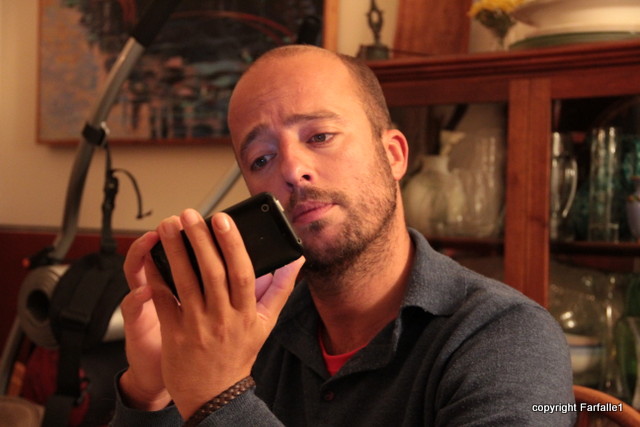
Speedy and I were interested in their approach to travel.  Rather than going to places to ‘see the sights,’ they planned  part of their itinerary around good hostels.  Once in situ they were still not eager to wear out their shoes visiting all the must-see places noted in the tour books.  Instead they enjoyed hiking in the countryside, watching the daily life around them and meeting new people.  (Speedy mentioned that in the days of the Grand Tour one traveled to see art, monuments and so forth and tried very hard not to interact with people other than of one’s own nationality or class.  They’ve turned this notion on its head.)  In every port of call Katie and Molly made new friends.  They received extraordinary generosity in London and in Bosnia.  And having found new friends they keep in touch with them on their miraculous iPhones (they do everything on those phones.  Molly, from a hostel corridor, even had a job interview with someone in South Korea  on her iPhone.)

Perhaps it’s the interconnectedness that makes the world seem  so much more approachable.  Boon could couch-surf using the wi-fi at the Frigidarium ice cream shop in Rapallo to find a bed 100 km away; my niece could chat with her parents in the States, buy her train tickets (no need to pick them up, just show the ticket-taker the phone screen), and arrange a hostel stay, all from her little iPhone.

Suddenly these young people have showed us a very different world than the one in which we’ve lived, a world in which connecting to strangers is common currency, in which strangers are met with interest and curiosity rather than caution.  I asked if there were lots and lots of people hopping around the globe the way they are.  “Yes!” they said, “and most of them are Australian.”  The part about the Australians might not be strictly true, but it does seem that young people are no longer as constrained as earlier generations have been.  Jobs are more flexible (if harder to find), travel is easier, staying in touch a cinch.

Not that traveling the world is new; it probably began about the time we traded in our fins for feet.  Nomads do it to find food, some religious persons do it to spread their word and as a form of praise, gypsies do it as a matter of course, hobos do it of necessity.  (Even Speedy took a two-month vacation trip when he was in college, touring Belgium, France, Italy, Switzerland, Germany, and Holland  on a motorcycle and making new friends.  Then he took his wanderlust as an occupation.)  What is wonderfully new to me is that a pair of ‘unaccompanied’ young women can safely travel to unknown places.  This was rarely done in times past, I believe.

There is something very special about a wanderer, something that speaks to the unheeded wanderer in each of us.  It’s the feeling that Chico, of the aforementioned Frigidarium,  had when he met Boon and felt he was in the presence of someone of immense calm, someone fascinating, someone whom he actively wished to help.  These young people are answering a call we must all feel at some level at some point in our lives, but which most of us have learned to ignore.  (We like our couches! ) Because they are answering the call for us, we want to help in any way we can.

Still, even our vagabonds have to go ‘home’ to roost from time to time (and how nice for them that home awaits).  What a joy it was for us to be the Half Way House for a few days, and to continue our own education into the ways of this new, smaller world.

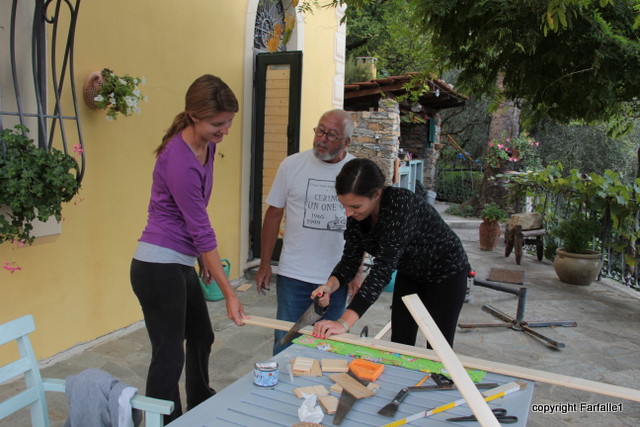
Katie and Molly help Speedy with the great door project

Boon

Tags

, , , , , ,

Couch-surfing. I’d never heard of it until a short time ago and based on the number of members of the couch-surfing web-site, I am the last person on the planet to have heard of it.  We are not members of Couch-Surfing, but Wijnand Boon of the Netherlands is, and we were privileged to meet him a couple of weeks ago.

Here’s how it came about.  I happened to check the e-mail for this blog, something I do faithfully at least twice a month, and there was a note posted earlier the very same day saying, basically, help!  I’m in Rapallo, the weather is terrible, I can’t find a place to pitch my tent, is there anything you can do to help.  Well, it was 11:30 at night and raining pitchforks, with thunder and lightening to liven things up.

I would like to tell you that I got in the car and drove into town to find the hapless writer of this e-mail, but I didn’t.  I said to myself, too late, too late… and I went to bed, albeit with a large measure of guilt under my pillow.  I did write and say that I had only just found the message and I was sorry I was too late to help.

The next morning I was still feeling unhappy about neglecting a request from an unfortunate visitor to Rapallo.  How happy I was to receive a note from Boon, for it was he who had written, saying that he’d found a wonderful room for the night after all, but he could surely use a place either to sleep or pitch his tent for the next two nights.  Long story short he came to stay with us.  The guest-room was already overflowing with nieces, but Wijnand was happy to stay on the futon downstairs, and I think (I hope) he was comfortable enough.

He is traveling by foot from his home in Leiden, Netherlands to Cairo, Egypt.  The purpose is two-fold.  He began his 6,000 mile walk in reaction to a speech by Dutch Queen Beatrice on Christmas Day, I believe 2009, in which she spoke of social media as alienating people from one another.  WB begged to differ. He is making his journey to prove that social media connects us all on the very basic levels of necessity.  Using only social media such as Facebook, Twitter, Couch Surfing and people’s blogs he is finding places to stay along his route and making friends and connections every step of the way.  Social media is liberating, as he is proving, not alienating.  It can take a fair amount of effort (especially in suspicious old Liguria) and sometimes he needs to contact a few people before he makes a good contact.  But so far he has had almost nothing but success.

Some time after WB began his long trek  he was contacted by the good people at Masterpeace who are building towards a giant Peace Rally on September 21, 2014.  Like WB, Masterpeace wants to use social media to bring peace-loving people together, literally and virtually, and to promote world-wide activities focused on peace.  They asked Wijnand if he would walk for them, and he agreed. (You’ll find their logo at the bottom of his page, as well as the logo of Mammut, the Swiss boot-maker, who are his only sponsor and whose hiking boots he happily wears.)

Though Boon’s web-page says he is ‘walking 6,000 miles with only an iPhone and a guitar,’ he actually does have some other gear, such as clothing (!), a camera (a gift from one of his hosts), a tent and other necessities for living on the road.  He carries this all on an ingenious two-large-wheeled cart; it has handles which he can use to either push or pull, as well as a harness he can strap on for hands-free pulling.  It comes apart so it can be stuffed into the boot of a small car.

But don’t let mention of a car make you think that WB has ‘cheated’ on even a step of his journey.  He was able to come up to our house on the bus and take a ride down two days later in the car, but that was a side journey.  He has walked every step of the way from Leiden, through Portugal, Spain and France and is now working his way down The Boot towards Rome.  (You can find a map of his route on his web page.)

We are so happy to have met him.  While we don’t see eye to eye on many things (role of government, paper money, oh just all sorts of things) we had a fine time discussing them and trading thoughts.  Most refreshingly, we were able to disagree in a completely civil and respectful manner.  And that is part of what Wijnand Boon’s trip is all about – mutual trust and respect. A man of many talents, Boon entertained us with his guitar playing and singing one of his own songs (‘The Knowledge of You‘).

For old farts like us, the idea of trusting a complete stranger in our house (especially with lovely nieces thick on the ground) is a long shot.  We were able to do it to a point, and I think (I hope) we learned a lot from the experience.  Boon travels with an unwavering faith in the goodness and generosity of  people.  In two years, he says, he has had not one bad experience. I’m old and cynical enough to just shake my head and hope desperately that nothing happens on this odyssey to discourage him.

And speaking of being old and cynical… the whole notion of couch-surfing seems extremely foreign to us.  The idea of simply throwing open our doors and making up the futon for anyone who needs a bed is just… well… unthinkable.  And yet social networking seems to be making a success of such ideas.  It is, I suspect, mostly young people (20’s, 30’s?) who couch surf on both sides of the transaction, but maybe I’m wrong.  In any event, it is people who are willing to trust their fellow-man unreservedly.

Back when we were young in nineteen-mumble-mumble it seemed like we had a great deal to teach the world.  All of a sudden it seems like maybe we have a great deal to learn.

Thank you Wijnand Boon for beginning the lessons so gently.

Wijnand Boon making new friends

Crackers!

Tags

, , , ,

No, we’re not crackers, at least not yet.  But we do love to eat them with our late afternoon snack with salami (Speedy) and  cheese (Fern).

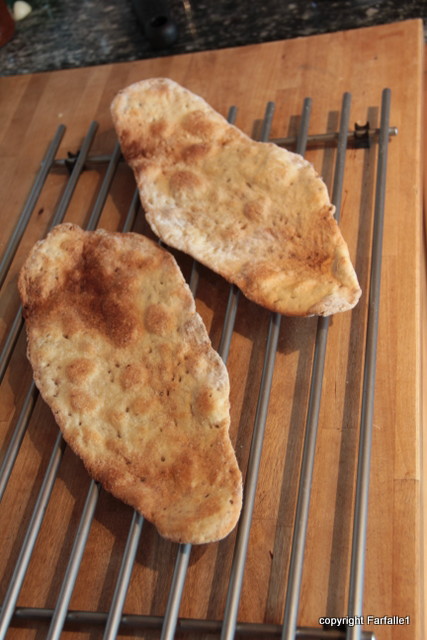
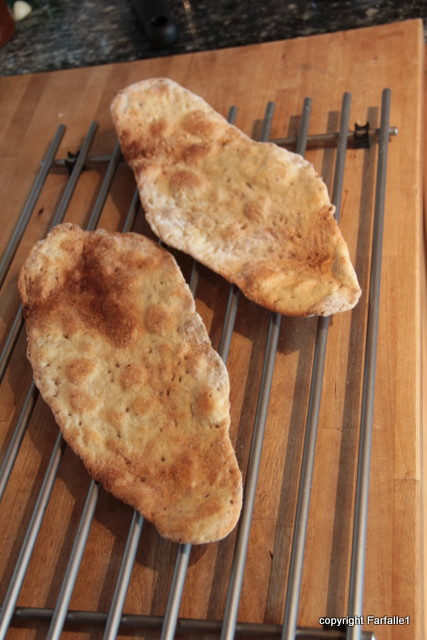
Not long ago we discovered at our local bakery an absolutely delicious, crispy cracker which they call ‘krick-krock’ and which are known throughout Italy as lingue (tongues) for obvious reasons:

Say ‘Ahhhhhh!’  The problem is they are rather expensive, at least when one eats them in the quantities that we like to.  What to do?  It didn’t take Speedy long to break the code on how they’re made.  Does it take a bit of work?  Well, yes.  Are they easier to produce with four hands than two?  Yes, but not at all impossible with only two, Speedy can attest to that.  I guarantee they are worth the effort – you’ll never want another Trisket or Saltine after you eaten these crackers (I just can’t call them ‘Speedy’s tongues’ – it sounds troubling).

Here’s the recipe Speedy developed.

First, make a starter (called a ‘biga) by dissolving

1/3 tsp yeast in
1/2 cup warm water
to this add
enough white flour to make a slurry (think library paste)

Let the starter age anywhere from 2 hours to 24 hours – it lives to serve you.

When you’re ready to make the dough dissolve
1/2 tsp yeast in
1 Cup warm water (or, better yet,  1/2 Cup warm water, 1/2 Cup beer)

when the yeast is dissolved stir in
your biga
2 tsp salt
1/4 Cup olive oil
1/3 Cup whole wheat flour
1/3 Cup corn meal
enough White Flour to make a stiff dough (2-3 Cups)

Cover and let rise in a warmish spot for 2-3 hours.

Pre-heat oven to 500. (!)

Knead into the risen dough
2/3 Cup crumbled rye bran

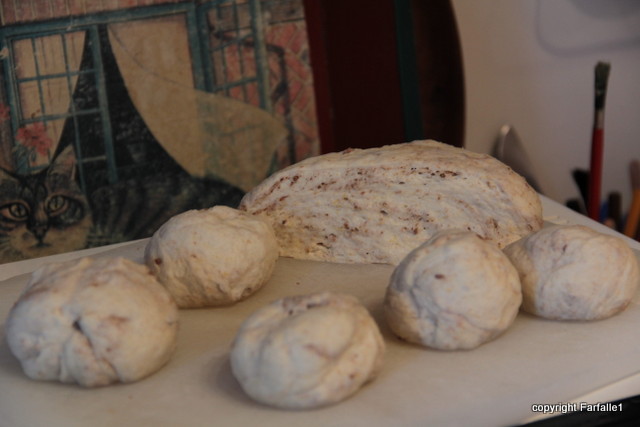
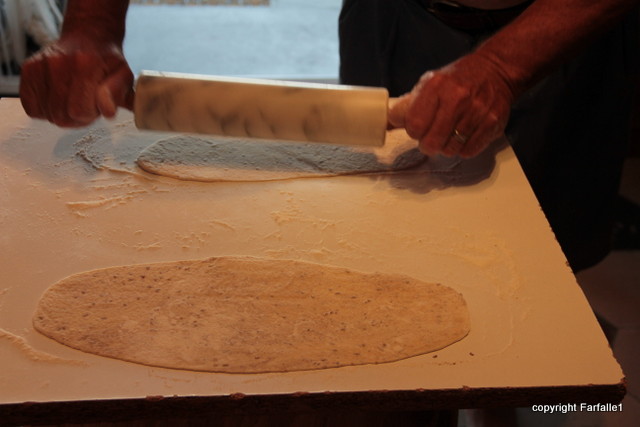
Break off a knob about the size of two extra large eggs, and roll out on a well-floured board to desired thickness (1/8  inch isn’t so bad) in the shape of a long thin tongue.

Transfer the tongue to an oiled baking sheet, brush with olive oil and salt to taste (we use a lot of salt because we love our crackers salty) and put on the top rack of the oven.

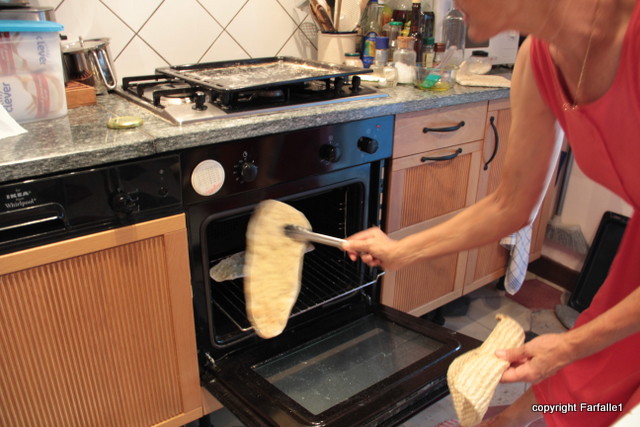
Keep an eye on them!  When they just start to take a little color pull the pan out and use tongs to flip the tongues over (no need to oil or salt the other side).

Pop them back in and keep a watchful eye.  When the top again begins to brown pull them off the baking sheet with tongs and place them on the bottom rack of the oven to dry out a bit, finish cooking and get crispy.  Keep an eye on them, this step doesn’t take very long.  You can be rolling out and baking the next lot while the first ones are on the bottom rack.

When they’re done put them on a rack to cool.  They keep very well in a plastic container for as long as you can keep from gobbling them up (we use an ancient Tupperware cake saver).  Just break them into the size you want and enjoy.

I know it sounds like a fair amount of work, but the results are very much worth it; you won’t be sorry.  Even if they get a little over-done on the bottom rack they are still delicious.

Buon Appetito, and please pass the beer!

Smoke!

Tags

, ,

The other day I found an empty cigarette pack along the path.  What struck me immediately was how bold the health warning was:

You probably don’t need a translation, but just in case: it says Smoking Kills (literally it says ‘the smoke kills’ but we know what they mean).  This is the message that an Italian smoker will see every time he flips open his pack to take out a ciggie.

It’s been a long time since I smoked.  I remember the rather tepid warnings that the Surgeon General  placed on cigarette packs in the U.S. some years ago.  Are they different now than they used to be?  Nope.  Here’s the sissy warning a U.S. smoker may or may not take note of each time he lights up:

First, it’s on the side of the box where it’s much less obtrusive.  Second, though it informs us that dire diseases are the caused by smoking, there’s no mention of the ultimate price: death.

Not content with simply telling us that cigarettes will kill us, the Italian packs go on to tell us how on the back:

Fatal lung cancer.  There.  Just in case you were in any doubt – your lung cancer will be fatal.  Smoke these things and you will die sooner than otherwise.

So are all the warnings over the top?  It turns out the answer is a resounding no.  Smoking is enormously costly, in terms of money and of life itself.

Infosearchlab.com reports that more than 443,000 people in the U.S. die annually due to cigarette smoke.  Of these deaths, 50,000 are caused by passive (second-hand) smoking.  In China, 2,000 people die of smoke every day – 1.2 million a year.  According to the Corriere della Sera,  70,000-83,000 Italians die every year due to smoking, which works out to about the same per capita number of deaths annually as the U.S.

It’s such a difficult question, isn’t it?  To what point should a government intrude in the behavior of the citizens?  When does a vice stop being something personal and become something public?  I guess given the prevalence of smoking and the expense of caring for all the people it makes sick, government intervention is advisable.  To paraphrase an old nostrum about punches, your right to smoke ends where my nose begins.

An interesting side-note that Speedy mentioned: as recently as 2005 tobacco companies in Italy were mostly owned by the government.  In an Alice in Wonderland twist, the government was promoting and profiting from the sale of cigarettes at the same time they were instituting dire warnings on packages and limiting where people may smoke.

How much warning is too much?  Clearly the Italians are giving a much harsher warning than the Americans.  Recently a U.S. court of appeals found that a Washington DC lower court’s ruling that graphic warning images must be put on cigarette packs violated Corporations’ right of free speech.  (Don’t get me started on ‘Corporations are people.’) The issue was whether the tobacco companies should be required to put images of things like a man breathing through a hole in his neck on the cigarette packs.  The first court said yes; the appeals court said no.  Supreme court, anyone?  The World Health Organization says that pictures are effective deterrents.  Australia has gone to the extreme.  Beginning in December they old familiar cigarette packaging will be gone, replaced by gross graphic images like this:

Photo courtesy of cbsnews.com

How to reduce the number of people smoking in places like the U.S. then, if you can’t require that disgusting pictures be put on each pack?  High taxes is one way.  According to Huff Post this is the route Indiana has taken.  Placing a minimum price on a pack of cigarettes is another (the theory being that people will not be able to smoke as much if they can no longer buy cheap ‘off’ brands).  This is the approach Italy has taken (with some amount of EU difficulty), though there’s  debate about whether or not this approach is effective.

So how much does it cost to smoke?  Prices have sure gone up since I used to put .35 cents in the vending machine in the basement of my college dorm (it was right next to the candy bar machine, making for a complete, if not well-balanced, meal).  That depends upon where you live.  If you’re in West Virginia you can support your habit for $4.84 a pack.  But if you live in New York the same pack will cost you $12.50.  Here in Italy cigarettes cost about E 5 a pack, about $6.

Do Italians smoke more than Americans?  According to the WHO again, 25% of Italian males aged 25 and older are ‘current smokers.’  In the US it is 34% for the same demographic.  19% of women in both countries aged 15 and older are’ current smokers.’  And we won’t even discuss China.

Our own observations suggest that there is a lot less smoking here than there used to be, though we still see both men and women zooming around on their scooters with a fag clutched in their teeth. And it seems that a lot of young people smoke – I guess it’s still considered cool.  Smoking is not allowed here in any public building – no such thing as a ‘smoking section’ in a restaurant.  If you want to smoke, step outside please.

They say there’s nothing worse than a reformed smoker for being anti-smoking.  As a former 2-pack a day person I guess I qualify.  Here’s the thing though – while I may deplore the fact that smokers cost all of us huge amounts of money every year, and while I will run as fast as I can to get away from your smoke, I’ll never blame you if you’re a smoker.  I remember all too well how much I loved smoking, how it was woven into the fabric of my daily life, and how almost impossible it was to quit.  I still miss it.

Bucket or Bellyful?

Tags

, , , ,

(Click on photos to get larger, clearer images)

It’s been a fiery summer in both Europe and the U.S.  We’ve had our own little bit of excitement here in San Maurizio, although nothing on the scale of the tragic fires in Spain or the numerous fires in western U.S.

It began Thursday.  Speedy was home reading in the afternoon, and noticed there seemed to be a lot of helicopter traffic.  He had a look around, and this is what he saw on the hillside behind us:
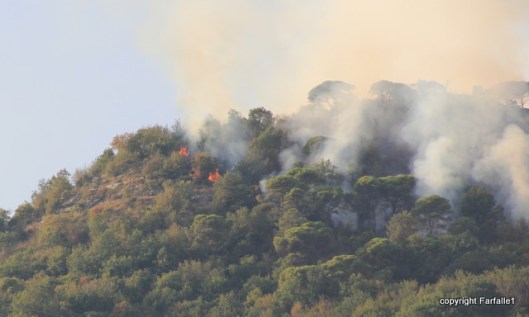
Photo by Speedy

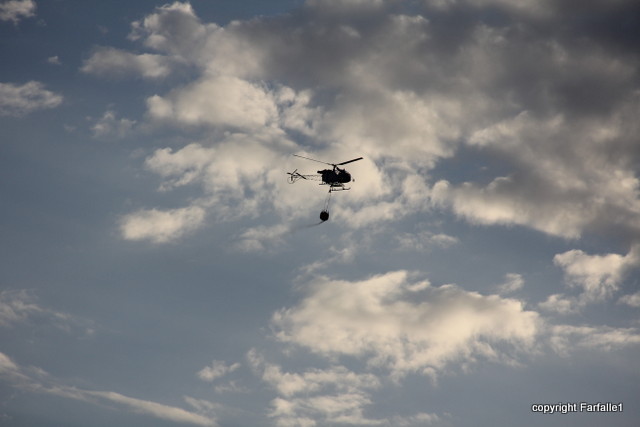
He kept track of the action all afternoon. First the wind blew to the east, then it swapped around and blew to the west. Two helicopters carried countless buckets of water to dump on the stubborn fires which, instead of going out, seemed to simply move on to another shrub or tree.  With so many individual fires we wondered if this were arson.  We don’t know, but we have been told the cause of the blazes is under investigation.

The ‘copter pilots are real sharp-shooters with their water buckets.  I wondered, though: as they move slowly to a position above their target fire, do the rotors fan the blaze and undo some of the good the water is doing? In any event, they do some demanding and amazing flying and, more often than not, their bucketful of water lands right on the selected target.
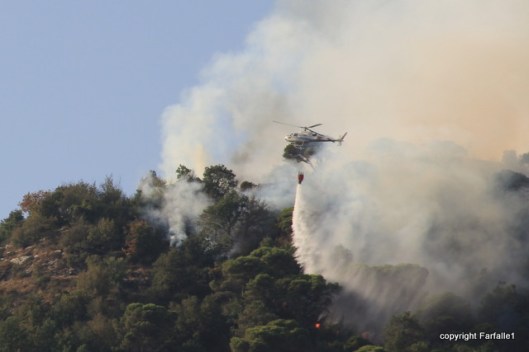
Photo by Speedy

The thing is, it looks like such a teeny amount of water – and so much effort is required to get it to the fire. It’s hard to imagine that it’s effective, but it is. By the end of the afternoon it looked like the fire was largely under control. The helicopters don’t fly at night, so it was good to see that the flames were out.

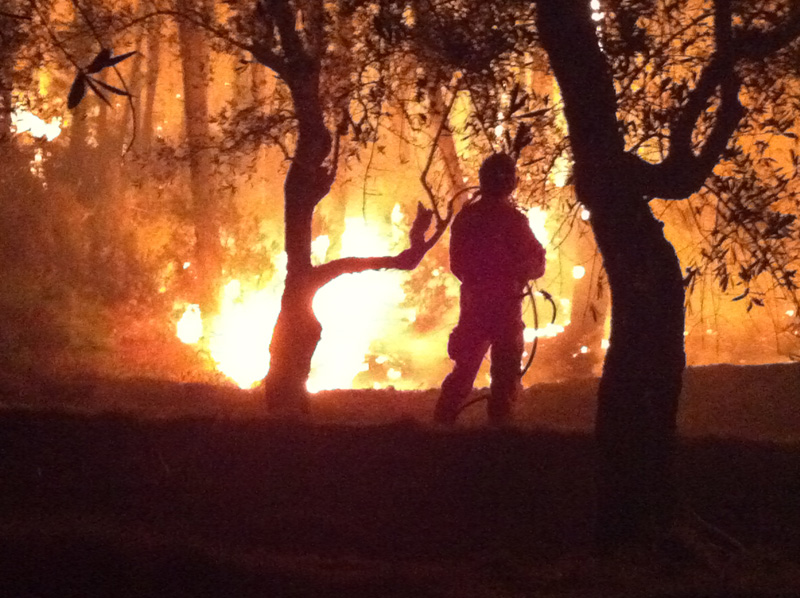
Or so we thought. I woke up at 3 a.m. and looked at the mountain to see it all ablaze again. This was disconcerting, and instead of going back to sleep I spent the rest of the night tossing, turning, and making a mental list of things to put into a box to carry away should it become necessary. Speedy spent his wakeful hour using GoogleEarth to compute how far the fire was from us. According to his calculations it was about 750 meters from our house as the cinder flies. It was less than 300 meters from the restored rustico of some friends. That’s too close!

Fortunately my list of what to pack was unnecessary. And the reason why is because, unbeknownst to us, there was a legion of volunteer firefighters  (Vigilanza Antincendi Boschivi) on the ground, not only that night but during both days of the fire. It turned out that one of our acquaintances, who is too modest to allow me to use his name, is one of these volunteers, and he was able to give me some useful information.

Photo courtesy of vab-arcetri.org

The Corpo Forestale is in charge of organizing the fighting of fires outside of cities and towns. They decide which aircraft will be used (if needed) for each fire, and where and when the volunteers will go. There are two sizes of helicopter (ours was the smaller one) and the famous bright yellow Canadair airplanes (about which more shortly). The small helicopters carry what look like rather small buckets of water, though our friends says that when the water is mistakenly dumped on the volunteers it does not feel like a small bucket. The Canadairs carry a belly full of water, much more than the small buckets. We were told that the larger helicopter carries even more water than the plane, but we’ve never seen one. There are fires that don’t require aircraft, but forests in Italy tend to be on steep mountainsides; more often than not a plane or helicopter is the only way to get water to the fire.

The volunteers often work more on fire containment than actual fire-fighting; our friend said, however, that they did both with this particular fire. They hump in some heavy equipment and somehow manage to keep the fire from spreading. That is why, on Thursday night, the fire burned up the mountain instead of coming down towards the houses below and why, even though I watched, and heard, tree after tree go up in flames, the fire slowly abated so there was less of it as the sun came up. Thank you, VAB volunteers!

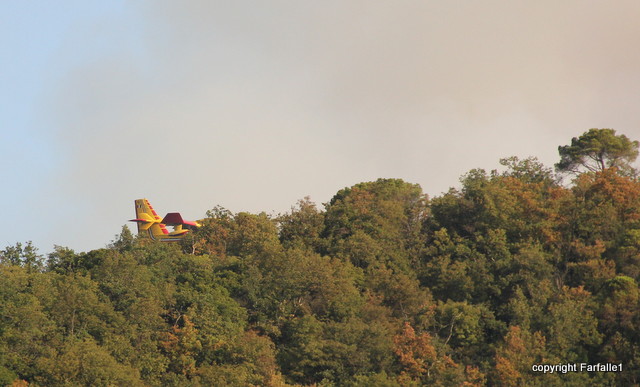
Daylight brought us a Canadair.

It is so exciting to watch these planes fly. They swoop down over the sea and fill up the plane’s belly with water, which they they carry back to the fire and release. There are moments, watching them, when it seems certain there is going to be a terrible mishap.

They use the plane’s inertia to propel the water where they want it to go. The pilot might, for instance, fly right at the side of the mountain, nosing up abruptly just before hitting, and releasing his water at the same time. The water goes straight into the mountain, and the plane, thank goodness, does not. Other times the pilot is able simply to drop his water as he goes (watch out, volunteers below!). Retired old pilot Speedy says it is no doubt very scientific, that the pilots are able to compute when to release the water based on air speed and altitude above target.
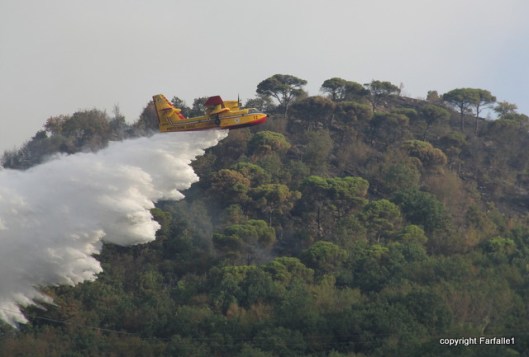
The Canadair, joined briefly by a second, grey plane, flew back and forth all morning. After lunch one small helicopter came back, and by the end of Friday it seemed the excitement was over. Our friend said he had been called to go back Saturday, but we saw no activity at ‘our’ fire. Perhaps he was out putting out other fires. Sadly, there’s no shortage of them at this time of year.

There are some more photos of the fire here, and I tried, for the first time, to make a video, which you can see here. (Sorry that it’s a little wobbly – next time I’ll use a tripod.) The most exciting part of the video is that you can hear the cock who can’t tell time (1 a.m., dawn, sunset: all the same to him), you can hear the loud sound that water meeting fire makes, and you can hear a short conversation between Speedy and myself. Very exciting. Unfortunately you won’t see the plane actually dumping water as that happened behind the mountain – but you can hear it (as well as the lovely low grumble of the twin engined plane).

The systems the Corpo Forestale have developed for fighting the numerous fires in Italy are admirable. The timely arrival and expertise of all the firefighters has surely saved millions of euros over the years (although the cost of fire-fighting with aircraft is extraordinary.  The small helicopter, the 412, costs E 2,200/hour; the larger, the Ericson S64, costs E 7,000/hour and the Canadair costs E 10,000/hour.)  What did they do before airplanes were invented? I suppose lots more forest burned. How lucky we are that we have helicopters with their little buckets and planes with their great big bellies. Given the choice, I guess I’d always choose the plane, just for the drama. But there’s an elegance to the helicopters, and a delicacy of approach which is also very appealing. Actually, I guess if my house/land were on fire I wouldn’t care who came, as long as he brought a lot of water with him!

La Cervara

Tags

Photo from helicopter courtesy of http://www.parks.it

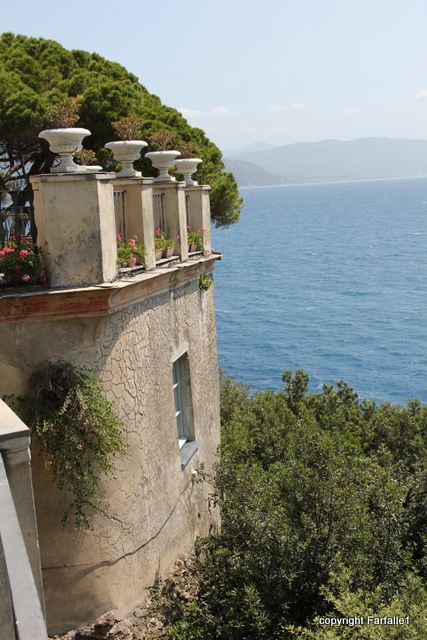
Monasteries in Italy have had a tough time of it.  La Cervara, a monastery constructed in 1361 which sits above the road between Santa Margherita and Portofino, is no exception. When France invaded at the end of the 18th century the monastic orders here were suppressed and the resident Benedictines had to abandon La Cervara.

The monastery has been in a state of loving rehabilitation since 1990; the present owners report that the work is 50% complete.  It’s hard to believe there’s as much to do as has already been done.  It looks perfect to the casual visitor.  In fact, when a friend and I recently took the tour I was reminded of nothing so much as the exquisitet restorations that one sees all through Tuscany, and which are not as common here in Liguria.

The first building was erected by Ottone Lanfranco, a Genovese priest, on land owned by the Carthusians.  Around 1420 ownership was transferred to the Benedictine order, who stayed until the above mentioned troubles.

As was the case for Montallegro, bad weather played a role in La Cervara’s history.  Pope Gregory XI was returning the papacy from Avignon to Rome in 1377 when a tempest arose, and his ship took shelter in the harbor near La Cervara.  The Pope rested with the monks there for a while, and got to know and respect them.  Upon his return to Rome he showed favor to the monastery, eventually elevating it to the status of Abbey.

The monks at La Cervara were not uneducated simple men; rather they were cosmopolitan, well-traveled and worldly wise.  La Cervara was a prestigious abbey and its inhabitants, usually about twenty in number, were frequently looked to for counsel in the great houses of Genova and throughout Europe.

The 15th and 16th centuries were the high points of La Cervara’s history. More buildings were added to the complex, including, in the 16th century, a tower from which to watch for the raiding pirates from Africa, those pesky Saracens.

In 1525 poor  King Francis I of France was defeated by the Holy Roman Emperor Charles V at nearby Pavia.  He was brought to La Cervara where he was imprisoned in a different tower, one with a lovely view looking out to sea.

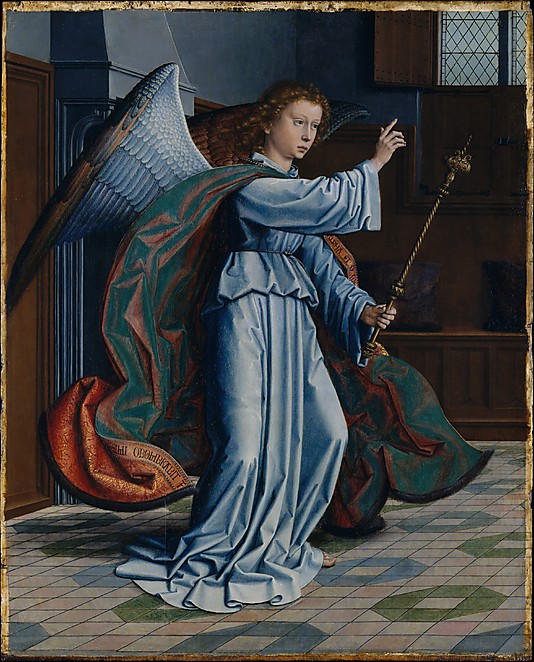
During the suppression, most of La Cervara’s beautiful artifacts and art works were removed.  The Polyptych, painted by Gerard David was separated.  Four panels are now in Palazzo Bianco in Genova, and the other three are in the Metropolitan Museum in New York and the Louvre in Paris.

Image courtesy of the Metropolitan Museum of Art

In the beginning of the 19th century La Cervara again became a religious house, passing through the hands of several orders (Trappists, Somaschi, Carthusians) and eventually it was placed under the Diocese of Chiavari.  Finally in 1937 it passed into private hands.  The first private owner added a long hall and built a grand double stairway and a very large room.  More interested in sport and socializing, he did little to preserve or augment the chapel (but neither did he do any damage).

The present owners have been painstaking in their restoration of La Cervara.  The work has been under the direction of architect Mide Osculati and the art restoration has been overseen by Pinin Brambilla Barcilon, who restored the famous painting of The Last Supper in Milano. A private home, La Cervara is also available to rent for conferences, weddings, parties and the like.  A fortunate friend has been to several evening events there and describes how  the soft candlelight inside echoes the twinkling lights on the coast across the bay.  No electric lights – only candles; it is, she says, ‘magical.’  Her favorite place, she says,  “is the cloister at night with only one single shiny jet of water ….not a big splashy fountain, one single jet is all it takes to create beauty.”  You can see the fountain, elegant and eloquent in its simplicity in two of the photos above. Thank you for sharing that lovely image, fortunate friend!
An example of the care taken in the restoration:  it was thought the original floor of the chapel was ardesia, the dark slate indigenous to this area, because that’s what was there, albeit in deplorable condition.  The architect was reluctant to use that material again because it is so dark.  Further digging  revealed, though, that before the ardesia was put down, the floor had been brick.  Unable to find hand-made bricks that matched the light original color, the architect procured the new bricks from Spain.  They look just right, too.

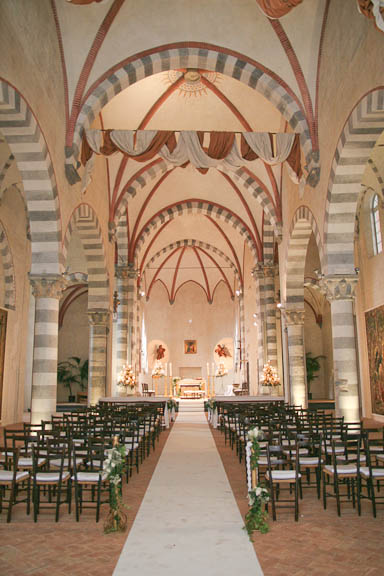
Photo by Roberto Bozzo, courtesy of http://www.fotografi-matrimonio.com

Instead of trying to recreate the missing sacred art in the chapel the owners have installed four enormous tapestries – not religious in theme, but somehow absolutely appropriate for the setting.  You can see just a wee bit of one in the photo above.

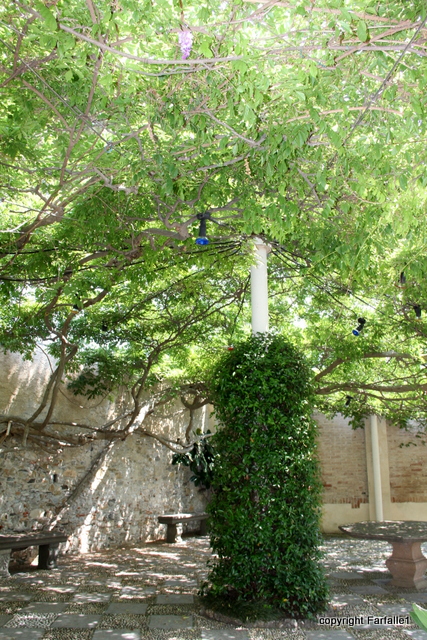
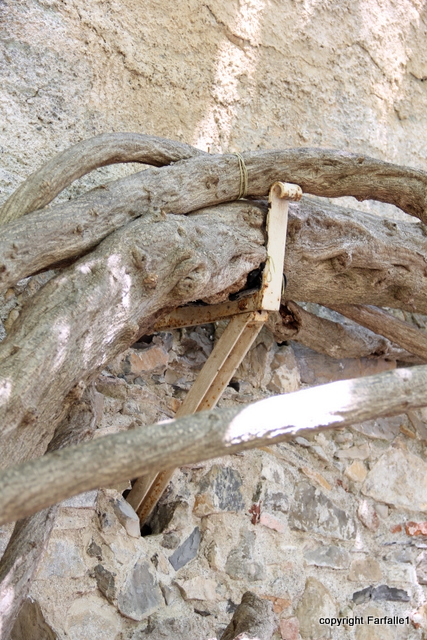
In an extraordinary and successful attempt to save a 150-year old wisteria, the owners used a crane to life the ancient branches from where they had fallen on the ground, one or two inches every week.  It took over a year to get the vine into position, but the wisteria survived and is splendid.

Center pole supports some of the branches, which also grow along the wall on the left.

Ancient branch, now well supported

Unfortunately one is not allowed to take photographs inside the buildings, but the gardens (formerly the monks’ orchard) are fair game.


La Cervara is open to the public on the first and third Sunday of each month  from March through October; guided tours are run at 10, 11 and 12 o’clock.

Pizzo Tombolo

Tags

Photo courtesy of piazzacavour.it

Ah, the old ladies of Italy.  They are in a class of their own.  Once one reaches ‘a certain age,’ it seems, one can go to the front of any line.

We were in a very crowded ice cream shop a while back in Santa Margherita, and a lady of just that age came through and scusami-ed her way to the very front.  Two seconds another lady appeared and announced to one and all, ‘that’s my friend,’ which of course entitled her to move up to the front.  Then came another, then another and another – all with the same excuse – ‘those are my friends.’  Finally Speedy asked, in very good humor, ‘how many of you sisters are there?’  Everyone got a chuckle, the ladies (there were six finally) got their ice-creams and the line began a more organized movement.

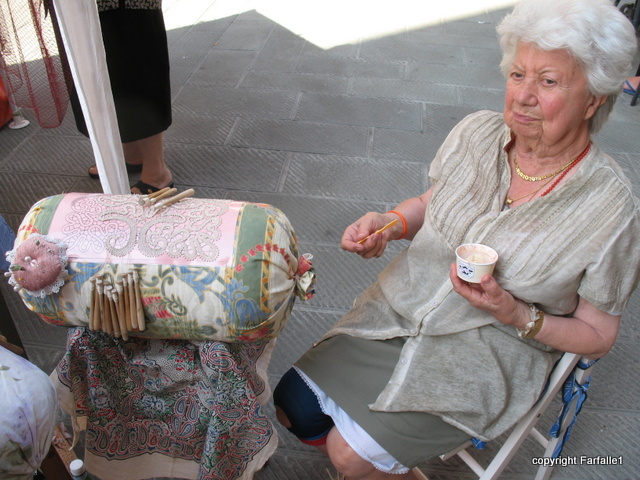
When we went outside we were so happy we had not been grumpy.  All the ice-cream ladies were demonstrating Pizzo Tombolo, an incomprehensible cross between crochet, embroidery and knot-tying.  If you’re like me a bobbin always makes you laugh (that and banana peels on the side walk, sorry, I just can’t help it, they are hilarious).  So I was chuckling away when I approached the group and asked about their work.

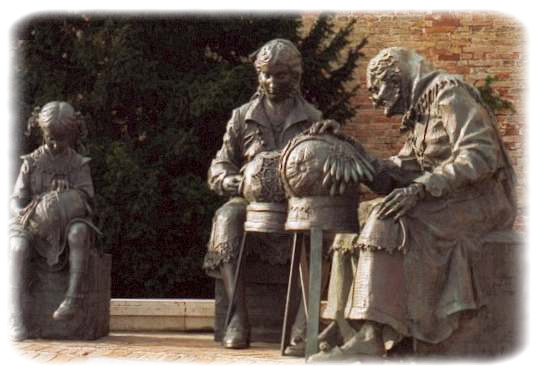
Meet Giuseppina (note the ice cream).  Why she is not blind I can’t imagine.  She doesn’t even seem to need glasses. She is working on a pizzo, also known as ‘merletto.’ The Tombolo is the pillow on which the work is done.

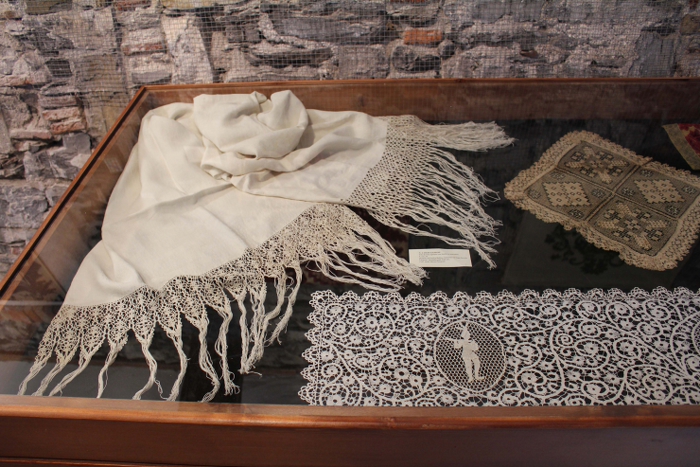
The ancient art of making a delicate and lacy adornment for clothing and furnishings has existed in Rapallo for centuries.   Archaeologists have discovered bits and pieces from as early as the 13th century.  A shop inventory from Genoa in 1600 mentions articles made from ‘filo di Rapallo’ (thread of Rapallo), suggesting that the ornate handwork was well known and appreciated outside the town.

There is a lovely story about how one of the styles of lace-making in Rapallo, known as Bella Nina, got its name.  In the 1500’s the dreaded pirate Dragut made a raid on Rapallo.  All the townspeople fled in terror.  But upon entering the home of a fisherman, one of the pirates who had stayed behind found two women poorly hidden behind a pile of nets.  One was very old and couldn’t move; one was young and beautiful, and was working lace on a pillow.

‘Why didn’t you leave with the others?’ he asked.  The young woman replied that her grandmother was paralyzed and she did not wish to abandon her. When asked their names, the young woman replied they were both called Nina, as women’s names were handed down from mother to daughter.

The pirate asked what the young woman was doing, and she showed him her delicate handwork.  When asked what it was called, Nina said that it had no name, it was just the work that women of Rapallo did.  The pirate was so impressed with Nina’s beauty and fidelity that he said he would not harm either of the women and that henceforth the work she was doing should be known as ‘Bella Nina.’

How is the work done?  I can’t begin to tell you!

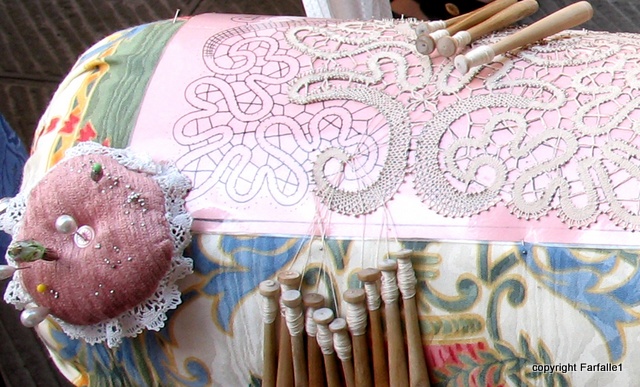
As you can see in the enlarged photo above, Giuseppina attaches a pattern to her tombolo, then uses a million straight pins as anchors for her weaving and knotting.  Now you know as much as I do, which isn’t nearly enough to undertake the craft.  However, if you do want to learn how to do this, you can sign up at the Scuola di Tombolo “Le amiche del ‘Merletto’ in Santa, or, come winter, at the Accademia Culturale in Rapallo.

If you’d like to know more about Pizzo Tombolo, there is a lot of information here and here.

And if you’re in Rapallo and you’d like to see a panoply of examples of Pizzo Tombolo, you can visit the Museo del Merletto.  I’m embarrassed to say I haven’t been there yet, but writing this has aroused my curiosity and I think a visit is order.  I wonder… am I old enough now to go to the front of the line?

Italian at Bronze statue of woman doing Pizzo Tombolo courtesy of merlettoitaliano.it


A(nagrafe) to Zed

Tags

, , ,

Anagrafe (an-ah-gra-fey) is the office in each comune that keeps track of who’s who and the status of each inhabitant: births, deaths, marriages, divorces, that sort of thing.  This is true, it seems, for both Italians and resident expatriates  (Anagrafe issues our Carte d’Identite).  I’m sure they do other things of which we’re completely unaware.

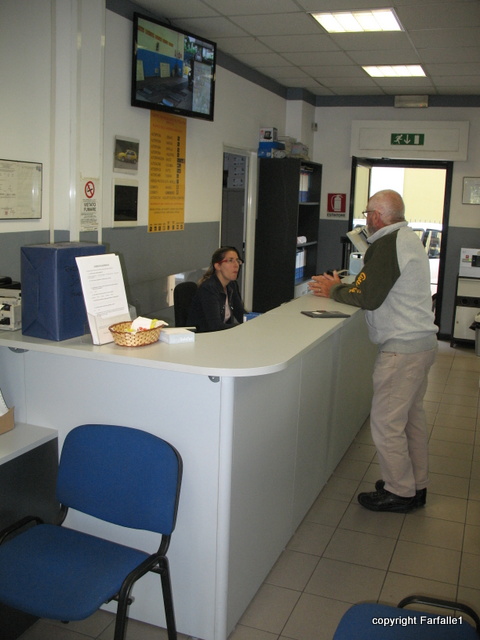
One such thing was brought to our attention last week when we received a visit from the very affable Piermanlio (a roman name, he told us) who spent two and a half hours grilling  interviewing us.  He works for the Statistics Department of Anagrafe (who knew?) and spends a good part of his life traveling from one expatriate domicile to the next interviewing people.  Then he spends some more time transmitting his data to the main office in Rome (without identity information attached) where it is all, presumably, crunched up and turned into important reports of some sort, which in turn lead to enlightened social policies, new laws and more bureaucracy.

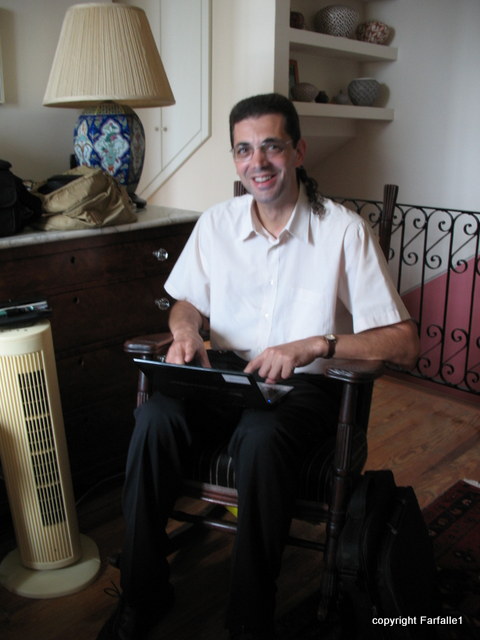
Here are two things you might not be able to tell about Manlio from the above photo:  he is probably one of the most patient and kindest guys in the world; it is hard for him to find shoes because his feet are large.  For this reason he takes exceptionally good care of the shoes he wears. ( I guess that’s three things, but since the last two are so closely related I’m counting them as one.)

The last time the U.S. took the census we won the long-form lottery, and spent about thirty or forty minutes filling in the form with information about our race, gender, education, income and what kind of house we lived in.  Well.  Italy could certainly teach the U.S. something about long forms.

At first we thought Speedy would be the only one interviewed, which was fine by me, as it took ages.  To the surprise of all three of us Manlio was instructed by his computer to interview me when Speedy was done.  What response triggered that, I wonder?  Most of the questions were the same, but there were some amusing differences.    They were all multiple choice questions and all answers were entered immediately into Manlio’s laptop.  If an answer was wildly out of the norm the computer might give Manlio a query sign.  If it was totally ridiculous the system was blocked til a realistic answer was put in.  How do we know?  Speedy answered 8 years old when asked at what age he began working (happens to be true).  Turns out the question meant when he stopped being a student and began to work as an adult.  ‘8 years old’ caused a delicious block.

Here are some of the topics Manlio covered with us during our time together, other than the obvious of age, heritage, race, religion and education.

Do we have relatives living in Italy?  Do we have relatives living outside the US but not in Italy?

In our family, who makes the decisions?  Who does the housework, do we share the burden? Who does the marketing?  Who cooks?  Is it up to the husband to choose who the wife’s friends will be?

Do we like Italian food?  Do we eat it often? Do we eat food of other cuisines?

Are we healthy?  Smoke? Weight? Height? Do we take medicines? (polite Manlio: ‘oh yes?  They’re prescribed, I would assume.’  Us: ‘Of course!’)

Curious omission noted here: no questions about drinking and/or wine!

Do we have a car?  How many TV’s? Motorini?  A video camera? (why a video camera?)  When we watch TV, do we watch in English or Italian or ? Do we have a satellite dish?  More than one?

Do we have a telephone  land line?

Why did we move to Italy?  Who decided that we would move to Italy?  How did mother feel about it (Really!  This was a question for me, the only one of us with an extant mother when we came.)

What language do we use when speaking to each other?

Do we read newspapers, if yes in hard or virtual form? Magazines? Books?  In what language(s)?

Do we follow Italian politics?  Do we talk about politics with friends? Do we feel knowledgable about Italian Politics?  How often do we discuss politics?  Same questions again vis-a-vis the U.S.

What do we do for entertainment: movies? sports? concerts?

I guess one can catch the drift of the kinds of questions being asked and the kind of information they are trying to gather.  There are so many people from all over the world living in Italy now, there’s perhaps not unreasonable concern that the ‘national identity’ might erode.  At the very least there is also interest in knowing if the basic ‘rights’ generally recognized here are being observed by one and all.

I guess my favorite question, one directed to both of us, was: Has anyone in Italy made you feel uncomfortable because you are a foreigner?  How lucky I felt at that moment.  Italians like Americans; they do not necessarily like all the other nationalities represented in the immigrant population.  No.  No one has ever made us feel uncomfortable, I’m happy to say, though I’m certain others have not been so fortunate.

My favorite unasked question: Does your husband still beat you?

I guess it’s not just a cold, hard, statistical office after all.  They care about us, they really care.

Damn Pigs

Tags

, ,

Photo courtesy of /www.atripaldanews.it

Oh sure, they look kind of cute and fuzzy when you see a photo like the one above.

You want to know how they look even better? Like THIS:

Photo of Cinghiale alle Cacciatore courtesy of maremmaguide.com

I’m as soft as the next person, and if I had to kill my own meat I’d definitely be a vegetarian. But what we really need around here is a ‘cacciatore’ – a hunter. After ten years with nary a sign we’ve been invaded by the wild boars, known here as ‘cinghiale’ (pronounced ching-ghee-ah’-lay).  They have visited and torn up each of our six fascie though, through some miracle, they have so far left the vegetable garden untouched.

Wikipedia has a great deal of information about this widely-dispersed ungulate.  Some of the more interesting data are: height, averages 22-43″ (that last is almost 4′ tall at shoulder – yikes!); weight, 110-210 pounds, though in Tuscany and Liguria they tend to be larger, perhaps 180-220 pounds.  They have four tusks which they keep sharp for defense and for rooting around.

And that’s the crux of our problem with the pigs – they root around like crazy, and do an amazing amount of damage to ground and crops in a short period of time.

Looks like a roto-tiller went through, doesn’t it?

They tend to be crepuscular or nocturnal, so we don’t see them that often.  But we know when they’ve been here.  Plants are uprooted, there are big dirt holes where there used to be none, and there is a wild and pungent smell that is unmistakable (and not very pleasant).

They are more nimble than you’d imagine.  The photo above shows the chewed up edge of a wall where the pigs have scrabbled up from the fascia below.

As far as I know they don’t actually climb trees, but they will certainly stand up tall and break branches if there is something there they want (in the case above, it was some plums – see previous post).

This year brought us a banner crop of apricots, most of which we harvested.  A lot of spoiled ones fell on the ground, and there were a lot left at the top of the tree which we couldn’t reach.  We were surprised that the cinghiale didn’t eat the groundfalls on the their early visits, choosing instead to dig trenches around other trees.  Then one day last week Speedy went out to the apricot tree to get some fruit for lunch.  There was no sign of an apricot anywhere.  Everything on the ground had been vacuumed up, and the tree, which had been madly speckled yellow with fruit the night before showed nothing but green leaves, not a fruit to be seen.  Turns out these rascals know how to butt the trees to get the very ripe fruit to fall.  And they’re smart enough to wait until the fruit is very ripe to do it.  Speedy couldn’t believe his eyes; he just stood there staring, wondering if he was looking at the wrong tree.  But no.  The thieves had come and taken everything.

We asked a lot of people what could be done.  The obvious solution is to fence the property.  But this is Italy!  In order to put up a permanent fence, we are told, we would have to do a ‘project’, complete with geometra, plans, town approval and so forth.  It seems a daunting prospect, in addition to sounding very expensive.  Introducing natural predators might be a solution, but somehow I think the town fathers would take a dim view if we imported tigers, wolves and, for the piglets, pythons.

Simone, who keeps our motorini running smoothly, said he had heard that the pigs don’t like shade cloth and olive nets, and that if we were to build a not terribly high fence of one or the other of these, the pigs would not come in.  Worth a try, we thought.

We did this on the two points where we surmised the pigs were gaining access, and for three nights we had no visitors.  Then they came back and tore up two upper fascie.  My theory is they simply walked down the steps from the street above our house to get there, but we don’t really know.

There is a hunting season in the fall, and we hear a lot of gunshots, but I don’t think there’s any way the hunters can keep up with the exploding population of cinghiale.  They are well adapted to suburban and country life, and the sows produce two litters a year of from anywhere between three and fourteen piglets.  They are, in short, a nuisance.

I’m sure there is a solution to our problem (see ‘fence’ above) and no doubt we’ll resign ourselves to it one of these days.  In the meantime our property is beginning to look like a Christo exhibition.  And I just know that those damn pigs are watching the garden and waiting for the tomatoes to ripen.

First It Was the Apricots, Now It’s the Plums

Tags

, ,

The property we live on came with a bunch of olive trees and some (to us) mystery trees that turned out to be plums of the teeny variety. I’ve had a very hard time figuring out just what type of plums these are (other than very small) – maybe one of you can help?

BEFORE!

BEFORE!

I never gave much thought to plums other than the fact that they came in blue/purple and yellow/green. It turns out there are a great many varieties, from small to large, from early ripening to late. And like so many things in the botanical world, they have wonderful common names: Dennistons’ Superb Plum (it’s ‘reliable’); wouldn’t it be great to be superb and reliable at the same time?  There is the usual smattering of place-name names, mostly British: Warwickshire, Shropshire. My favorite, I guess, is the Blue Tit Plum (‘popular’ (I bet!) and ‘reliable’).*

But losing oneself in the world of plummy nomenclature doesn’t get one any closer to identifying one’s own plums. I never did sort out what we have, other than that they are some sort of very small, early, yellow plum.

AFTER!

In the end it doesn’t matter what they’re called. It’s enough for us to know they make delicious jam.

*Names of plums harvested here.