Movin’ on

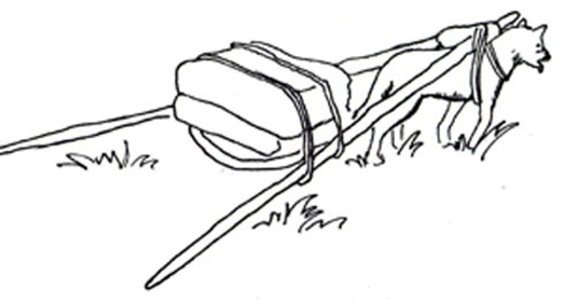
Photo courtesy of hannibalkennels.on.ca

Rapallo is making it very hard to leave. After the terrible rains and devastating floods the weather has become sunny, warm, in a word, perfect. But we know winter is coming, so it is time to pack up our gear and head to warmer climes. I’m just glad we don’t have to carry our home with us as the plains Indians used to do. Now that would be complicated.

We’ll report from the other side in a week or two. Meanwhile, I hope the sun is shining on you, too.

Sad Time for the Heron

Tags

, , ,


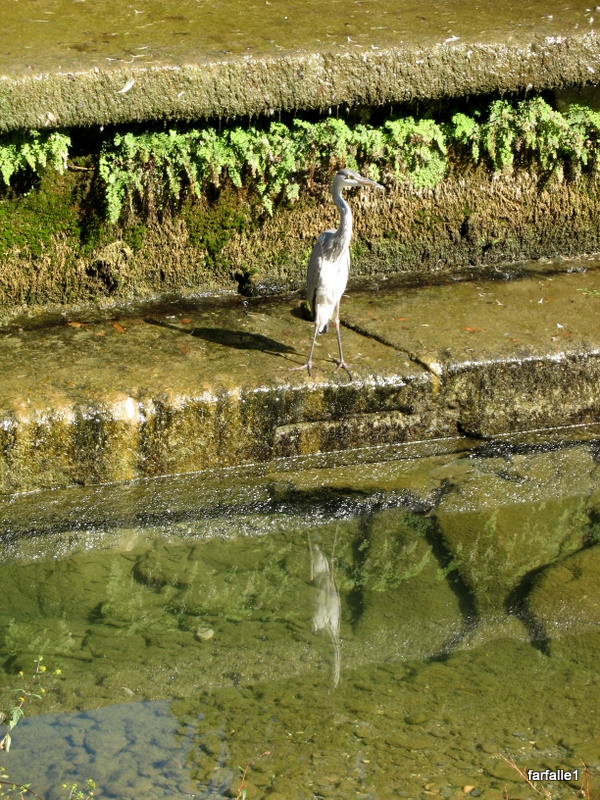
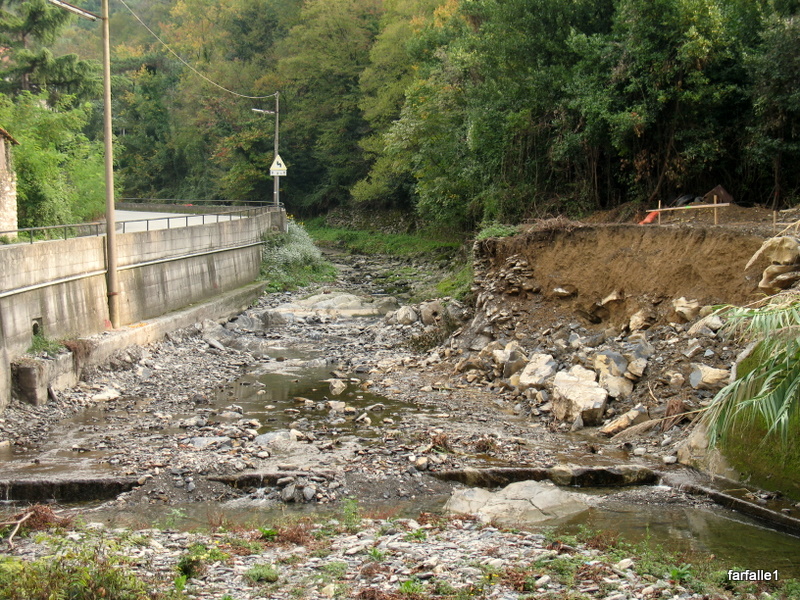
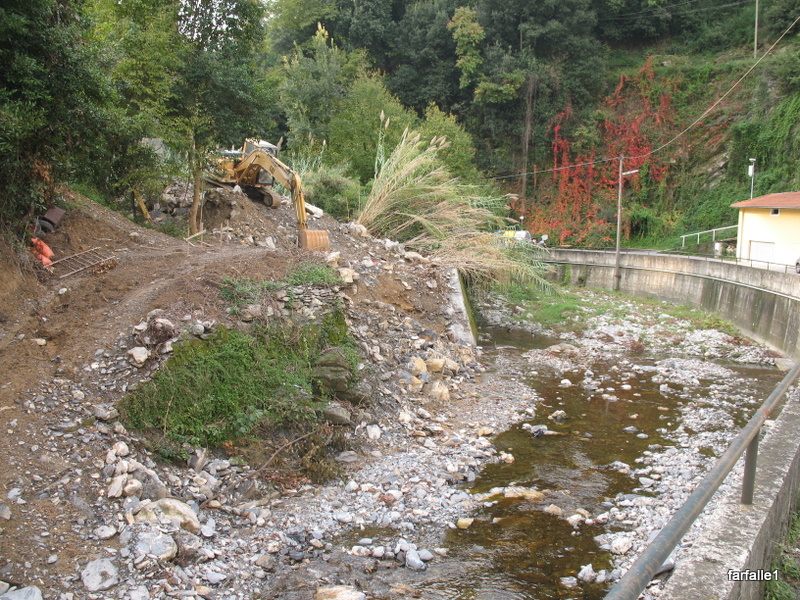
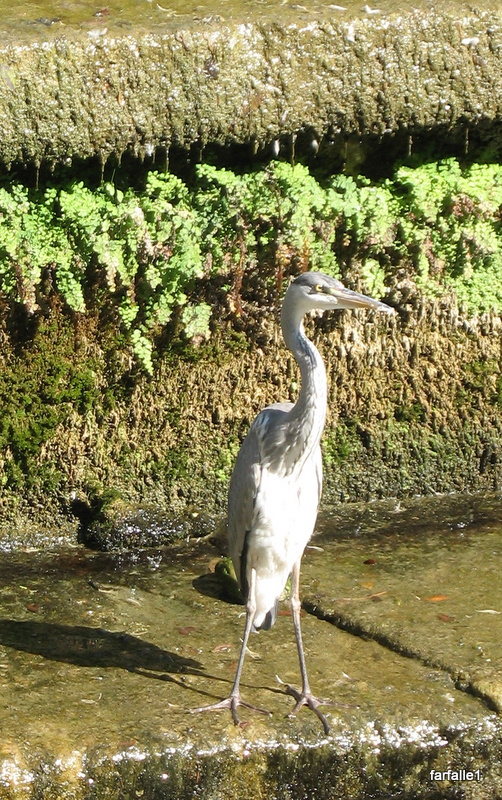
This beautiful heron, or others of his kin, live somewhere near the Torrente San Francesco, which flows down our mountain to Rapallo.  He is frequently to be seen fishing in various spots along the Torrente, but has always especially favored this small dam, under which the little fish like to congregate in a sort of heron buffet.  I’m glad I took the above photo, because the very next day this is what I found when I came down the hill:

What a mess!  And gone is the little dam where the heron fished.

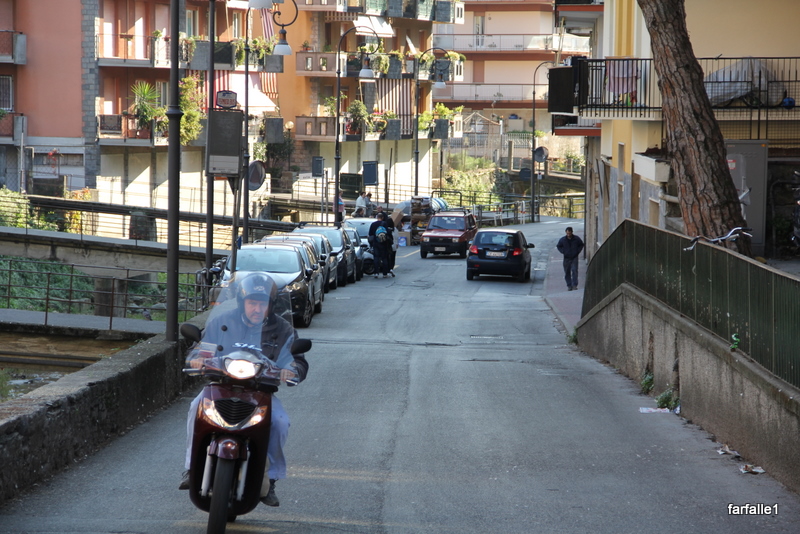
On a related topic, there is some talk of widening Via Bette, the narrow street that runs along the Torrente.  Closer to town than the section pictured above, the street is lined with shops on the non-river side. Frequently vehicles stop on the river side of the road (‘for just a moment!’) so people can do a bit of quick shopping; it can be a matter of some ingenuity to get two cars going in opposite directions past one another.  And when the bus comes: che casino!


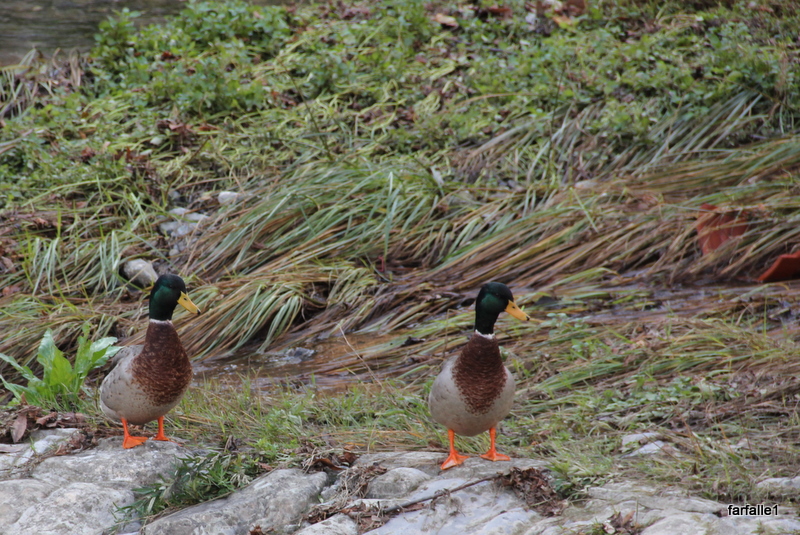
(Note that there are pedestrians on the river side, walking in the street – it’s so much nicer to walk near the water, and people often do, not only putting themselves at risk, but further constricting the available space for cars.) What is distressing about the road-widening project is that it calls for covering over the Torrente.  That will eliminate not only more fishing for the heron (who, in fact, usually doesn’t fish near the shops) but also paddling and family-raising space for the many ducks who live there.

There are also proposals for two new tunnels – one from the Autostrada to Santa Margherita Ligure, and one from Via Bette to the Val Fontanabuona, the valley on the other side of our mountain.  I hope that the road-widening project, like the tunnel projects, will remain in the talking stage for many years.  It will be some consolation to the poor heron, who has lost his seat at the all-you-can-eat special.

All is not lost for the heron though.  The destruction in the top photo is the beginning stage of a new bridge across the Torrente to serve the houses on the hill above.  Fish like to congregate under bridges; maybe the heron’s smorgasbord will return.  I hope so.

New Math, Italian Style

Tags

, , , , , ,

Some years ago speed limits came to the Italian Autostrada system, as they have to most major European highways (even most of the Autobahn!).  While this makes some people, the Captain amongst them, sad, it has proved not to be such a bad thing after all.  The limit on the Autostrada, unless otherwise noted, is 130 kmh, or 80.77 mph, which is not exactly crawling.

But leave it to Italy to monitor speed in a slightly different way.  Rather than waste endless fuel and manpower by putting police cruisers with radar and officers in chase vehicles on the roads, the Autostrada has installed a speed monitoring system called Tutor (because it’s supposed to teach you to slow down).  It doesn’t actually measure your speed at a given point, though.  What it does is measure how long it takes you to get from one Tutor camera to another, some distance down the road.  Stop for a cup of coffee between the two cameras and you can go as fast as you like while on the highway!  What a concept.  Of course if you don’t want to stop, then you have to drive at a speed that averages out to the limit or just slightly over.  But still, that leaves some room for testing the capabilities of your new Ferrari or blowing the cobwebs out of your original Fiat 500.

It’s all done through a sophisticated camera -> computer -> camera -> police computer system, which is explained (in English) on this web site.  If I understand it correctly. your car’s tags are photographed by camera 1, and stored in the server; they are then matched up with another photograph taken by camera 2, and the server figures out your average speed.  If it’s too high, you’ll receive a highly unpleasant piece of mail from the Road Police.

I’m making fun of this a little, but the system has proved to be effective. The Tutor brochure, thoughtfully provided by the Autostrada, has a compelling graph that shows a death rate in 1999 of 1.14 (per thousand? per km of total Autostrada? not noted on the graph, alas), which was reduced in 2009 to .32. That’s a handsome 72% decline.  Roads in general went from 1.38 deaths to .83 –  a not nearly so impressive 40% (but it’s all good).  In fairness it has to be said, too, that cars themselves are much safer now than in 1999.

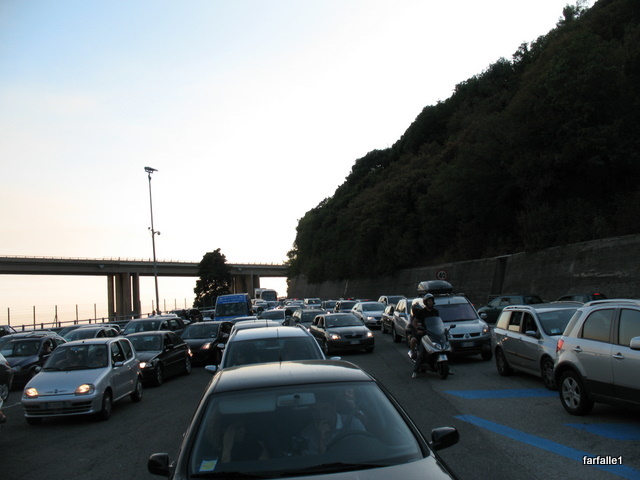
As the above photo of stalled traffic on the A10 suggests, the Autostrada system gets a lot of use: 4 million people a day travel on the system; in 2008, 915 million vehicles used the roads.  Anyone who has ever driven on the Autostrada on any day other than Sunday will not be surprised to learn that trucks account for 19% of the vehicles and 24% of the kilometers traveled on the system (2008).  45% of the fatal accidents involve a truck.

Does it surprise you to hear that Italy has fewer road fatalities per 100,000 population (8.7) than the U.S. (12.3)?  Or, if you prefer, 12 fatalities per 100,000 vehicles in Italy compared to 15 per 100,000 in the U.S. It actually didn’t surprise me.  After living and driving in both countries I will take crazy Italian drivers over crazy U.S. drivers any day.  Italians drive fast, often, but they drive well, and while they may seem aggressive at times, it is usually a sporting sort of aggression (‘Let’s race! Isn’t this fun?’) rather than an angry aggression (‘Get out of my lane! I hate you!’).

What I have noticed more than anything here in Italy is a shared concern for safety; if someone stops on the side of the road he will follow the rules that require putting on a reflective vest and setting up a reflective warning triangle.  If there is damage on the road a warning sign is quickly put up.  One time the Captain and I drove back from Ikea with an oversize load sticking out the back of our car – we didn’t flag it correctly, and another motorist had something to say about that.  We snuck home with our tails between our legs (we didn’t know the rule at that time).  There is a sense of cooperation in road matters that I never feel in the U.S.  Here we have not ‘my’ lane and ‘your’ lane – rather we have ‘our’ road, and if one of us needs a bit of the other’s lane, well, that’s okay.  I’ll move over for you happily without getting all territorial about it.  I think in the U.S. we’re a bit more protective of ‘our’ space – maybe because we have so much more of it and can afford to be.

And speaking of sporting… the Autostrada, in its philosophy of full disclosure, wants you to know where the Tutor cameras are.  Warning signs alert you when you pass one.  And if you want to plan your coffee breaks to maximize your speed thrills on your journey, check out this site for a map of Tutor cameras before you leave home.

Buon viaggio!

Tutor map: http://www.autostrade.it/en/assistenza-al-traffico/tutor.html?initPosAra=3_4

A Long Sad Story with a Happy Ending

Tags

,

Photo courtesy of catsofaustralia.com

Early in the autumn of 2010 our septic system failed for the second time.  The first time it happened, in 2008, we discovered that the tank had been improperly installed and had a hole at the bottom where a rock poked into it, which sent all manner of unpleasant stuff to our downhill neighbors.  They were remarkably calm about it, but of course wanted us to fix the problem.  Which we did by removing the damaged tank and replacing it with a spanking new one.

We were very unhappy when they came back last fall and told us that ‘it’ was happening again.  Arrrrrgh.  Our loyal muratore Giovanni came over and had his merry band of laborers dig up the tank again.  The tank was fine; the only solution was that the septic field had failed after 10 years.  Giovanni’s crew kept digging to try to find the source of the problem.  Imagine our surprise when we discovered that we didn’t HAVE a septic field!  Instead we had a perforated pipe, about 12 feet long, that came off the septic tank and ran underground — and then ended.  Evidently when we did the reconstruction on our house our impressario (contractor) decided that we could make do with less than what the plans called for (he has since died, so we can’t ask him about it).  And, oddly enough, it worked fine for all those years.  But the heavy rains of last fall saturated the ground and ”took space” that our sewage had been using.

But it was no longer working, and we had to do something, quickly.   We were scheduled to leave in mid-November, so we had a hurried bunch of meetings with our geometra and with Giovanni, and came up with a plan whereby Giovanni would continue to dig and install the septic field properly.  Plans were finalized a day or two before we left.

When we arrived in Arizona we found an *urgent* e-mail from our geometra saying that he had called off the work.  A little further digging had revealed that there was nothing ahead but ledge.  There simply was no place to put a septic field.  What, he asked, did we want to do?

When we did the original reconstruction there was no public sewer in the road above us.  In the meantime, thank goodness, the sewer had arrived in San Maurizio, and when it was installed the Captain had the presence of mind to request a hook-up, even though we didn’t need it and thought we never would.  Wasn’t that a lucky thing?

Please, we asked our geometra, design a plan that will work well for us to connect to the sewer.  We knew it would be complex and costly, because our septic tank is some 40 vertical feet below the street.  Clearly, the easy fix was to go downhill, through our neighbors’ property and let gravity do the work.  Our geometra felt the neighbors out and wrote back quickly that we could forget about that solution. Then we waited.  And waited.  It is a funny thing about Italy – if you ask someone to do something and you are there to nag a little if necessary, the something will get done.  If you don’t happen to be around, nothing will happen at all.

Thus it was that when we returned in May we found the beginnings of a design for a pump-up system, but no work done, and a septic system that was still being generous to the neighbors.  The Captain attacked the problem with his usual vigor.  Within three weeks he had learned all there is to know about septic pumps, whom to contact to get a good one, and what other equipment was required.  The geometra participated in the process by seeing that the requisite permissions were requested and going over the plans.  The Captain and Giovanni organized the work and the work party, which, in addition to Giovanni’s digging crew included an electrician and a hydraulic specialist.  We didn’t want to wait for approval before beginning, so begin we did.  After all, you’re allowed to dig up your property without a permit.  And that’s what we did.

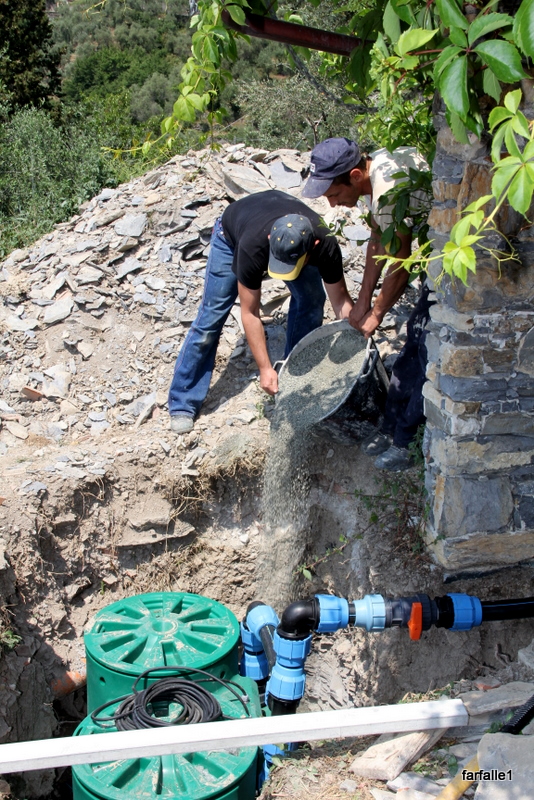
It was no simple matter.  We wanted to use as much of our existing system as possible.  We had to do the work quickly too, so we decided on an integral tank/pumps system rather than building a concrete tank and installing the pumps therein.  So Giovanni simply diverted the pipe that formerly led to the septic tank to the gleaming new septic tank with its pumps (two are required, one to use and one to use when the one you’re using stops working).  The unit is a triumph of Italian design and engineering.  Here it is in place with a fair amount of the plumbing already attached:
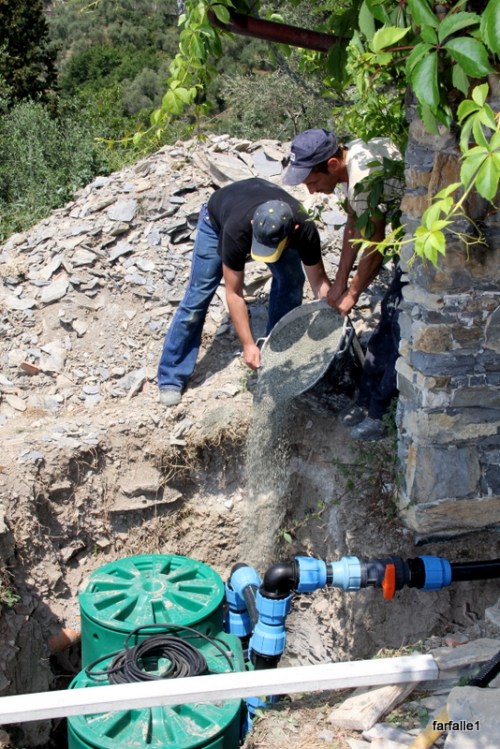
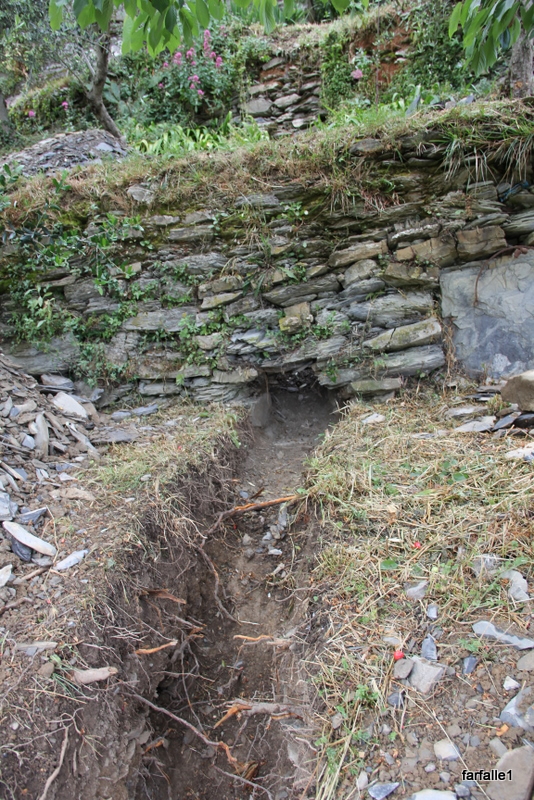
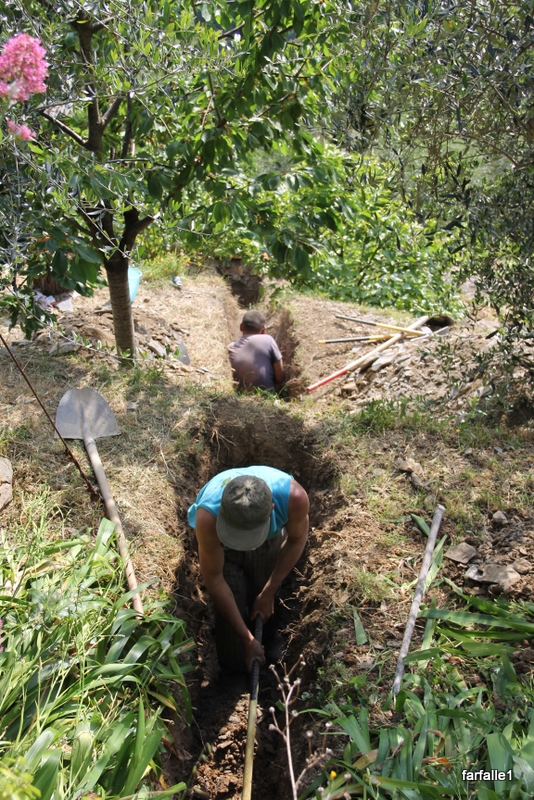
But before the above could happen, there was a lot of digging to do.  We needed a trench that would be wide enough to hold both an electrical line and the line from the tanks that would carry the waste up to the sewer connection.  We had to climb 40 vertical feet breaching four ancient stone walls and one new one in the process, beginning with the back wall of our wood shed.
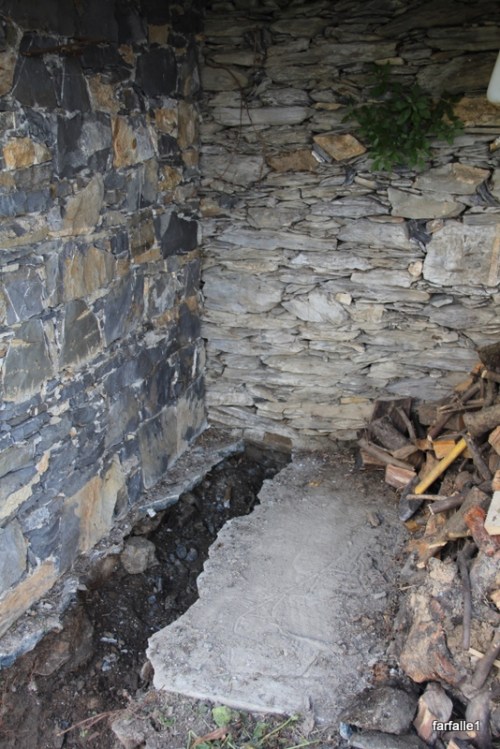
This is where Giovanni’s genius shines.  We assumed he would simply break through the stone walls and keep the pipe fairly close to the surface with a 90-degree bend at each wall, but no – he went under the walls.  This meant an almost straight run uphill for the line thereby reducing the backpressure on the pumps, which the Captain felt was extremely important.
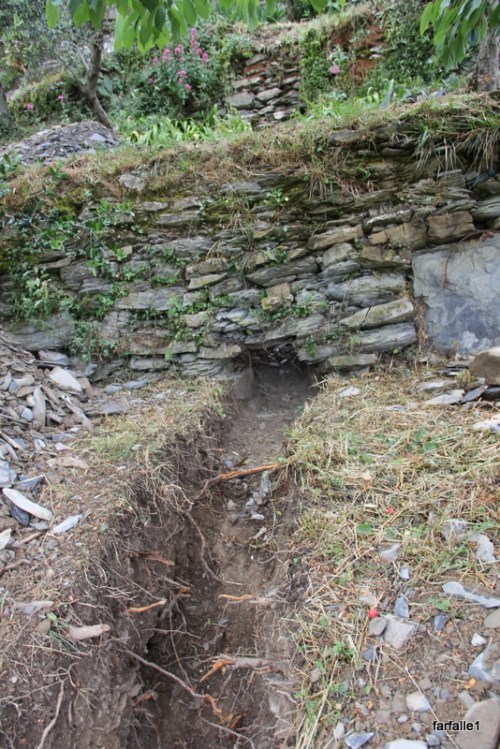
That means that in places the trenches had to be very deep indeed.
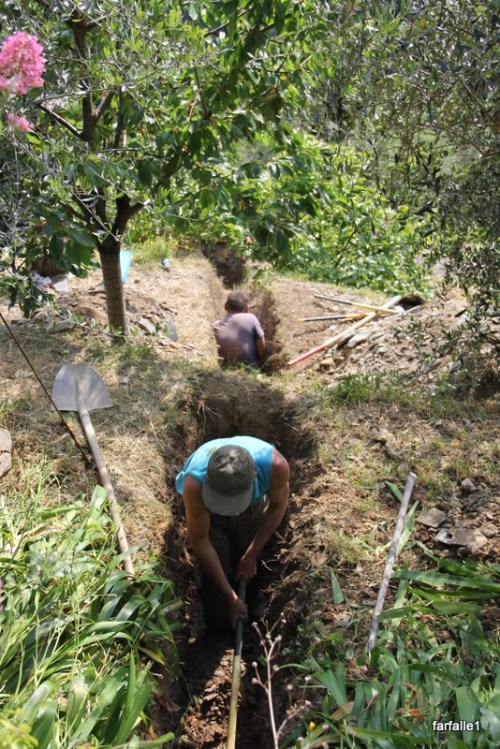
The men had to be very careful at one point because they had to dig all around the electric lines that serve the house.
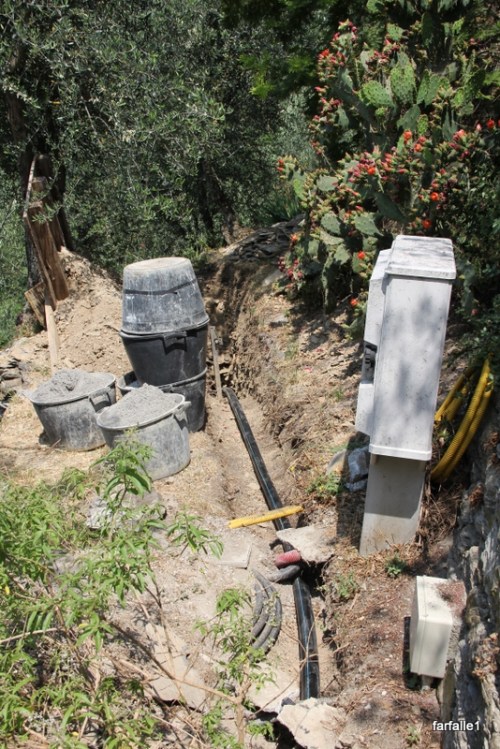
Weren’t they smart to pass the line under the electrical conduits?  That way if there’s ever a leak it won’t short circuit the electric service.

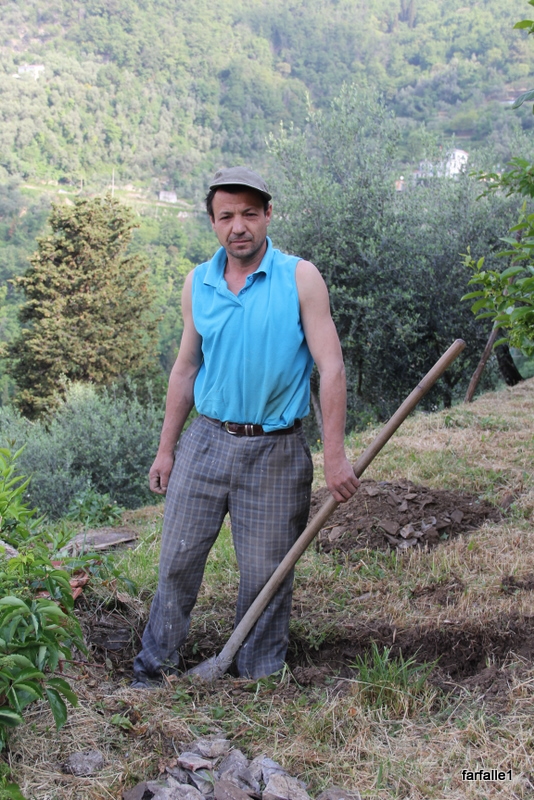
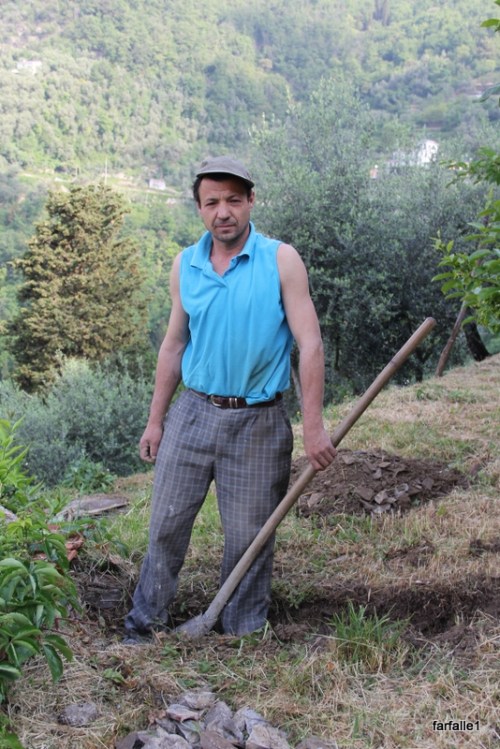
The men who dug did some of the tidiest work we’ve ever seen. They made careful piles of material to refill the trenches when the pipe was laid, and they created a new stone dump at the far end of a lower fascia where they put all the big rocks they couldn’t use again. I’m embarrassed that I don’t know their names. Giovanni’s crew tends to change frequently as new men arrive from Romania, and then strike out on their own after they’re well settled here.  To a man they are incredibly strong, hard working and persistent.
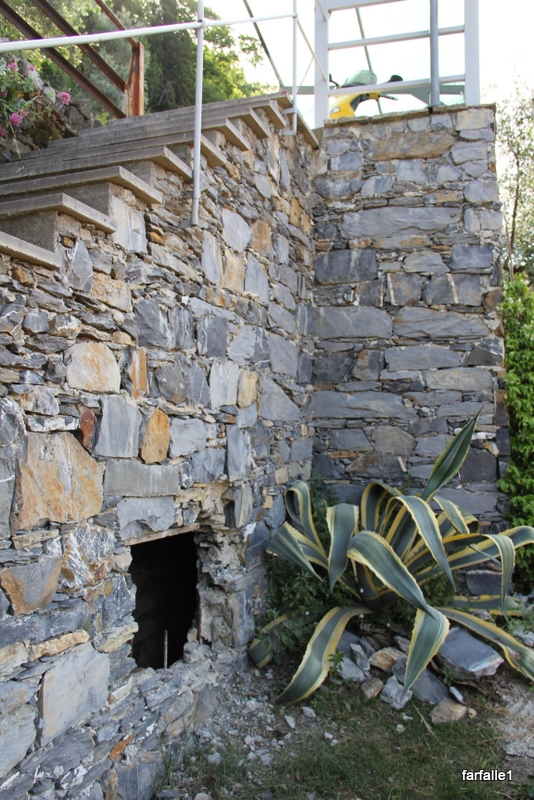
They had to break through the supporting wall of the stairs that descend from the street level so that the pipe could run under the stairs (thank goodness they left that space hollow when, five years ago, they built the walls for the parcheggio above).
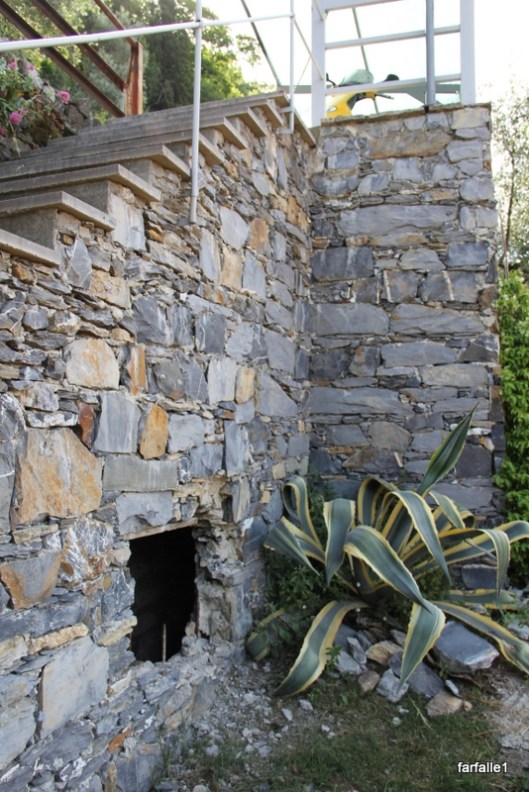

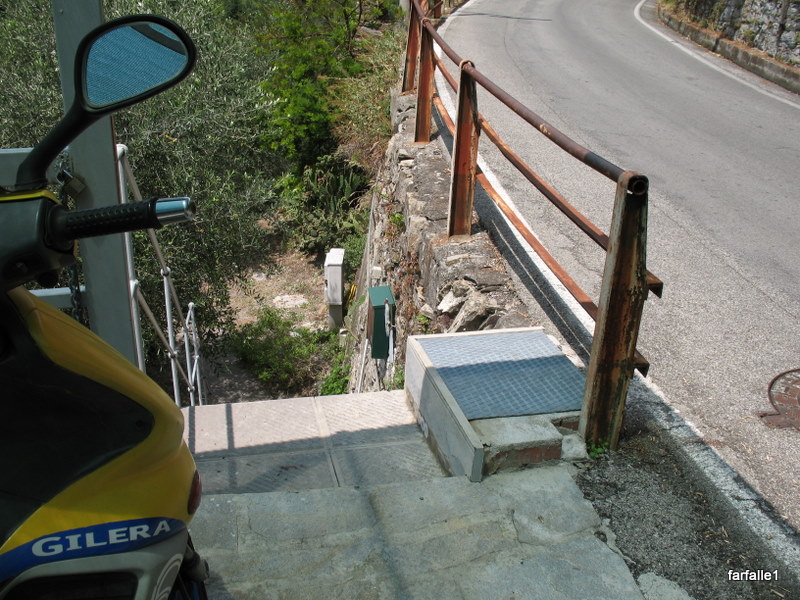
The pipe emerged again at the top step only to disappear into a new box built just for the purpose as required by the sewer company for reasons no one of us could plumb.  From there it was just a short downhill journey to the main sewer line.
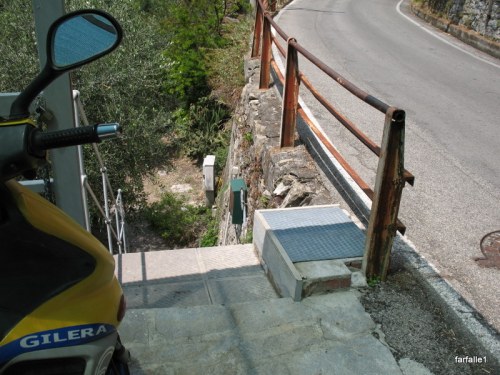
(An interesting aside – one of our sour neighbors who have a right of passage down the stairs (yes, the same ones who were so patient while we dumped sewage on their property) complained that the new connection box is ‘unsafe.’  Our geometra opined that it was unsafe if one were blind, and that if we really felt we needed to address this complaint (which he didn’t think we did) we could just put something decorative on top of the box to alert the eye.  We’ve done nothing, and have heard nothing more on the matter. They send an old lady down the stairs once a year, just to be sure we remember they have the right.  I’m waiting for a letter from a lawyer. )

It took about 10 days to complete the physical part of the work on the project – each person showed up when promised and did what was necessary.  We were extremely lucky that about a day before the work was finished we received permission from the Sewer Department to connect to the main.  It was such a relief when the work was done.  It was a big undertaking, and the Captain put in untold hours planning and overseeing work.  What a joy it was the first time we heard a great whoosh up at the connection box and realized that our pumps were sending our waste on its way to Rapallo.

A sewer connection is one of those things we just never think about until necessity thrusts the thought upon us.  This problem drove us crazy for about six months; to this day I think with relief, when I flush, of where the water and whatnot are going.  Let’s hope the pumps last longer than we do!
Mystery Solved…

Tags

, , , ,


No, not the heinous murder on Via Enrico Toti, about which I told you last week.  That is still under investigation; our friend on the State Police force here in Rapallo has told us they have enlisted the aid of the Vigili del Fuoco, the Guardia Forestale and  the Polizia Provinciale to solve the crime.  No doubt the Guardia di Finanza will be called in at some point too.

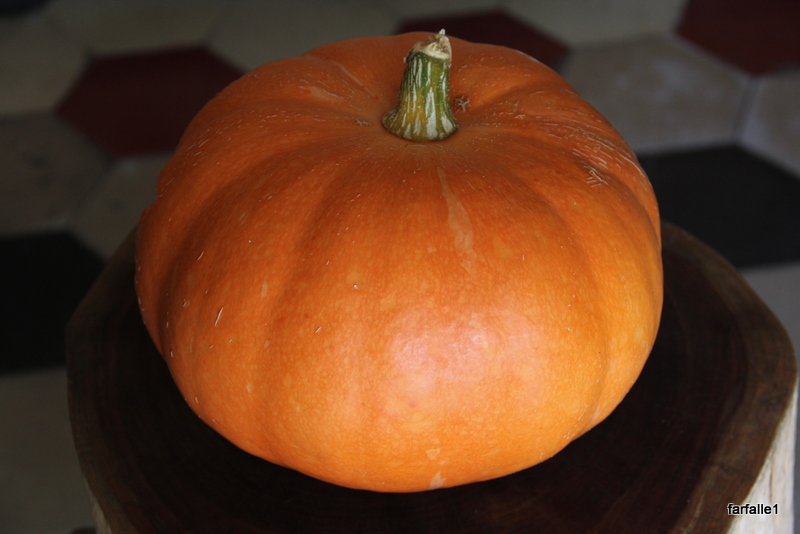
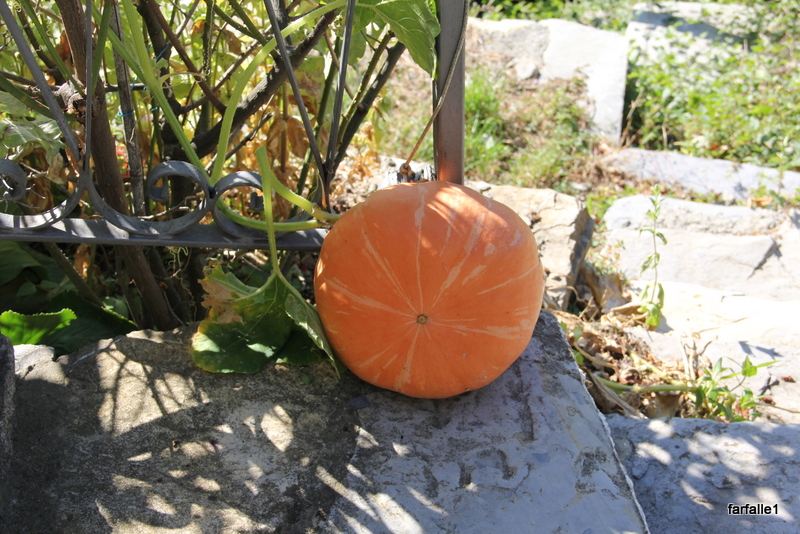
The mystery that is solved, almost to my satisfaction, is the one I told you about on August 18, having to do with a strange vegetable that arrived uninvited both in the compost pile and under a climbing rose.  And am I embarrassed!  You’d think after umpety-bumpteen years of gardening I would recognize a pumpkin when I saw one, but I didn’t recognize these as pumpkins, not at all. And while I’m calling it a pumpkin, I’m still not 100% convinced it is a true pumpkin.

As the strange yellow squash-like orbs of August matured they began to take on a more pumpkiny look – orange skin, though not as orange as a good old New England pumpkin gets.  I find the light stripes highly suspicious:

I never grew a pumpkin before that had this sort of stripes.  It’s almost as if a decorative gourd eloped with a smallish pumpkin and had a couple of dubious, if beautiful, offspring.

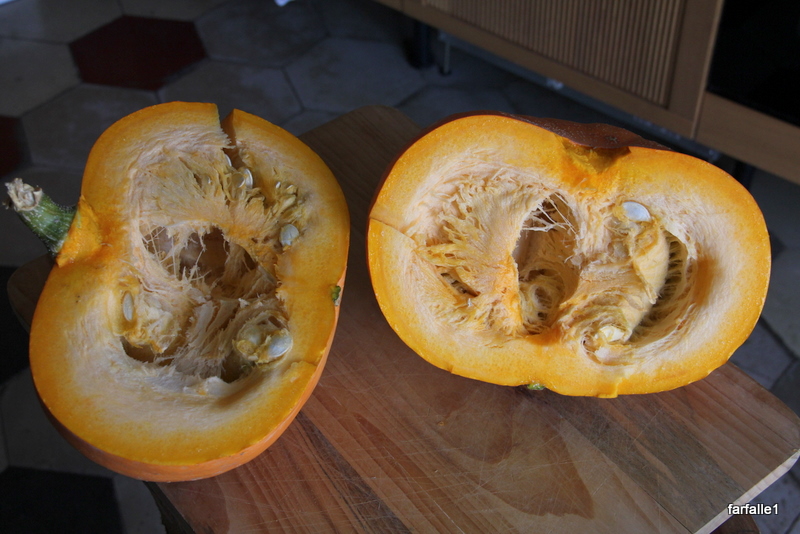
The pumpkins (I’ll call them that for the sake of ease) each weighed about seven pounds.  Inside the one we opened were more seeds than anything else, which is a pumpkiny trait.  But there was not as much non-fibrous flesh as I associate with true pumpkins.

So what did we do with this gorgeous thing?  One night I made a baked squash (pumpkin)  gratin, which used about half of one pumpkin (recipe of Deborah Madison here).  After peeling and cutting it into cubes and boiling briefly I whizzed up the other half in the food processor, and a few nights later made a fabulous sformata of squash (pumpkin), courtesy of Mario Batali (recipe here).

We had company for both these dishes, and they were really well received.  So if you have a squash kicking around, or a pumpkin, or something in between, try one of these autumn/winter dishes – you won’t be disappointed.

That’s one mystery solved.  Now back to Via Toti…

Tragedy on Via Enrico Toti

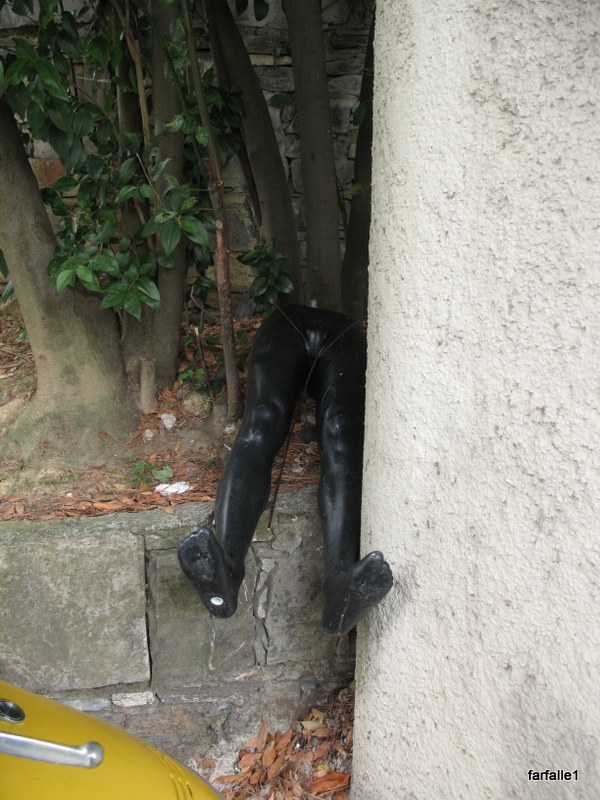
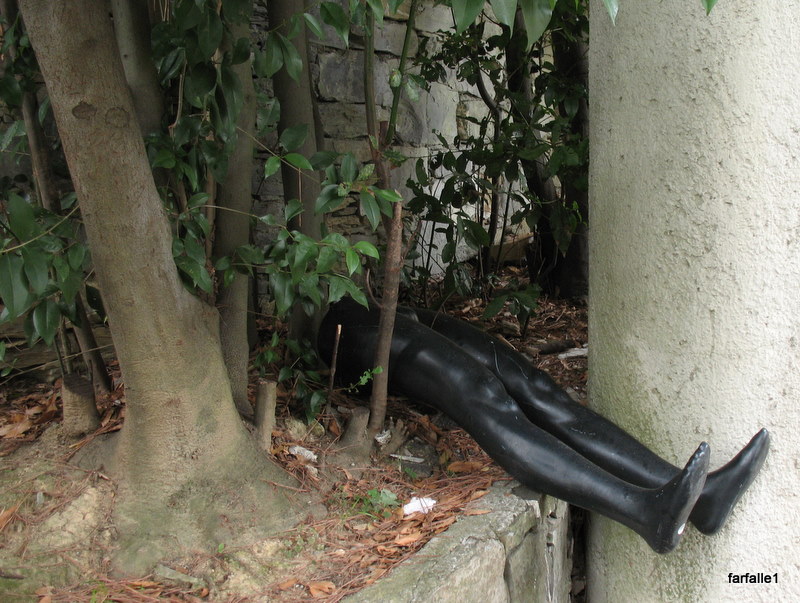
Imagine my horror when I walked out of my palestra (Energym) and discovered the hideous remains of a murdered male.

It’s horrible enough to find a corpse, but to find one dismembered – I’m amazed I didn’t faint dead away.

I called the police of course and they immediately arrived, put crime-scene tape all around the… crime scene, dusted the remains for fingerprints, and then summoned an ambulance to remove the pathetic body.  They put the time of death at about 8 hours before I called them as rigor was still present.

Minor crimes in Italy are frequently not solved, major ones frequently are, one way or another (we won’t mention Amanda Knox here).  But this crime will be difficult to resolve – there are obviously no fingerprints or dental work that might aid in identification.

Who was the victim?  Why was he so cruelly chopped in half in the prime of life?  And why was he left near the palestra?  There are a few clues, anyway, which will give the detectives a start.  Obviously he’s black. His fine physique suggests he cared about his appearance – perhaps he was an athlete or a model.  Clearly the disposal of his body was done in haste – the perpetrators didn’t even bother to cover him with a few leaves to delay discovery.

It is all a great mystery.  You may not read about it in the papers, but depend on it, I’ll be following developments here in Rapallo.

The Best Thing We Ate This Week – Three P’s Pasta

Tags

, ,

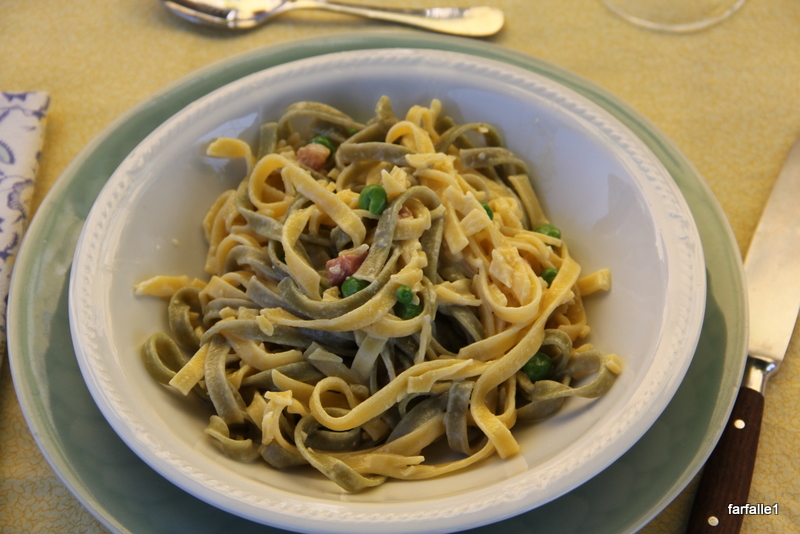
Piselle, Pancetta, Panna!  (Peas, smoked bacon cubes, cream!)

A dear friend served us this dish, made with fresh (!) peas in the Spring and was kind enough to share the recipe.  Before I could share it with you the weather got too hot to be thinking about pasta and cream, so I waited.  But now the days are shorter, the evenings cooler, and anything creamy doesn’t sound like such a bad idea. We made it this week and it was every bit as good as we remembered. 

It’s a simple enough recipe that it doesn’t require a separate page.  Here’s what you need:

Chicken (or other) broth
Fresh or frozen peas
Pancetta (or diced bacon)
Olive oil
Paglia e fieno pasta (mix of yellow and green noodles) – fresh is much, much                                                                                                                better than dry
Heavy cream
Parmigiano

Here’s what you do, as described by our friend:

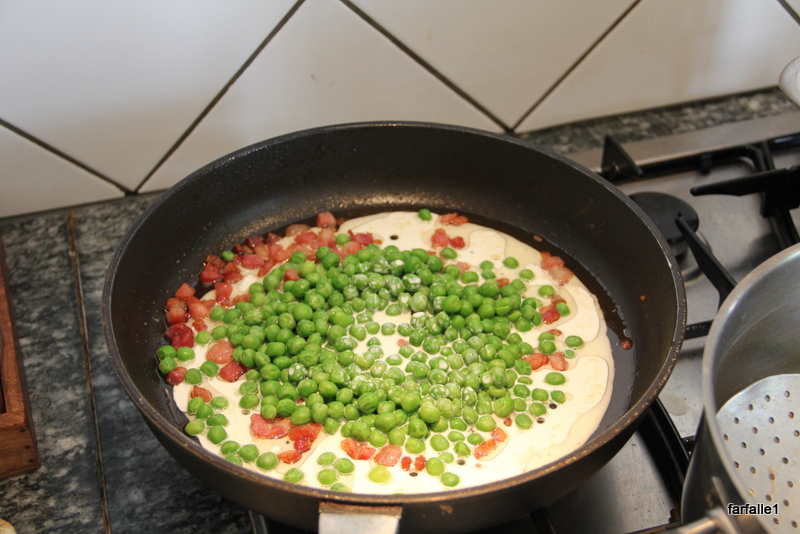
Just saute some pancetta (or diced bacon in the USA) in a bit of olive oil.

Fresh peas really make a difference in this dish, but if not available frozen peas will do (but no canned peas please). Saute the peas in a little chicken broth until barely cooked and still crunchy.

The proper pasta for this dish is called Paglia & Fieno (it means Straw and Hay: the yellow noodles are the Straw and the green ones the Hay).  Cook the pasta until it is done to your taste.

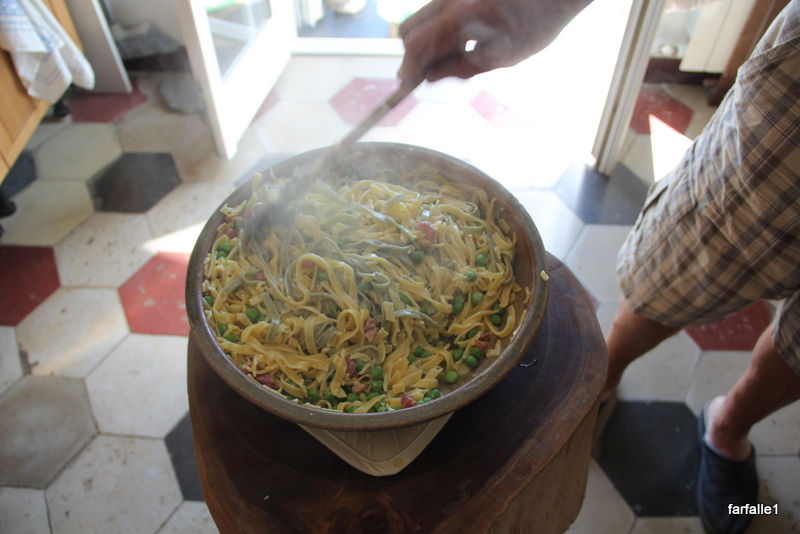
While the pasta is cooking drain the peas, reserving the broth, add them to the pancetta and mix in enough heavy cream to cover the pasta well.

Grate a little Parmesan over the top and serve.

Use the reserved broth to thin if the dish seems too sticky.


Note that as a variation for this dish you can sautè some diced onions (or better yet – spring onions) in with the pancetta. Another variation is to substitute diced cooked ham for the pancetta.

You’ll notice there are no quantities given for the various ingredients.  Just get the amount of pasta that you want and use what seems to be an appropriate amount of the other ingredients according to your own preferences.  You can’t go wrong.  Buon Appetito!

A Sorry State of Affairs

Tags

,

No I’m not talking about Prime Minister Berlusconi’s latest schenanigans… I wouldn’t know where to begin (besides, then I would have had to call this post ‘Sorry Affairs of State’).  I’m talking olives:

Our friend R says the heavy rain of a couple of weeks ago damaged all the fruit.  Our friend E says that insects are the culprits.  As I’m much more diplomatic than our Prime Minister, I’m going to say they’re both right; and whatever the reason, there is no usable olive crop for us this year, or for anyone else we know.  The aforementioned R, who is famous for taking 95 kili of fruit from one tree last year, says he’ll be lucky to get a quintale (100 kili) from his 80 + trees this year. I don’t know if he’ll bother.  We have only about 15 trees, and many of them have no fruit anyway, so it would be a complete waste of time for us to harvest.

It’s a pity, because we look forward to the fun of harvesting and then going to the frantoio with friends and watching our very own olive oil come out of the machines (you can see the process here).  But this year it’s not to be.  We’ll hope for better luck next year, with the olives AND with the Prime Minister.

Spunky Old Dame

Tags

,

I loved this story that appeared in the English-speaking part of ANSA news service this weekend:

Woman, 88, sees off thief

‘I would have chased him if it weren’t for my artificial hip’

(ANSA) – Pordenone, September 30 – An 88-year-old Italian woman got rid of a thief in her house Thursday, telling him he should be ashamed of himself and get a job.

The man turned up on her door in the northern city of Aviano posing as an electricity-meter man the morning after she had celebrated her birthday with some friends, Rina Zorzin told Italian TV Friday after receiving the compliments of Mayor Stefano Del Cont Bernard.

“First he asked to see the meter and when I refused he took out a gun, thinking that would frighten me,” she said.

“But nothing scares me any more, at my age, so I jumped onto his back to stop him.

“He grabbed me round the wrists and forced me to sit down”.

Undaunted, Ms Zorzin taunted the would-be thief: “look all you want, look for gold, I’m not giving you anything”.

Then, when the man was looking elsewhere, she managed to get out of the house and shout for help, crying “thief, dirty thief, you ought to be ashamed, go and get a job”.

The would-be thief gave up and took flight, Zorzin said.

“I would have chased after him, too, if it weren’t for my artificial hip,” she told the RAI state TV corporation.

******************************

What I love about the story is that this is the same kind of lady who will cheerfully elbow you out of the way at the meat counter or bus stop.  What I also love about it is that the thief gave up and ran away.  In the U.S. he might well have shot the old woman.