The Strangest Dinner

Tags

, , , , ,

It’s Sniven’s fault. It was he who encouraged us to come to Gold Canyon, and he who put the Captain back in touch with Captain Harris after many years.  Sniven makes an almost-annual visit to the Southwest, and being a democratic fellow he divides his time; one year he stays in what he amusingly calls ‘The Harris Hovel,’ and the next he stays with us.  Once he took a year off and it completely confused all of us to the point that we didn’t know where he should stay.  During his visits the five of us are very likely to gather for the evening meal and a catch-up of the day’s activities.  Also, perhaps, some gin. Not the game.

This year one of the evening conversations turned to the Aubrey-Maturin series of nautical tales set during the Napoleonic Wars, written by Patrick O’Brian.  The three gentlemen around our table had all enjoyed reading the books enormously, and began to reminisce about various elements.  “What on earth,” asked Sniven, “is Soused Hog’s Face?” referring to a dish that appears in Master and Commander. Research ensued, and the assembled group decided that nothing would do but that we would try it.

Unfortunately an actual hog’s face, while readily available, was nothing either of the principal cooks wished to tackle (what to do with the teeth?).  But the Captain found an acceptable recipe which called for ‘pork,’ and he took on the job.  It turns out there is more onion than anything else in this gelled dish.  It also turns out it is absolutely delicious, and is perfect for a hot summer meal.

(An interesting post-script: we served leftover Face to Italian friends a couple of days later.  Marguerita said, “But we make exactly this dish in Bari, but without the onions.”)


The discussion then turned to amusing English dessert nomenclature, specifically Boiled Baby and Spotted Dick.  Both, it turns out, are puddings, and neither difficult to make.  We opted for Spotted Dick on the theory that it was somehow funnier, and I volunteered to make it.  It is served under a ‘lashing’ of custard, not shown here, but happily consumed at our meal.


Sniven wasn’t done with us, though.  Years ago his adored Granny from Nova Scotia used to make him some kind of milky, custardy dried cod dish.  (She served it with dulse, which the kindly Sniven inflicted on us (I mean ‘brought to us’) several years ago; we went without this year.)  Mrs. Harris, of whom I’ve spoken in other posts, is an amazing cook and has an encyclopedic knowledge of food, food history and food preparations.  She took on the chef-detective task of replicating a food memory from long ago.  I’m not a great fan of  baccala, the Italian name for dried salted cod;  in fact I hate it, so I was pretty sure I wouldn’t enjoy Granny’s dish.  I could not have been more wrong, which simply proves the theory that the addition of cream and butter makes anything divine.


So that was our Very Strange Dinner:  first course: Cod in the style of Granny; second course: Soused Hog’s Face à la Maturin and Aubrey, served with a nondescript salad; dessert: Spotted Dick.

Somehow it all worked.  It brought to mind those enormous menus we read about from the 17th century and 18th centuries, where the meal would begin with fish, travel through foul to meat, and end with some extraordinarily complex dessert, all washed down by barrels of ale (if you want some fine examples, dip into the Diary of Samuel Pepys).

It was, to be sure, about the strangest dinner any of has eaten, at least in its joining of disparate components.  The pity is that Sniven has taken himself back to the shores of Maryland where he resides with beautiful Judith, and we are unlikely to be doing much more experimenting with odd menus in the next little while.

You can find the recipe for the Cod here, the Soused Hog’s Face here, and the Spotted Dick here.
Smarter than me

Tags

, ,

The Captain is an alchemist!  He has turned his motorcycle into several other things, including a beautiful new camera for me.  The only problem is that it is far smarter than I am.  I read the book, take some pictures, and then forget everything I’ve learned.  But it’s lots of fun, very interesting and will, I hope, lead eventually to better photographs here.  I’ve had no complaints about the Canon point-and-shoot I’ve been using for several years; but the new camera does a great deal more.  Or it will once I learn how to ask it to!

Here are a few shots I took using a fast shutter speed.  Stay tuned for more excitement in the weeks ahead.

Golf Course Bunny prepares for Easter

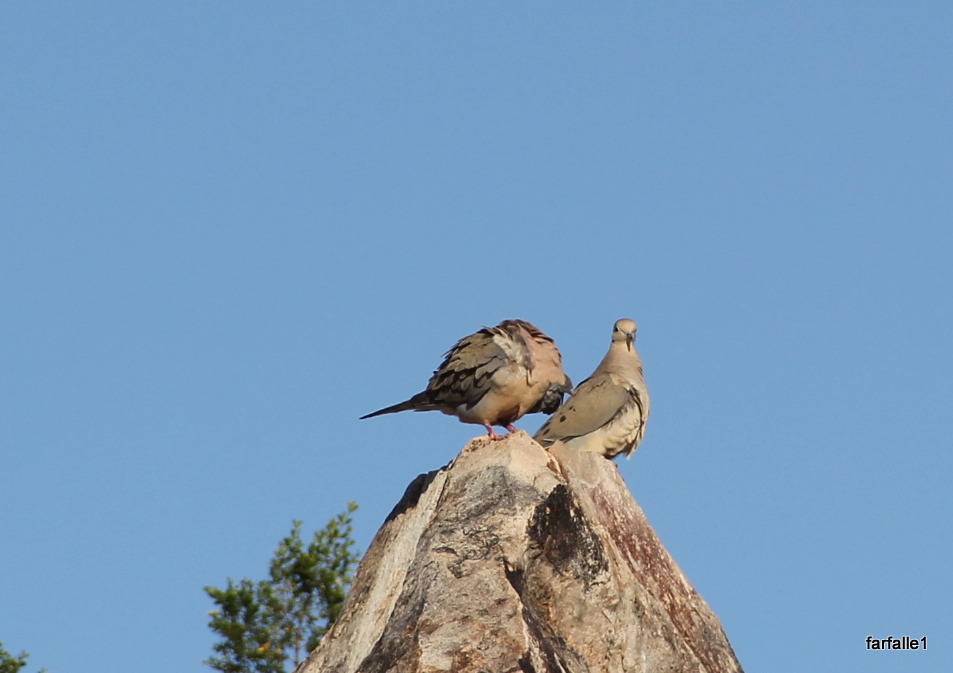
Silly Season for the doves

Grass. Obviously.

Tattered Glory

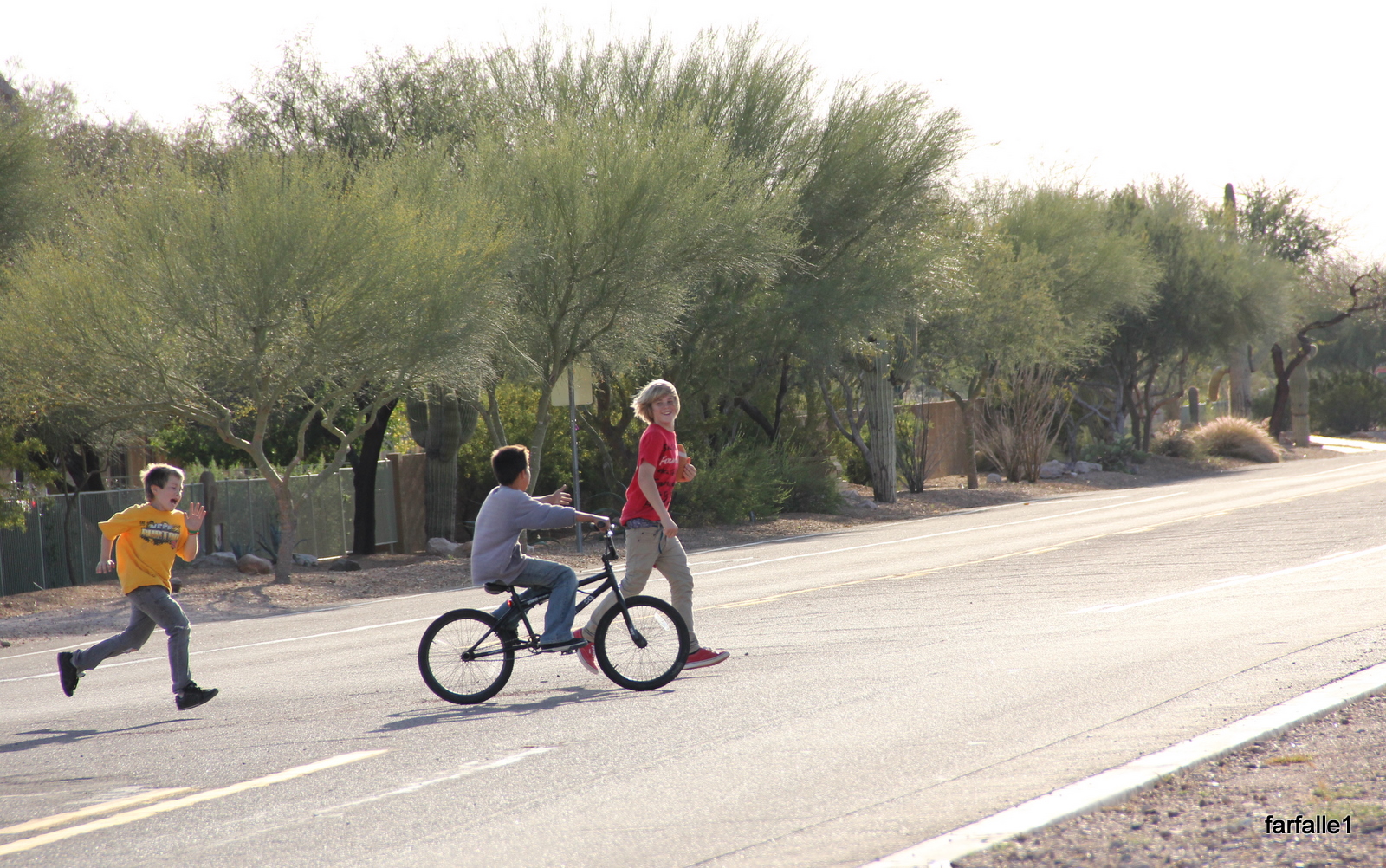
Crossing Kings Ranch Road - quickly

Laura's pup

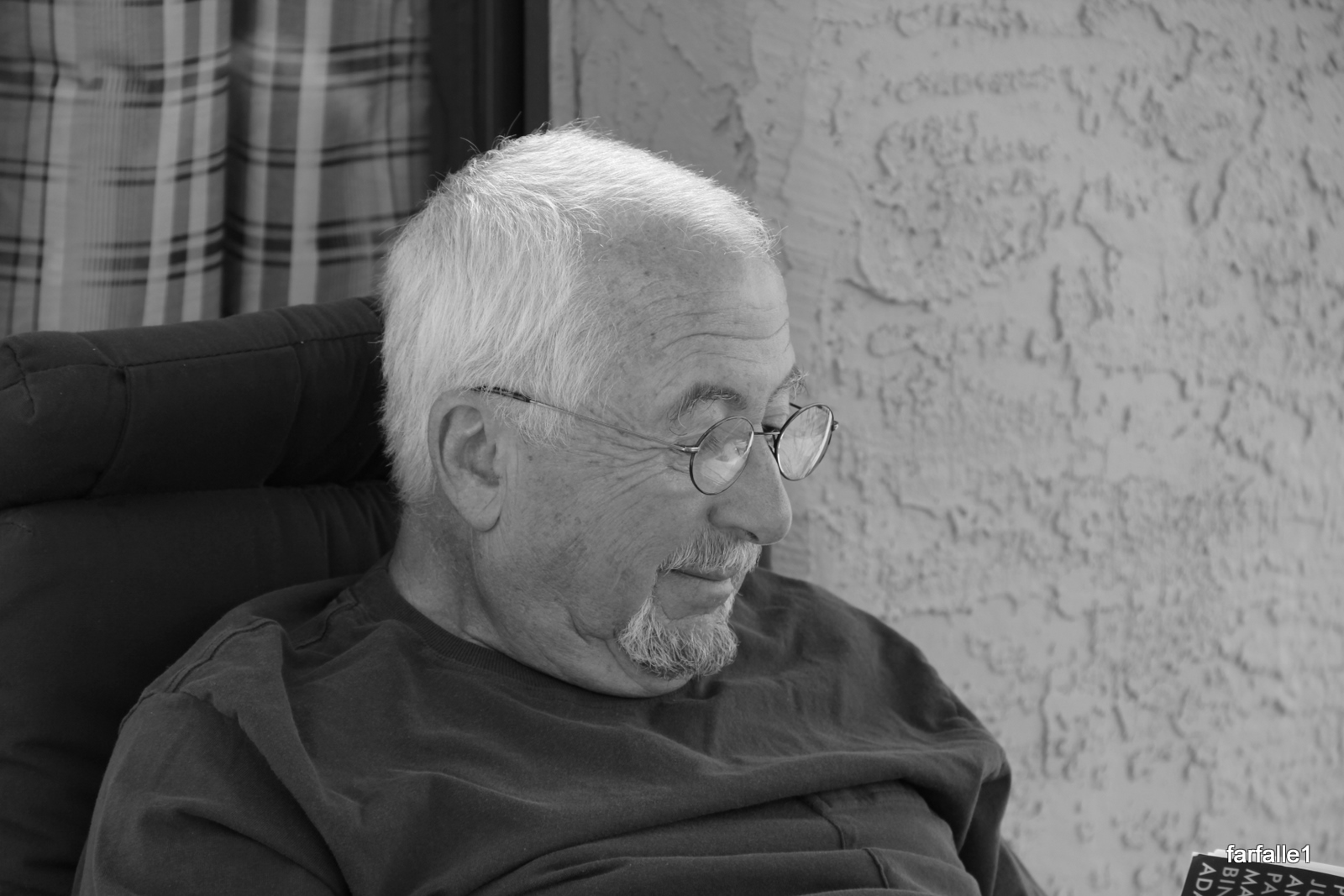
The Captain, bemused, reads


So Sorry!

Tags

Photo courtesy of dreamstime.com

The other day I followed a woman out of Costco, each of us pushing our heavily laden carts.  She moved away from the door and paused; I walked past her with my cart.  After I was past she said to me, “Oh, I’m sorry!”  It took me a full beat to figure out what she was talking about; evidently she felt by stopping she had somehow put herself in my way.  She hadn’t.  And she certainly didn’t owe me an apology.

This incident was preceded by no fewer than three other women apologizing for passing nearby in the aisles of the store.  What is it with American women? When did we become so apologetic for taking up a little space? For existing? It’s driving me nuts!  Women, answer this question honestly:  If you’re walking down the street and a person bumps into you, do you immediately say, “I’m sorry?”

I’m pretty sure that doesn’t happen so much in Italy!  Granted, if an Italian of either gender bumps into you, or you into him, there will follow a two-minute scusi-fest.  But space is always shared in Italy, be it on the narrow roads or in the narrow shopping aisles.  Simply being in close proximity to another is not a misdemeanor. I’ve never had the feeling that my Italian women friends feel they must apologize if they’re taking up a patch of ground that someone else might wish to occupy.  Perhaps it’s simply that Americans have a much larger sense of ‘personal space’ than do Italians.  There’s more space in the U.S. for everything, so perhaps we Americans create larger ‘me-mine’ zones than do residents of more crowded countries.

I first noticed this apology trend about 10 years ago.  Three women friends and I took a vacation together in California.  We made a pact at the very start of the holiday that whoever said, “I’m sorry” would put a quarter in the kitty.  It worked pretty well, and I think we all finished the holiday feeling we were a much less ‘sorry’ bunch.  And how rich the kitty was! Maybe that experience overly sensitized me.

It’s just that I hate to hear women apologizing when they have no reason to. And yes, it seems to be only women – certainly not men, and rarely young people.  And it seems to be happening more and more here in America.

Ladies – Stop It!  You have every right to be exactly where you are.    Please, if you catch yourself apologizing for passing close to someone else or when someone else bumps into you,  put a quarter in a kitty and save up for a treat for yourself (I hope a very small treat).

Tenth Tee Apricot Bars

Tags

, ,

I took up golf this winter.  I’m not proud of it, but I did it.  It seemed like a good way to spend time with the Captain who engages in this foolish and impossibly difficult sport five or six times a week.  I’ve always scoffed at all things golf, from the size of the ball to the costumes of the participants.  But it has turned out to be far more challenging than I ever imagined.  And irritating. And, sometimes, exhilarating.

We joined a club not too far from here, one of a mere 250 such in the greater Phoenix area.  It has two stand-out characteristics.  One is the view of Red Mountain that one gets from various angles at different parts of the course.

The Captain with Red Mountain in the distance

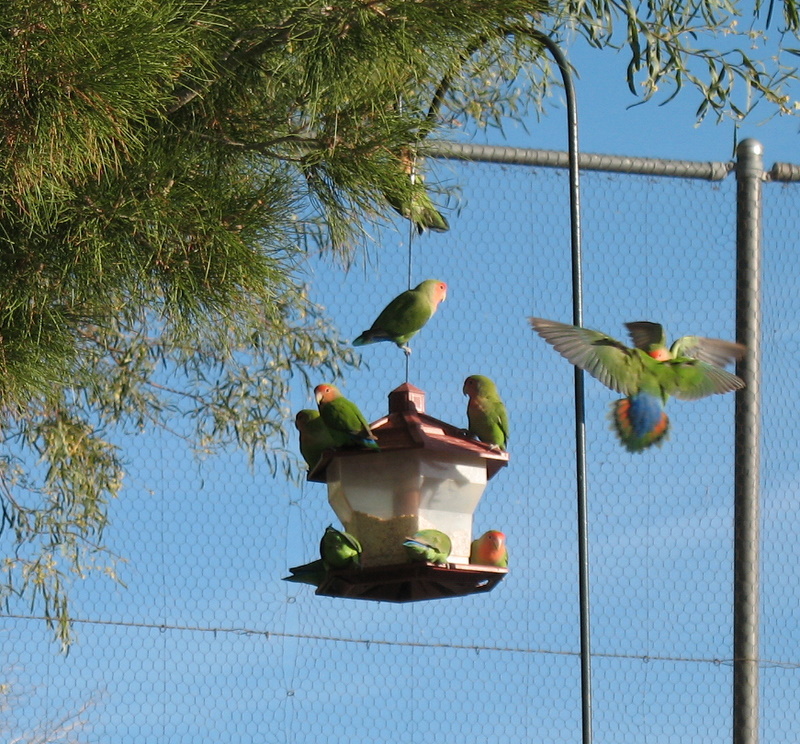
The other is the population of Peach-Faced Love Birds.

Peach-faced lovebirds at a course-side feeder

The birds are native to two places on earth: West Africa and East Mesa, Arizona.  They look like parakeets and make a constant twittery racket.  They have the adorable habit of sitting next to each other and leaning in, very lovey-dovey.  There are hundreds of them twittering and tweeting all through the golf course.  No, not THAT kind of twitter and tweet…

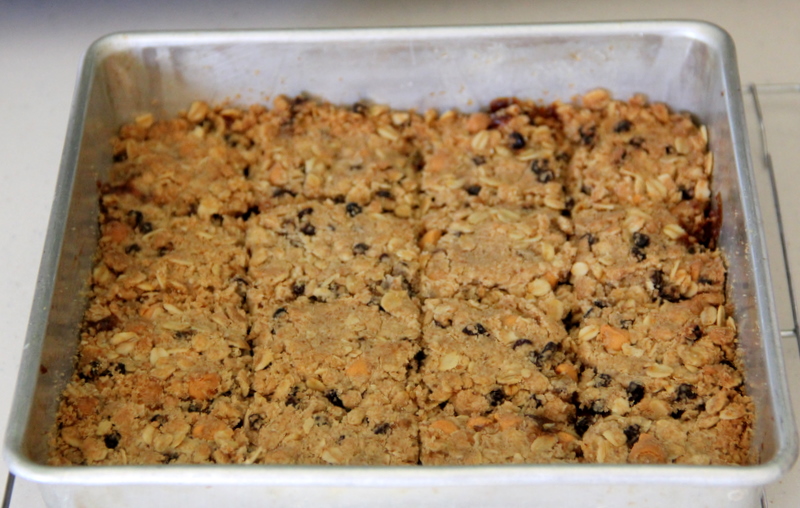
Part of our golf routine is the Snack that takes place on the tenth tee (for me and others) and the eleventh fairway (for the Captain).  This is always something home baked, and recently it has been these delicious oatmeal bars.  I found the recipe at   allrecipes.com, but have made some alterations.  Our stalwart 2:00 p.m. Canadian golf pal (he’s got the same kind of membership we have that allows for afternoon play) is quite fond of them, I think.  So Bob, this recipe’s for you.

Scorpio Rising

Tags

,

Up my pant leg, that is…

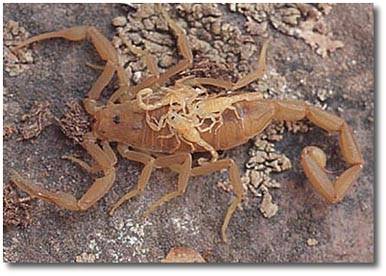
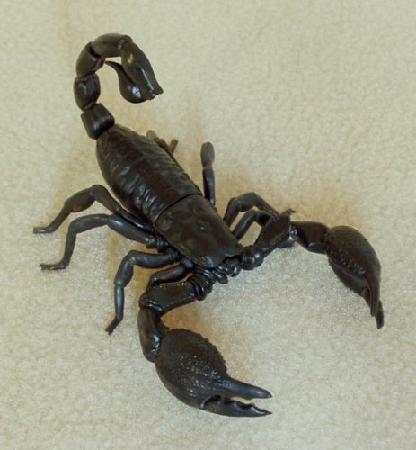
Mother scorpion and babies, courtesy of phoenix.about.com

I went out to the garage to get something, and after a few minutes back in the house I felt a sharp sting – the unmistakable feeling of something small defending its territory in my trousers.  Ouch!

Pants quickly off and shaken, a teeny sandy, orangey scorpion trembled, terrified in the pile of the carpet.  It was literally a half inch long, or less.  Which is lucky for me.  There are many varieties of scorpion inhabiting the southwestern desert.  The Arizona Bark Scorpion, seen above, is venomous and can, in certain individuals, cause seizures.  My little guy was either a baby or an altogether different species; we didn’t keep him around long enough to ask him.  My heroic Captain whisked him away on a paper towel and set him free outside, where he belongs.  The sting site got a little red, a little puffy, and was off and on sore for the rest of the night, but by the next morning I had forgotten I’d been stung.

photo courtesy of dimackey.com

There are scorpions in Italy as well.  We frequently find small black ones in various parts of the house.  Sometimes they are dead and dessicated, sometimes they are quite lively.  For well over a year a little fellow lived under the baseboard next to Luciano‘s supper dish; we assume he came out at night to scarf down kitty scraps.  During the day he hid in the safety of his baseboard with only his larger claw partly visible, like a child who thinks he’s hiding because he can’t see you.  We got pretty fond of Blackie, especially after we checked with the vet and learned that in the off chance that he stung Luciano, there would not be any major trouble.  Little Blackie stayed with us even after Luciano was gone, and in memory of our funny cat I sometimes put down a crumb of something for his baseboard buddy to eat.  Then we had an infestation of ants, as sometimes happens in spring.  Without thinking we spread poison along the ant trail which happened to lead along Blackie’s baseboard.  That was the end of him.  We felt pretty bad about that.

So, are scorpions dangerous?  Clearly the Arizona Bark Scorpion can be, though Dr. Trisha McNair reports that of the 1,400 scorpion species worldwide, only about 25 have venom that can kill a person.  European scorpions in general are a nuisance at worst, their sting being like that of a bee or wasp.  There’s more on scorpions here from Dr. McNair.  But toxic or not, I can tell you from experience you don’t really want them crawling around in your pants!

Uppity Up Up

Tags

,

Hot air ballooning is a big attraction in the Southwest. Probably the best known balloon event is the Albuquerque (New Mexico) International Balloon Fiesta, held in October each year. Among the zillions of scheduled events is a ‘mass ascension’ of hundreds of balloons, which must be quite something to see.

There’s ballooning activity here in Arizona as well, though it appears from the web sites I could find to be centered more around Phoenix proper , Scottsdale and Sedona rather than out to the east where we are.

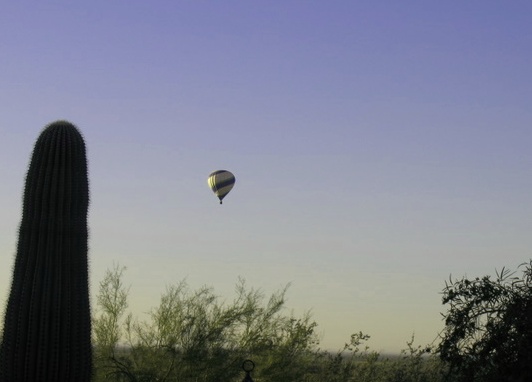
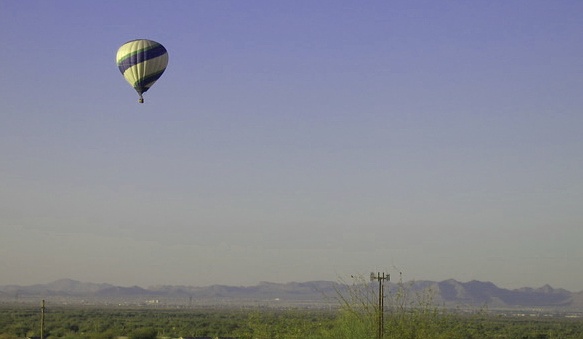
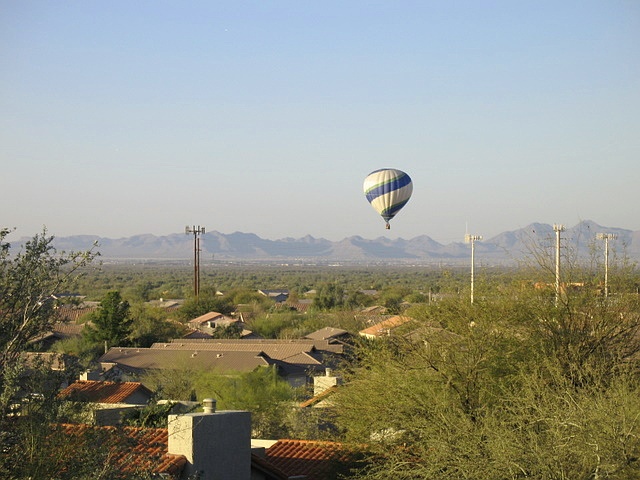
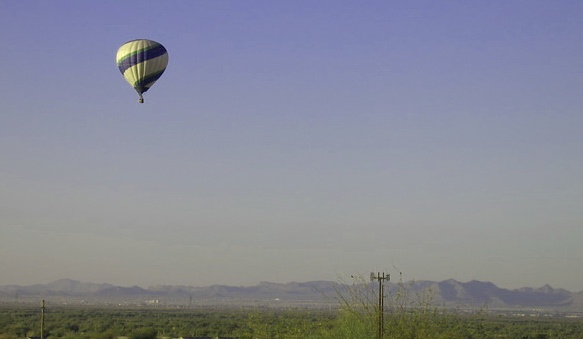
I suspect the balloon we saw the other day belongs to an individual rather than one of the several tour companies that run balloon flights in the area.  We don’t often see balloons here, though part of the reason might be that flights generally take off at dawn and at dusk when the air is at its stillest.  We’re not usually looking out the window at dawn (ahem).

Our first glimpse, off to the east:

Getting closer and losing altitude:


About to land in the parking lot of a nearby shopping center:

It’s such a pretty sight, a hot air balloon; it gets one thinking adventurous thoughts.

The Captain and I went on a hot air balloon ride a number of years ago with the dashing Captain Bollard who dressed the part and served champagne.  I was terrified; the wicker basket you ride in comes up only to about your waist.  I spent the entire flight kneeling on the floor of the basket and peeking over the edge.  If I’d had a rosary you would’ve heard clicking beads a mile away.

Most of a balloon flight is calm, slow, gentle, graceful and still.  Until the captain decides it is time to gain some altitude.  Then he ignites a flame under the bottom hole of the balloon that makes a huge whooshing sound (the hot air fills the balloon above which is what makes it rise).  What a shock it was to hear that for the first time, and to be so close to a rather large open flame.  In a wicker basket.  Still, you see things from a completely new perspective when you look down from a balloon.  And since you’re not as high or moving as fast as you are in an airplane, you have time to look carefully at the scene slowly passing beneath you.  Sometimes you see a lot of faces staring up with their mouths open, which is quite satisfying.

One day about 15 years ago The Captain (not of balloons, by the way) and I were sitting on our terrace at our New England home having sundown drinks with friends.  We lived far out in the woods, and there were not many clear areas nearby other than the space in front of our house.  We watched a balloon in the distance grow larger and larger; in fact pretty soon it seemed immense – to the point that our 130-pound guard dog started quivering and soiled himself.  Yes, the same dog that kept delivery men rooted to their van seats in our driveway.  The balloon filled our sky and suddenly we realized that the pilot was looking for a place to land.  We also realized that he really had few options.  We knew who it was because there was only one balloonist for miles around (not Captain Bollard).  Sure enough, before long the balloon bounced along the field in front of our house, knocked over two sections of garden fence, took out a row of tomatoes and came to rest in our lettuce.  The sprightly 70+ year old pilot was all apologies, his comely companion, ever so much younger, was charming.  Drinks were offered, toasts drunk, the chase car appeared, and before we knew it balloon and balloonists were gone, as if it had all been something we imagined.

And that’s the thing about balloons, I think – they get the imagination going.  They’re romantic and slightly exotic; surely if you’re in a balloon, adventure cannot be far away!  So if you ever have a chance to have a balloon ride, I hope you’ll do it.  Even if you’re afraid – you can always kneel on the floor of the basket.


Sunnies

Tags

, ,

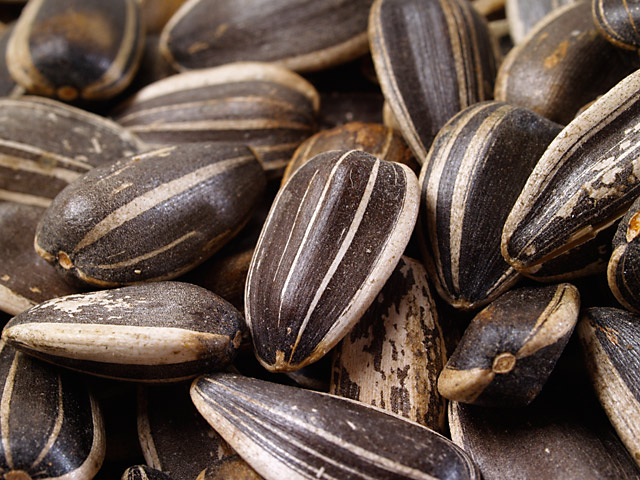
Today I met a Canadian man who grows sunflowers, flax and other grains and vegetables on quite a large scale.  He and his family also have a business that cleans the seeds and hulls them.  Then they ship them off all around the world.

I never thought about how a sunflower might get hulled – I just know that sometimes I buy them salted with the shells on for nibbling, and sometimes with the shells off for bread-making.  That turns out to be two different varieties of sunflower.

My new acquaintance described the hulling procedure this way:  The seeds are fired against the side of a round ceramic receptacle – not too hard, because you don’t want to damage the kernel.  The hull cracks and everything is sent on its merry way on a vibrating belt (to help seed separate from hull) to another part of the machine where the hull is blown away.  Then there’s a weighing and color sorting part of the machine that the seeds pass through.  Any seed retaining its hull is routed back to the ceramic chamber for another percussive meeting with the sides and another shuddering journey on the conveyor belt.

I don’t know if my friend’s hulling machine looks anything like the one above; it’s probably something similar.  Who would ever have imagined when noshing on the humble sunflower that it had had such an adventure?

Photo courtesy of infinitetrends.in

Photo courtesy of vt-fiddle.com

Win, Win, Win

Tags

, , , , , , ,

My last post was hard to write because it was about a very disturbing subject.  What better antidote than to tell you about something really positive?

Are you sick of hearing me say, “We’re in Arizona?”  (Will it make you feel any better if I tell you the temperature was 27 F a few mornings ago (-2 C)?)  One of the things the Phoenix valley is famous for is its citrus orchards.  There are far fewer now than there once were, as many have been ripped out to make room for housing developments, but some of the developments saved as many trees as possible and built the houses among them.

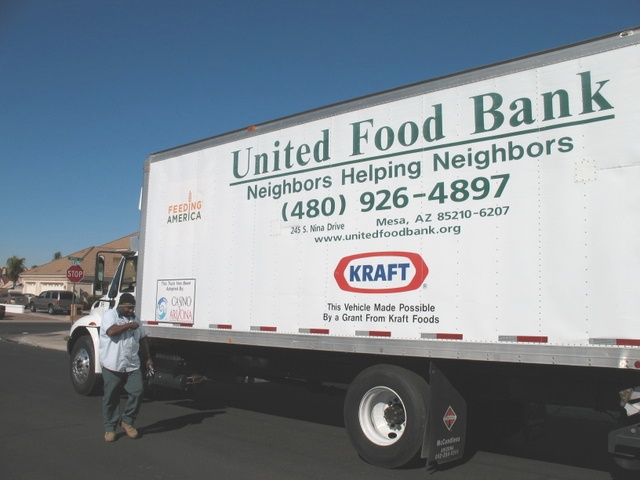
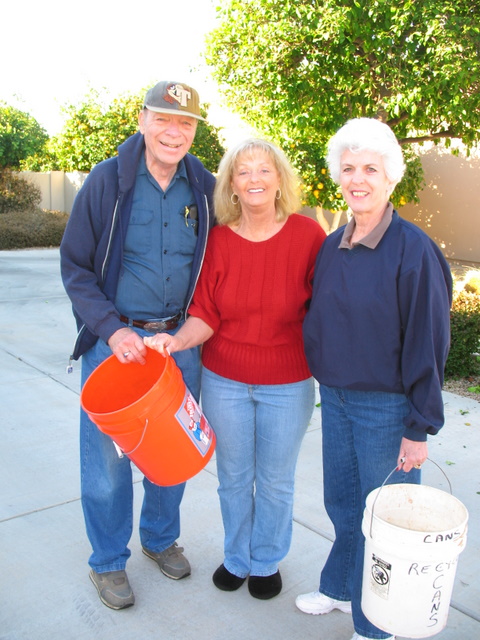
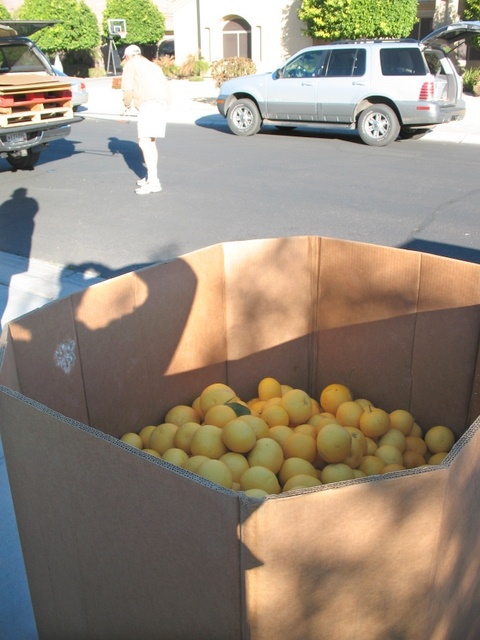
Such is the case in a lovely development in Mesa where I was recently fortunate enough to join a bunch of volunteers who were picking citrus for the United Food Bank, which acquires, stores and distributes food through partner social service agencies.  Many of the houses in this development have ten or more fruit trees in their yards.  I guess there’s only so much grapefruit a family can eat. And yes – it’s mostly grapefruit.  Why?  Grapefruit is faster-growing and more productive than the other citruses, so more grapefruit trees were planted than orange or lemon (or tangerine, or tangelo, or…)

Here’s how it works.  The United Food Bank coordinator has teams of people who gather at a staging area and then carpool to wherever we’re picking.  Our team leader is the indefatigable Terry Parsons, who happens to be a neighbor.

On this particular day we began picking at the home of Lori Wegner (seen below with a couple of hardy pickers).  That was a good thing, because she puts out great goodies.  It turns out that most of the homeowners put out great goodies; at a subsequent house we were invited to take whatever we wanted from an outdoor fridge, which included soft drinks, water and beer.

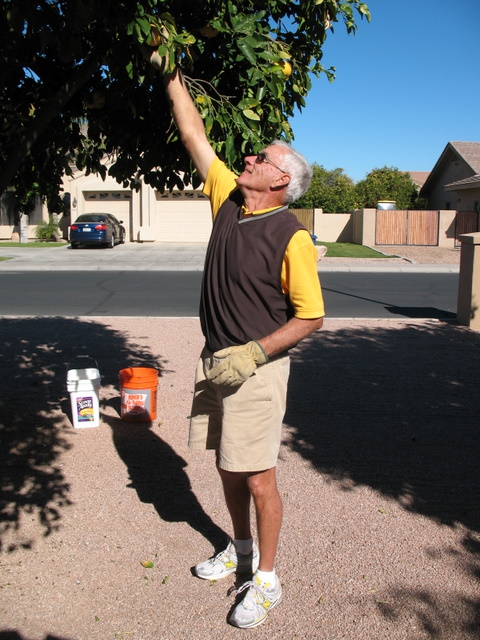
Picking is not especially easy work.  In fact I can’t imagine doing it all day long; I’m pooped after two and a half or three hours.  There are three basic jobs in the picking operation.  The first is just to hand-pick whatever is easily accessible, and that is what I try to do because it is the least back-breaking approach.  But one must be sly and quick to be successful, because others also want to do this work, and most of the fruit is not low-hanging.

The higher-up fruit is reached with long poles with a curved prong at the end.  You put the prong around the stem of the fruit and drag or jerk down; then you duck because the fruit may well land on your head.  In any event it will eventually land on the ground  where the third kind of work is required: stooping down to pick the fruit up and put it in pails.  The pails fill up pretty fast, and they are heavy.

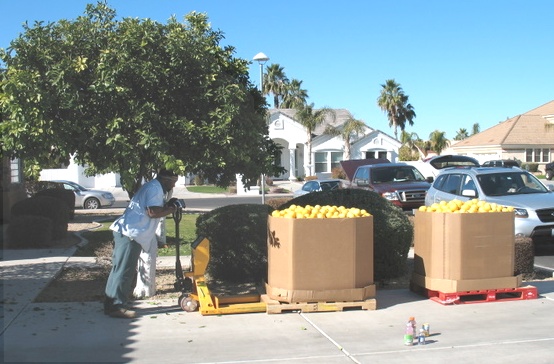
Someone who is not me (my aching back!) then carries the pails and dumps the fruit into huge cardboard bins that other volunteers have assembled on palettes.

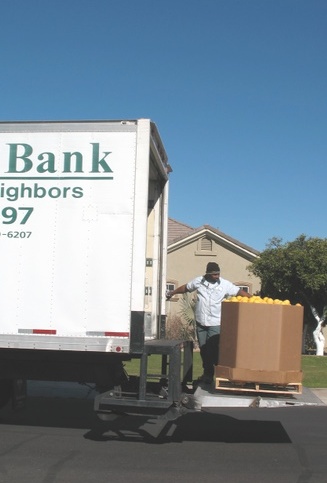
At the end of the morning the Food Bank truck miraculously appears and a man with a small fork lift picks up the bins and puts them into the truck.

Once they arrive at the food bank there are other volunteers who sort the fruit; that which is not suitable for consumption is sent to the squeezing station where it is turned into juice.

Terry told me that there is an even larger food bank in the area that sends semi-trucks of citrus up to Oregon where they have no citrus, and comes back full of surplus Oregon apples.  How clever that is!  (It got me thinking about all the untended olive trees in Liguria – could volunteers pick the olives for oil which could be sold to benefit the food banks?  Or the oil given to hospitals or to the food banks themselves?)

So – who wins the citrus lottery?  First the homeowner.  She has more fruit than she knows what to do with and has to pay someone to come and remove it from her trees if the volunteers don’t do it.  She also will get a small tax write-off for the value of the fruit, if she wants one.  The second winner is the Food Bank and by extension the hungry people whom it feeds.  (I  wonder if some of them say, “Oh no, not more grapefruit!”)  The third, and biggest, winners are the volunteers.  They get to be outdoors in the lovely weather with a group of jolly others, to see parts of town and lovely homes they otherwise might not see,  to eat delicious snacks, and they get to feel really good about doing something helpful for others.  And no one at all loses.

Death in America

Tags

, , ,

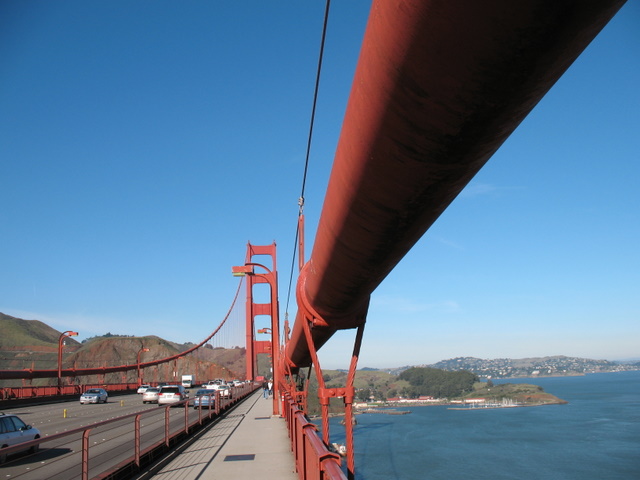
Here we are in Arizona, now famous around the world for its violence and death, and I have to tell you that in early January I felt a bit like an  angel of death myself.  Friends visiting from Italy very much wanted to go to San Francisco, so that is what we did for three days in the early days of the new year.  One of our goals?  Walk across the Golden Gate Bridge.  We met our goal on a crisp, breezy (read ‘cold, windy’) afternoon, and it could not have been lovelier.

On almost every bridge support we were somewhat surprised to see one of these signs:

The blue sign says, “Crisis Counseling – There is Hope – Make the Call.  The consequences of jumping from this bridge are fatal and tragic.”  Also, the bridge railings are surprisingly low, making it very easy for would-be suicides to clambor over and make the leap.

On our walk back across the bridge, with the wind mercifully behind us, we noticed a small commotion at rail side.  Indeed, someone had just jumped to his or her death moments before we arrived.  The people responding to the tragedy were extremely low-key and very, very professional.  I doubt many bridge-walkers that day knew that anything untoward had happened.  There’s a reason why they were so good – they get a lot of practice.  Someone jumps off the bridge about once every ten days.  No one survives.

Flash forward a few days to January 8 – what a good day for our visit to Tucson to look for a church my friends particularly wanted to see.  There was a fair amount of traffic in the outskirts of the city, and as we waited in an accident-caused traffic jam the Captain called to tell us there had been some kind of assassination attempt somewhere nearby and we might want to head home.  We didn’t want to head home, so we pushed ahead and eventually arrived downtown.  Downtown Tucson on a Saturday is a very sleepy place – most of the shops were closed and there were very few people about.  I don’t think it had anything to do with the terrible events that had unfolded at the suburban Safeway Market a few hours previous.

These two experiences with our friends, one right after the other, made me feel extremely uneasy – is America really and truly such a violent place?  More violent that the rest of the world?  I’ve waited a long time to write about what happened because it’s taken a while to sort out my thoughts on this question.

Here is a picture of Jared Lee Loughren, the unrepentent man who shot and killed six people and injured twelve others (including the now famously and miraculously recovering Representative Gabrielle Giffords)  in Tucson the day we were there:

This is what insanity looks like, at least in one of its iterations.  And my point, I guess, is that insanity is all around us, not only in the United States, but on every continent in the world, even in our beloved Italy.  It is a difficult to find hard figures, but according to Wikipedia there were 5.7 murders per 100,000 population  in the U.S. in 2006 and in Italy there were 1.06 per 100,000.   The difference between the U.S. and Italy, I suspect, is the ease with which one can get guns and the number of guns that are in private hands.  Here in Arizona, which is one of the gun-totingest states, it is legal to carry licensed guns both openly and concealed.  I can’t tell you how disconcerting it is to be in a store and see a fellow swagger in with a pistol on his belt.

The NRA will tell you that it is not guns that kill, but people who kill.  They will also tell you that it is our Constitutional right to arm ourselves.  The first is a nonsense.  People cannot kill nearly as effectively without guns – it is guns in the hands of people like Mr. Loughren  that kill, and kill often and very effectively.  The second assertion is open to frequent debate.  The second amendment of the U.S. Constitution says, ” A well regulated Militia, being necessary to the security of a free State, the right of the people to keep and bear Arms, shall not be infringed.”  Some say that it means anyone and everyone has the right to own and carry guns.  Others say that the framers intended that guns be owned privately but used in a militia setting to protect the country.

It doesn’t matter who’s right – what matters is that as things stand now there are a lot of guns in the hands of a lot of people.  Most people are responsible and careful.  But there is a small percentage who are not, and they are the ones who are deadly.

So why the description of the suicide at the beginning of this screed?  Only this.  It is disturbed people who kill – either themselves or others.  Some take their own lives, some decide to take the lives of others.  It all adds up to the tragedy of senseless death.  These deaths, all of them, are tragic to the close circle of family and friends around the dead and the killers; but they are also tragic and harmful to the fabric of society as a whole.

So… what to do?  One of the men taking care of the suicide on the bridge told me that if only the authorities would put up a wire fence high enough to make it difficult for people to jump the number of jumpers would decrease.  And it seems logical that if only we could keep guns out of the hands of those who are not stable enough to have them we would all be a lot safer.  The first isn’t happening because the bridge authorities do not want to ruin the view from the bridge.  The second is not happening because no one knows how to do it.