Near and South of The Border, part one

In the last post I said we were going to California… and we did, and it was fantastic.  But before I give you the expatriate view on that alternate reality I want to tell you about a quick trip we made a couple of weeks ago:

Expatriate in the Indian Nation
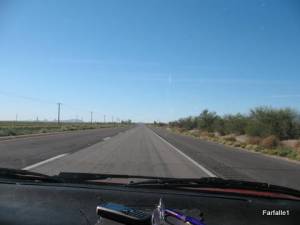
long-straight-road“Desolate” is a word that popped into our heads more than once on the four-hour drive from home to Yuma, in the very southwest corner of Arizona. (View Map).
Even the names of some of the areas we passed through sound lonely: Gila Bend, Sentinel, Aztec, the Sand Tank Mountains, the Growler Mountains, the Granite Mountains.  It wasn’t until we got to the town of Dateland that things sounded a little more convivial. Most of the ‘towns’ depicted on the map looked just like the vacant countryside around them. It is hard to imagine, and impossible to capture with a camera, the miles and miles of empty, dry space in the American southwest.

Our three-day adventure included three nations: the U.S., Mexico, and the Cocopah Nation, where we stayed in the hotel/casino. We’re not wild gamblers (well, I easily could be, given the opportunity and the necessary funds; the Captain?  No.).  We chose to stay at the Casino because it was new and clean and, most importantly, just a couple of miles from the home of our friends who had included us in their family reunion.  The pluses of our hotel included a very nice pool and large rooms.  The only negative was the pervasive smell of other people’s cigarettes which emanated from the nearby casino.

As casinos go, Cocopah is not large, but for that very reason it is not intimidating, and the staff were all extremely pleasant.  The air, thick with smoke, sang with the cheerful electronic songs of the slot machines.  I wanted to take some photos, but quickly learned (!) that photography inside a casino is NOT allowed.

When we checked in to the hotel we were given a welcome packet which included a bonus of $5.00 cash if we ‘cashed out’ of the casino with more than $15.00.  So while the Captain sensibly sat by the pool and read a good book I took a $20 bill and put it in a slot machine, played four times at .25 each, and then ‘cashed out’ with $19, which, with the $5 bonus, gave me $24, a 20% profit.casino_style_video_poker-628681

Smart people would leave at this point, but not me.  I took my free money back to the casino and played video poker for about half an hour, winning and losing.  I prefer blackjack – it seems to me one has a better chance of winning, though I certainly don’t know.  However, the only blackjack tables with empty seats cost $10 a hand, which is more than I want to gamble on three cards.  Anyway, the video poker was highly entertaining, and after my play I had lost only $1.25, leaving me an aggregate profit of $2.75, enough to buy… not very much.

Staying at the Cocopah Casino in the Cocopah Nation didn’t really feel like being in a different country.  The place was full of non-native Americans who were tossing away their money just as fast as they could.  It seems a rather nice revenge after all the Indian Nations have suffered in the last three hundred years. In any event, we spent most of our visit with our friends, with whom great conversation and fabulous food is always a sure bet.

Expatriate in the land of the slim and beautiful

Tags

woman

Last week a woman stopped me, with my wet hair and bloodshot eyes, in the parking lot of the Mesa YMCA and asked if I’d been swimming.  “Yes,” I replied, “and it was great!”

“Isn’t it cold?” she asked.

“Not at all,” I answered, “the pool is heated and it’s always between 82 and 84 F [27-29 C], and it’s pretty clean, too.”

(Photo courtesy of Centiblab.com)

“I haven’t been in a swim suit in 10 years,” the woman said, gazing longingly through the fence where the light played on the blue pool..  She was easily ten years younger than I and had a lovely, slim figure.  “I hate my legs,” she continued, “so I’ll never wear a swim suit again.”

We continued our conversation a bit longer, with me trying to persuade her that a) she was lovely (she was), b) no one would care what her legs look like and c) swimming is wonderful exercise and if she likes it, why not do it?  But it was all useless.  She was paralyzed by her leg hate, and couldn’t imagine exposing herself in a swim suit to anyone, anywhere, anytime.

What a pity.  And how odd.

Or maybe not.

Many of us focus on some aspect of our appearance that doesn’t please us.  As adults, though, we usually get past adolescent insecurity and are able to accept ourselves, literally warts and all.  For some, though, this preoccupation can become a form of mental illness called Body dysmorphic disorder, most commonly, but not always, found in the young.  And guys – it’s not just for females, as a study in the British Medical Journal posited a few years ago. It can lead to self-hatred and a myriad of other disorders, including anorexia.

None of this is ‘news.’ Media has been yakking for years about the unrealistic expectations young men and women have for their own appearances based on how models look. There was a big faroo-farah in 2006 when Madrid banned overly-skinny models from the fashion catwalks, and Italy followed suit. In 2004 Dove soap began a campaign aimed at young women to help them be satisfied with their bodies.

I found myself wondering that day in the parking lot of the Y if this problem exists to the same extent in Italian adults.  I don’t know the answer.  To the casual observer at the beach, European bathers seem much happier in their skins than their American counterparts – but that’s just one person’s observation. Certainly my own friends there do not seem as preoccupied with their appearances as some of my friends here. Curiously, a Google of ‘where do people worry most about appearance’ brought up a raft of sites in the UK.  hmmmmm.  Interesting, and perhaps meaningless. This is not scientific.

I wish I could meet that lady again and persuade her to swim.  I wish I could tell her about all the lovely people who sunbathe on Rapallo beaches in all kinds of dress and undress, revealing all sizes and shapes of bodies. I wish I could tell her that it’s not what her legs look like that matters.  It’s what my legs look like that matters.  Just kidding.  By the way – that’s a picture of me when I was young at the top of the post.  Just kidding again; I’m definitely an expatriate in the land of the slim and beautiful… but I’m not upset by it and am happy just to be alive, and so grateful that no matter what I look like, I can still swim!

Expatriate is visiting another foreign country later this week: California.  Stay tuned.


My name is Fern, I’ll be your server. Here’s your menu.

Tags

e_shipwreck(photo courtesy of http://www.beady.com/roundtheworld/)

Well, okay, a lot of people did not send in their desert island foods… but the ones that did were imaginative and submitted delicious suggestions. In one case I had to extrapolate the component foods from prepared dishes. Here’s a breakdown:

3 people insisted upon coffee (Illy, please).

Fruit suggestions were prunes, oranges, raspberries and lemons.

2 people opted for chocolate.

Milk got a vote, but cream got two, one for regular and one for ice.

Requested veggies were tomatoes (I know, it’s a fruit, but it seems more vegetably than fruity) and asparagus.

goatFor starches people selected spaghetti, tortillas (2), spicy raman, potatoes and Asian sticky rice.
Meat did not include goat, which is odd when you consider the locale.  However pork, regular and as sausages, and roasting chickens received nods.

Three people requested cheese, all different: monterey jack, saga blue, and cheddar.

One fun-loving soul included popcorn on his list.

(photo courtesy of Kentucky College of Agriculture)

So what’s the conclusion?  No one included foods that would get him voted off the island.  And if we all end up on the same island at the same time we’ll eat really well and have a good time.  Especially since, I am told there is a gin spring and a river of merlot in the landscape…

$26.00

BOOKS!  Who doesn’t love ’em?  Is there anything better than holding a new (or gently used) book in your hands, flipping through, tasting a paragraph here, devouring an illustration there?  Much as I love bits and bytes, books will always win the race for my heart…

In 1957 the VNSA held their first book sale in Phoenix and raised $900 to benefit the Visiting Nurses (the VN of VNSA). The sale has been held every year since, though since the transfer of Visiting Nurses to a large hospital corporation, the VNSA now stands for Volunteer Nonprofit Service Association.  This year the sale benefited three Valley agencies: Arizona Friends of Foster Children Foundation, Literacy Volunteers of Maricopa County, and Toby House, Inc, an agency that helps adults with severe mental illness.

The sale is held in a 50,000 square foot building on the Arizona State Fairgrounds for two days at the beginning of each February (some great pictures of the 2004 event are here).  People line up for entry to the sale hours ahead, some bringing flashlights to read through Friday night in order to be among the first to enter Saturday morning.  Fire regulations dictate how many hundreds may be in the exhibit hall at any one time, so sometimes the wait can be long.  We go on Sunday, when everything is half price and the crowds are somewhat diminished. This year there were over 600,000 items for sale (books, records, cd’s, dvd’s, maps, etc.) and the VNSA expected to raise in excess of $350,000; there was plenty left for us to buy on the second day of the sale.  Here’s what I bought with my $26.00:

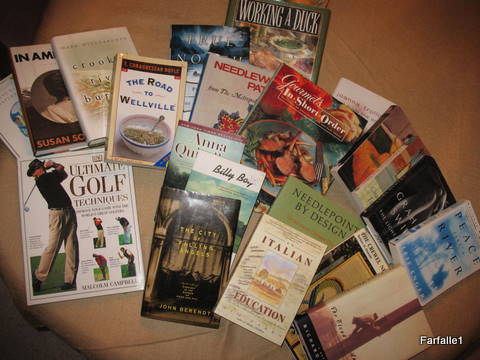
books-purchased

Notice that book up at the top, Working a Duck?  What a find.  Written by Melicia Phillips and Sean O. McElroy (Doubleday, 1993, $25.00) it tells you everything you could EVER want to know about preparing and cooking any part of a duck.

The Captain was not thrilled with the Christmas arrival of two more cookbooks.  “Maybe we have enough cookbooks,” was his comment.   Damn, I thought, that leaves only golf for next year.  Oh well.  BUT – he was well pleased with the duck book, because it filled an empty space on the cookbook shelf (right between crabs and eggs).  In fact, can one ever have enough duck recipes?

Ever the culinary adventurer, the Captain dove right in and two nights later served up Fried Noodles with Duck, Ginger, Garlic and Scallions, a recipe with a definite Eastern accent (and I don’t mean Vermont). It takes a bit of preparation, but if you, too, are an adventurer you can find the recipe (slightly changed) here, or over on the right under Recipes.

Just in case the Duck book wasn’t a hit, you’ll notice in the photo above there is also a great big golf book.  One must cover all the bases…

Apache Trail in the Snow

Tags

, , , ,

apachemap

(Map courtesy of http://www.americansouthwest.net/arizona)

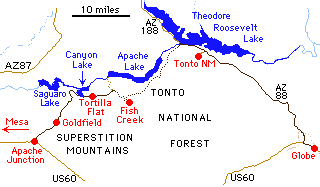
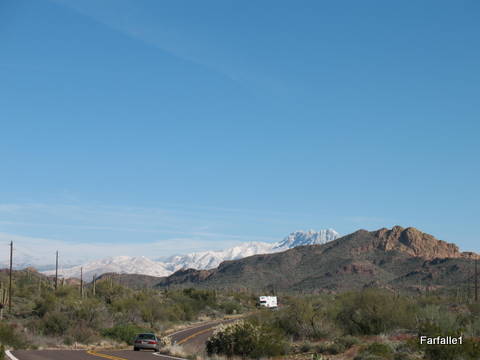
Last week it snowed here in Arizona.  No, not down here in the ‘Valley of the Sun,’ but in the Superstition Mountains and the peaks of the Tonto National Park.  The radio instructed us not to drive north for several days as many roads were impassable.  Exciting!

img_8534

We waited, as instructed, and then set out on the Apache Trail. What is it and how did it get that name? Briefly, according to Tom Kollenborn’s article on the Trail, the general path of the trail was used back in 900 AD by the Salado Indians.  Later the Apache Indians used it in raids against the peaceful Pima Indians who lived in the valley.

roosevelt-dam

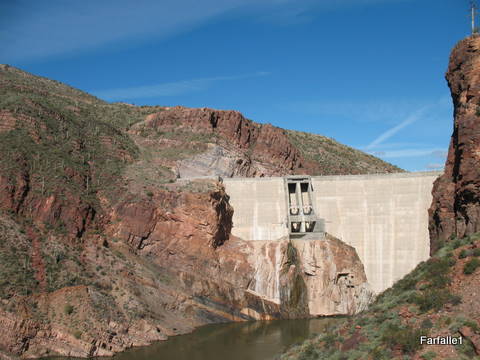
Theodore Roosevelt Dam at the top of the trail was built from 1905-1911, and there was a need to connect the dam site at Roosevelt with the Valley towns of Mesa and Apache Junction.  The road was built from 1903-1905, but access was restricted until completion of the dam.  Ironically, the laborers for the road-building project were also Apache Indians.  Today the Apache Trail, also known as Arizona Route 88, is one of the loveliest roads in the state, but it is narrow and rugged. One end is in Apache Junction, and the other in Globe.

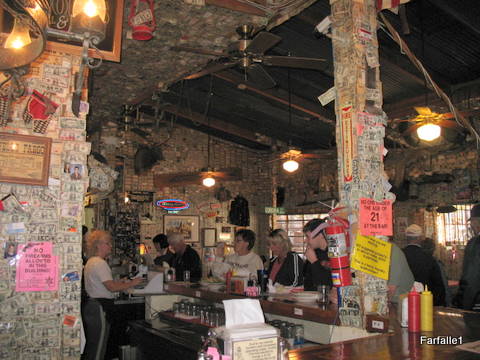
My pal Mary Ann and I set out at about 9 a.m., and got home sometime after 5 p.m., having covered only 150 miles.  We stopped briefly in Tortilla Flat, which is completely touristic and hilarious. (Steinbeck’s Tortilla Flat was in California.) It is full of visitors who have enjoyed the scenic ride past Canyon Lake; not many venture farther, especially when the road is under water. (!) Here’s a photo of the dollar-bill papered dining room of the small restaurant there.

img_8543

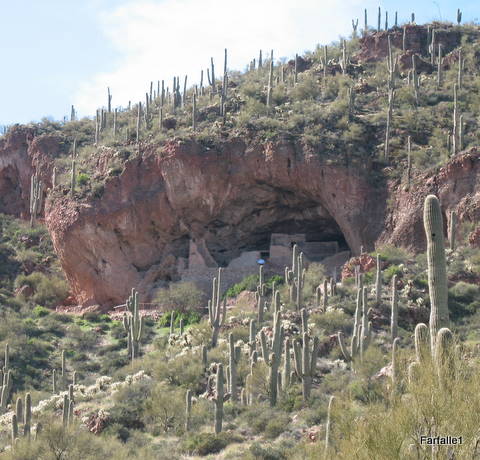
We especially wanted to visit Tonto National Monument on the other side of Roosevelt Dam, but didn’t get there until 2 p.m., and we were starving, having not seen a building since leaving Tortilla Flat.  Did I mention it’s a really isolated part of the world?  So we took a quick peek at the ancient cliff dwelling visible from the Visitors’ Center and motored on in search of a sandwich.

ruins-at-tonto-national-monument

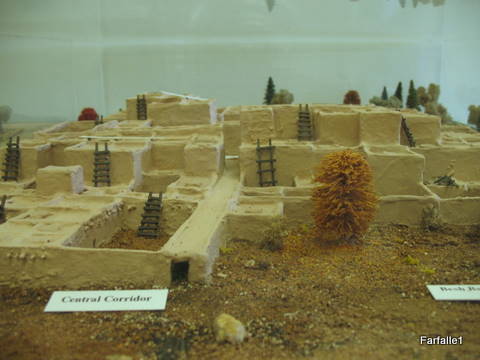
After The Best Pre-Packaged Sandwich I Ever Ate we continued on to Globe where we visited the Besh-ba-Gowah ruins.  They are the remnants of a Salado settlement, dating from about 1200 AD. They have been well reconstructed, and one is able to walk through the settlement and imagine what it might have been like to live there 700 years ago. The visitor’s center is extremely interesting and there’s an excellent video and a museum stuffed with archaeological finds from the site.  Here’s a model of the ruins:

img_8601

Evidently they liked ladders.  The dark hole labled ‘central corridor’ was a long, dark hall that gave access to the areas within.  The ‘tree’ seems all out of proportion to me – it must have been huge.

It was a breath-takingly beautiful drive, especially the old road from Apache Junction to Roosevelt Dam.  If you’d like to see more photos, click here, or over on the right under Photographs – Apache Trail in the Snow. As always, I recommend the slide show. You will see there a rare shot that captures both the male AND female jackalope.

Rustic Bread

Tags

, , , ,

There are many things we miss about Italy when we are in the States (just as there are things we miss about the States when in Italy).  Aside from missing friends, a lot of our pangs for Italy have to do with food, especially bread.  Good bread is available here, but it is quite expensive.  At home in Italy we routinely visit one of two bakeries for our daily loaf, as well as for assorted pizza treats, and sweeties to accompany tea.

The first bakery we fell in love with in Rapallo is called Paneficio Campo (Via Trieste) and is owned and operated by Nino and Maddallena and their three daughters. They are originally from Calabria, and are true artists with their rustic loaves.  The Captain, who has spent no small amount of time on his bread recipes, has dubbed Nino a Genius.

Our ‘local’ bakery,Panificio Schenone Giorgio on Via Betti, is closer to our house, and makes killer pizzette, which are excellent for a before dinner treat.  They also make very nice ciabatta, the shoe-shaped loaf which originated in Liguria, but which is now common throughout the boot. We don’t know the proprietors, but it is clearly a family operation.

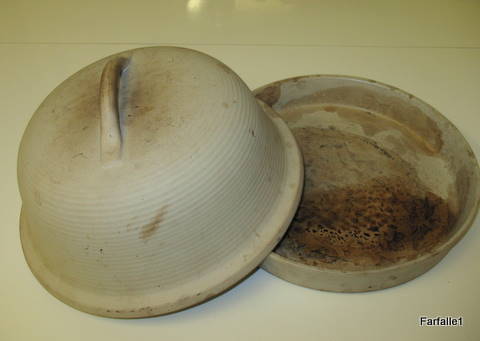
la-cloche-covered-baker1

What to do about bread while in America?  Easy! We make our own.  Last year we discovered the wonderful La Cloche Covered Baker, a domed ceramic baking pot which we bought from King Arthur Flour. (You can see from the photo above it’s received a lot of use).

How’s the bread that’s cooked in La Cloche?  Fantastic!

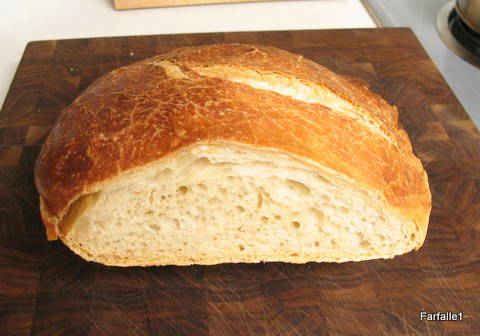
no-knead-almost-bread

The loaf above was made from a very simple bread recipe (with a surprise ingredient) developed and given to us by Sherri Harris, about whom you’ve previously read in these pages.  The recipe is over on the right, called ‘No-Knead Bread (Almost).‘  Also on the right is another recipe which was sent along with the cloche by King Arthur (himself!  really!!): ‘Rustic Hearth Bread.’

Making your own bread is such a pleasure. If one didn’t want the expense of the cloche there is surely something one could substitute: perhaps a heat-proof bowl upside down on a tile-lined baking sheets? The house smells wonderful during and after bread-baking, and nothing tastes better than a warm slab of fresh bread with a lot of butter on top.  Oh yum!

Buon appetito!

Cats and the Metro

Tags

, , , , ,

img_7598

But cats don’t like to ride on the metro, I hear you say. True. But no sooner did I grouse about the lack of good public transportation in the US than lo and behold! The Phoenix Light Rail system opened.  This is more like it!  The Metro offers a very inexpensive and convenient way to travel around metropolitan Phoenix, including outlying Tempe (home of Arizona State University) and a bit of Mesa.

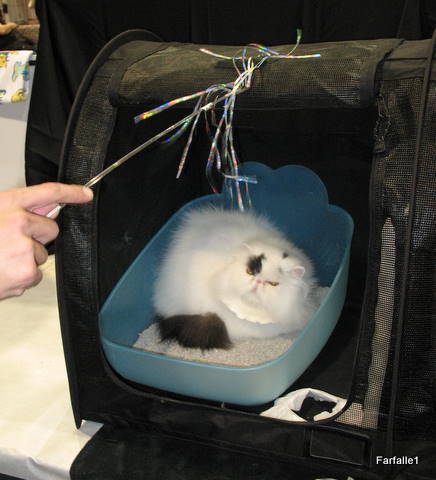
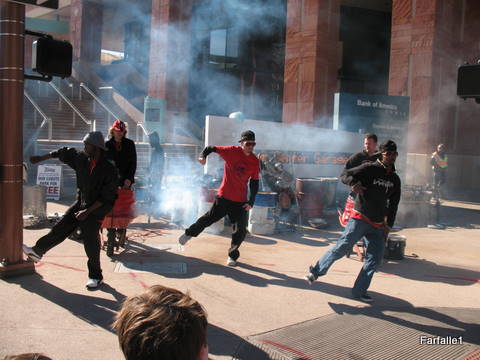
The grand opening was on December 27-28, 2009.  As luck would have it the Captain and I were attending a cat show (I know.  But we like cats.), and we stumbled serendipitously into the gigantic street fair celebrating the opening just outside the Phoenix Convention Center.  As it turned out, there were festivities of one sort or another at almost all the major stops along the 20-miles of Metro.

img_7608

It took twelve years to build the system, and it was gravely inconvenient for many businesses and residents during construction.  But now, everyone seems well pleased. The Metro web site gives all the information you could need to take advantage of this service.  The fares are ridiculously low – $2.50 will buy you an all-day pass, which includes some amount of bus transfer.  If you’re over 65 your day-pass costs only $1.25.  There are Park and Ride lots at many stations which offer free parking during the Metro’s hours of operation.

In addition, some fun blogs have sprung up around Light Rail: RailLife.com, Blogs about Phoenix Lightrail, and my favorite, found by the now-famous Mrs. Harris (bread, pumpkin ice cream), PHX Rail Food, which is a great guide for places to eat within easy walking distance of each Metro stop. You Are Here gives an urban stroller’s guide to metro Phoenix, with guides to culture, shopping, sports, events, dining and nightlife all along the Route.

Speaking of Mrs. Harris, she had the brilliant idea that we should take a day and ride the Metro from one end (Sycamore and Main in Mesa) to the other (Montebello and 19th Ave. in Phoenix).  So that is exactly what we did a while ago, and it was loads of fun.  We met a lot of people, all of whom were pleasant and chatty.  We stopped in Tempe for a walk-around and ended up giving our opinion on speed radar on the freeways for a PBS show (our 15 seconds of fame). Then we took a mid-day break and visited the Phoenix Art Museum where, in addition to walking through several exhibits, we ate a delightful lunch.

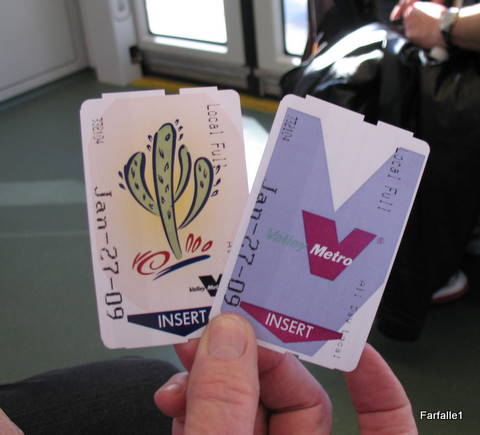
tickets
We rode to the end of the line, then jogged to the other track and rode straight back to where we began.

If you’re interested in some photographs of both the cat show and the festivities outside the Convention Center at the Metro’s opening, click here, or over on the right under Photographs (Cat Show and Rail Opening)(You’ll see that I was fascinated by the break dancing.).

If you’re interested in some of the sights along the Metro, click here, or over on the right under Photographs (Riding the Light Rail).  These photographs are in three sections: sights along the rail ride, people we met, and some of the art at the Metro stops (each stop has at least one piece of art incorporated in its design).

And if you need to get your cat somewhere, you can probably take her on the Light Rail, but she’ll have to be in a cat-carrier.  She might even enjoy the journey! We did.

rail pics

cat show and rail opening pics

Desert Island Food

Tags

, ,

Every now and then the Captain and I play the Desert Island Food game, and I’d like to invite you to play…

You’ve played before, right?  Imagine that you have been marooned on a dessert island (now that’s being an expatriate).  You might be there for a day, a week, or… forever.  You are allowed to take only FOUR foods with you.  What are they?


No fair saying something like ‘vegetables’ – that’s too broad; narrow it down to which vegetable. Your choices can be raw ingredients or some prepared dish (tuna casserole?) (maybe not). You’ll have unlimited water and a fire for cooking. A beverage counts as ‘food.’ Since you’re on an island it’s not inconceivable that you will be able to catch something from time to time, either in the water or on the ground (I’m hoping for a fish or a clam now and then), but you can’t assume that certain foods will always be available. It’s important to consider your health, physical, mental and emotional – you’re likely to be on that island for a long time.

Submit your desert island foods via comments, and in a month I’ll tally them all up and tell you what the most preferred foods are.

Here are mine (for today, anyway) – I bet some of you will be a lot more imaginative and creative, but here goes:

Brie cheese
oranges
spinach
wheat thins

Freeway Shock and Highway Art

Tags

, ,

img_7293

At the risk of stating the obvious, there is much, much, MUCH more open space here in Arizona than there is in our beloved Liguria, or in Italy as a whole, for that matter.  One of the luxuries all this space provides is the continued ability of the State to build huge new highways.  We are as great fans of the Italian Autostrada system as anyone else (and especially fans of the highway rest stops, the Autogrills particularly – yum!).  But if you find an autostrada with more than four lanes in one direction you have found a rarity.  Two lanes in each direction, sometimes with no emergency lane, are common in Italy (as they were on the dreadful old Pennsylvania Turnpike near Philly).

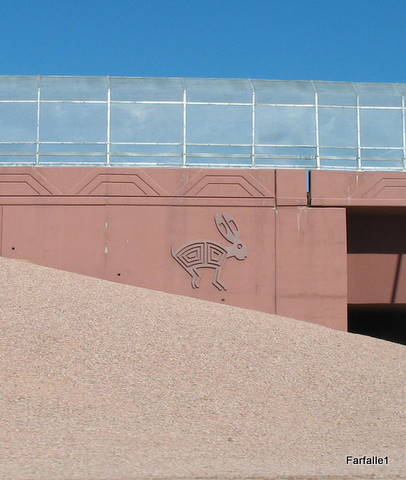
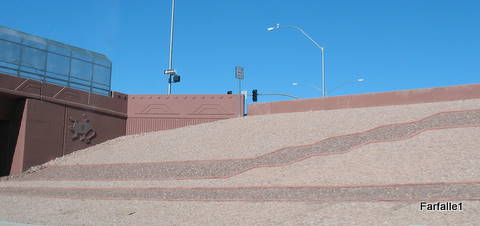
The Loop 202 was recently completed around Phoenix, making it a much shorter trip to get from our part of the Valley to Phoenix or to Sky Harbor Airport on the east side of the city.  For whatever reason extra care was taken to make the bridge abutments and the gravel banks on the sides of the highway beautiful.  The themes are, unsurprisingly, southwestern, and are all different.  It makes the drive much more interesting and fun, as do the lovely shrubs and trees that have been planted on some of the banks.

img_7290

But for all the space given to the new road, it is still choked with rush-hour traffic before 9 a.m. and between 3 and 7 p.m.  It’s hard to imagine where all the traffic went before this road was opened.  Driving around Phoenix at rush hour is about like trying to drive around Venice at any time.

And no matter what you may have heard about driving and drivers in Italy, both are a whole lot worse here.  The captain opines that the most dangerous instrument in the world is a woman in an SUV talking on her cell phone.  While I don’t necessarily agree with him (harumph!), I do think that drivers here exhibit an aggressiveness and a carelessness that is, well, not Italian.

Good or bad, the drivers here have a beautiful new highway. If you’d like to see some more photographs of the Loop’s bridge art, click on ‘bridge art’ under photographs over on the right, or click right here.  As usual, a slide show is recommended.

The Best Thing I Ate Last Week

Tags

, ,

lobster-aftermath

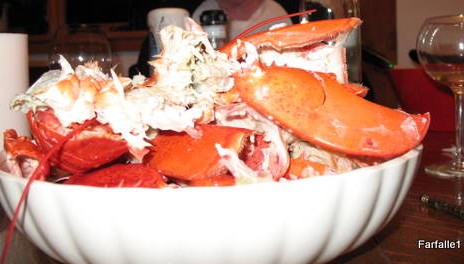
Not much comment required here… the best place in the world to eat the best lobsters in the world is New England, preferably within 100 miles of the coast.  We bought these beauties live, from a tank; each one weighed about 1.5 pounds.

Now the awkward part – how to kill the little dears?  While plunging them headfirst into a large pot of boiling water is the time-honored way, some say that there is a more humane way to do it with a knife, which you can see here, complete with gruesome photos of lobster-cide.  A friend skilled in biology once told me that lobsters have such a basic nervous system there is some doubt about whether they actually feel pain, as we think of it.  Who knows?  Ask a lobster!

The advantage of the quick knife through the brain is, supposedly, instant and relatively painless death.  The benefit of the boiling water method accrues completely to the murderess – one can look the other way and scream while thrusting the beast into the pot.  That way you won’t hear it if it screams.  Surely death by boiling water is also quick?  I have never heard a lobster scream, but then, being a practitioner of the second method, I have a pretty well-developed scream of my own.

However you choose to do in your lobster, serve it with drawn butter and lemon, and put out a big bowl for shells and extra liquid, as well as plenty of napkins. If you’ve never eaten lobster and don’t know how to tackle it, you can find some excellent instruction here.

A note on what you might find within:  if you find some orange stuff you’ve got a female and those are her eggs – considered delicious by many.  The green stuff is the lobster’s liver; while it is yummy, it might not be such a good idea to eat it; the liver is where all the poisons and contaminants of the lobster’s body gather.  The lobster is a bottom-dwelling garbage eater, so what his body considers poison is probably pretty gross.

Is it worth traveling to New England to eat lobster.  Oh yes!  The ‘shedders’ (lobsters who have outgrown their old, hard carapace and are wearing a new one that is still soft) have less meat in relation to the shell size, but the shell is much softer, and some consider the meat sweeter.  Typically a lobster sheds in the summer, so if you want a crusty old fella bursting with meat, eat lobster  in the winter or spring.  Having said that, my two companions had hard-shell lobsters and mine was soft-shelled; you really just never know.

Buon Appetito!