Giovanni Castagneto

Tags

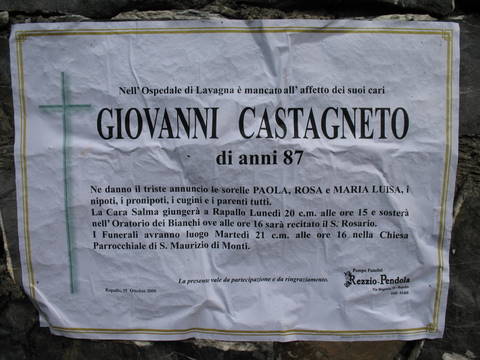
Giovanni Castagneto, aged 87, died on Sunday.

He was already an old man when we met him.  We caught glimpses of his sister (she of the long skirts and kerchiefed head) and of him from time to time when we moved to San Maurizio, but it wasn’t until we’d been here for about 5 years that Giovanni decided it was safe to make our acquaintance.

There was a knock on the door one day, and there was Giovanni, paying an official call.  With him he brought two small pages, on which he had carefully written the first names of everyone in his family.  He introduced us to each in turn, lingering over the cousin, “I should have married.”

He never did take a wife, and lived always with his older sister.  She never took to us, at least not to the point of actually meeting us.  But then, she had not had his cosmopolitan experiences.

Giovanni served in the Italian Army during World War II.  He was sent to Russia, where he suffered terrible hardships during the failed winter siege of Stalingrad.  (You can read about the Italian Army’s Russian misadventures here). We don’t know what befell Giovanni in Russia, but we know this: he walked back to Italy. That’s a hike of 2,680 kilometers (1,665 miles), undertaken in appalling conditions.  In his old age it was those battles and that long walk home that filled his mind.  Whenever we met, the conversation invariably turned to Russia. He would get a distant look in his eye and say, “I was in Russia,” almost as if he couldn’t believe it himself.  Was he 8th Army? Alpino?  We don’t know, the conversation never got beyond the fact that he’d walked back, that most of those walking with him died on the journey, and that it was cold winter.

Giovanni was, in the years we knew him, a contadino.  He took care of his vines, his olive trees, his chickens and his garden.  He was too old to be a fast worker, but he was steady and efficient.  And he was generous.  Frequently we would open our door to find a little basket filled with grapes or figs, or just some flowers.  Whenever he gave us something we’d try to use it in a way we could share with him.  Grapes became grape jam (not the staple here that it is in the US), erba Luisa (lemon verbena) became liquor.  It was the only way we could think of to repay his kindnesses.  That and when, as always happened, a conversation turned to Russia, showing honest interest and a truly felt amazement at the transformative experience of his life. I wonder if, as he drifted away at the last, he was once again in a snow-blind day putting one foot in front of the other, walking home.

Riding in Style

Tags

,

Many of our friends deplore the number of scooters on the streets, and the abandon with which they are driven.  To which we reply, Think how crowded our already crowded streets and parking areas would be if every one of those scooters was a single-occupant car.  It would be day-long gridlock – a nightmare.

Having said that, there are some scooter drivers who give the rest of us a bad name by being reckless and thoughtless.  And there are scooter practices which car-drivers find annoying; for instance, all scooters will move to the front of any line of cars, and will pass any slow-moving column of cars.  Personally I think irritation at this practice is just envy on car-drivers’ part! I was stranded in a long line in down-town Rapallo a while back; here’s a photo of a few of the scooters who made their way past me and up to the front of the line:
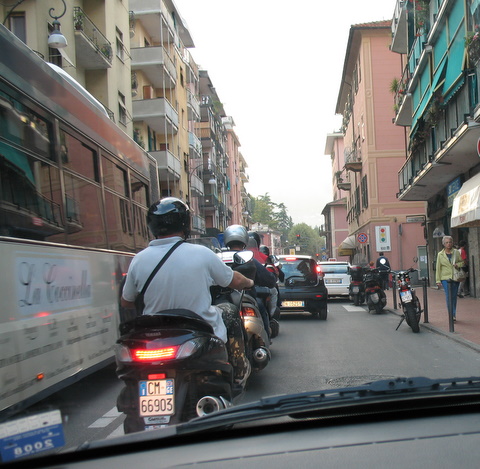
We’ve been making a years-long study of the various driving styles of the Italian Scooter Drivers, and herewith we present our findings.

First of all there are the Wild Young Men who ride with their helmets on the back of their heads, sometimes unfastened (though this is illegal so you don’t see it so often), and always, always, their elbows bent out.  What is it about leaning forward and sticking your elbows out that makes you go faster?  I don’t know, but they all do it, so it must work. You know if you see someone coming at you on a scooter with arms akimbo that you’d better watch out, because he won’t be. And yes, it’s always ‘he.’
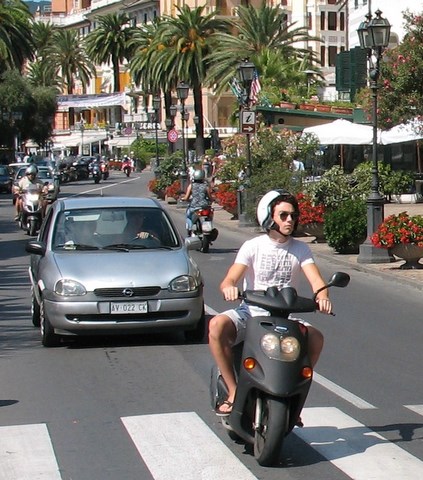
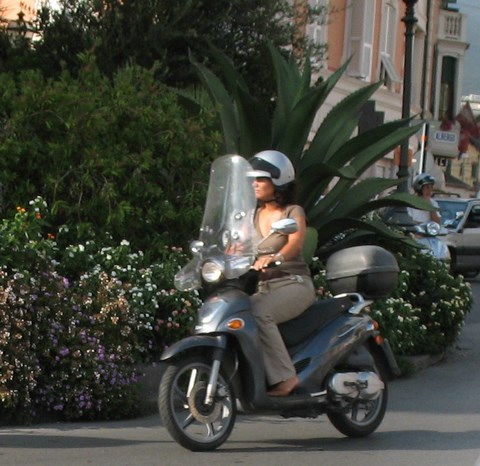
The counterpoint to the young boys is the Straight Young Girls. They seem always to be reed-slim, and they sit absolutely erect, with their knees and elbows tucked demurely in. They don’t necessarily drive more slowly than the boys, but they make a neater package. I have to say here that I had a hard time getting the photos to illustrate these styles – the scooters go by quickly, so many of my attempts were blurred failures. The example of this riding style is a woman a little older than the teens of whom I’m speaking, but she has not lost her youthful Style.
Then there are the Young Bucks out cruising. They’ve learned to keep their elbows in, but haven’t yet learned to watch the road all the time. There are more important things to look at!

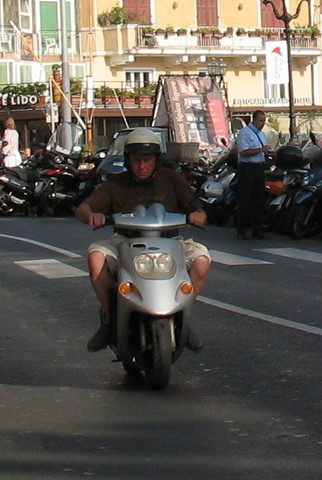
Time passes, young men age, and through some bizarre rule of body physics the elbows go in and the knees go out. I was able to capture a rare elbows AND knees out gent. This is uncommon; usually the Old Guys simply put their knees at right angles to the scooter and hold their arms in.

Smoking levels are down in Italy, but many people of both genders enjoy smoking as they scoot along. The Captain has noted that most smokers like to light up immediately after putting on their helmets but before they’ve started the motor. (Only yesterday I watched a man put on his helmet, then pull out his papers and tobacco and proceed to roll a big fat cigarette before setting out; that was a first for me.) The Captain wants to invent a ‘sigaretta finta’ (fake cigarette) for those trying to quit – something they could keep in the scooter and put a match to when they set off, and then clench between their teeth as they drive. He thinks it’s an idea with real financial potential; I think we should keep our day jobs. I was unable to capture the not unusual sight of someone driving, smoking AND talking on the cell phone all at the same time. It’s a rather terrifying sight.
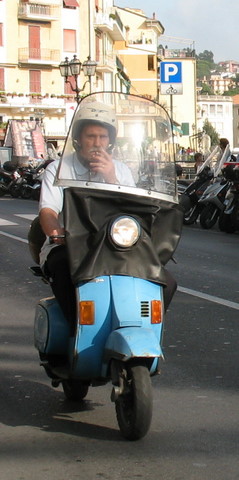
Another oddity of the older gentlemen riders is the One Foot Dragging style. I’m not sure what this accomplishes – maybe it serves as a sort of outrigger in case balance should suddenly vanish.
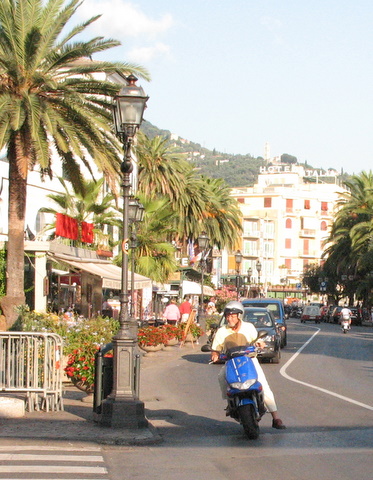
I felt very fortunate to be able to capture a photo of the almost-never-seen Two Foot Dragger:

Perhaps this driver had an especially wiggly passenger?

Before showing you the last two photos, which are of everyone’s favorite scooter style, I want to mention three important styles I was not able to document with pictures. The first is highly illegal, but still often seen. It is the Entire Family of Four on One Scooter. Dad drives; Mom sits pillion; between them, smooshed to near invisibility, is the smaller of two children. Standing between Dad’s legs and arms, between him and the steering handles, is the larger of the two children. Phew!

The Chat is an amusing illustration of the Italian national past-time of sharing information. It’s not unusual to see two scooters zooming along side-by-side as the drivers engage in animated conversation involving, of course, lots of hand language.

You go years without seeing something and then, boom, three times in one week: last week I saw the ever-rarer Side Saddle Passenger, not once, but three times. This style gives me the jim-jams because having tried it once or twice myself I know how completely unstable the side-sitting passenger feels. And if you’re wearing a slippery skirt it’s just a short slide from the scooter seat to the pavement. Ick. Give me my jeans and let me straddle that seat, please. This riding style is favored by older couples, the woman in her sweater and matching A-line skirt, which is too tight to allow her to ride modestly in any other way.

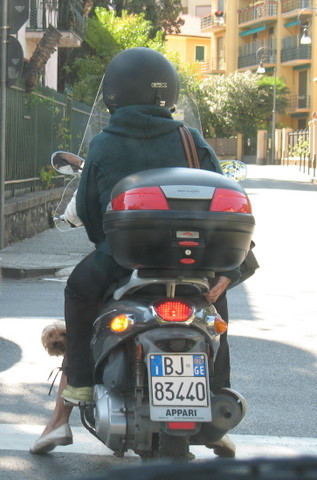
Everybody’s favorite motor-scooter sight has to be the Dog on the Floorboard. We frequently see the older men up here on the mountain transporting their hunting dogs to the woods for a good run. These dogs seem all to be liver-spotted spaniels, and they are excellent passengers.

The other day I rode behind a scooter which had an unwilling lab as passenger. It was hilarious; the dog was all over the place and howling at the top of its lungs. It’s owner was driving very cautiously, but it was still all too much for the dog who sounded more like an air-raid siren than a dog. Perhaps they had come from the vet; or perhaps it was a training exercise. In any event, it had Fail written all over it.

Of course, the smaller your dog, the easier it will be to carry it on your scooter:

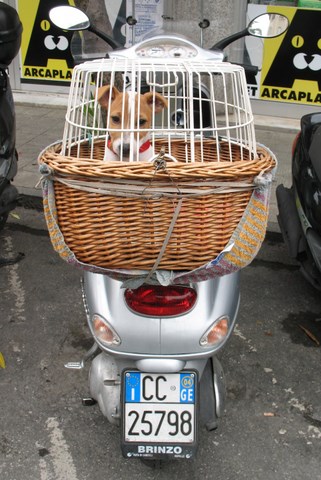
If you don’t trust your pooch to balance on the floor, and he’s small enough, you can always tuck him into a basket:

This last is a bit of a cheat because the scooter is stationary, but it’s clear they will soon be on the move:

Have I left anything or anyone out? Let me know if I’ve missed any Moto-Riding styles and I’ll update the catalog.
Blog Action Day – Poverty

Tags

, , , , , ,

This is not the blog I had planned to post today, the one about amusing scooter-riding styles, but my conscience has been stirred, and I’d like to try to stir yours as well.

This blog is nothing more than the musings of a highly advantaged woman on the difficulties and humorous aspects of living a bifurcated life. The USA and Italy… who wouldn’t want to live in either of them? How lucky can a girl be?

The financial crisis of the last months, if nothing else, has pointed out how much so many of us have to lose. We are so fortunate! And it places in even starker contrast the differences between the rich and the poor. If you’re reading this, you are in the ‘rich’ part of the equation – you have a computer, you have some time in which to noodle around, and you can read. And if you’re hungry it’s probably only because you’re on a diet (as I should be).

Over 3 billion people, more than half the world’s population, live on less than $2.50 a day. 1.4 billion live below the World Bank’s poverty line of $1.25 a day. No one I know has tried to do that since Frommer’s Europe on $5 a day was outdated. Would we care to try to do it now? I don’t think so.

As a retired librarian (at the prettiest small library in the world) the fact that over 1 billion of the world’s population is absolutely illiterate (that doesn’t count the functionally illiterate) is every bit as disturbing. In the U.S., 20% of the adult population reads at or below 5th grade level, which is below the level needed to earn a living wage. Basic reading and writing skills are closely connected to leaving poverty behind.

I don’t want to be all preachy in this post (oh all right, I want to be a little preachy). The fact is that you and I are rich, and we are rich because of the pure accident of where and when we were born. With luck we’ve taken the good cards we were dealt and are making something of our hands. But we started from a point so far above the truly poor that we probably can’t even imagine what their lives might be like.

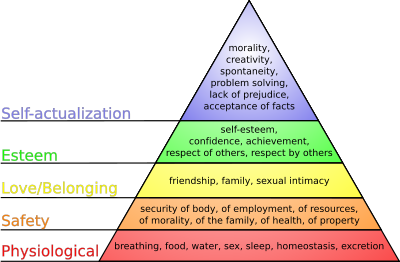
I once took a psychology class where I was introduced to Maslow’s Hierarchy of Needs. The billion or so people living in poverty cannot think about anything above the lowest level, or perhaps the second lowest level of the pyramid, while we rich people get to think about love and self-actualization and what to read next and which fabulous pasta dish we want for dinner tonight. What a world! How did it get so out of whack?

I haven’t the skill to discuss the underlying economic and political theories of poverty intelligently. But I’ve got eyes and I know what poverty looks like when I see it, as do you: it’s not an idea or an issue.  It’s a small person with huge eyes and a swollen belly.  Thanks to Blog Action Day I can give you a several links to sites where you can do something that will make a very big difference in the lives of the world’s poor, one person at a time. I can’t think of anything else that can make us feel so good for such a small investment of time and money. So won’t you join me?

The Global Fund to Fight Aids, Tuberculosis and Malaria is the official charity of this year’s Blog Action Day.  The name says it all.

Kiva makes very small loans ($25, for instance) to help poor people start very small businesses.

Heifer Project (which commenters below reminded me of) helps feed people by giving them food-producing animals, such as goats, sheep and chickens. They tackle hunger on the very front line.

If you live in the United States, please think about supporting your local Literacy Volunteers, either with a donation or as a volunteer.  If you live in the UK, check out what you can do here. Share the joy of reading and give someone a leg up to a better life!

And stay tuned for that post on scooter-riding; it’ll be along soon.

Driving me Crazy!

Tags

, ,

There has not been time to post fascinating entries about Life in Italy because of the time-gobbling demands of Learning to Drive in a Foreign Language (foreign to me, that is).  To make up for it, I have added two recipes on the right (Fish in the Ligurian Style and Adriana’s Fruit Torta) and have added to the Driving School Diary in Elaborations.

Above you see my present nemesises.  These four lads sit behind me and chatter away through each lesson.  Professoressa Elena intersperses her lecture with many a  “Silenzio!” but to no effect.  These guys have a lot to say and it’s all really important and can’t wait 30 minutes until class is dismissed.  Evidently it is all hysterically funny, as well, because it is all punctuated with frequent snorts and giggles.

The Italian word for ‘chatter’ is wonderfully onomatopoetic – it’s ‘chiacchiera’ (kee-ah-kee-yehr’-ah), and that’s what it sounds like behind me during driving school classes. I’m not really grumpy about it, to tell the truth.  I remember giggling for about 4 years running when I was their age.  In fact they seem like really nice kids. I just wish it weren’t so distracting as I try to focus on what Elena is saying; my problem, not theirs.

The text for the driving exam is 250 pages long. I think it’s kind of pathetic that the first book I’m reading in its original Italian is the Driving Manual, rather than, say, The Divine Comedy or the poetry of Montale. I have managed to read 200 of the pages; what lies ahead?  First Aid – that will be fun!  I have already learned from practice exams that we do not want to peel cloth off burn victims and that we do want to immerse their limbs in cold water if possible to alleviate pain.  I can hardly wait for my first accident!  Then, last but hardly least, there are the engine parts – that will be a sort of maze for me, I think – there are lots of parts that run with oil (brakes, engine), and other parts that run with water (radiator, window-cleaning), leaving out gas for the minute. Fortunately the questions on engines are rather basic, and Elena has already told us that any question including the words ‘change the tire pressure’ is false.  A useful clue.

Let me leave you with the most interesting thing I learned in my reading yesterday (insurance (which was incomprehensible), and driving under the influence (equally dangerous in any language)):  we really do not want to get behind the wheel of a car if we’ve just eaten a heavily spiced meal, or one heavy in fats or fried foods.  Who knew?

The Best Thing We Ate This Week – Barley Mushroom Casserole

Tags

, ,

Do you find the cooler autumn weather gives your appetite a big boost?  I do!  These days it seems I can’t stop eating, and there is no end of good food here, alas.

Yesterday I was charged to bring home potatoes to go with the Saturday Night Steak.  But a friend and a glass of wine detained me, so the Captain was left with only his imagination and what was already on hand for the starchy part of our meal.

What he came up with was the perfect dish for the season, combining ease of eating and the wonderful Fall flavors of mushrooms and grain.  It does take a bit of planning ahead as there is a fair amount of let-it-sit time in this recipe.  But if you don’t need to whip something up in five minutes this dish is the perfect accompaniment for any meat you may be serving.  I think it would be great at Thanksgiving. If you’re not a meat eater this can be used as a healthy main course. Barley retains its bran and germ, which are nutritious.  (According to the European Journal of Clinical Nutrition, eating whole grain barley can regulate blood sugar for up to 10 hrs after consumption compared to white or even whole-grain wheat, which has a similar glycemic index.)

So there it is: good for you, satisfying to eat, filling and, most importantly, yummy – you’ll find the recipe here or over on the right under recipes, *starred* as a Best.

Zoom Zoom

Tags

, , , , , , ,

Sunday in Japan Valentino Rossi won his sixth Moto GP Championship.  That’s motorcycles, and a happy result for Italy.  And in Singapore Filipe Massa and Kimi Raikkonon did not win the Formula One race for Ferrari.  That’s cars, and cause for a national day of mourning in Italy.

Should you care?

Well, that depends.  If you live with or are going to talk to one of the 90% of all Italian males or 60% of the males in the rest of the world (and who knows what percentage of females) who follow motor sports closely, the answer is Yes.  You will want to be at least familiar with the main players so as not to appear a complete dunce.

Personally I stopped watching Formula 1 when Michael Schumacher retired.  There was something about his utter focus, determination and single-mindedness that warmed the cold northern cockles of my heart. (If you haven’t heard of Schumacher, he was the Tiger Woods of Formula One.  If you haven’t heard of Tiger Woods you need a subscription to Sports Illustrated.)  The new Ferrari ace, Massa, is a cute kid, but he doesn’t seem to have the killer instinct that Schumacher had.  And I never did watch the motorcycle races; those boys lean over way too far.

If you live in Italy, however, there’s a more pressing reason for you to keep abreast of at least the racing schedule, if not the results.  Within half an hour of the completion of either of these races the ordinarily gutsy driving of the Italian male becomes downright lunatic.  Sunday morning as I coasted sedately down the hill to Rapallo, shortly after the completion of the MotoGP, a young kid on his all terrain bike came screaming around a car in the opposite direction on a blind curve; he was in the middle of my lane, and very fortunate I wasn’t driving my gravel truck today.

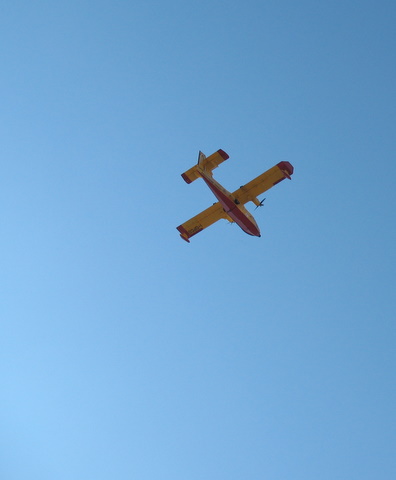
We were on our way to the beautiful city of Chiavari just down the coast from Rapallo.  There is a Mercatino dei Sapori (a food market!) on the last weekend of each month; vendors come from all around the country with absolutely delicious things to eat. Over on the right you can find a link to an album of photos of this delightful event.  This week, however, my interest strayed from the comestibles to the sky, because there was a Canadair flying from the sea to an inland fire and back again, over and over.

The Canadairs are small 2-engine airplanes with big stomachs.  The pilots, who must have to pass an insanity test for the job, skim over the sea and pick up a belly-full of water which they then carry back to the site of the fire, on which they dump their load of water, back and forth, back and forth.  Again on the right you’ll find a link to photos of the Canadairs fighting fire – both from Sunday and from a couple of years ago when they were flying over the hill just behind us.  They engage in amazing feats of flying prowess, aiming right towards a hillside, for instance, and pulling up at the last possible moment, at the same time releasing their water which inertia carries forward to the burning hillside.  It’s incredible to see, much more exciting than either of the races that were on TV that morning.

There’s a great urban myth about the forestieri finding the charred remains of a swimmer, in full scuba outfit, high on a burned out mountain.  He must have been scooped out of the sea by a Canadair and dropped right into the heart of the fire!!  I believed this entertaining tale the first three times I heard it; then the penny dropped.

The pilot this morning flew back and forth low over the city of Chiavari instead of over a less-populated area.  We could hear the low grumble of his engines as he neared the city; the sound growing to a roar as he passed low over the narrow streets, which sent the sound bouncing back and forth till we weren’t sure from which direction it was coming.  The Captain, who should know, says he was between 300-400 feet above us, which sounds like a lot until it’s an airplane flying over your head.  Then it doesn’t seem like nearly enough.

As we were scooting home we watched this hot dog fly parallel to the coast up towards Rapallo.  He then banked sharply and flew directly at a cruise ship in the bay outside Portofino, banked very sharply and flew between the ship and the land, banked again in the other direction around the Portofino lighthouse, and headed back up to the airport at Genova where the Canadairs are based (rather poor pictures of these maneurvers, blue tinted for some reason, on the right).  Anyone on the ship or at the lighthouse will have had a more exciting morning than they had planned. The Captain says that the pilots eat in the cafeteria at the Genova airport at 12:30.  As it was 12:10 I’m sure this fellow was on his way back for lunch.  But he couldn’t resist giving the folks on the land a bit of a thrill.  No doubt he had watched the motor cycle race that morning.

If you see a path, take it

Tags

, , ,

Not always good advice, but as often as not it works out well here, so if you’re planning a trip to Italy, be sure to pack your walking shoes.

We used to wonder why so many places in Italy were built in ‘inconvenient’ locations, for example San Fruttuoso, which was once a very important abbey.  Nowadays you can reach it only by boat or on foot.  But of course, we finally realized, in the 1200’s when it was built it was as convenient for it to be there as anywhere else, in fact being on the sea made it more convenient.

Italians are inveterate walkers.  You can be out in the middle of nowhere on some trail that you figure no one has been on for a century; you’ll round a corner, and there will be a middle-aged lady in her straight skirt and high heels walking towards you.  The passagiata is one style of walking, and ‘footing’ along the sentieros is another, slightly more energetic approach. After that I guess you graduate to hiking.  One reason Italians seem so much slimmer and healthier than Americans, I’m sure, is because walking is still central to life here (leaving out the Mediterranean diet for the moment).  In the town where we used to live in the U.S., people routinely drove to the Pharmacy to pick up their newspapers, then got in their cars and drove about 100 yards to the Post Office to pick up mail. The pace of life here accommodates the time it takes to walk in a way that the hurried life in America frequently doesn’t.

Almost every community, certainly every region, has  available maps of the public paths, so it is not difficult to find places to walk.  Not all paths are on these maps, however; there’s no substitute for an ancient neighbor who can tell you which unpromising looking set of steps to take to get someplace quickly. Every place in Italy is connected to every other place by these paths.  Some have been turned into roads since the invention of the automobile, but the shortest distance between two locales is frequently still the ‘sentiero’ – the path.  A good example is the connection between Rapallo and San Maurizio, the frazione where we live.  It’s about 8 kilometers by car, but it is surely not more than 4 or 5 by foot through the woods.  Now that autumn has arrived it is a lovely walk, dry scuffling leaves underfoot and cool breezes off the sea just when you think you’re becoming overheated.

I walked into town yesterday, partly for the sheer pleasure, and partly because my moto was receiving its new back tire.  Here are some photos of the journey.

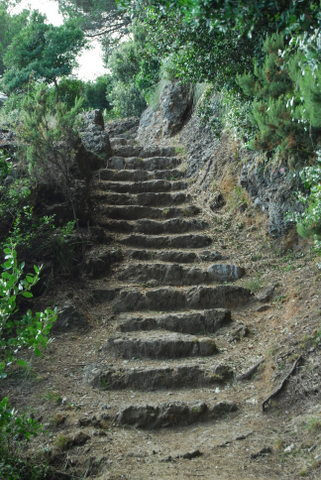
After leaving our street I walked down this long flight of steps, cutting out 2 switchbacks in the road – isn’t it inviting?

Then I crossed the street and walked down a curving road through a small settlement. Now I know where all the barking we hear comes from. I’ve never seen so many watch dogs.
One house had 3, each fiercer than the last!

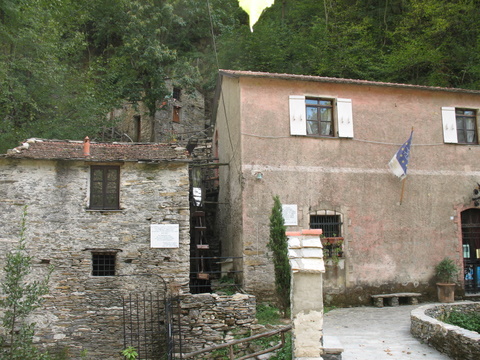
Continuing down the hill I arrived at the old mills, which have recently been restored. We’re told there used to be five or six mills in this narrow valley; now there is just this one, but it served double purpose, milling both olives and chestnuts. The old mill wheel between the buildings could be used for both milling operations. Now it is a civic museum and quite interesting to visit.


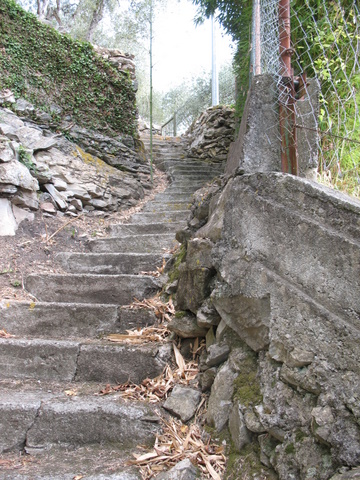
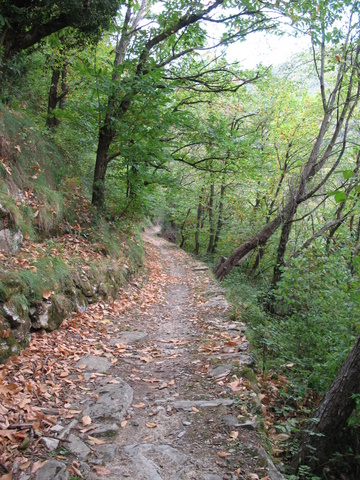
The stone paths here have always interested me – they’re the devil to walk on because so many of the stones are set end-up rather than flat. I don’t know why, but have decided it was to give better traction to the mules as they made their way up and down these trails loaded with goods.


It was unusually quiet walking down this path. I didn’t hear scooters, or buses honking, or dogs barking, just the occasional bit of birdsong.

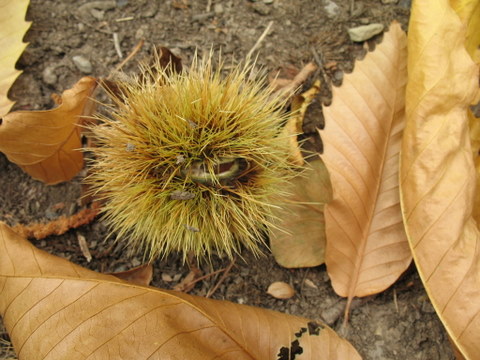
You know it’s autumn when you start finding chestnuts on the ground. The ones on the ground now are a bit early; the recent big winds brought them down before they were ripe. The wild boar, cinghiale, love these nuts, so it’s a good idea to keep your eyes and ears open when you’re in the chestnut forest, even though the boars are usually nocturnal.

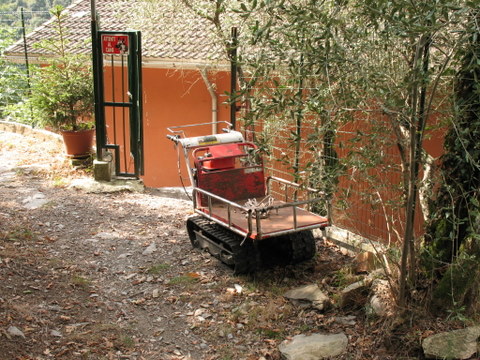
Amazingly there is a ‘last homely house’ well along this path. I met the woman who lives in it several years ago; she works in the hospital and has (of course!) a lot of dogs. It’s impossible to drive to her home; she parks about a quarter of a mile down the hill and uses this ingenious device to get her goods up to the house – the Modern Mule.

At last I arrived in Rapallo. It took me over an hour to make this walk, but only because I stopped to take so many photos. It was a glorious day to be out and about and hard to find an excuse to be indoors.

But I had to go to driving school

Aquileia, Croatia and Great Food

Tags

, , , , ,

Cikat Bay, Mali Losinj

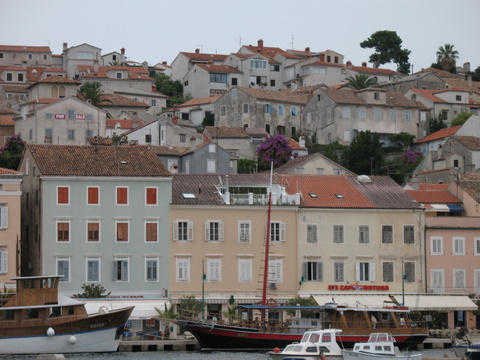
We’ve been away for a week visiting a friend in Mali Losinj, Croatia.  If you’re looking for a gorgeous spot for a vacation, let me recommend the island of Losinj.  It was developed as a tourist area in the late 19th century and now that Croatia once again has a market economy, it is flourishing.

Mali Losinj

The only culture shock we suffered was linguistic.  What a lot of consonants!  But I know what happened: all the vowels ran away and are now in Italy where they live happily (and pronounced) at the end of every word. Once we learned a couple of tricks (‘j’ is pronounced like the English ‘i’; ‘c’ with a little hat on it is pronounced ‘ch’) we were able hesitantly to begin to sound out a few words.  It’s a nice language to hear spoken, full of swishy sibilants and rounded sounds.

Croatia is not yet part of the EU so we had to cross through border control, which seemed oddly quaint and old-fashioned. They use a currency called the Kuna, seven of which will buy you one euro.

The water of the Adriatic there is the clearest and cleanest we’ve ever seen.  The food is good: Italian from the days when this part of Croatia was a part of Italy, with a healthy mix of northern cuisine from the days when it was part of the Austro-Hungarian empire, and Slavic from eastern influences.

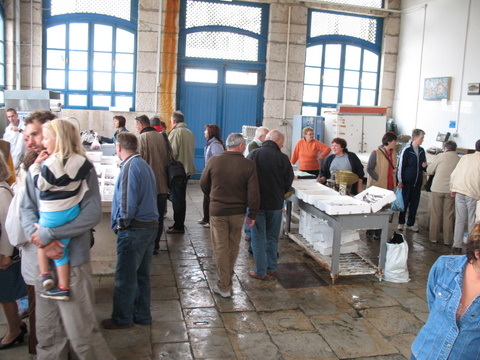
Fish Market in Mali Losinj

We stayed with one of the three best cooks I know, the Captain and the Contessa being the other two (she’s not a Real contessa but she’s a Real Cook).  Our friend Adri buys her lamb by the animal from the farmer who lives in the hills behind her house, cuts the beast up and puts it in the freezer.  The fish comes either from her neighbor who’s a fisherman, or from the local fish market.  It is always whole and never more than 8 hours caught when she receives it. You get a much better sense of what you’re eating when you see your food whole than you do when you buy it neatly packaged in the grocery store.

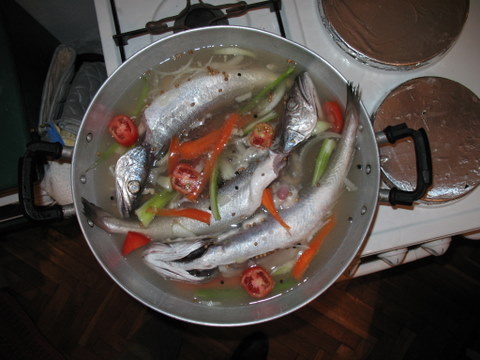
Nasello ready to be cooked

The Best Thing We Ate This Week is many things: Adri’s poached nasello (hake fish), her slow-cooked lamb, her dessert made with plums the first day, apples and pears the next, the Captain’s chicken gizzard sauce.  I did nothing but eat while the other two spent companionable hours in the kitchen whipping up one delicacy after another.  I hope to be able to give recipes soon for some of these treats; but both cooks work without measuring, so I need to experiment before being secure enough to pass on the procedures.

Mosaics in the Basilica at Aquileia

On our way to Croatia we spent the night near a town called Aquileia, which is the site of extensive Roman ruins and the largest early-Christian mosaic floor in the world (3rd-4th century, 700 square meters).  It was a complete surprise to us, and thrilling to see.  How could we never have heard of it before?  We stayed in a charming Agriturismo which I cheerfully recommend to you called Villa Asiola.  Parts of it date from the 11th century.  And they serve ham and cheese with breakfast!

There’s a photo album over on the right under Photographs, Aquileia and Croatia, if you’d like to see some pictures of our trip (including some very photogenic cats). As usual, I recommend a slide show.

The Best Thing We Ate This Week – Tagliatelli al Frutti di Mare

Tags

, , ,

Spring cleaning around here happens in August, if at all.  I don’t know why I wait until just before the mice move in to clean the house from stem to stern, but that’s what I do.  Like clockwork, I finished the Deep Clean of the kitchen last week, and the first mouse walked into the live trap three days later.  Bah!

While cleaning, though, the Captain and I went through all the cookbooks in the kitchen to see if there were any we could live without (there were three).  We stumbled upon a very slim magazine called “Primi Piatti, Speciale Pasta Corta” that was languishing on the top shelf.  Neither of us can remember where on earth it came from.  But it was great fun to rediscover it.

The Captain is a meat eater, first and always.  But on Fridays he frequently cooks up something yummy from the sea.  Lately we seem to have been on a fresh tagliatelli kick – well, perhaps I should say ‘fresh’ as we’ve been buying packaged fresh pasta at the grocery store.  It is not, perhaps, as fresh-fresh as from the pasta fresca shop, but it is a lot fresher than dry pasta. Although the recipe from our funny magazine is for farfalle (all the recipes are for short pasta), we substituted tagliatelli with no ill results.

This is easy to fix, and a joy to eat. It’s almost a meal in itself, but we followed up with a tomato and red onion salad, and then nectarines. The recipe is over on the right under recipes.

Buon appetito!